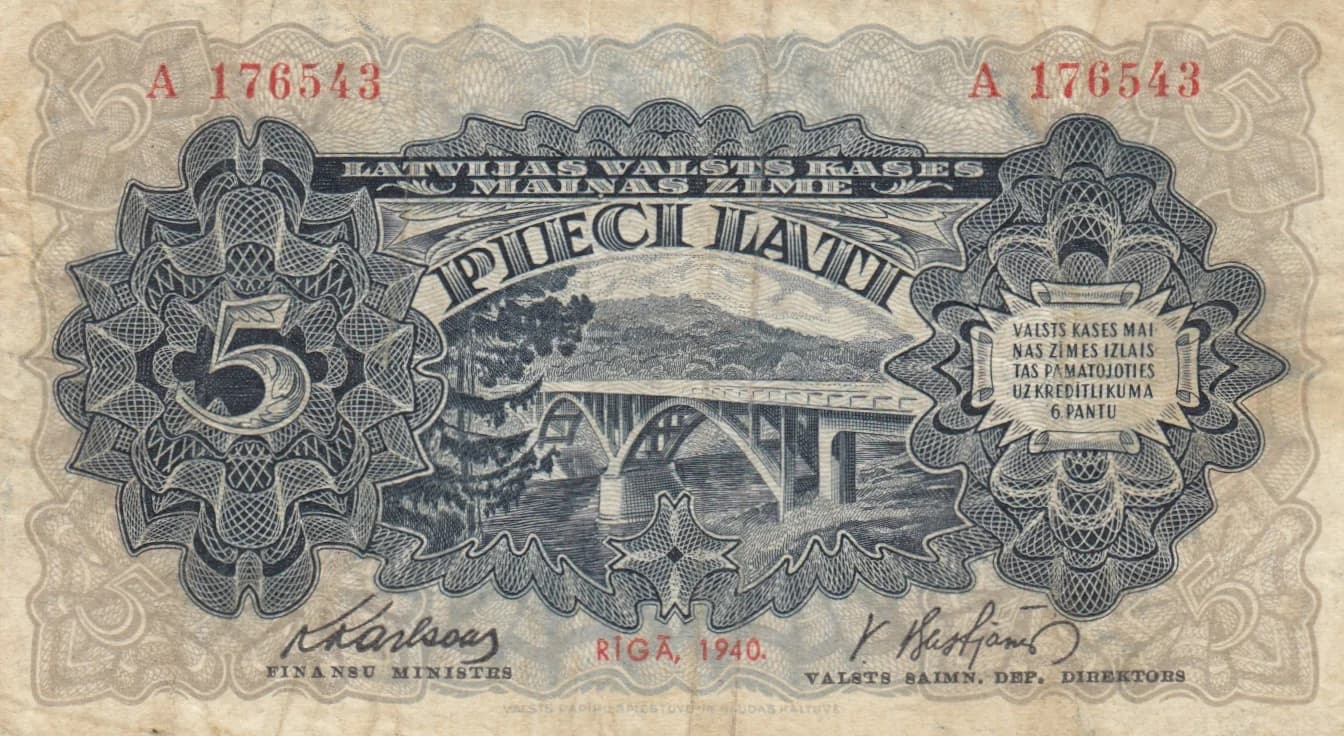
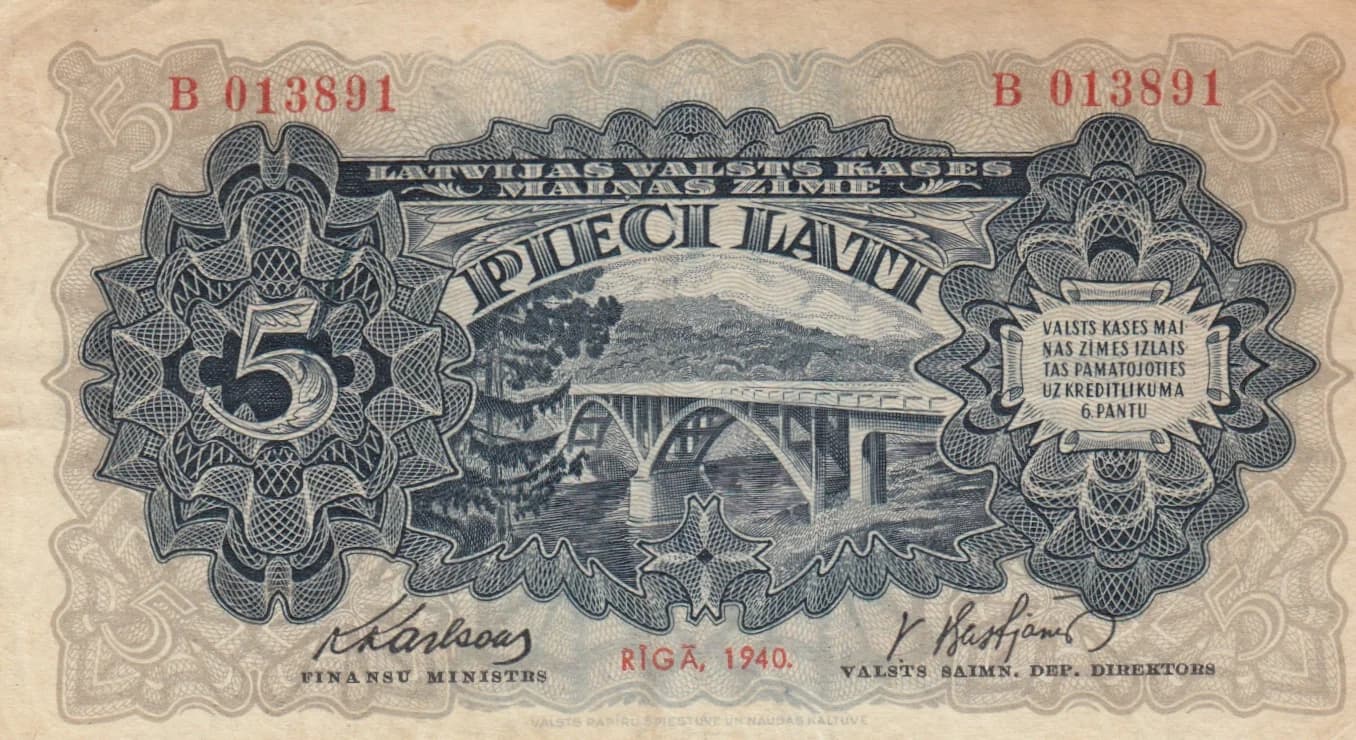
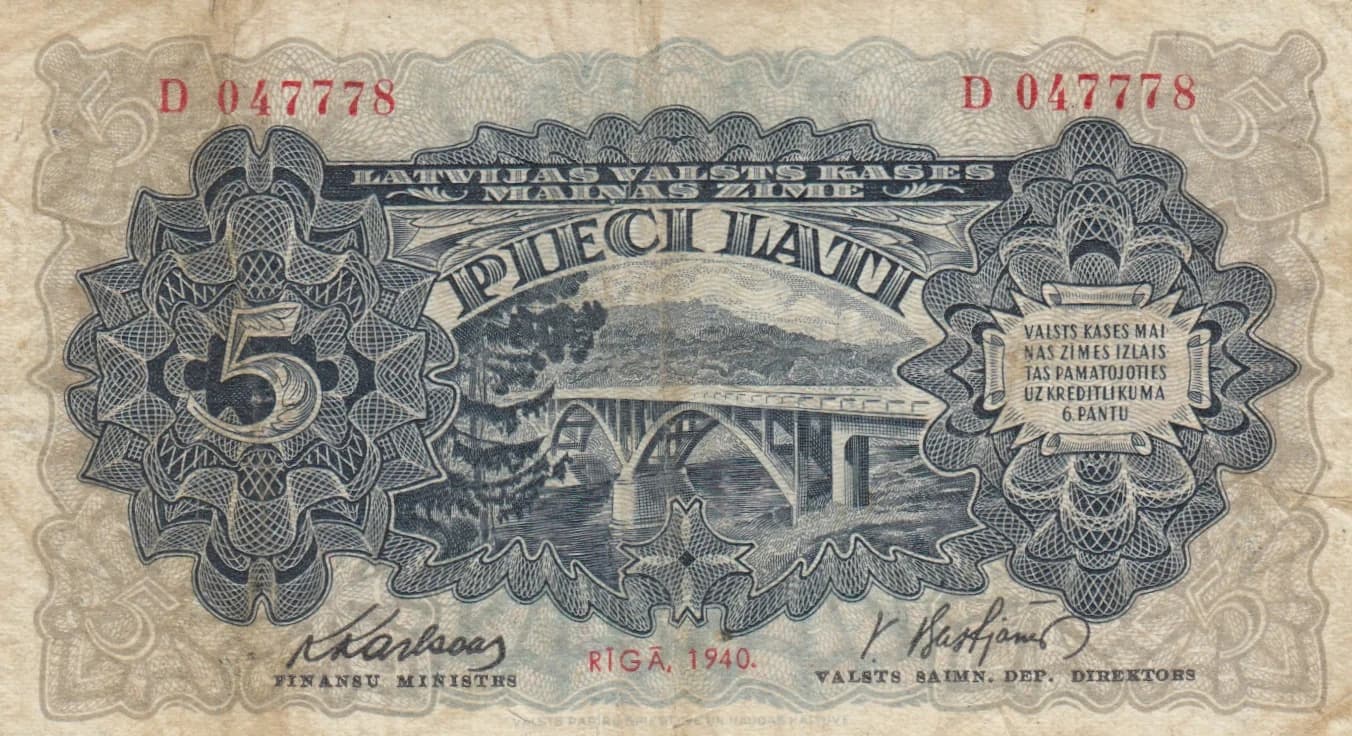
5 latu 1940
“serie C”
Market Prices
7 salesAbout This Note
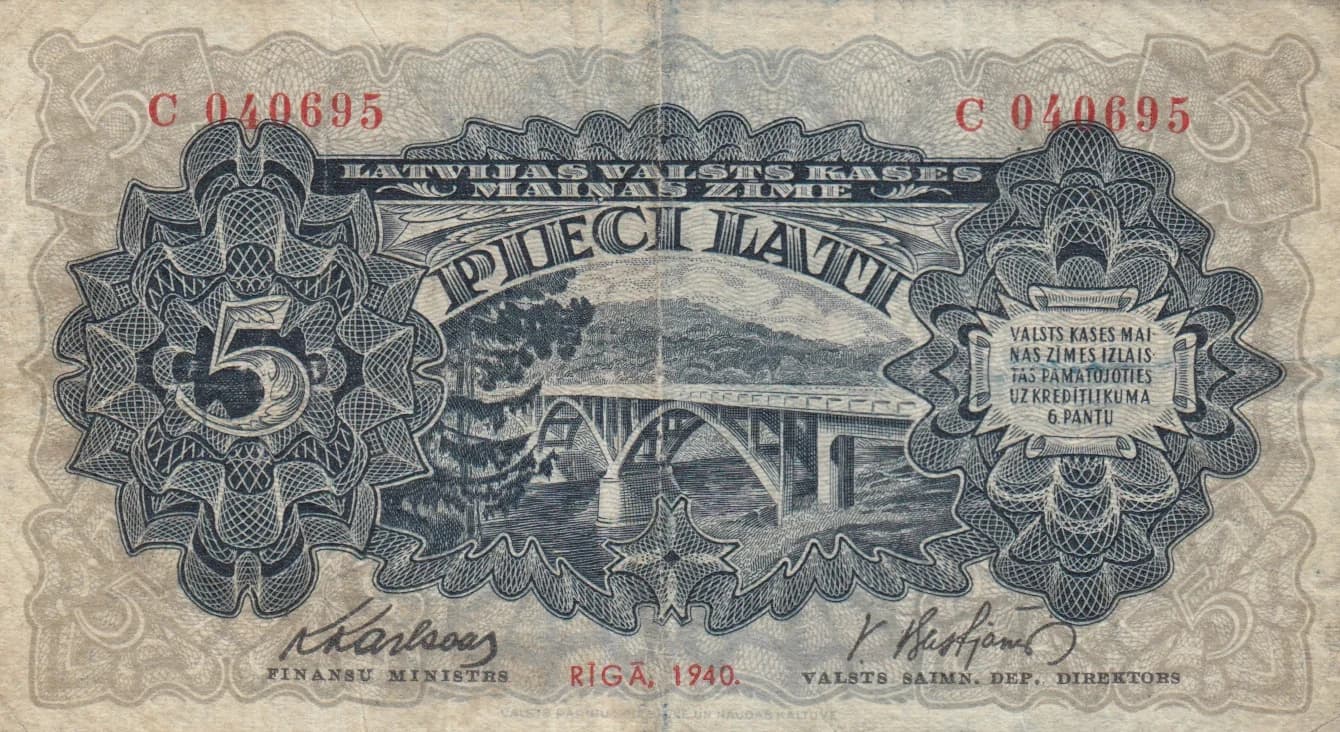
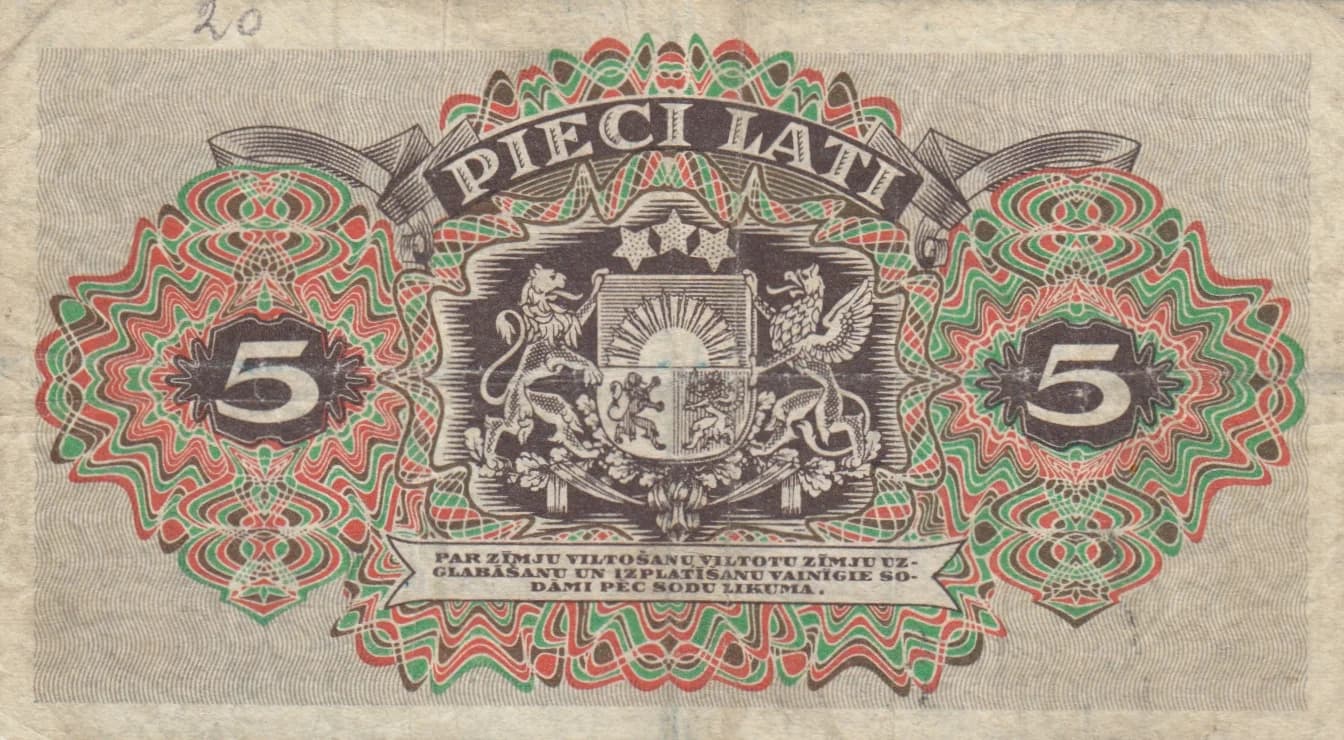
This VF-graded 5 latu note from 1940 represents an attractive example of interwar Latvian currency featuring a distinctive stone arch bridge vignette on the obverse and an elaborate heraldic coat of arms on the reverse. The note displays characteristic aging with visible foxing and creasing consistent with its 80+ year history, while retaining clear impressions of the fine engraving work and multi-color printing that define this issue. As a series C specimen, this note exemplifies the final period of independent Latvia's central bank operations before Soviet annexation.
Common. The 5 latu 1940 series (Pick-34a) represents a standard denomination from a final-year government issue with no historical evidence of exceptionally limited print runs or high recall rates. Series C specimens are neither particularly early nor late in the serial number sequence, suggesting standard circulation production. VF condition is a desirable grade but not exceptionally scarce for this note type. These notes were produced in quantities sufficient for everyday circulation and many examples survive in various conditions.
Issued in 1940 during Latvia's final year of independence, this banknote reflects the nation's governmental authority through signatures of the Finance Minister and State Economy Defense Director, the latter title indicating wartime economic preparations. The coat of arms depicted on the reverse—featuring the lion, eagle, and sun symbol representing Latvia's historic regions and aspirations—served as a potent national symbol during this turbulent period. The note's production in Riga in 1940 marks it as currency from the eve of Soviet occupation, making the entire 1940 series historically significant.
The obverse features a central vignette of a Romanesque or medieval stone arch bridge spanning water with a rural landscape and distant hills in the background, framed by ornate geometric and floral borders in black and cream. Large numeral 5 denominations appear in circular medallion frames on both left and right sides. The reverse displays Latvia's national coat of arms—a complex heraldic achievement featuring a shield divided into quarters representing the historic regions (lion of Kurzeme/Courland, griffin of Zemgale/Semigallia, and other heraldic charges), surmounted by a rising sun symbol and flanked by ornamental red and green geometric border patterns. Large numeral 5 appears again in decoratively framed corner positions. The overall design emphasizes national sovereignty and historical continuity through heraldic imagery and architectural symbolism.
FRONT SIDE: Serial number 'C 040695' (printed in red on both left and right margins); 'DIECIAUT' (Five in Latvian, denomination indicator); 'FINANSU MINISTRS' (Finance Minister); 'RIGA, 1940.' (Place and year of issue); 'VALSTS SAIMIN. DEF. DIREKTORS' (State Economy Defense Director); 'VALSTS KASES MAJ NAS ZIMES IZLAIS TAS PAMATUJOTTIES UZ KREDITUIKUMA 6-PANTU' (State Treasury authorization text regarding issuance under credit law, article 6). BACK SIDE: 'DIECIAUT' (Five); 'GARDA JU VILTOSANU VILTOTU ZIMJU UZ-GARA SANT U POPAISAND VAINIGGE SD DAMI PEC SODU LIKUMA' (Guarding against counterfeiting; forging or counterfeiting notes punishable under penal law).
Intaglio engraving (line engraving) combined with multi-color letterpress or offset printing. The fine line work visible throughout—particularly in the guilloché patterns, border ornamentation, and heraldic details—is characteristic of steel plate engraving. Red and green inks were applied separately to the reverse, indicating multi-pass color printing typical of security banknote production of the period. The complexity of the engraved design served as an anti-counterfeiting measure. This note was likely produced by a European security printer specializing in currency production, though the specific printer name does not appear in visible inscriptions on these sides.
Series C variant as noted in collector data. This 1940 issue exists in multiple series (A, B, C, etc.) representing different printing runs. The note shows clear red serial numbering 'C 040695' indicating the series C variety. Signature varieties may exist based on different Finance Ministers or Defense Directors in office during 1940, though both signatures are not clearly legible in the provided images. No date overprints or other modifications are evident.