5 rubli 1919
“serie F”
Market Prices
About This Note
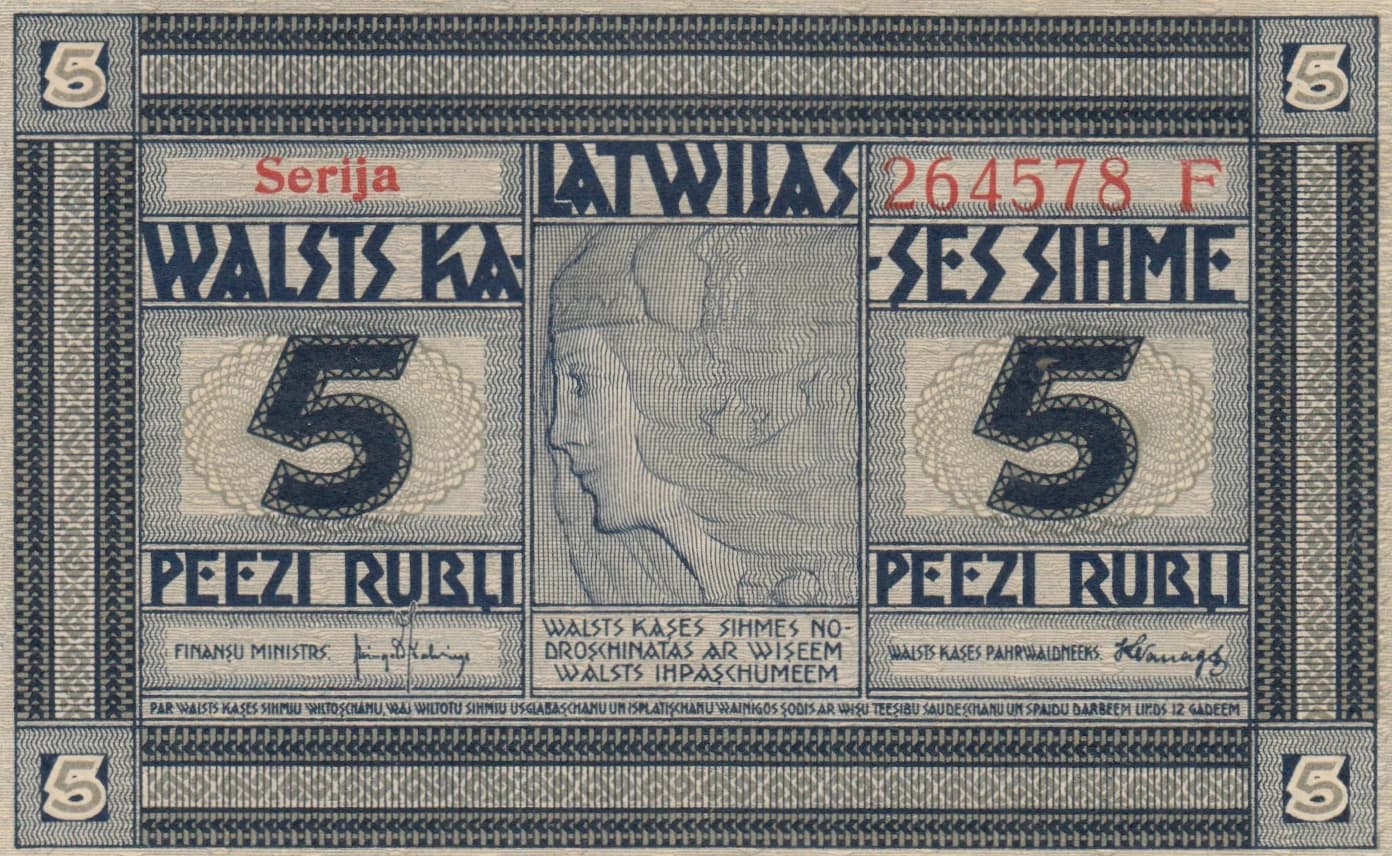
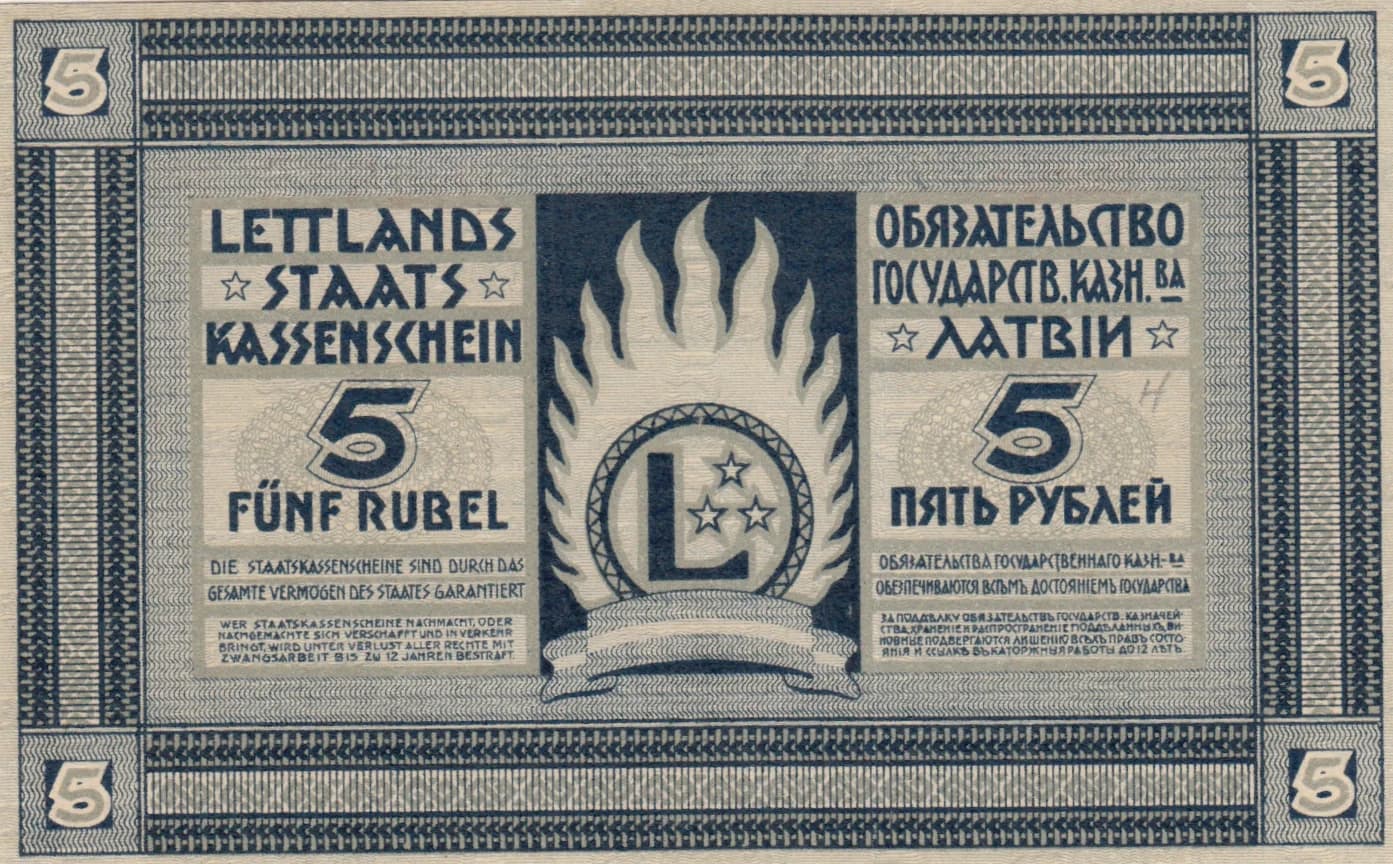
This is an UNC-graded 5 Rubli note from Latvia's 1919 emergency currency issue, Pick P-3fF, displaying exceptional preservation with crisp blue and cream coloring and sharp engraving throughout. The note features a striking left-facing male portrait in the central medallion on the obverse, while the reverse showcases a symbolic flaming torch within a wreath—potent imagery reflecting Latvia's struggle for independence. The serial number 2644578 F and Series F designation are clearly visible, making this an identifiable specimen from this historically significant emission.
Common. This is a regular issue from a newly established state in a denomination produced in substantial quantities to support early monetary circulation. The eBay price tracking data shows consistent availability with UNC specimens regularly selling in the $35-60 range, with circulated examples at $18-45, indicating robust supply. The 2016 catalog value of $200 for UNC reflects the historical significance rather than scarcity. Series F and standard six-digit serials do not indicate a limited printing. No evidence of recall, short-run status, or collector restriction exists.
Issued during Latvia's transition to independence in 1919, this banknote represents the nascent Latvian state's assertion of monetary sovereignty following the Russian Revolution and departure from the Russian Empire. The trilingual inscriptions in Latvian, German, and Russian reflect the complex linguistic and political landscape of newly independent Latvia. The torch and flame imagery on the reverse symbolize the national awakening and revolutionary fervor of the period, while the guarantee text emphasizes the state treasury's backing of the new currency during a period of profound institutional establishment.
The obverse features a left-facing male portrait in profile, rendered in a detailed circular medallion at the center—the identity of this historical figure is not specified in the visual data but likely represents a Latvian national hero or statesman from the independence period. The design employs a complex geometric border framework with ornamental floral and botanical motifs in the corners, characteristic of early 20th-century European banknote design. Large denomination numerals '5' flank the portrait on both sides. The reverse presents a dominant central flaming torch or flame symbol enclosed within a decorative circular wreath, with a prominent 'L' monogram in a starred circle—representing Latvia. The entire design is rendered in dark blue and cream/beige on white, with careful attention to fine line work throughout the border patterns, providing both aesthetic appeal and security through intricate engraving.
OBVERSE: 'Serija' (Series); 'WALSTS KA' (State [Treasury]); '5' and 'PEEZI RUBLI' (Five Rubles) appearing twice; 'BESSIHME' (Obligation/Promise); 'FINANSU MINISTRS' (Finance Minister); 'WALSTS KASES PAHRVALDNEEKS' (State Treasury Director); Latvian text regarding penalties for counterfeiting with imprisonment up to several years. REVERSE: 'LETTLANDS STAATS KASSENSCHEIN' / '5 FÜNF RUBEL' (German: Latvia's State Treasury Note / Five Rubles); 'ОБЯЗАТЕЛЬСТВО ГОСУДАРСТВ.КАССН.ВА ЛАТВИИ 5 ПЯТЬ РУБЛЕЙ' (Russian: State Treasury Obligation of Latvia, Five Rubles); German guarantee text: 'These state treasury notes are guaranteed by the entire assets of the state' and counterfeiting penalty text: 'Whoever counterfeits state treasury notes or puts counterfeit notes in circulation will be punished with imprisonment up to 12 years and loss of all rights'; Russian equivalent guarantee and penalty provisions specifying corrective labor punishment up to 12 years.
Intaglio engraving (recess/relief printing), as evidenced by the fine, complex geometric line patterns, detailed border designs, sharp definition of the portrait medallion, and the precise detail visible in the wreath and ornamental elements. The security features rely on engraving complexity rather than modern chemical or optical methods, consistent with 1919 printing technology. The printer is not definitively identified in the available data, though Latvian treasury notes of this period were typically produced by state or contracted European security printers; specific printer attribution would require additional catalog research.
This specimen is identified as Pick P-3fF, representing Series F of the 5 Rubli 1919 issue. The PMG population report indicates at least 16 catalogued variants exist for this base Pick number (including P-3e, P-3f, P-3s and others), suggesting multiple signature combinations, series designations, or minor design variations were issued. The 'F' series designation and serial number 2644578 F are specific identifiers for this variety. No overprints or emergency modifications are visible on this specimen. The note's UNC grade, multilingual text (Latvian/German/Russian), and unremarked condition indicate this is a standard variety from the primary production run rather than a post-issue variant or limited emergency reissue.