5 rubli 1919
“serie C”
Market Prices
5 salesAbout This Note
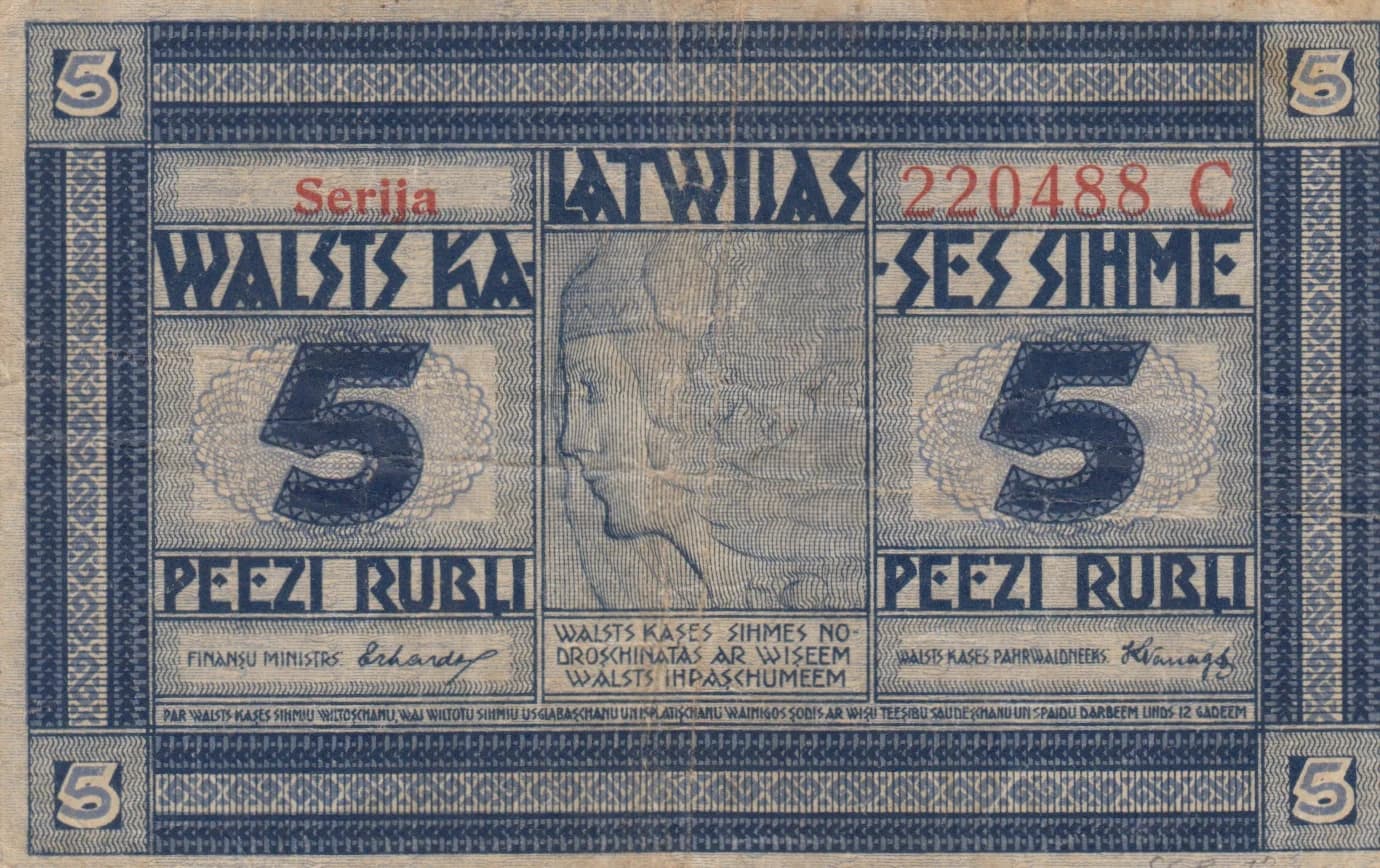
This VF-graded 5 rubli note from 1919 represents an early emission of Latvia's first independent currency, issued during the critical period of state formation. The note displays excellent engraving quality with a striking blue and cream color scheme, centered on a left-facing male portrait surrounded by ornamental wreaths and geometric patterns characteristic of early 20th-century design. Series C designation and serial number 220488 C are clearly visible, with the note showing appropriate age-related patina and moderate wear consistent with over a century of circulation.
Common. The 5 rubli denomination from the 1919 Latvian issue (Pick-3b) was produced in substantial quantities to meet currency needs during the critical early independence period. VF-graded examples appear regularly in collector markets and are not particularly difficult to obtain. While all notes from this historic emission are collectible, the denomination and series do not command premium pricing typical of scarce or rare issues.
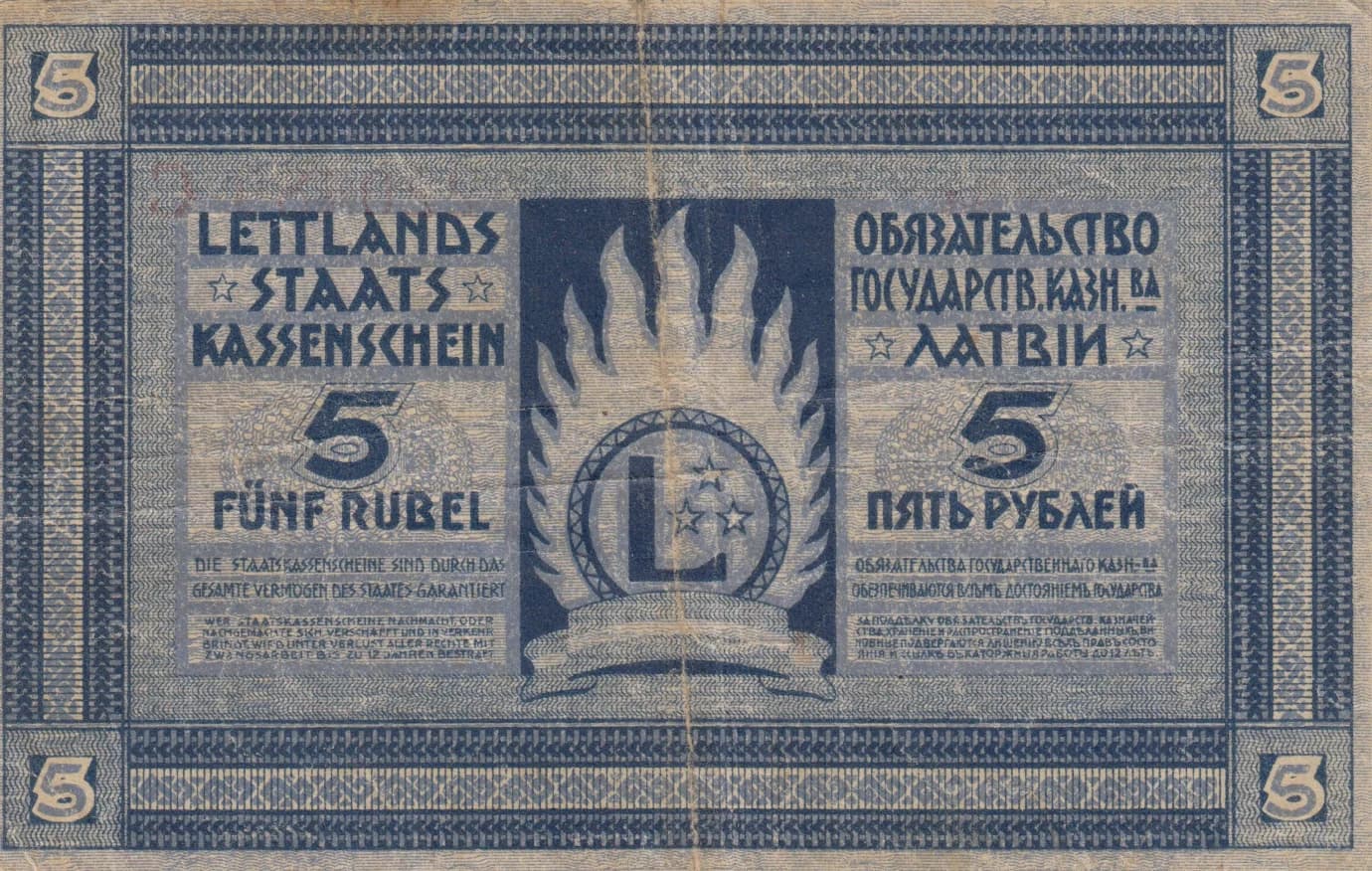
This banknote was issued by the newly independent Latvian state in 1919, immediately following Latvia's declaration of independence from the Russian Empire. The bilingual inscriptions in German and Russian reflect Latvia's complex historical position under Austro-Hungarian and Russian rule, while the heraldic emblem on the reverse featuring the letter 'L' and flames represents the emerging Latvian national identity. The note's guarantee 'secured by all state property' underscores the new nation's attempt to establish financial credibility during a period of significant political and economic upheaval in the region.
The obverse features a dignified male portrait in left profile, likely depicting a Latvian political or historical figure significant to the nation's independence movement, positioned centrally and framed by ornamental circular wreaths and linear decorative elements. The composition employs bilateral symmetry with large numeral 5s positioned in all four corners within decorative rectangular frames. The reverse presents a heraldic emblem as the focal point, rendered in a circular wreath design with a star-topped flame or fire element emerging above the shield containing the letter 'L', symbolizing Latvia's national identity. Both sides feature sophisticated Art Deco-influenced geometric borders and fine linear patterning throughout, creating depth and visual interest. The dual-language treatment (Latvian on obverse; German and Russian on reverse) reflects the multilingual administrative reality of the newly independent state.
FRONT SIDE: 'WALSTS KA' (State), 'SESSHIME' (Treasury/Cashier), 'PEEZI RUBLI' (Five rubles), 'Sudite' (Approve/Authorize), 'FINANŠU MINISTRS' (Finance Minister), 'WALSTS KASES SIHMES NODROSCHINATAS AR WISEEM WALSTS IHPASCHUMEEM' (State treasury bill secured by all state property), 'WALSTS KASES PAHRWAIDITEEKS' (State Treasury Director). REVERSE SIDE: 'LETTLANDS STAATS KASSENSCHEIN' (Latvian State Treasury Note - German), 'FÜNF RUBEL' (Five rubles - German), 'ОБЯЗАТЕЛЬСТВО ГОСУДАРСТВЕННОГО КАЗНАЧЕЙСТВА ЛАТВИИ' (Obligation of the State Treasury of Latvia - Russian), 'ПЯТЬ РУБЛЕЙ' (Five rubles - Russian), 'DIE STAATSKASSENSCHEINE SIND DURCH DAS GESAMTE VERMÖGEN DES STAATES GARANTIERT' (The state treasury notes are guaranteed by the total assets of the state - German), 'ОБЯЗАТЕЛЬСТВА ГОСУДАРСТВЕННОГО КАЗНАЧЕЙСТВА ОБЕСПЕЧИВАЮТСЯ ВСЕМ ДОСТОЯНИЕМ ГОСУДАРСТВА' (State treasury obligations are secured by all state property - Russian).
Intaglio engraving (recess printing), the standard security printing method for high-value banknotes of the period. The fine linear work, geometric background patterns, and variable line weight observed throughout both sides are characteristic of intaglio production. The intricate engraving patterns serve as security features preventing counterfeiting. The printer is not definitively identified in catalog records for Pick-3b, though Latvian notes of this period were produced by established European security printers; further research into Latvian state archives would be required for attribution.
This specimen is identified as series C with serial number 220488 C. The 1919 Latvian 5 rubli exists in multiple series (A, B, C, etc.) representing different printings or batches. The specific series, serial number progression, and any signature variants are key identifying features for collectors. Series C examples like this one represent a documented variety within Pick-3b, though all series variants of this denomination are considered part of the standard 1919 issue.