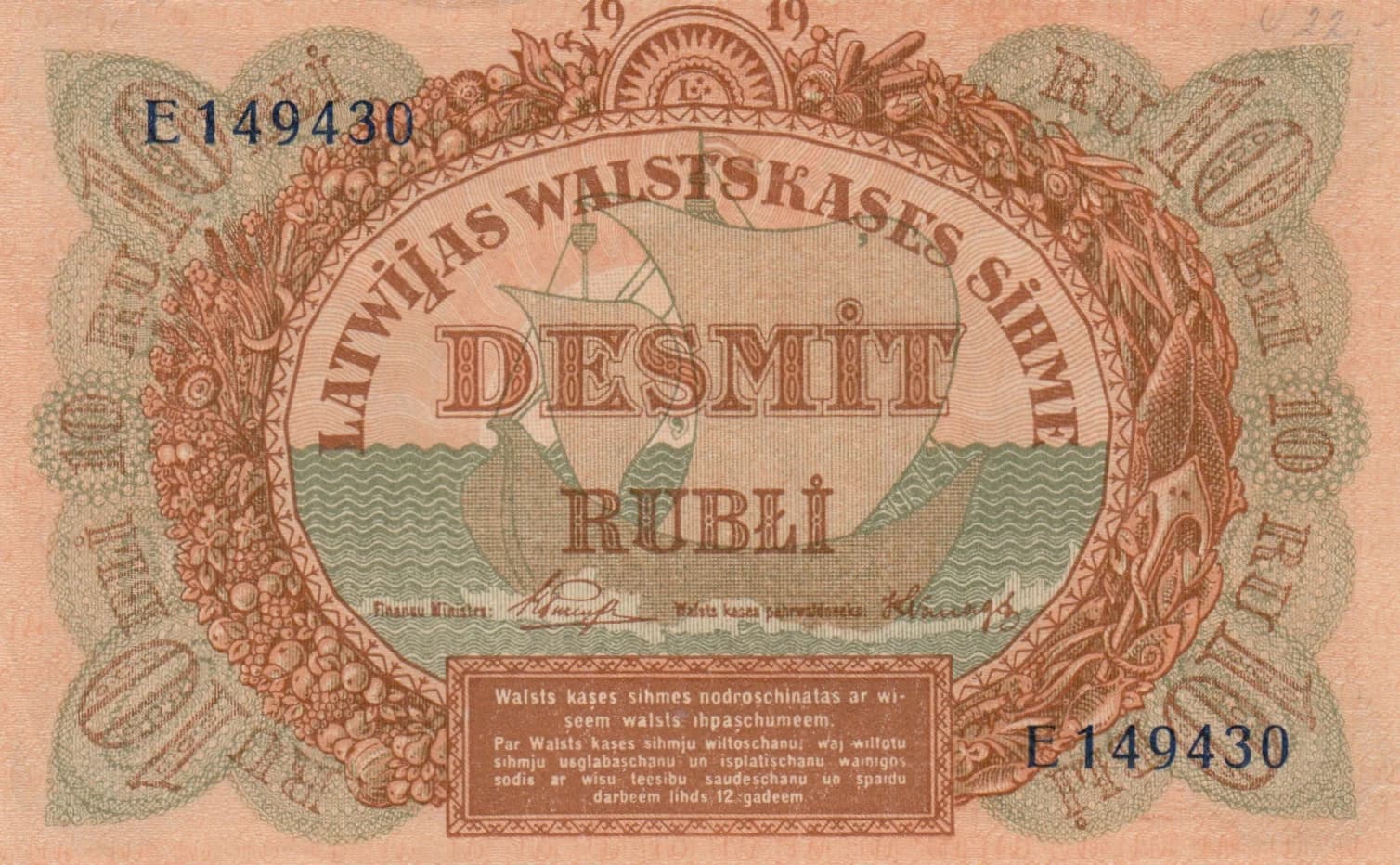
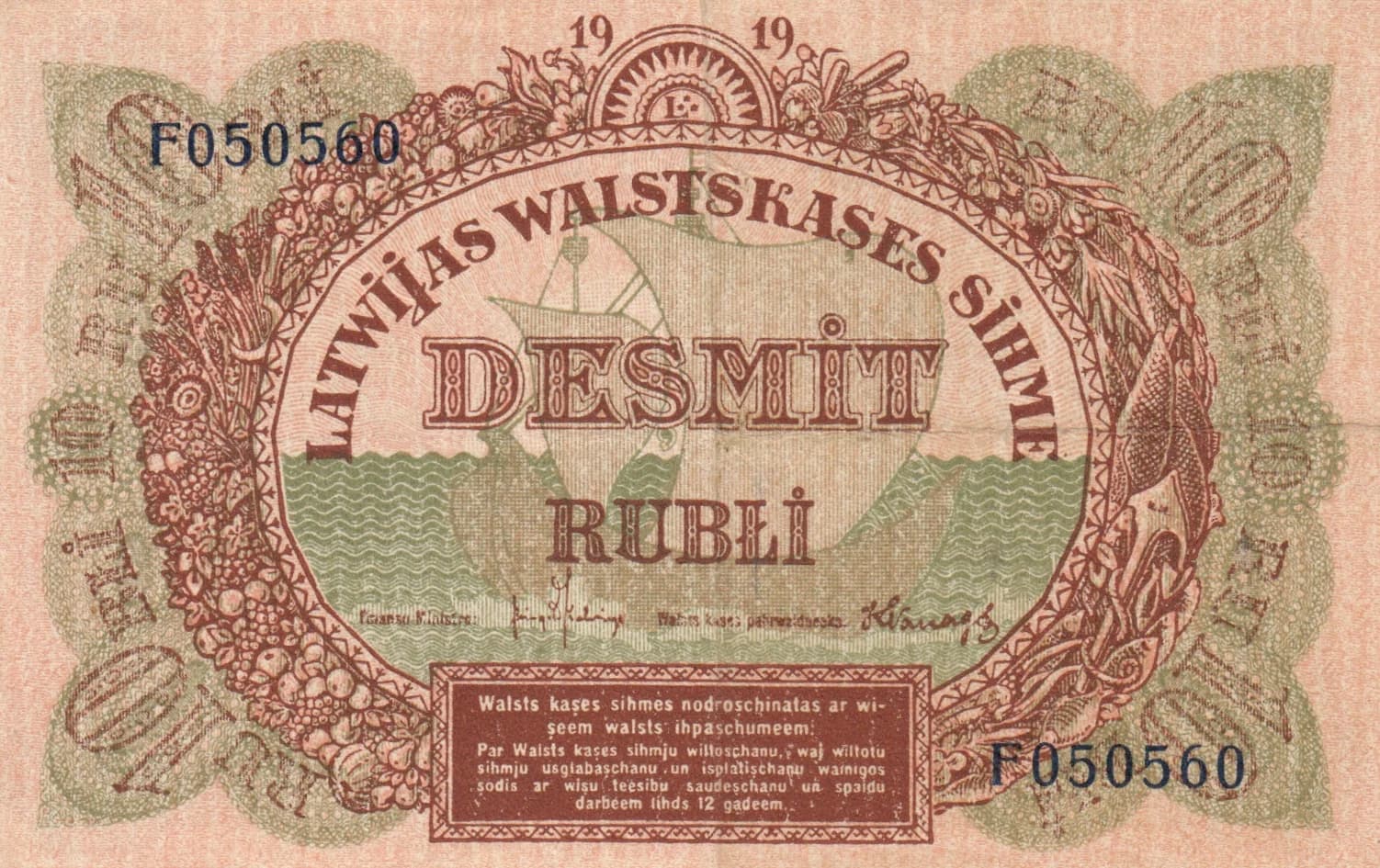
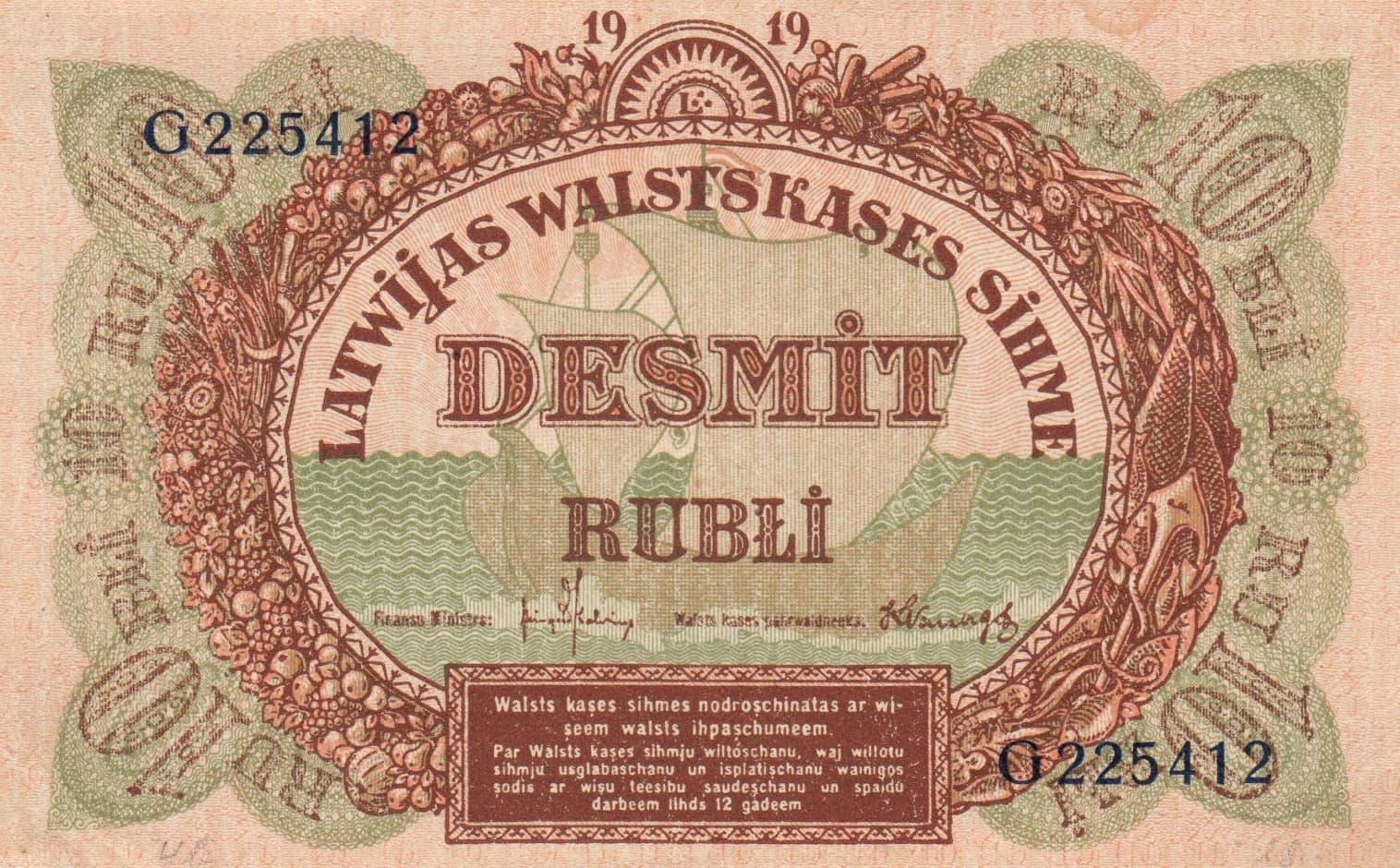
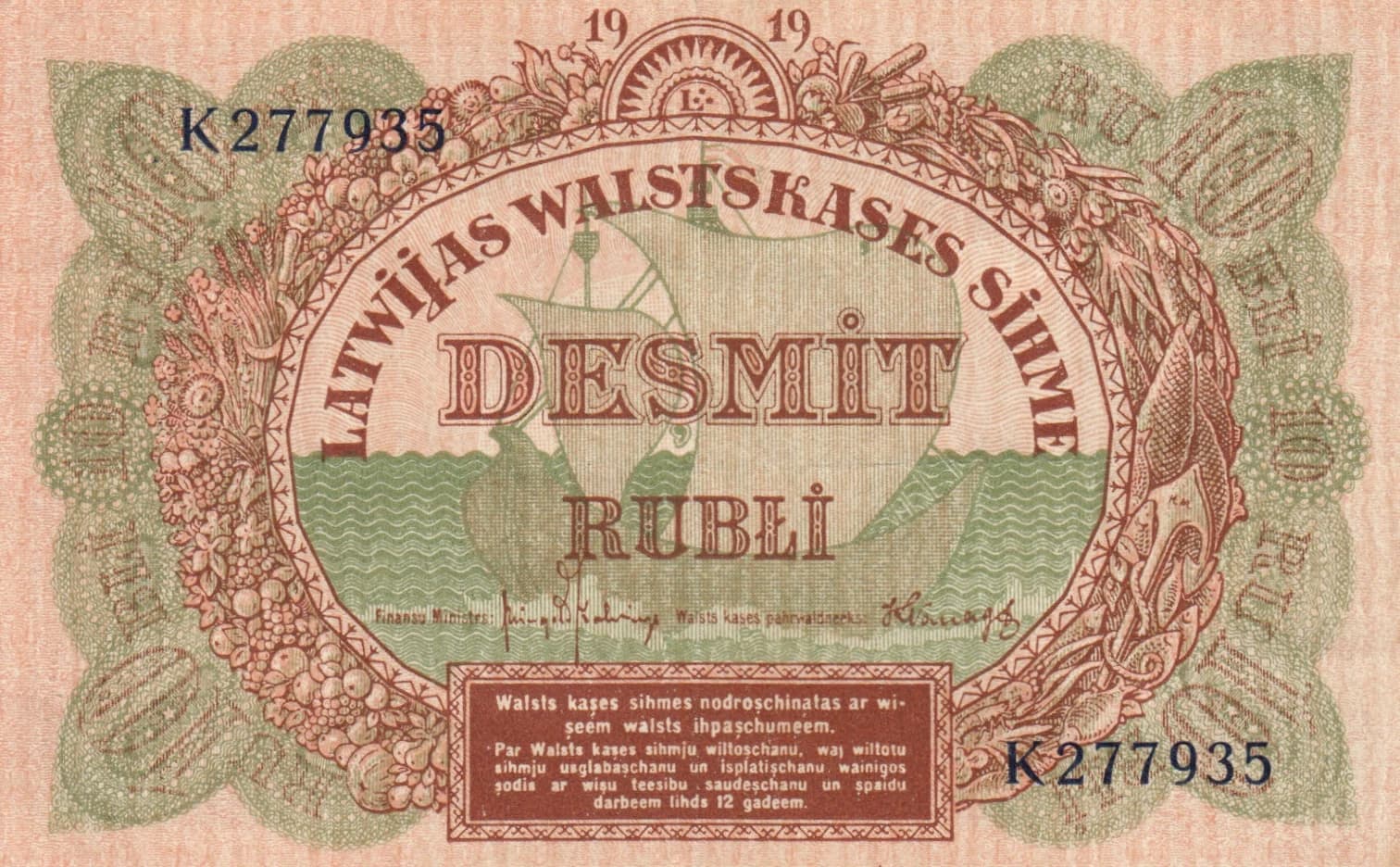
10 rubli 1919
Market Prices
13 salesAbout This Note
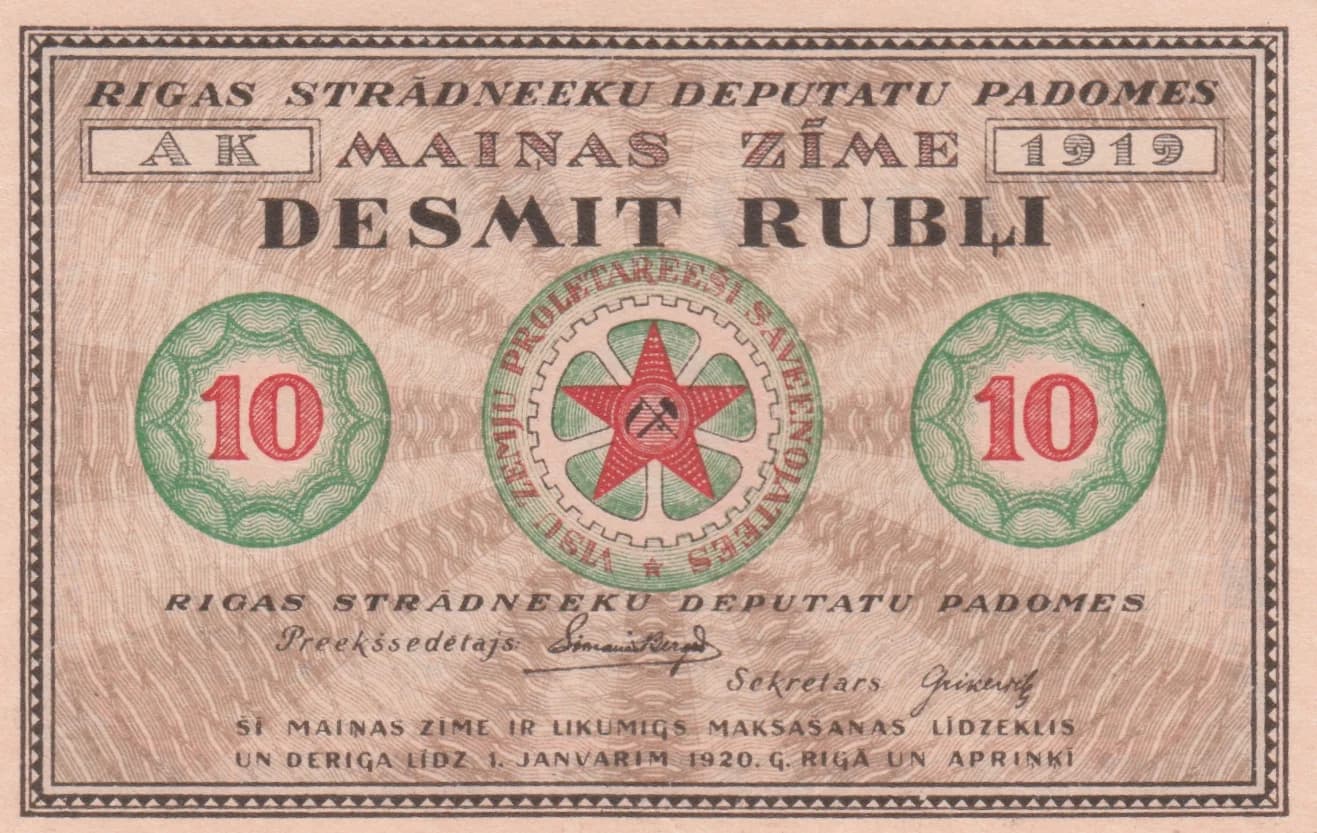
This is an exceptional uncirculated example of the 10 Rubli banknote issued by Riga's Workers Deputies Soviet in 1919, a scarce regional currency from Latvia's brief Soviet period. The note displays crisp, clean condition with vibrant red, green, and beige coloring throughout, featuring the iconic hammer and sickle symbol within a five-pointed star as the central design element. Its historical significance as a revolutionary-era exchange mark, combined with excellent preservation and strong collector demand evidenced by recent eBay sales, makes this an attractive acquisition for Soviet and Baltic numismatists.
Common. While regional Soviet currency from 1919 Riga possesses historical interest, eBay market data shows consistent sales activity with most examples trading between $3.29 and $44.80 depending on condition grade, with many F-VF examples selling in the $6.50-$12.60 range. The 2008 catalog valuation of $20 UNC aligns with observed market behavior. The PMG population report indicates limited professional grading submissions (1 variant recorded), but this reflects undersubmission rather than rarity. The note's brief validity period (expired January 1, 1920) suggests a contained, known print run that was replaced by subsequent currency issues, making survival relatively straightforward. No evidence exists of a recall or unusually short print run that would elevate rarity.
This note represents a fascinating transitional moment in Latvian history when the Riga Council of Workers' Deputies issued its own currency during the Soviet occupation of 1919, before Latvia's independence was fully established. The prominent hammer and sickle imagery and revolutionary tribunal warnings against counterfeiting reflect the radical political context of Soviet rule in the region. The note's validity expiration date of January 1, 1920, underscores its temporary nature as an emergency exchange mark for Riga and surrounding areas during this turbulent period.
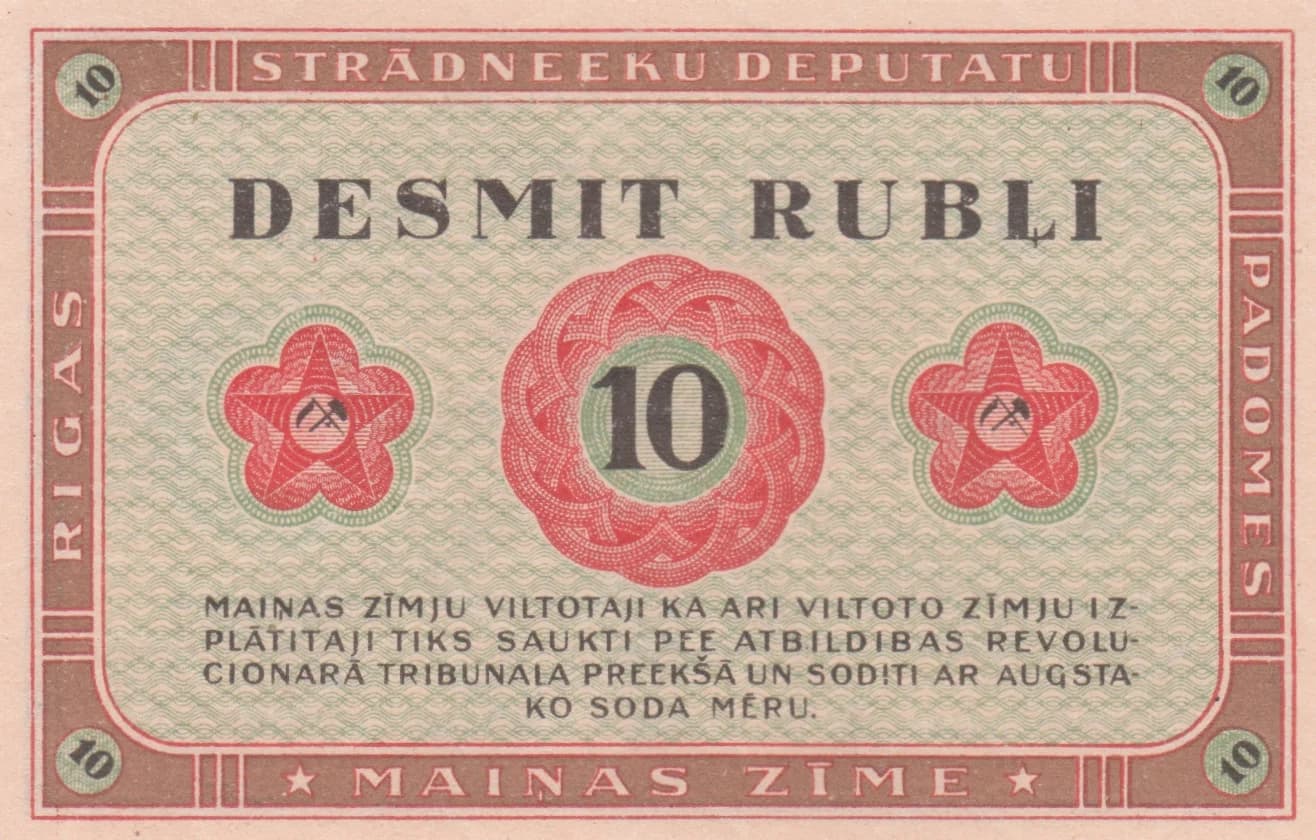
This beautifully symmetrical design exemplifies early Soviet revolutionary aesthetics applied to regional currency. The obverse features three circular medallions arranged horizontally: two smaller side medallions displaying the denomination '10' in red within ornate green circular frames, flanking a dominant central medallion containing a red five-pointed star with hammer and sickle centered within radiating gear/cog designs symbolizing industrial labor. The reverse maintains this tripartite composition but inverts the color scheme, with red stars on the sides and a large central circular medallion displaying the number '10' in green surrounded by decorative floral or petal-like waves in red. Both sides employ fine beige/tan background coloring with intricate geometric border patterns in brown and maroon, creating a formal, authoritative appearance befitting an official state currency despite its temporary status. The ornamental framing and repetitive geometric elements emphasize craftsmanship and legitimacy.
FRONT SIDE: 'RIGAS STRADNEEKU DEPUTATU PADOMES' (Riga Council of Workers' Deputies), 'AK MAINAS ZIME 1919' (Exchange Mark 1919), 'DESMIT RUBLI' (Ten Rubles), with signatures marked 'Strekssedetajs' (Chairman) and 'Sekretars' (Secretary). The legal tender statement reads: 'SI MAINAS ZIME IR LIKUMIGS MAKSASANAS LIDZEKLIS UN DERIGA LIDZ 1. JANUARIM 1920. G. RIGA UN APRINKI' (This exchange mark is a legal means of payment and valid until January 1, 1920. Riga and surrounding areas). BACK SIDE: 'STRADNEEKU DEPUTATU' (Workers' Deputies), 'DESMIT RUBLI' (Ten Rubles), 'RIGAS' (Riga), 'PADOMES' (Council), 'MAINAS ZIMIU VILTOTAJI KA ARI VILTOTO ZIMIU IZ-PLATITAJI TIKS SAUKTI PEE ATBILDIBAS REVOLU-CIONARA TRIBUNALA PREEKSA UN SODITI AR AUGSTA-KO SODA MERU' (Counterfeiters of exchange marks as well as those who distribute counterfeit marks will be prosecuted by the revolutionary tribunal and punished with the severest penalty), and 'MAINAS ZIME' (Exchange Mark).
This note was produced using intaglio engraving (line engraving), as evidenced by the fine line patterns visible in the background security design, the crisp detail in the ornamental medallions, and the sharp definition of the hammer and sickle imagery and text. The multi-color printing technique visible in the red, green, and brown elements suggests multi-plate intaglio printing, a standard security printing method for this era. The specific printer for Riga Soviet banknotes of 1919 is not definitively documented in widely available catalogs, though such notes were typically produced by available printing facilities in Riga or commissioned from established Central European printers.
The observed specimen appears to be the standard Pick P-R4 variety with no evident overprints, date variations, or serial number prefixes that would indicate a distinct sub-variety. The signatures shown ('Strekssedetajs' and 'Sekretars') are typical of the issue type. No significant printing varieties have been documented for this Pick number in standard catalogs. The note's uncirculated condition and clean impression are consistent with the base P-R4 issue with no identifying characteristics suggesting a separate printing stage or variety classification.