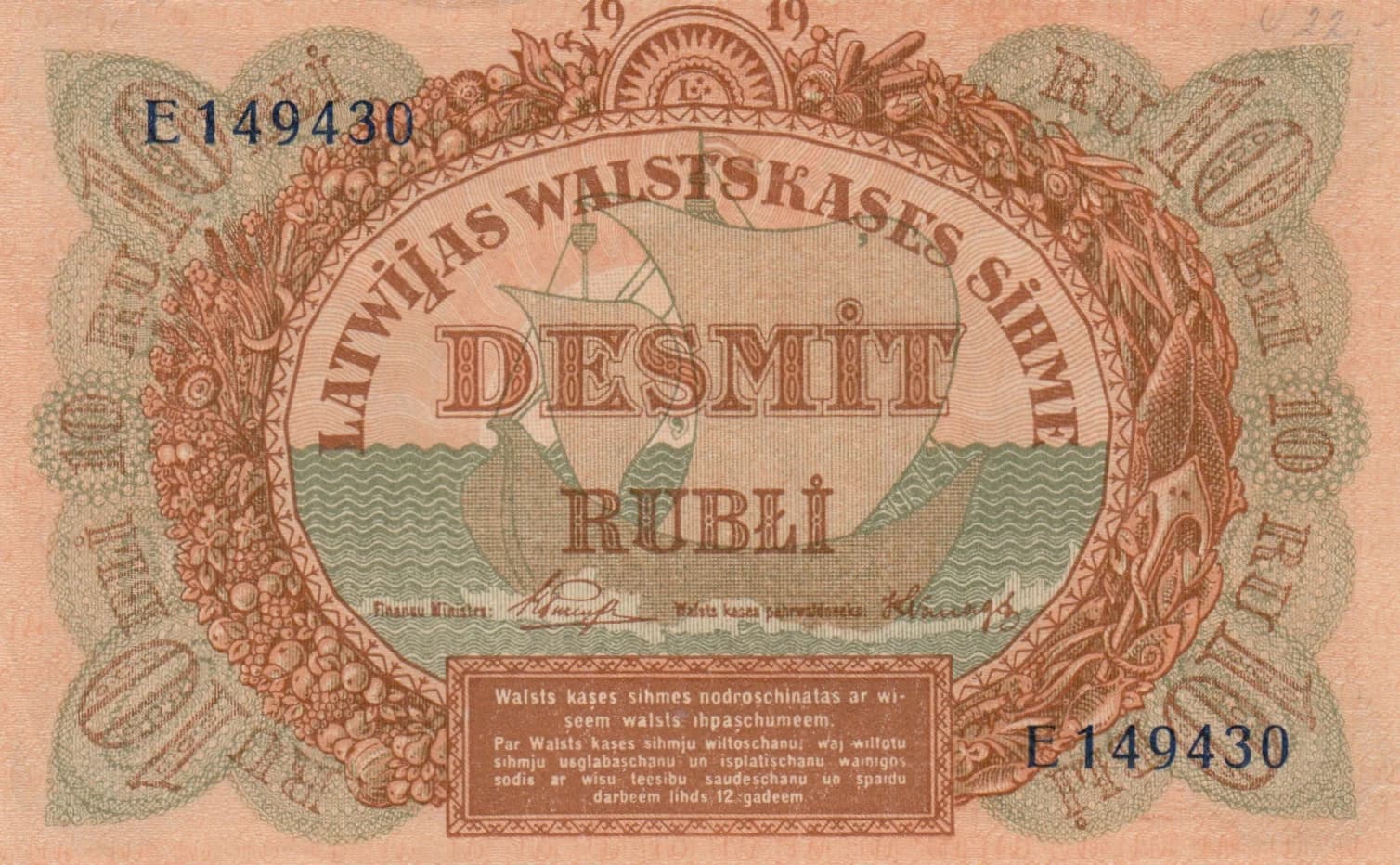
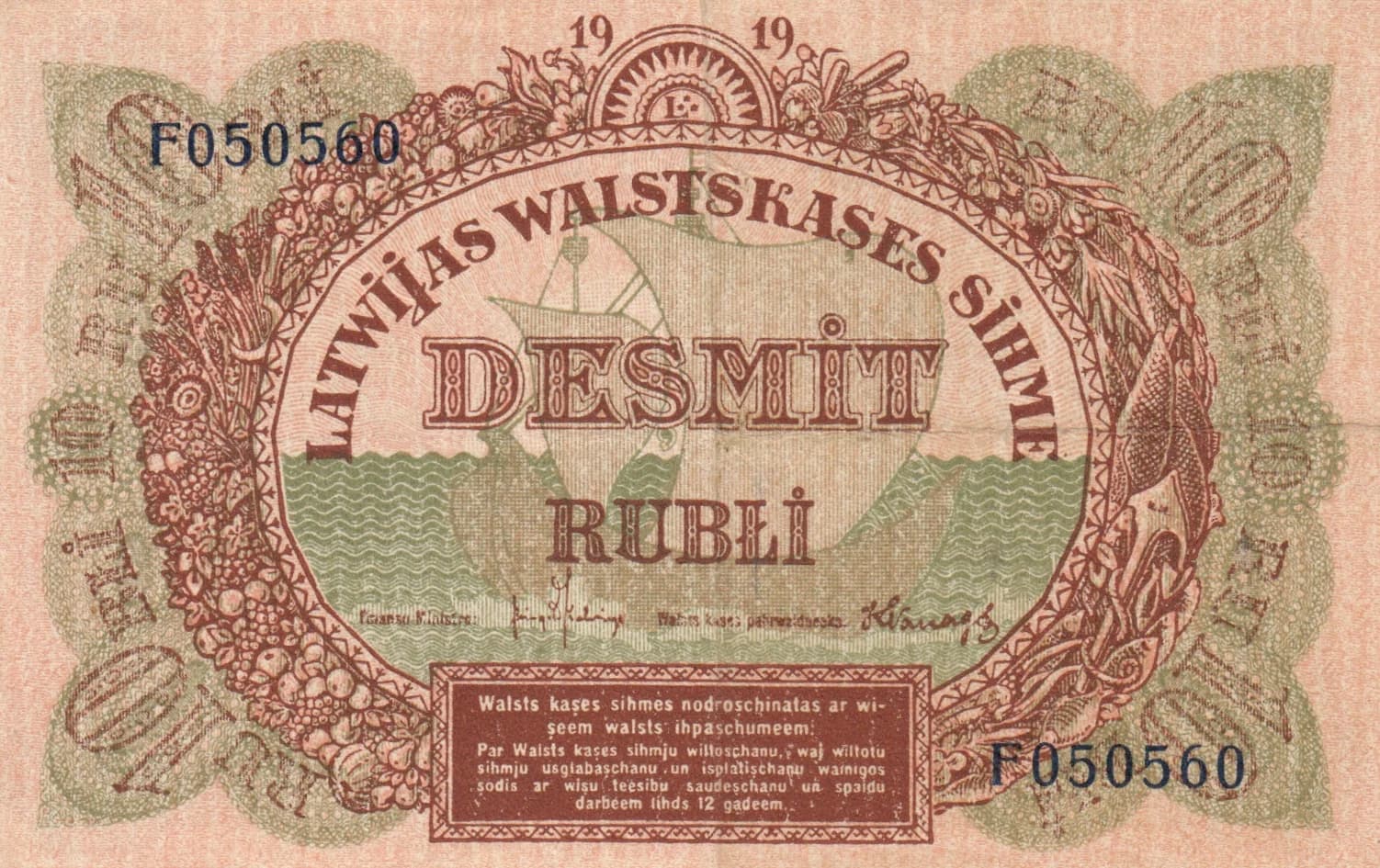
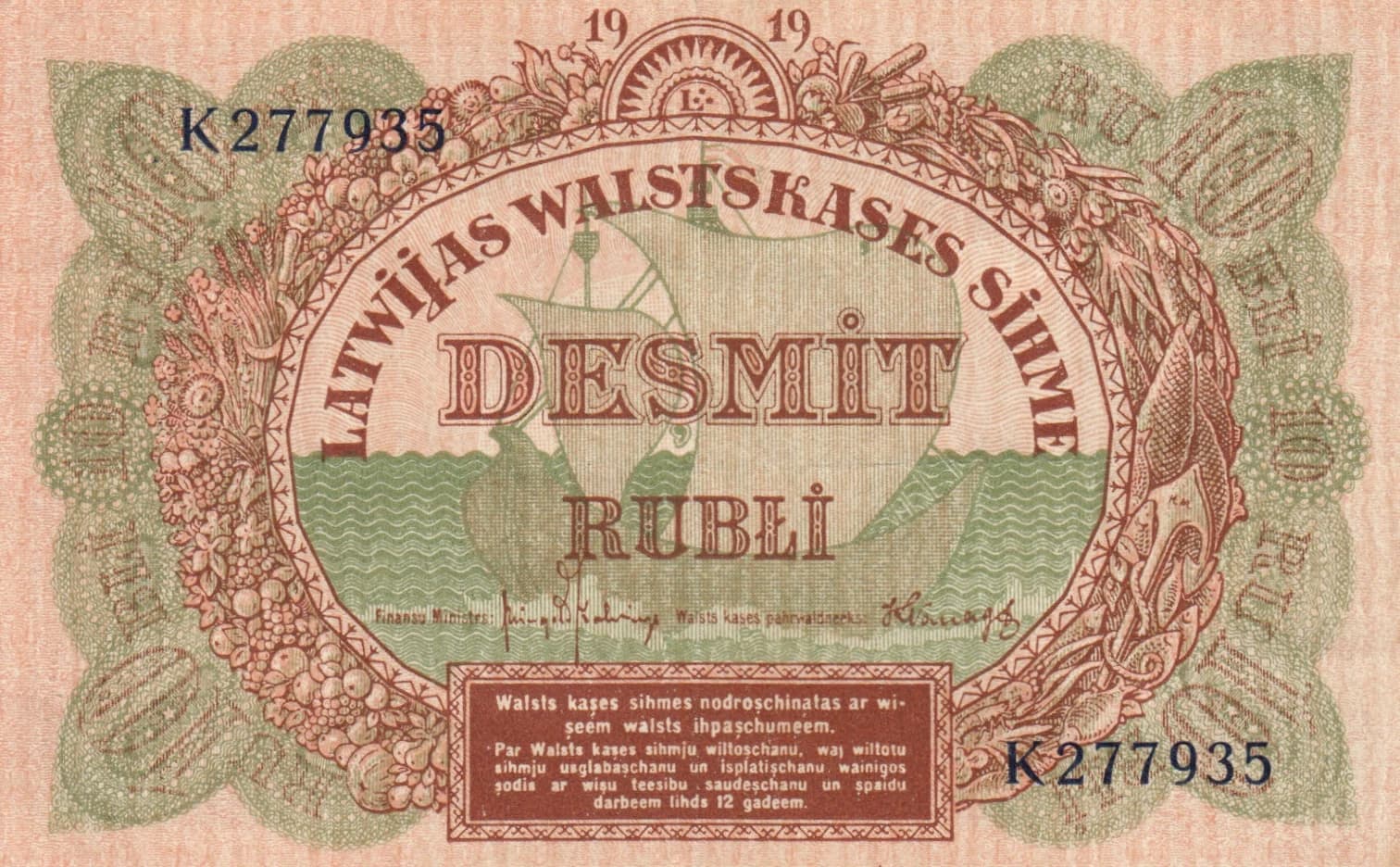
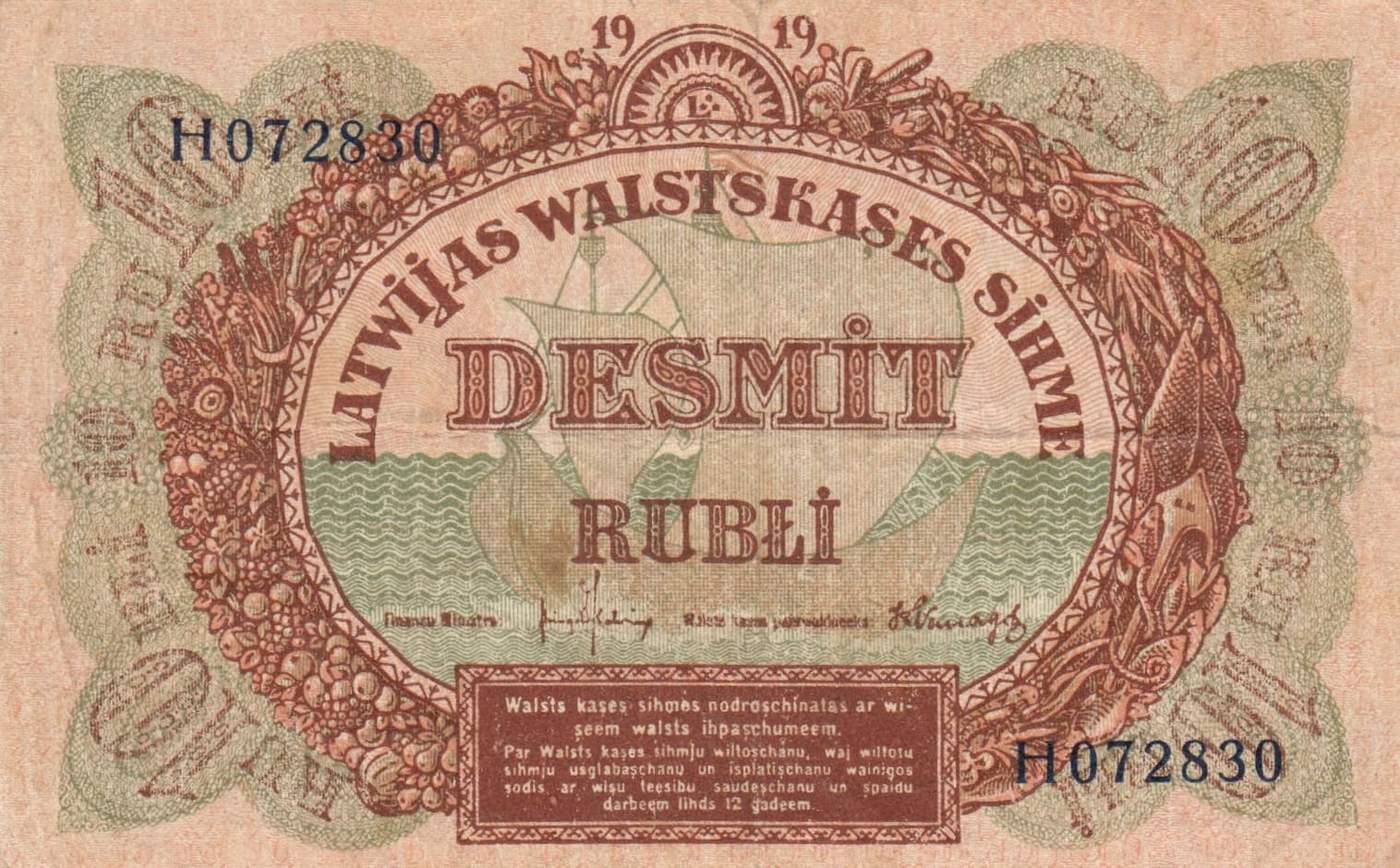
10 rubli 1919
“serie G”
Market Prices
9 salesAbout This Note
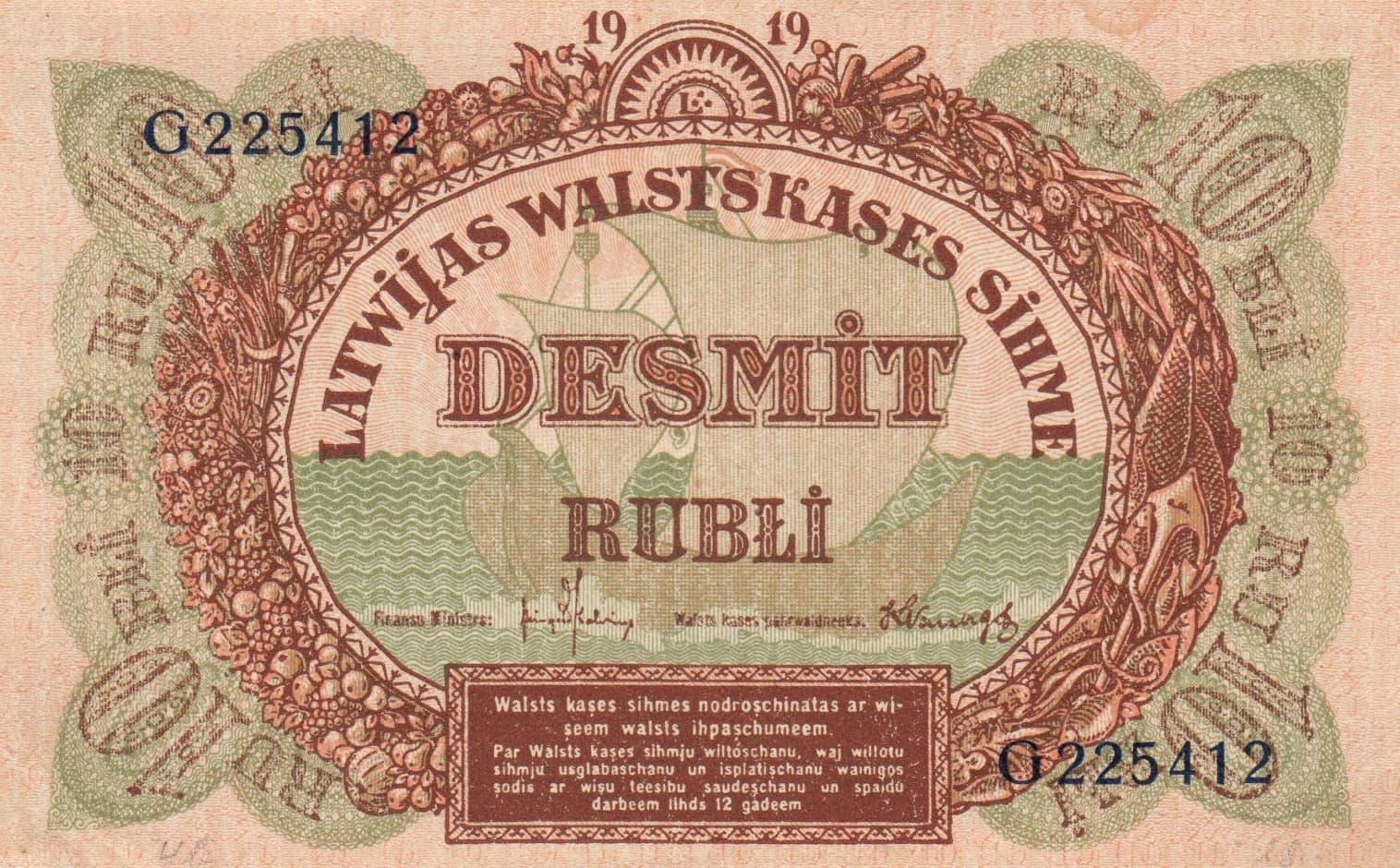
An exceptionally well-preserved example of Latvia's earliest independent currency, this 10 Rubli note from 1919 showcases the transitional period between Russian imperial and Latvian sovereignty. The note features vibrant peach, brown, and green tones with a striking central vignette of a Hanseatic galleon—symbolizing Latvia's maritime trading heritage—surrounded by ornate floral borders and security guilloche patterns. In AU condition with sharp printing and no visible wear, this Series G note represents a highly collectible piece of early 20th-century Baltic numismatics.
Common. eBay market data shows consistent trading between $9.50 and $42.00 USD depending on condition, with most sales in the $15-$30 range, and multiple sales documented across more than a decade (2009-2021). The note is listed in the PMG population report as one of 20 documented variants of the base Pick number, indicating reasonable availability. The series designation (G) is one of multiple known series (F, G, H, K, L documented), further supporting common status. No print run restrictions or recall information suggest scarcity.
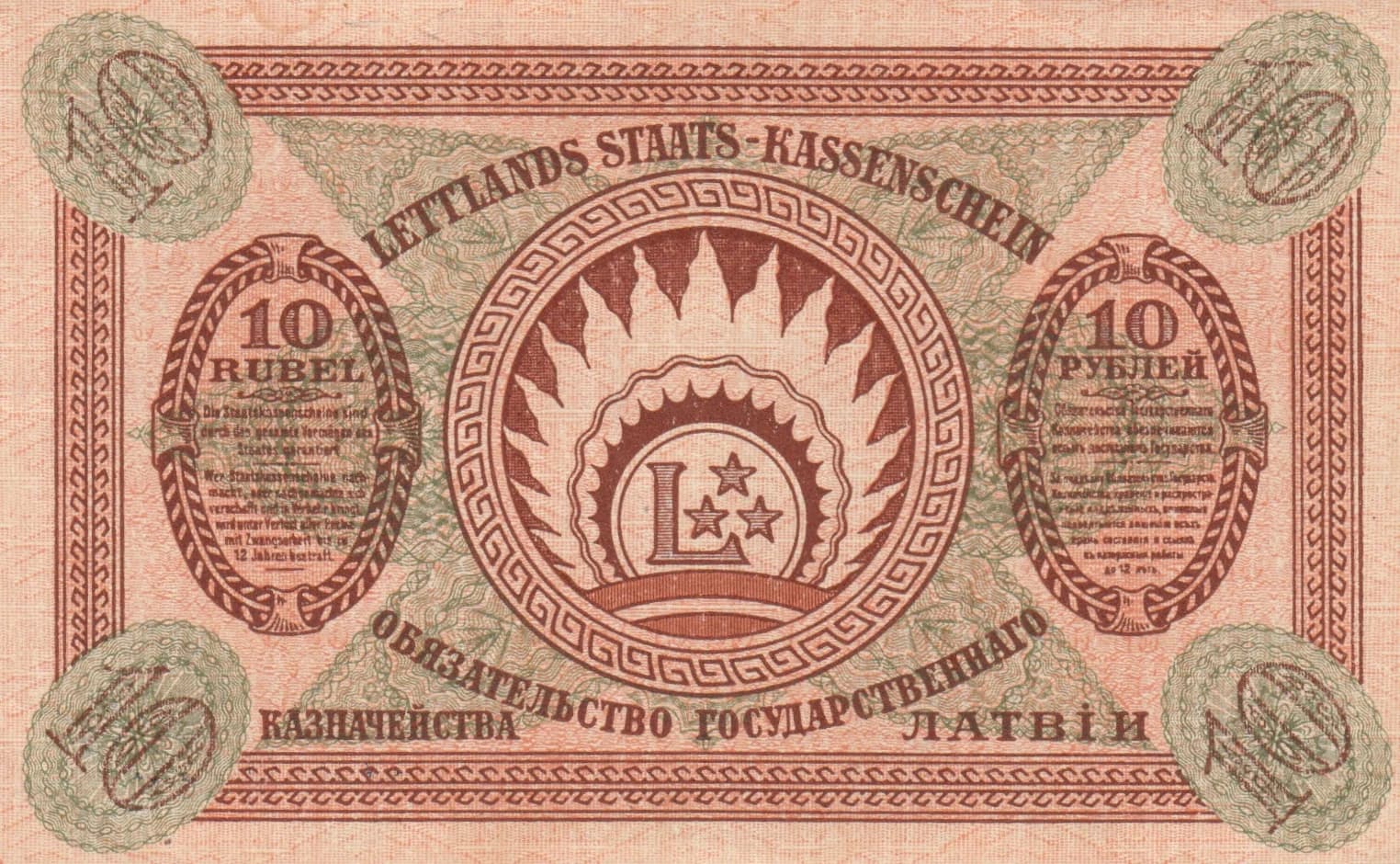
Issued in 1919 during Latvia's declaration of independence from the Russian Empire, this note represents the Latvian Government's attempt to establish monetary sovereignty using the Russian Rubli denomination during the transitional period before the adoption of the Lati in 1922. The trilingual inscriptions in Latvian, German, and Russian reflect the complex political and cultural landscape of the newly independent state, while the Hanseatic galleon symbolizes Latvia's historical role as a major Baltic trading power and Hanseatic League member. The elaborate state emblem on the reverse, featuring a rising sun and coat of arms, emphasizes national identity and the legitimacy of the new government's financial authority.
The obverse features an ornate circular frame with elaborate floral and scrollwork borders enclosing a central vignette of a Hanseatic merchant galleon under sail on choppy waters, with fortification architecture visible in the background—referencing Riga's maritime heritage and historical commercial importance. A decorative sunburst radiates from the top of the frame. The reverse presents the State emblem as the dominant central element: a rising sun with radiating lines above a coat of arms containing stars, all enclosed within a geometric Greek key meander pattern border and framed by ornate oval cartouches containing denomination text and institutional inscriptions. Laurel wreath and circular seal-like emblems appear in the corners. The color scheme of peach/salmon, brown/maroon, and green provides excellent contrast and visual hierarchy throughout both sides.
FRONT: 'LATVIJAS VALSTISKAS SIHMES DESMITH RUBELI' (Latvia State Ten Rubli); Extended legal text in Latvian: 'State treasury notes secured by all state assets. For the issue, storage and circulation of state treasury notes, penalties are provided for all violations and counterfeit work for 12 years.' Serial number G2254112 appears upper left and lower right. BACK: 'LETTLANDS STAATS-KASSENSCHEIN' (German: Latvia State Treasury Note); '10 RUBEL' / '10 РУБЛЕЙ' (Ten Rubli in German and Russian); 'КАЗНАЧЕЙСТВО ГОСУДАРСТВЕННОЙ ТАТВИИ' (Russian: Treasury of the State of Latvia); 'OBWALTUNGSSTAAT GOUDARSTVENTTI LATVII' (Mixed language: Administration/State of Latvia).
Steel plate engraving (intaglio), evidenced by the fine line engraving patterns visible throughout both sides, particularly in the background guilloche work and ornamental borders. The sharp impressions, fine detail in the decorative elements, and security features typical of high-security banknote production indicate professional work from an established security printer. The quality and sophistication suggest production by a major European security printer, though specific printer attribution for this Pick-4f variant is not definitively documented in the provided catalog data.
This note is catalogued as Pick-4f, indicating it is one of at least five identified varieties of the 10 Rubli 1919 issue (P-4b, P-4c, P-4e, P-4f documented). All variants share the 'Light Lines' watermark characteristic. The specific variety P-4f is distinguished by its watermark pattern and series designation. The observed specimen displays Series G, which falls within the documented series range (F, G, H, K, L). No visible signatures, overprints, or other distinguishing modification marks are noted in the visual analysis.