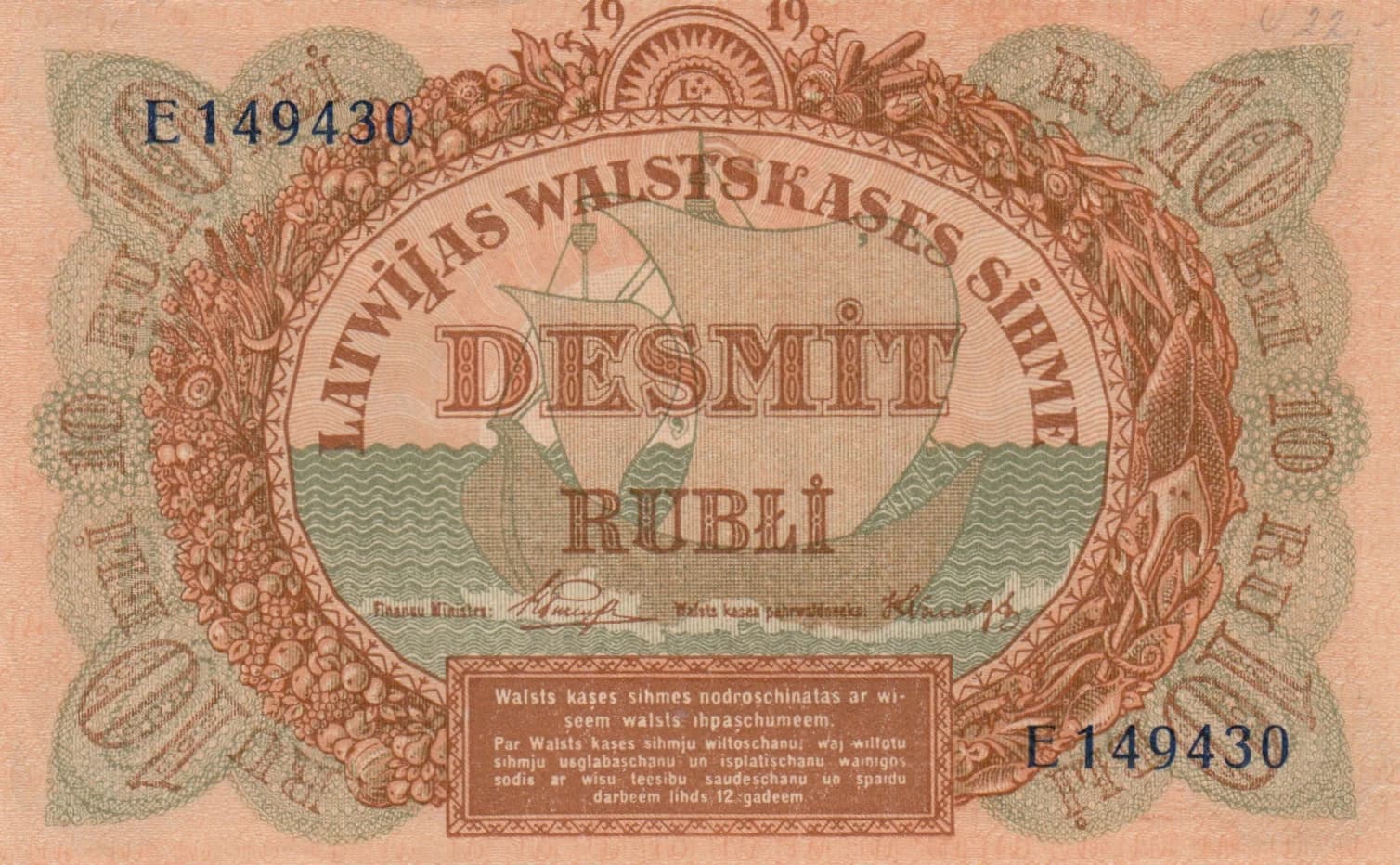
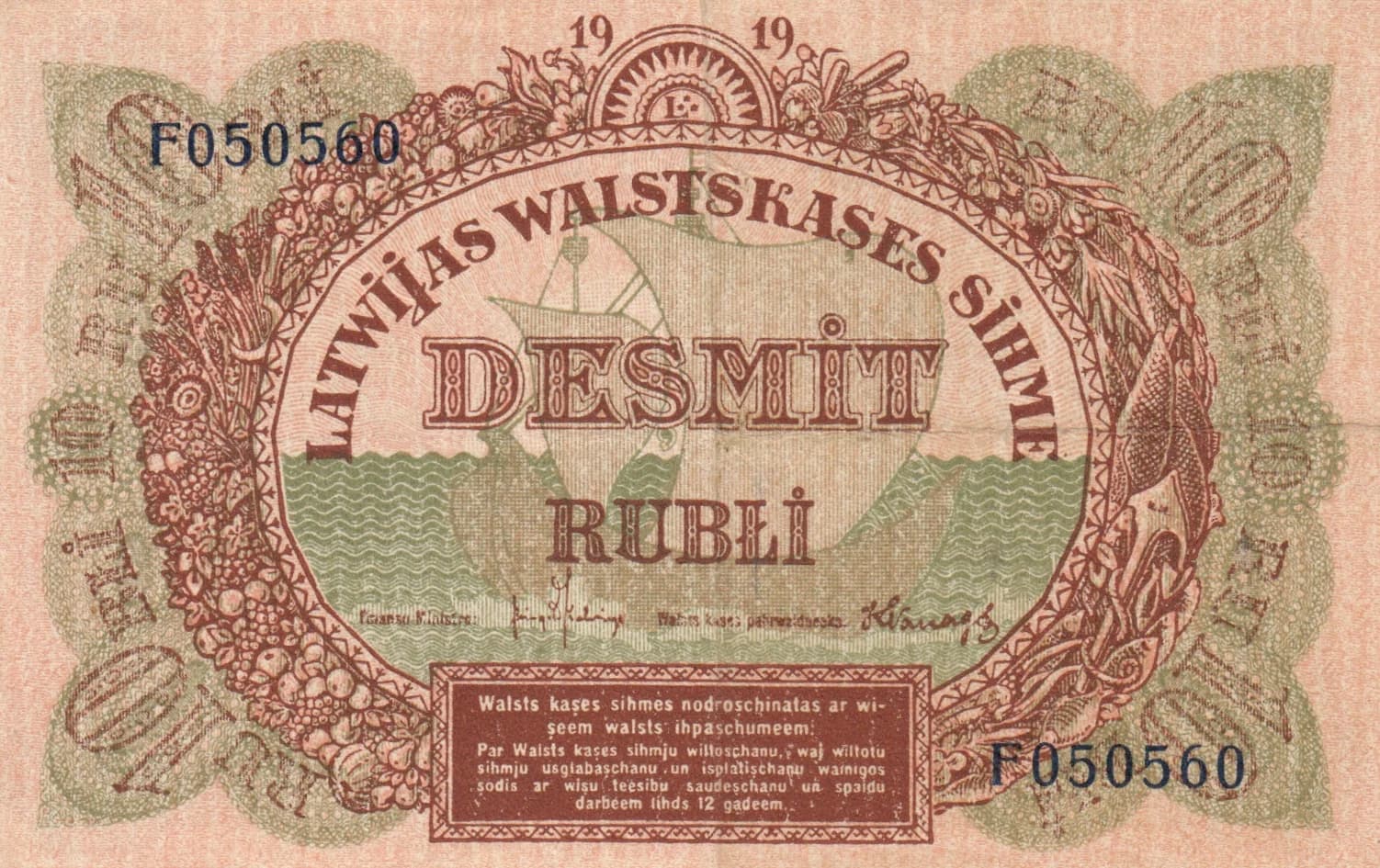
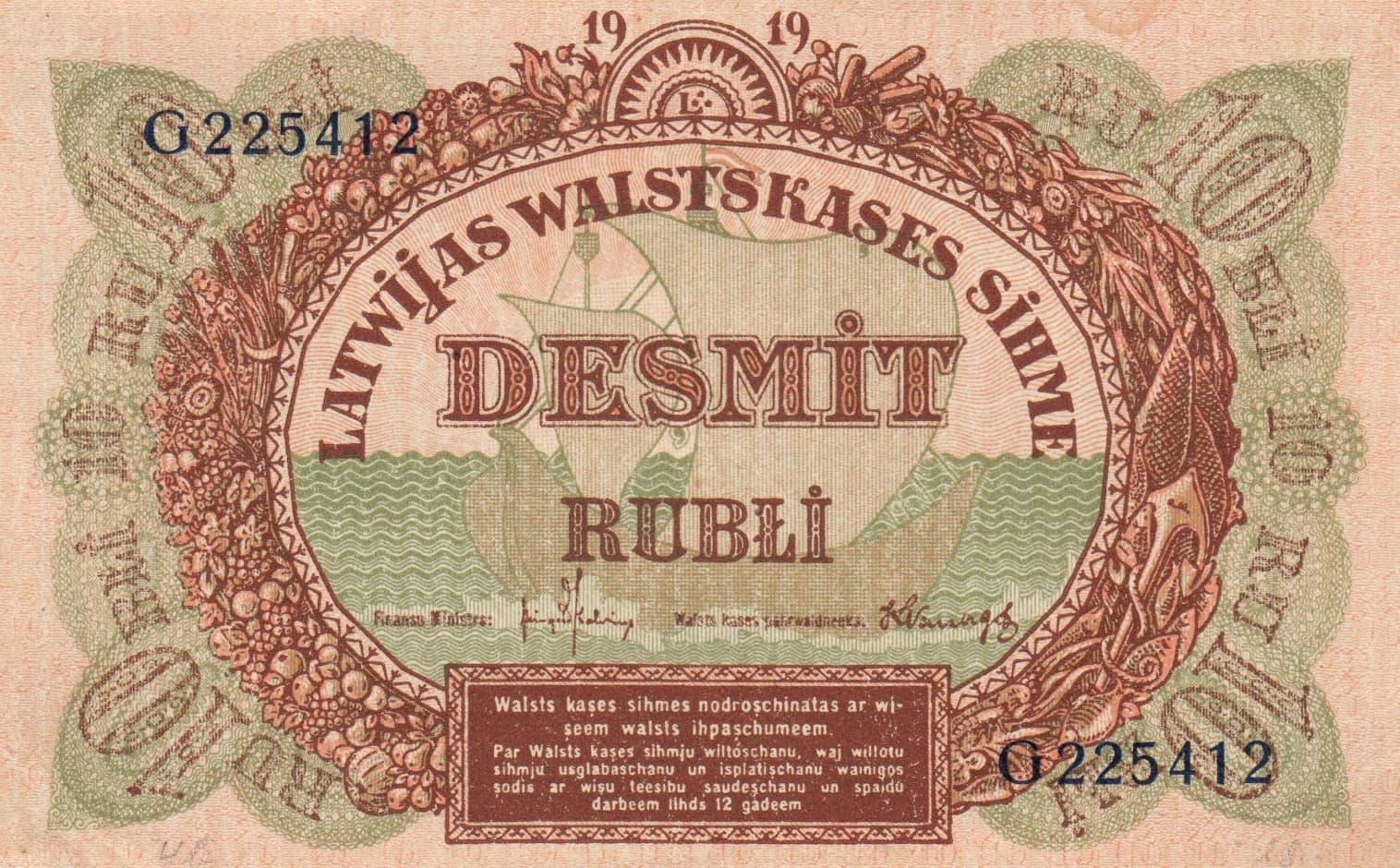
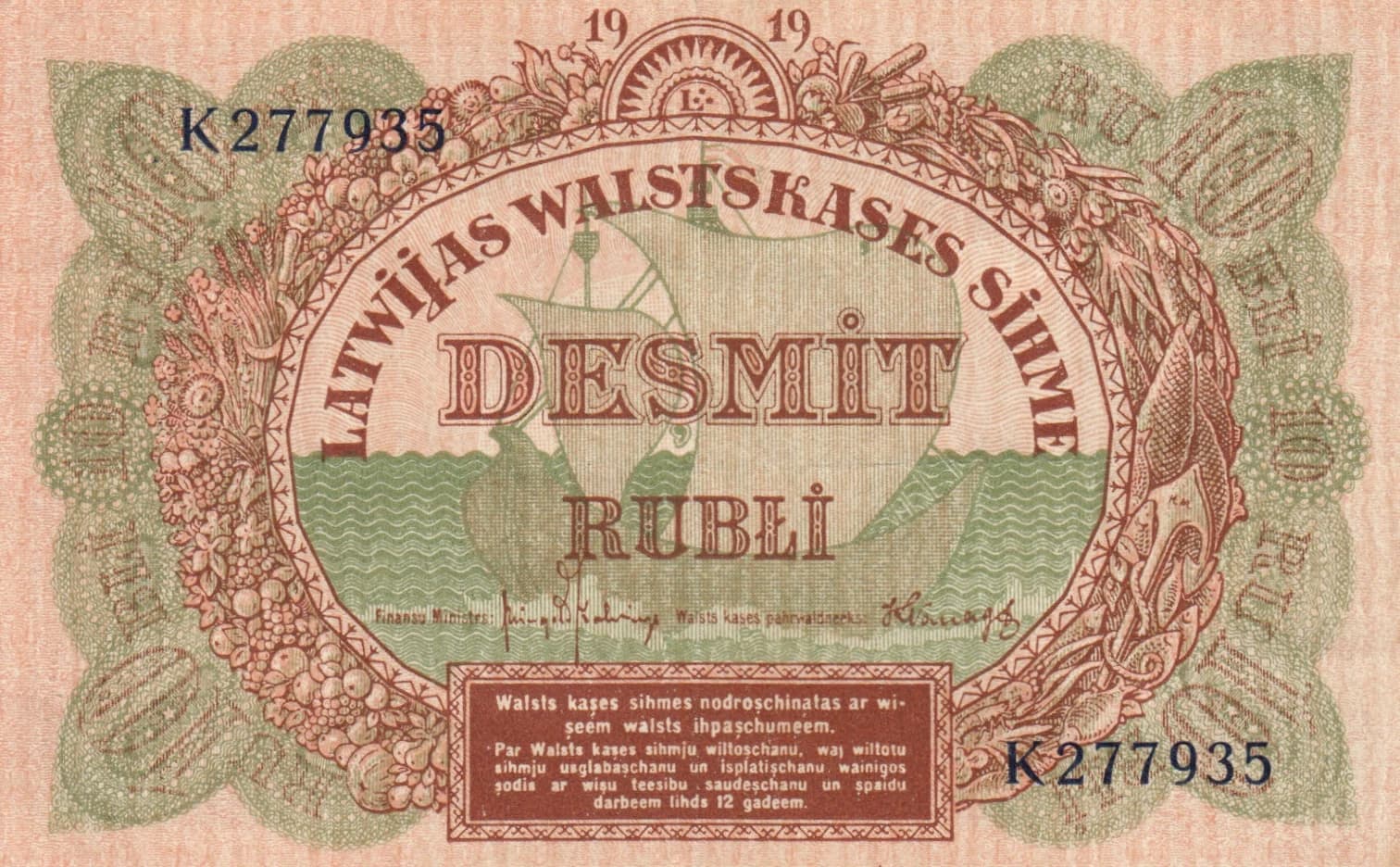
10 rubli 1919
“serie K”
Market Prices
9 salesAbout This Note
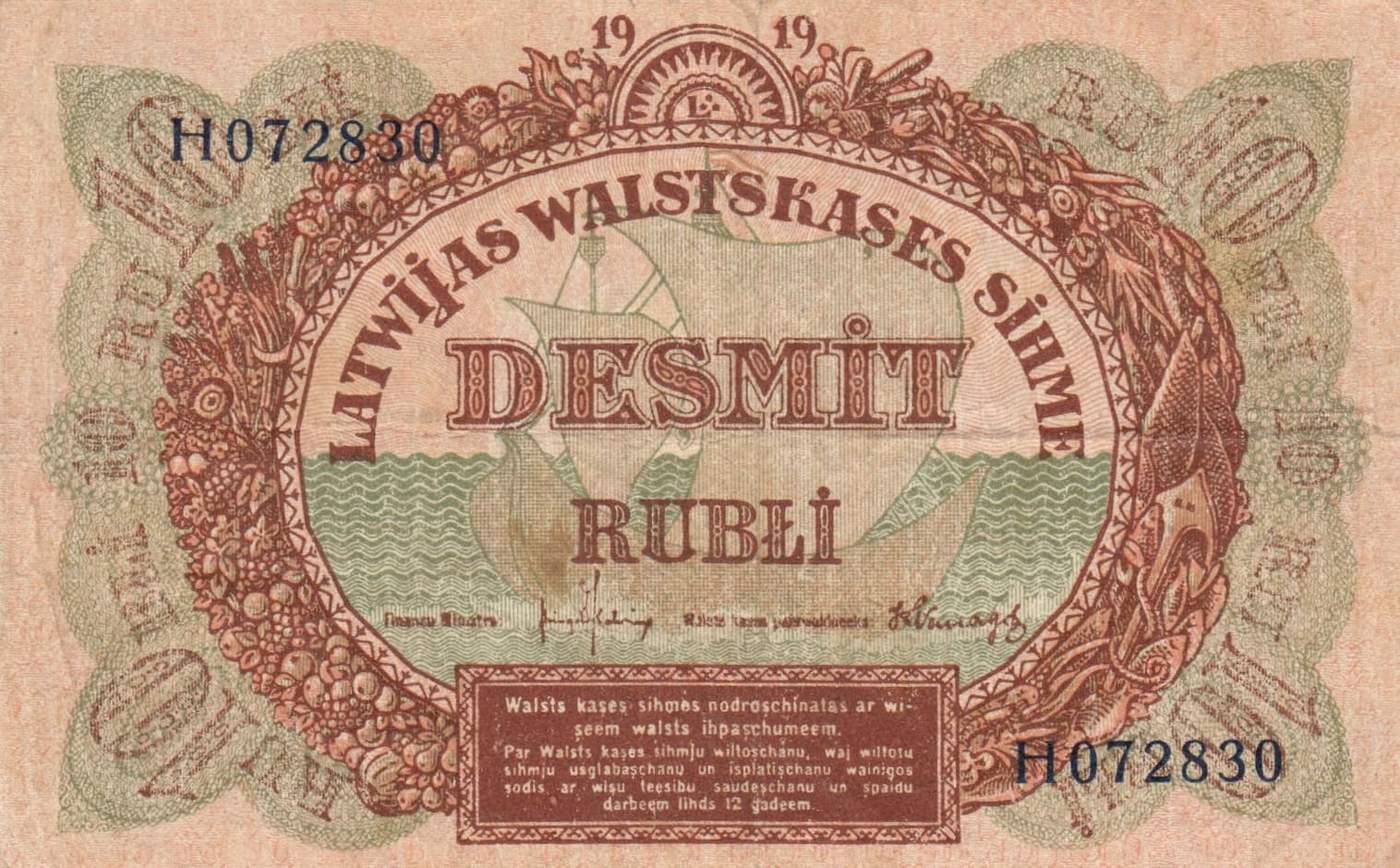
This VF-grade 10 Rubli note from 1919 represents an early emission of independent Latvia's first national currency, issued during the tumultuous period following the Russian Revolution and World War I. The note features a striking central vignette of a sailing ship symbolizing Latvia's maritime heritage, framed by burgundy ornamental borders with fine engraving work. The multilingual design (Latvian, German, and Russian) reflects the complex political and cultural landscape of the newly independent Baltic nation, making this a historically significant example of Latvia's transition to sovereignty.
Common. The 1919 10 Rubli note (Pick P-4f) was issued during the initial currency stabilization period of independent Latvia and represents a standard denomination from the early state treasury emission. While these notes are over 100 years old and no longer in circulation, they were produced in substantial quantities for everyday commerce. VF examples are readily available in the collector market at modest prices (typically $15-40 USD), indicating healthy supply. Notes from this series and denomination do not show evidence of being a short print run, a recalled issue, or exceptionally scarce in any particular variety.
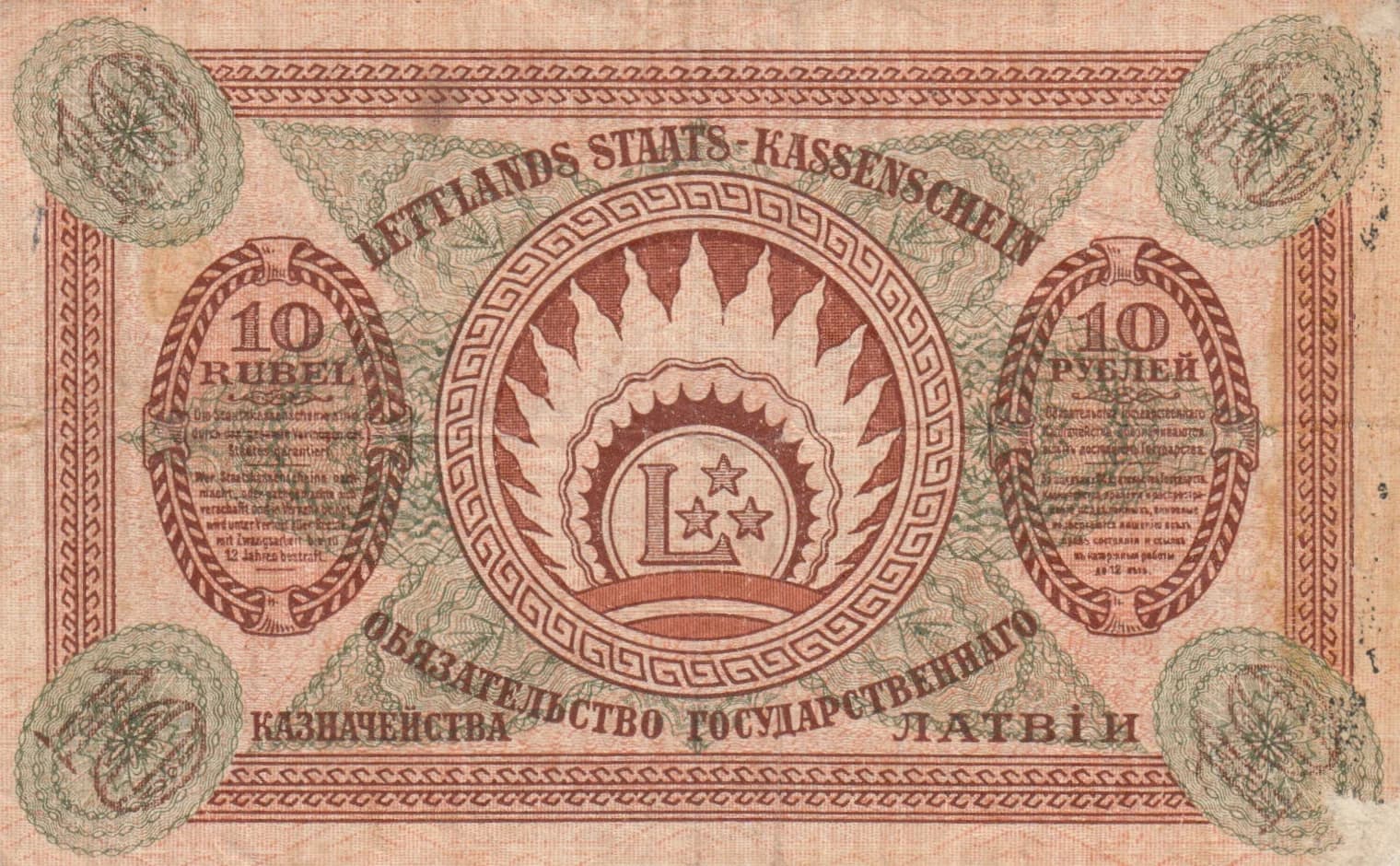
The 1919 10 Rubli note was issued by the newly established Latvian Government following independence from the Russian Empire in November 1918. The sailing ship vignette represents Latvia's strong seafaring and commercial traditions in the Baltic region, while the coat of arms on the reverse—featuring a rising sun and three stars—symbolizes national identity and hope for the young republic. The trilingual inscriptions (Latvian, German, and Russian) document the intersection of Baltic, Germanic, and Russian cultural and political influences during this transitional period in Eastern European history.
The obverse features a central oval medallion containing a detailed engraving of a full-rigged sailing ship on stylized wavy water, symbolizing Latvia's maritime commerce and Baltic heritage. This vignette is surrounded by an ornate circular sun or radiating design element at the top, with elaborate burgundy and tan floral scrollwork forming a rectangular border frame. The reverse displays Latvia's state coat of arms centered within a circular medallion with Greek key geometric patterning—the arms depicting a rising sun above a shield with three stars, representing sovereignty and national aspirations. Decorative corner medallions and wreaths flank the central heraldic design, with dual legal inscriptions in cartouches on either side. The overall composition reflects high-quality engraved security printing typical of early 20th-century European state currency.
FRONT SIDE: 'LATVIJAS WALSTISKAS SIHMEE' (Latvian State Treasury Note) | 'DESMIT RUBLI' (Ten Rubles) | Serial number: H0728830 | Date markers: 1919 | Legal warning: 'State treasury notes are secured by all state assets. Counterfeiting, forging, and distribution of false notes is punishable by law with all legal penalties and imprisonment until 12 years.' (Latvian) | BACK SIDE: 'LETTLANDS STAATS-KASSENSCHEIN' (Lettland State Treasury Note - German) | 'KAZNACHIECHSTVA GOSUDARSTVENNAGO LATVII' (State Treasury of Latvia - Russian) | '10 RUBEL' (German) | '10 РУБЛЕЙ' (10 Rubles - Russian) | Additional legal counterfeiting warnings in German and Russian in oval cartouches
Intaglio engraving (line engraving) on security paper, evidenced by the fine, detailed linework visible throughout both sides, particularly in the ornamental borders, the sailing ship vignette, and the coat of arms. The complex background patterns, multiple fine lines in the scrollwork, and the precision of the heraldic design are consistent with professional bank note engraving. Early Latvian notes of this period were typically produced by established European security printers; the quality and style suggest production by a Central or Western European security printing firm, though the specific printer for Pick 4f is not definitively identified in standard references without additional research.
Series K designation noted in catalog data. The serial number H0728830 indicates this specific note from the H series printing. Early Latvian 10 Rubli notes exist with variations in serial number prefixes and series letters; collector variants include different letter designations (A through K documented) across early 1919 emissions. The H and K series notes represent mid-range printings of this denomination. No major overprints, date variations, or signature varieties are evident on this Pick 4f issue—the design and inscription format appear consistent across known examples of the 1919 emission.