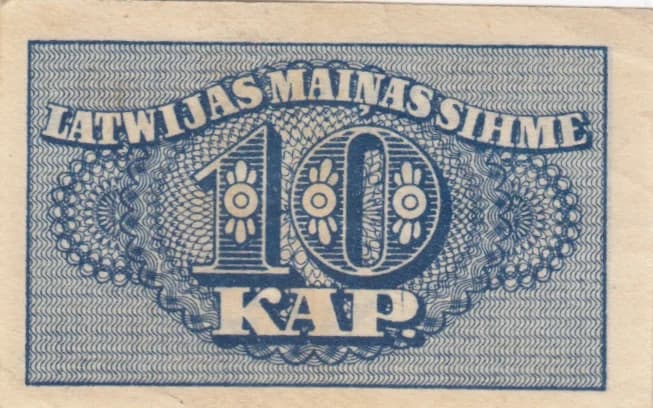
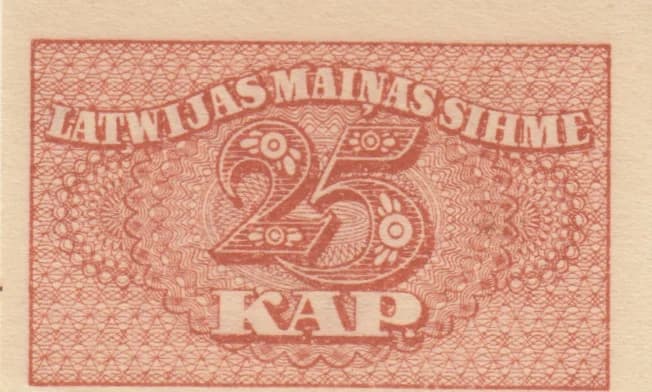
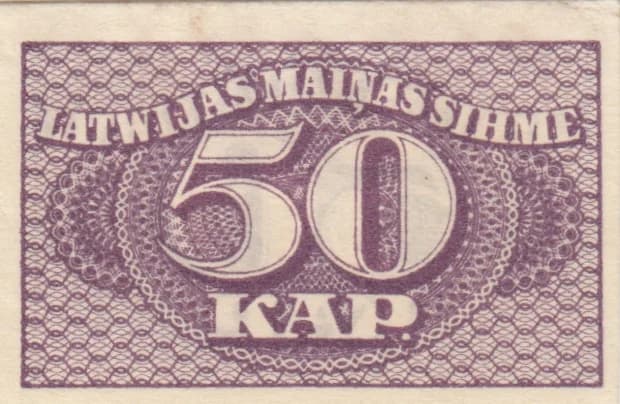
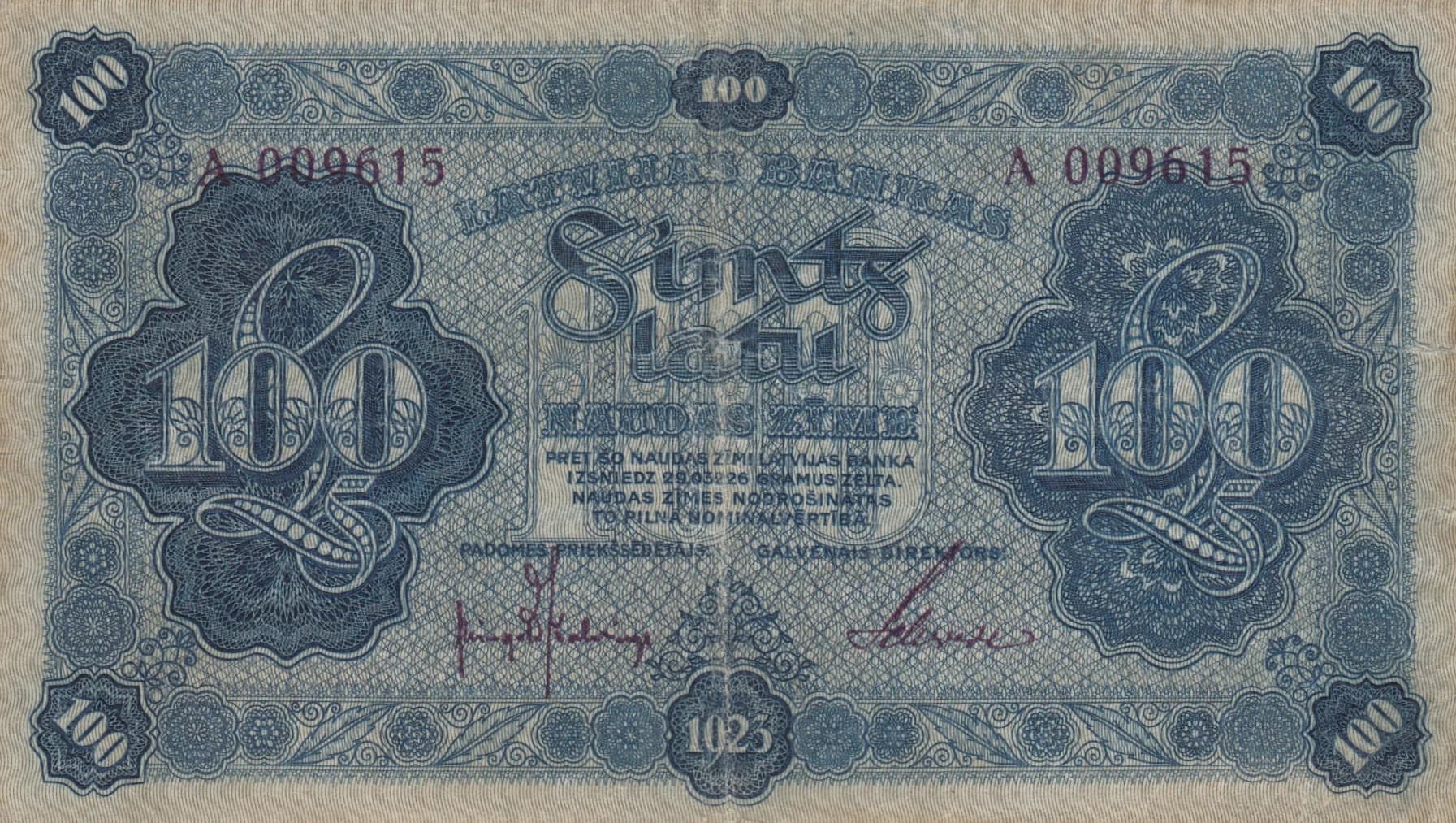
1 rubel 1919
Market Prices
6 salesAbout This Note
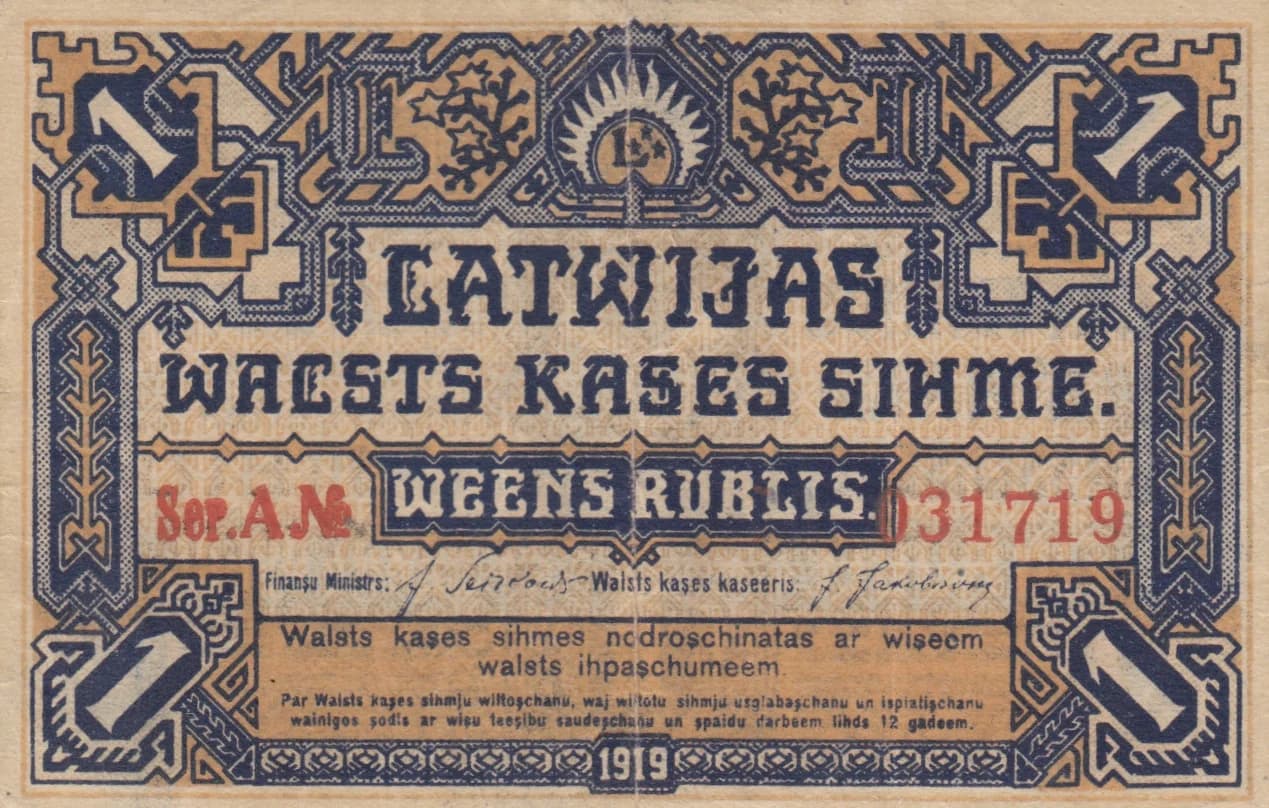
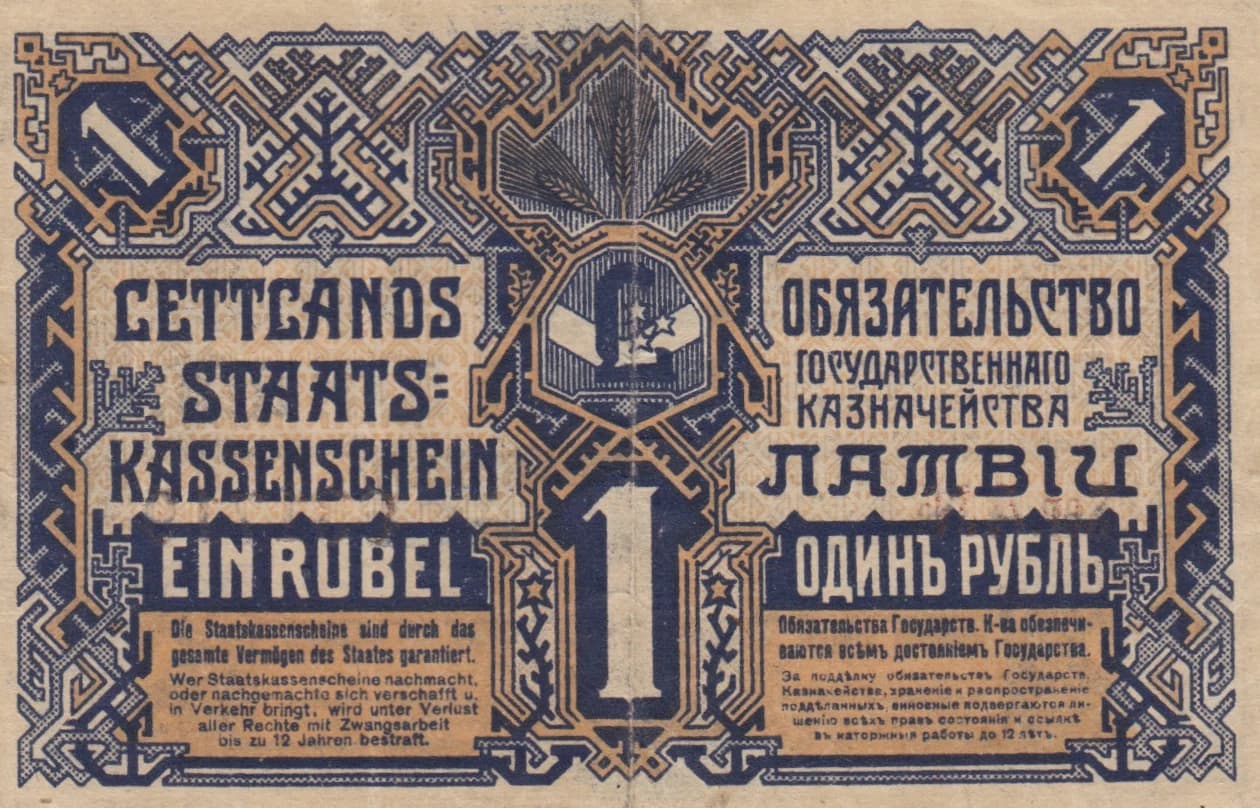
This is a VF-graded 1 Rubel note from Latvia's first independent currency issue in 1919, representing a pivotal moment in Baltic numismatic history. The note displays the characteristic Art Nouveau ornamental design with intricate blue and tan borders, a central heraldic emblem on the reverse, and multilingual inscriptions in Latvian, German, and Russian reflecting the region's complex political situation. Despite visible aging and foxing consistent with a century-old circulated note, the crisp detail in the engraved borders and clear legibility of all inscriptions make this an attractive example of early Latvian state currency.
Common. eBay market data shows consistent sales activity across multiple condition grades from 2015-2021, with VF examples selling for approximately $31, indicating strong collector interest but no scarcity premium. The catalog 2016 values ($50 for Good, $100 for Fine, $250 for EF) reflect a note that is widely available in collections. This was a regular issue from a legitimate government treasury rather than an emergency scrip or limited mintage, and examples survive in sufficient quantity to make them accessible to most collectors of Eastern European currency.
Issued by the newly independent Latvian state in 1919 following independence from the Russian Empire and German occupation, this note embodies the nation's assertion of sovereignty through its own currency. The trilingual text (Latvian, German, Russian) and the central heraldic coat of arms reflect Latvia's multicultural heritage and the transitional nature of the period. The note's design emphasizes state authority and legal guarantees backed by national assets, a common rhetorical device for newly established governments seeking to establish currency credibility during a period of geopolitical instability.
This note employs a symmetrical Art Nouveau aesthetic typical of early 20th-century European currency design. The obverse features ornate geometric and floral border patterns in dark blue with a tan/cream background, framing dense multilingual text arranged in formal registers. A circular seal or emblem appears at the top center with radiating lines and star motifs, including a crescent moon design within. The reverse maintains the matching decorative border scheme and centers on a larger heraldic emblem featuring what appears to be a lion or similar heraldic beast within a shield, surrounded by radiating lines suggesting national authority. The large numeral '1' is prominently displayed in the reverse center. Both sides emphasize security through complexity of design and multilingual legal warnings regarding counterfeiting penalties. No portraiture is employed; instead, the design relies entirely on abstract heraldic and geometric elements as the primary security feature, a common approach for transition-period emergency currency.
FRONT SIDE: 'Latviijas Walsts Kases Sihme' (Latvia State Treasury Note) / 'Weens Rublis' (One Ruble) / 'Finansu Ministrs' (Minister of Finance) / 'Walsts kases kaseeris' (State Treasury Cashier) / 'Walsts kases sihmes nedroschinatas ar wiseem walsts ihpaschumeem' (State treasury notes are guaranteed by all state resources) / 'Pār Walsts kages sihmu wiloschaķu, waj wilotu sihmu utglabaschanu un ispatigsanu wainigos sodi ir wigi tezdib. sauderscanu un spaidu darbiem likta li 12 gadiem' (For counterfeiting, circulation, preservation and illegal distribution of state notes, penalties are provided up to 12 years of hard labor). BACK SIDE: 'Staats-Kassenschein / Ein Rubel' (German: State Treasury Note / One Ruble) / 'Обязательство Государственного Казначейства Латвии / Один Рубль' (Russian: Obligation of the State Treasury of Latvia / One Ruble) / 'Die Staatskassenscheine sind durch das gesamte Vermögen des Staates garantiert' (German: The state treasury notes are guaranteed by the entire assets of the state) / 'Wer Staatskassenscheine nachmacht, oder nachgemacht sich verschafft oder in Verkehr bringt, wird unter Verlust aller Rechte mit Zwangsarbeit bis zu 12 Jahren bestraft' (German: Anyone who counterfeits state treasury notes, or obtains counterfeit ones, or puts them into circulation, will be punished with loss of all rights and forced labor up to 12 years) / Russian equivalents of counterfeiting penalties and state guarantees.
The note demonstrates finely detailed engraved intaglio printing characteristic of security printing of the era. The intricate border patterns, sharp line work in the geometric designs, and crisp legibility of the small-print legal text indicate professional banknote-quality engraving. The multilayered text and complex decorative elements throughout serve as anti-counterfeiting measures. Based on the Pick catalog designation and historical records, this note was likely produced by a European security printer, though the specific printer is not definitively identified in the available catalog data; however, given Latvia's geographic position and the high quality of execution, involvement of a German or Scandinavian printer is probable.
This specimen represents Pick P-1, the base variety for the 1 Rubel denomination. The visual analysis indicates 'Series A' designation and serial number 131719. The note displays the standard design without overprints or significant variants. The PMG population report indicates P-1 is the primary listing for this denomination, with multiple higher denomination variants (P-10a through P-19a) issued in the same series, suggesting this is the foundational denomination of the 1919 Latvian issue. No signature varieties or date variants are apparent from the provided visual analysis, though the formal signature lines for 'Finansu Ministrs' and 'Walsts kases kaseeris' would be consistent with authorized official variants if multiple signatories were employed across the series.