50 kip 1979
Market Prices
6 salesAbout This Note
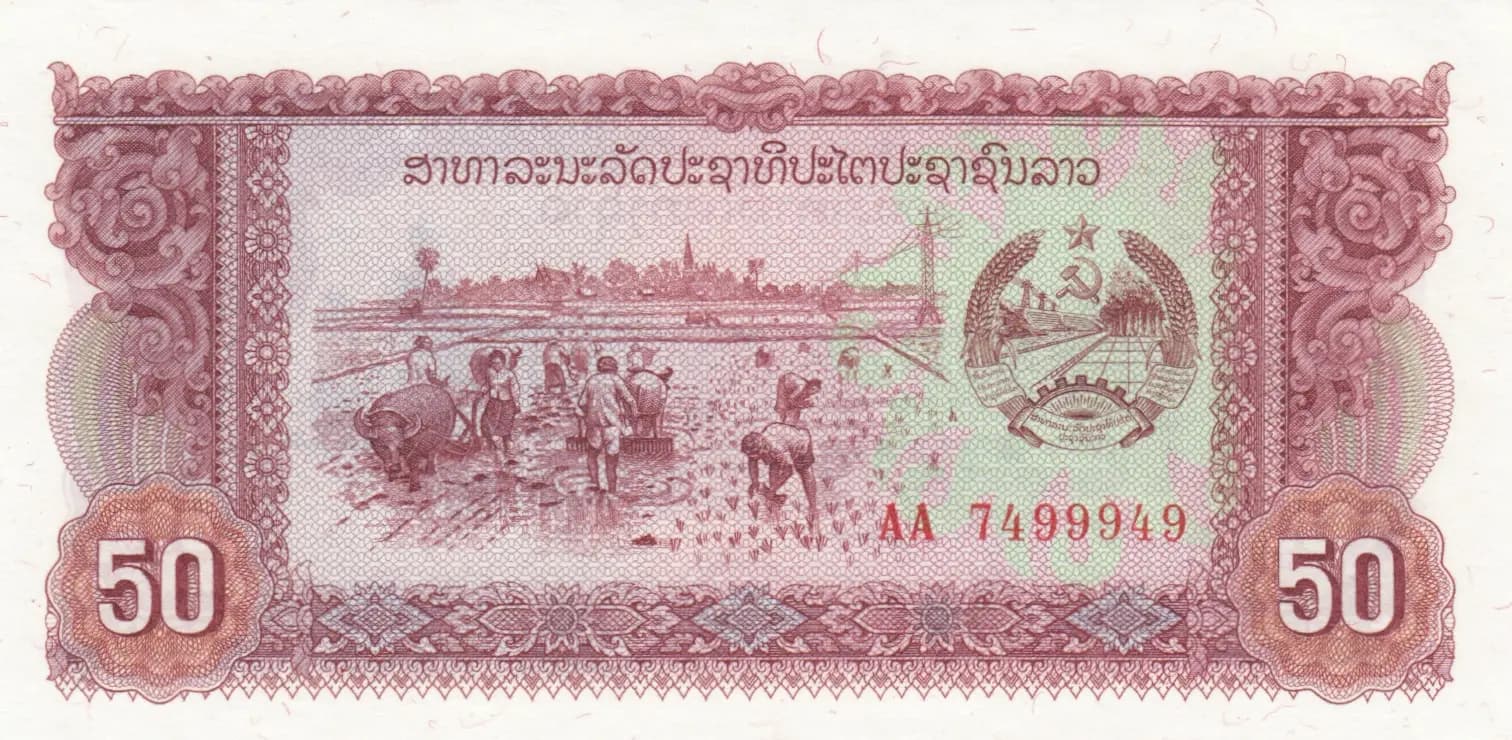
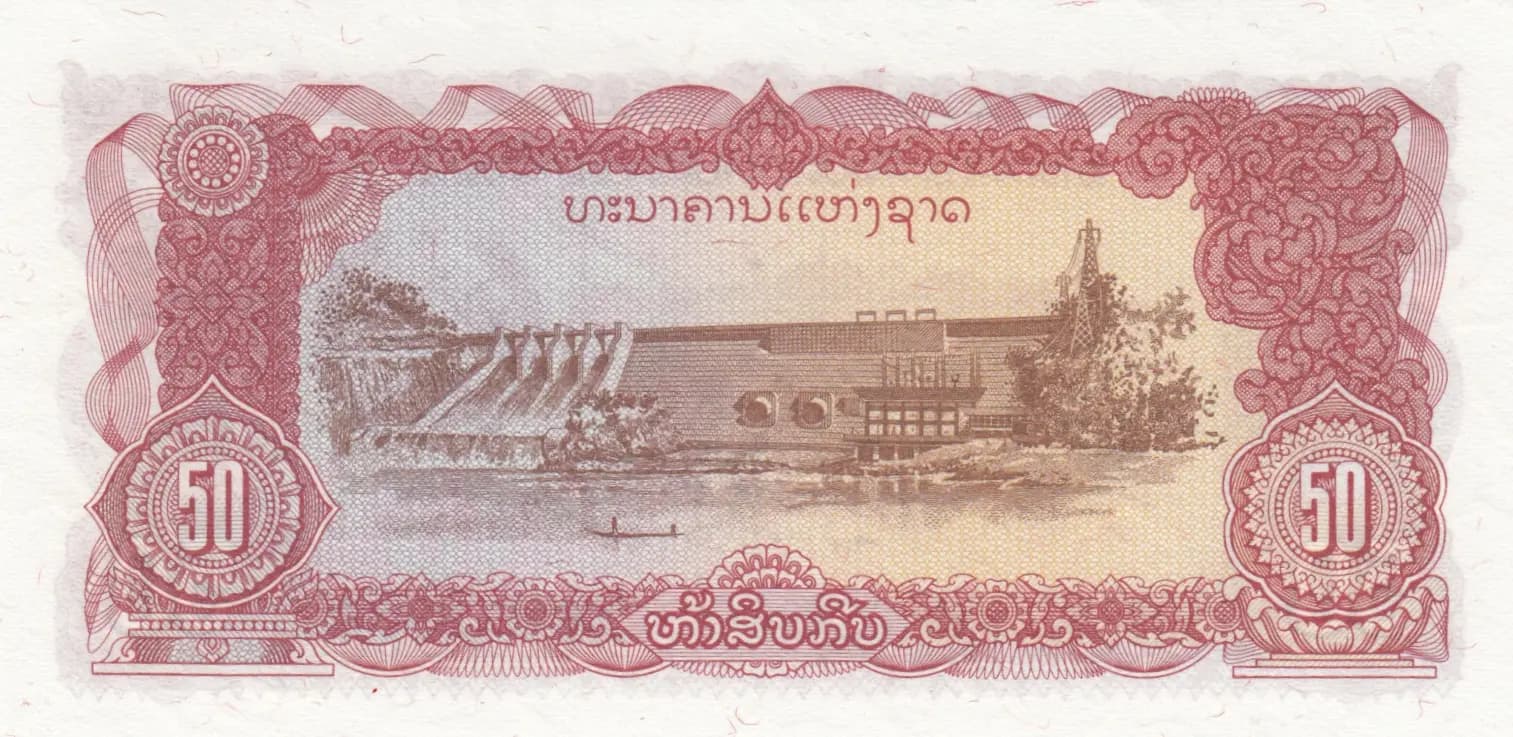
This is a 1979 Laotian 50 kip note in UNC condition, featuring striking socialist-era iconography with a prominent hammer and sickle emblem on the obverse. The note displays vibrant mauve and burgundy ornamental borders framing scenes of agricultural labor and the Nam-Ngum hydroelectric dam on the reverse—reflecting the newly communist state's focus on industrial and agricultural development. The bright colors, detailed engraving, and minimal wear are characteristic of uncirculated examples of this early post-revolutionary issue.
Common. This denomination and year represent a regular issue with substantial print runs. eBay market data confirms common status: recent comparable sales in 2009–2021 range from $0.44 to $28 USD, with most UNC examples selling under $5, and even PMG-graded specimens (67–68) averaging $16–$19. The 2019 catalog value of $1 for UNC examples further supports common classification. No evidence of rarity from PMG population data or market behavior.
Issued in 1979 by the Bank of the Lao People's Democratic Republic, this note reflects Laos's transition following the communist Pathet Lao victory in 1975. The imagery—workers engaged in agricultural labor, an industrial cityscape with shipping infrastructure, and the prominently featured Nam-Ngum dam—symbolizes the regime's emphasis on collective labor, modernization, and hydroelectric power development. The hammer and sickle emblem, rendered as a five-pointed star within a circular wreath, underscores the nation's alignment with Soviet-style socialism during the early years of the Lao PDR.
The obverse features a horizontally-oriented composition with deep mauve and burgundy ornamental scrollwork borders flanking the central imagery. At left-center is a detailed scene depicting multiple workers engaged in rice planting or general agricultural labor—a deliberate socialist realist motif emphasizing collective toil. Above this is a cityscape with industrial elements including ship silhouettes and smoke stacks, representing modernization and maritime commerce. The right side displays the state emblem: a hammer and sickle intersecting within a five-pointed star, surrounded by a decorative circular wreath—the official coat of arms of the Lao PDR. The denomination '50' appears in ornate circular frames in both bottom corners. The reverse depicts the Nam-Ngum hydroelectric dam as the central focal point, a significant infrastructure achievement of the early PDR regime, rendered in a landscape format with water, vegetation, and dam infrastructure (spillways) visible. The same ornamental mauve and burgundy borders frame this image, with denomination medallions repeated in the bottom corners. The note's color palette—cream background with rose, green, and brown tinting—is consistent with security printing practices of the period.
Front: 'ວາງກາລະມະບລດປະຊາທິປະໄຕປະຊາຊົນລາວ' (Democratic People's Republic of Laos); Serial number 'AA 7499949'. Back: 'ປະເມືອງແບ່งອາວ' (Nam-Ngum, the location of the depicted hydroelectric facility); Denomination '50' (in both corners).
This note was produced using intaglio (engraved line) printing, evidenced by the fine detail visible in the ornamental borders, scrollwork patterns, geometric designs, and the intricate rendering of the workers, cityscape, and dam infrastructure. The multi-color printing (mauve, burgundy, rose, green, cream, brown, and tan) suggests a multi-pass intaglio process with careful registration. The note was likely printed by a Soviet or Eastern Bloc security printer, consistent with Lao PDR's alignment and the technical quality typical of PDR-era currency. Security features are minimal by modern standards, relying primarily on engraving complexity and the watermark (stars, hammer, and sickles).
This note is cataloged as Pick P-29a, the standard regular-issue variety of the 1979 50 kip denomination. The PMG population report indicates three cataloged variants exist for this base Pick number: P-29a (regular), P-29a* (replacement notes, indicated by asterisk suffix), and P-29s (specimen notes, indicated by 's' suffix). The observed serial number prefix 'AA' and alphanumeric format are consistent with regular-issue production. The visual analysis does not reveal any distinguishing characteristics—such as overprints, signature variations, or date variations—that would indicate a scarcer variety within the P-29a classification. This appears to be a standard issue example.