100 kip 1957
Market Prices
100 salesAbout This Note
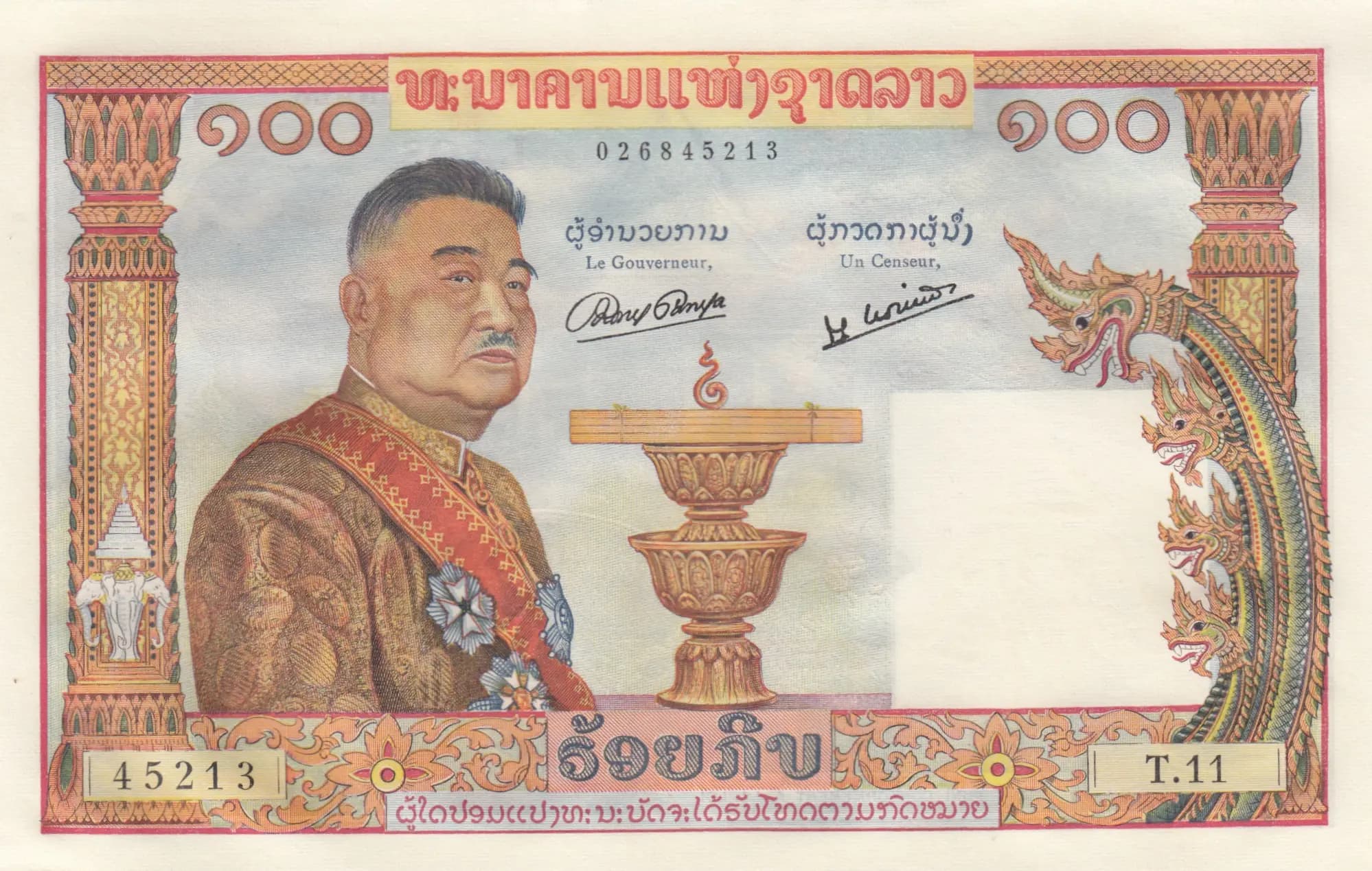
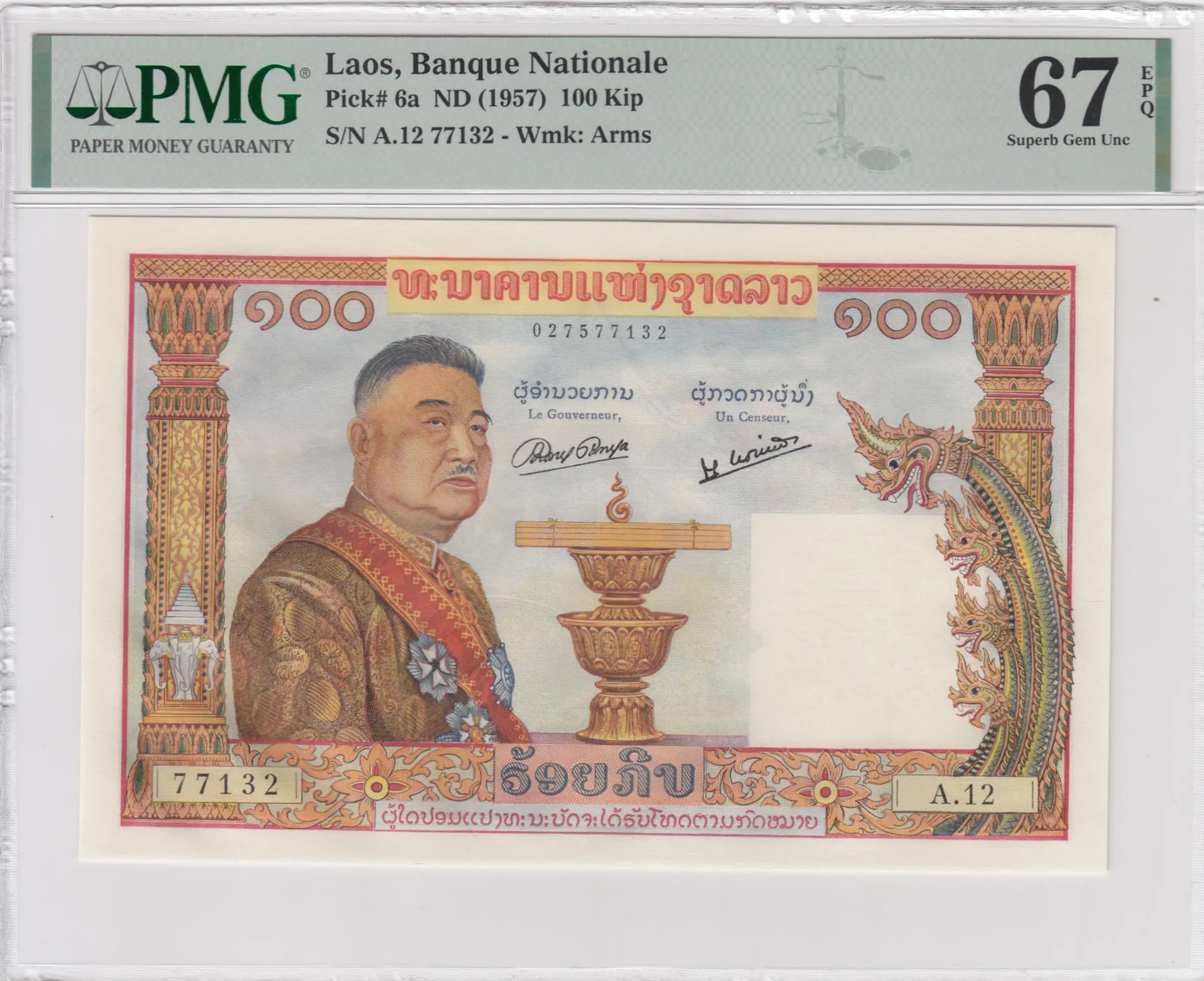
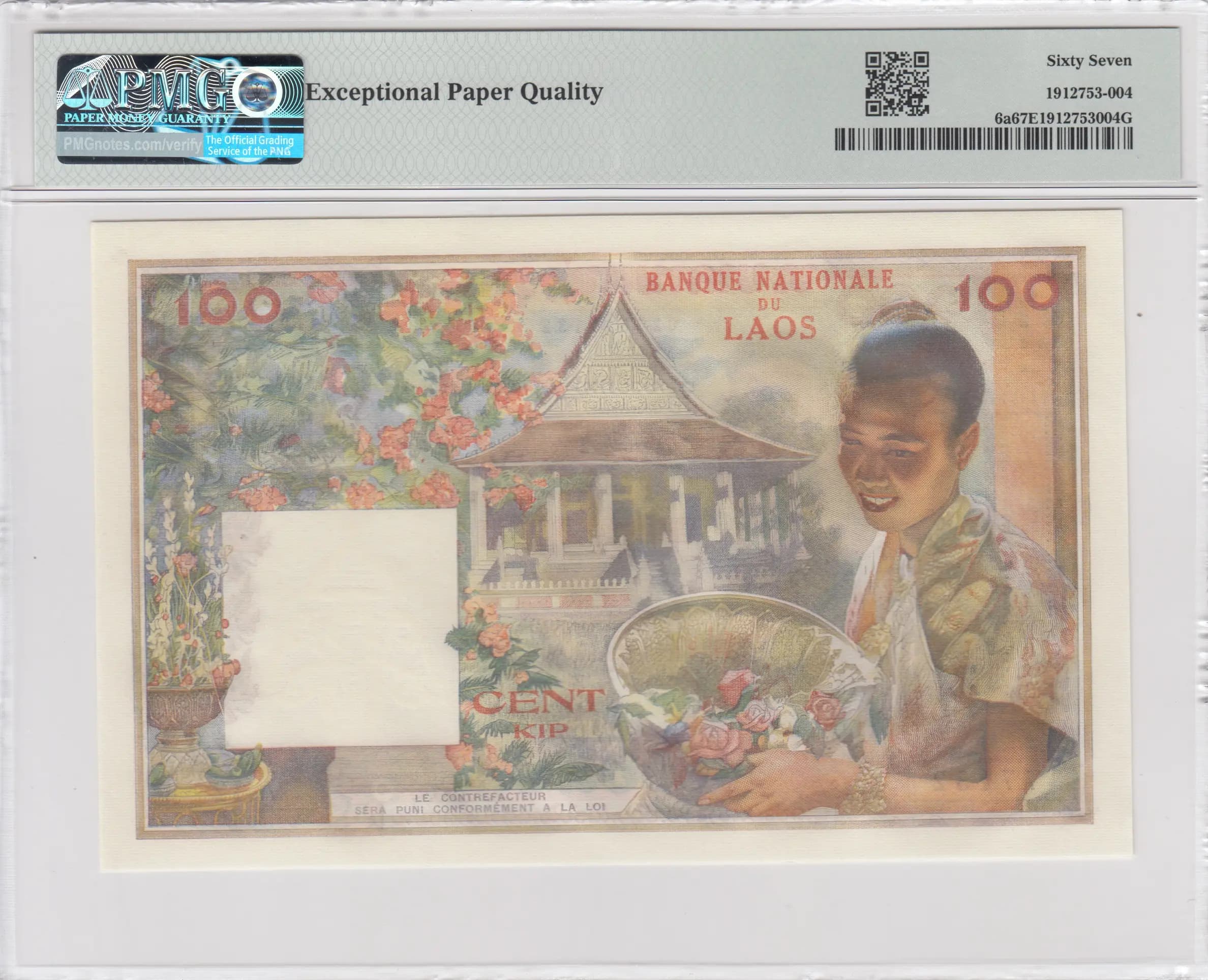
This is a PMG 67 EPQ example of the 1957 Laos 100 Kip (Pick P-6), representing one of the earliest banknotes issued by the newly independent Banque Nationale du Laos. The note exhibits exceptional preservation with vibrant color saturation across the red, gold, and tan palette, sharp printing details, and no visible circulation wear—befitting its near-gem grade. The obverse features King Sisavang Vong in formal regalia alongside ornate ceremonial vessels and a stylized dragon motif, while the reverse depicts a woman in traditional dress with floral arrangements and the Ho Phra Keo temple in Vientiane, making this a culturally significant representation of early Laotian sovereignty.
Common. While this is an early and historically significant note from independent Laos's first years, market data strongly indicates high availability in all grades. eBay transaction history spanning 2011–2026 shows consistent trading volume with specimens regularly appearing in grades PMG 64–67, with even higher-graded examples (PMG 68) selling for $167.52. Price progression shows typical market behavior for common notes: PMG 67 examples have ranged from $66–$111 in recent years, reflecting collector demand but abundant supply. The 2016 catalog valuation of $25 for UNC indicates this as a standard, readily-obtainable note rather than a scarce variety. Print runs during the early years of the Banque Nationale du Laos were substantial, and no evidence of recalls or extraordinary scarcity exists for Pick P-6.
The 1957 100 Kip notes were issued during Laos's early years as an independent nation following the French Indochina War, reflecting the establishment of the Banque Nationale du Laos. King Sisavang Vong, featured prominently on the obverse, served as the reigning monarch and symbol of national continuity during this transitional period. The reverse's inclusion of Ho Phra Keo temple—one of Vientiane's most sacred Buddhist landmarks—underscores the importance of religious and cultural identity in the newly formed nation's monetary symbolism.
The obverse centers on a formal three-quarter profile portrait of King Sisavang Vong positioned at left, depicted as an older Asian man wearing formal state regalia with medals and decorations across his chest and a red sash indicating royal rank. To the right of the royal portrait stands an ornate golden ceremonial vessel (likely a traditional Laotian ritual or royal object) rendered with intricate decorative patterning. The upper right corner features a stylized red and gold dragon or mythical creature—a motif referencing Southeast Asian heraldic traditions. The design is framed by elaborate golden ornamental borders and vertical pillar designs on both margins, executed in traditional Laotian architectural style. The reverse depicts a young woman in traditional Laotian dress positioned at right, smiling and holding a decorative basket filled with flowers. To her left stands a flowering plant arrangement in an ornate vase with red and pink blossoms. The background features the distinctive peaked-roof architecture of Ho Phra Keo temple in Vientiane, recognizable by its characteristic Buddhist temple design. The overall composition employs warm earth tones—reds, golds, tans, and cream—with green foliage accents, creating a visually balanced representation of Laotian cultural and religious heritage.
FRONT SIDE: Arabic numerals '100' appear at both upper left and lower right corners. The Lao text 'ແບ່ງຄວາມແຫ່ວວາດຕຸລາວ' translates to 'Banque Nationale du Laos' (National Bank of Laos). Official titles appear in Lao: 'ຜູ້ລັບວົງກາງ' (The Governor) and 'ຜູ້ວອດຸຖະຢັງ' (A Censor). Serial number A.12 0275771132 is printed. Currency designation 'ຣໍຍັກ' (Kip) appears. Fine print text 'ສືສົ້ມັະປະຕະນະບົວໄຕຣືັກຕະວາງວົາຍາວ' contains institutional/legal text. BACK SIDE: '100' appears at upper left and lower right. French text reads 'BANQUE NATIONALE DE LAOS' (National Bank of Laos), with denomination stated as '100 CENT KIP' (100 Kip). Anti-counterfeiting warning in French: 'LE CONTREFACTEUR SERA PUNI CONFORMEMENT A LA LOI' (The counterfeiter will be punished in accordance with the law).
This note was printed by the Bank of France (Banque de France), as documented in the catalog record. The printing exhibits characteristics consistent with mid-20th century intaglio (engraved) processes: fine line work in the decorative borders and architectural elements, precise color registration across multiple printing runs (evident in the layered reds, golds, and greens), and sharp, crisp inscription detail. The watermark featuring the tricephalic (three-headed) elephant arms—the heraldic symbol of Laos—was incorporated during the paper manufacturing process, a standard security feature for central bank notes of this era. The vibrant, well-preserved color saturation in this PMG 67 example suggests excellent ink formulation and careful production standards typical of Bank of France work.
The PMG Population Report identifies one cataloged variant for Pick P-6: the P-6a designation. The serial number on this example (A.12 0275771132) reflects standard series issuing practices. No overprints, date variations, or notable signature variants are evident on this specimen. The note aligns with the regular issue type designation noted in the market data, issued in 1957 with no recorded design modifications or emergency printings that would create distinct varieties for collectors to differentiate.