100 kip 1968
Market Prices
53 salesAbout This Note
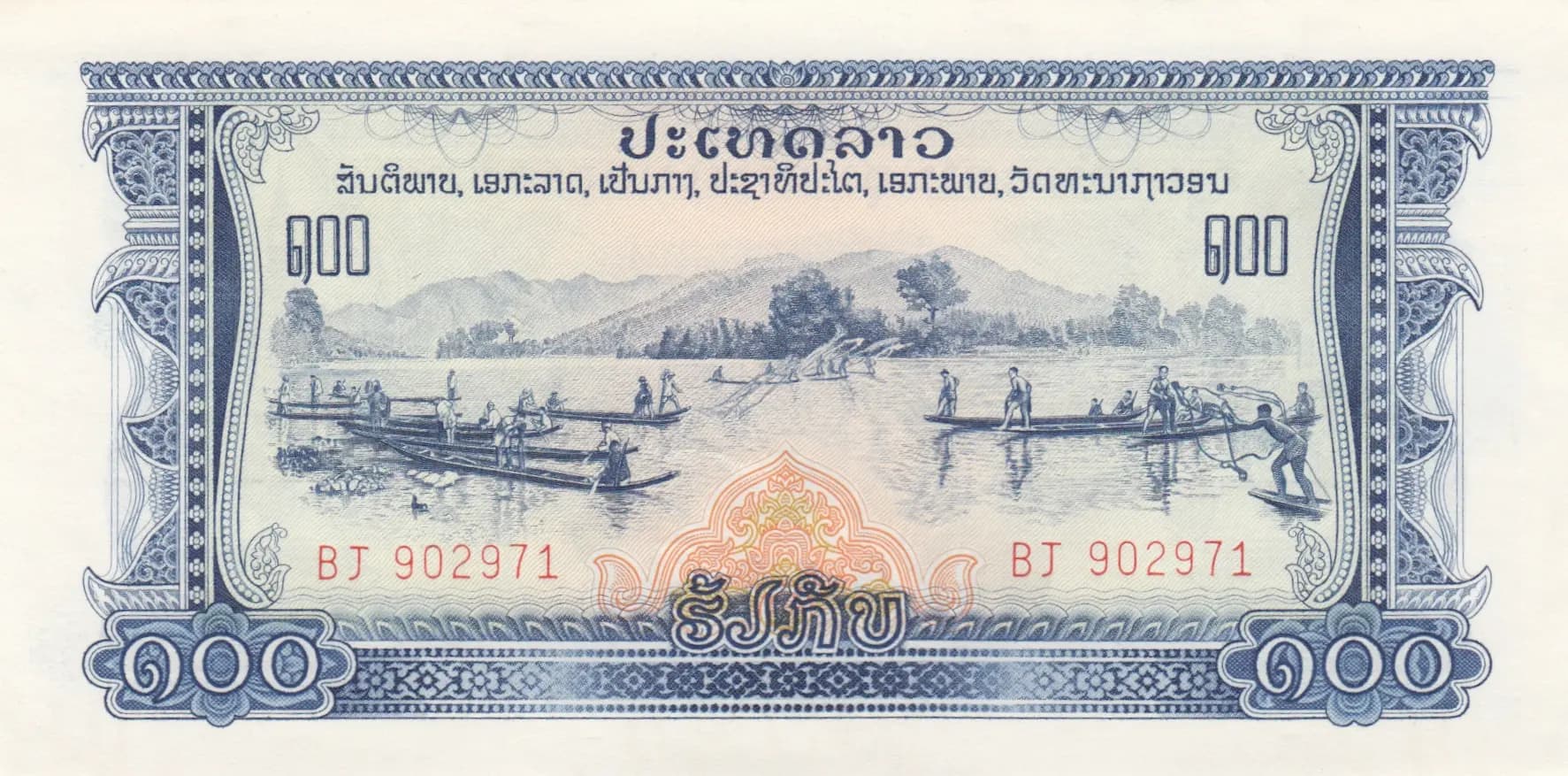
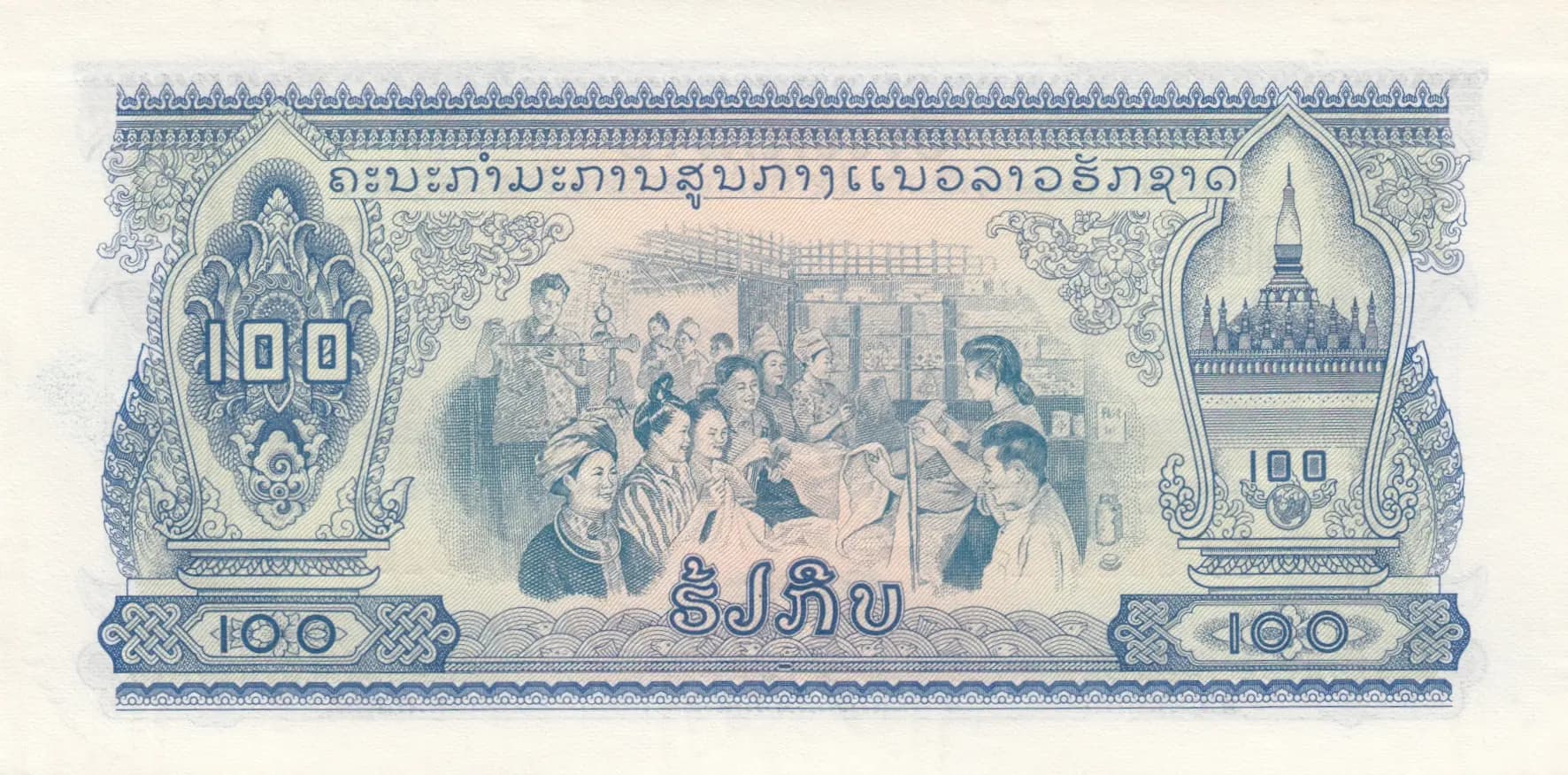
This is a 1968 Laotian 100 Kip note issued by the Lao Central National Committee, graded AU (About Uncirculated), displaying exceptional condition with crisp surfaces and sharp printing. The obverse features an engaging scene of traditional Lao fishing activities with multiple figures in boats along a river, framed by ornate decorative borders in blue and cream tones. The reverse depicts a cultural or commercial scene with figures in traditional dress alongside a detailed illustration of Pha That Luang, the iconic Buddhist stupa of Vientiane, making this a historically significant piece of Pathet Lao currency that became legal tender nationwide after the 1975 communist victory.
Common. Despite its historical significance as Pathet Lao revolutionary currency, eBay market data shows consistent sales volume with most graded examples (PMG 65-68) selling in the $12-$45 range, with occasional outlier sales reaching $80-$120. Ungraded examples routinely sell for under $5-$15. The relatively modest price levels across all condition grades and the consistent transaction history indicate this note was produced in sufficient quantities to remain available on the collector market. While historically interesting, it is not scarce.
Issued during the escalating Lao Civil War, this note was printed in the People's Republic of China and circulated exclusively in Pathet Lao-controlled areas, representing the communist faction's parallel economic authority. The imagery—traditional fishing scenes and the prominent depiction of Pha That Luang—reflects both the agrarian economy and Buddhist cultural heritage that the Pathet Lao sought to preserve within their revolutionary framework. When the Pathet Lao achieved national victory in 1975, these notes transitioned from regional propaganda currency to accepted legal tender throughout all of Laos.
The obverse depicts a picturesque scene of traditional Lao river life during the fishing season, with multiple human figures engaged in water-based activities from boats and shoreline positions, set against a backdrop of mountains and vegetation. The composition emphasizes the agrarian and waterborne culture central to Lao identity. The reverse presents a dual-element design: a commercial or cultural interior scene with figures in traditional dress (possibly representing a textile store or market as referenced in catalog sources), balanced by an architectural monument featuring Pha That Luang, Vientiane's most sacred Buddhist stupa, with its characteristic tall golden spire. Ornamental corner designs employing floral and geometric patterns in the traditional Lao aesthetic frame both sides. Decorative shields or emblems with religious symbolism appear on the reverse.
FRONT: The primary inscription reads 'ประเทศลาว' (Laos/Country of Laos), with additional text in Lao script identifying regional administrative divisions. Denomination marked as '100' (Arabic numerals) and 'ສີບ' (Lao for one hundred). Serial number 'BJ 902971' appears in two locations. BACK: Administrative or official designation text in Lao script. Denomination consistently marked as '100' (Arabic numerals) in all four corners and center, with 'ສີບ' (one hundred in Lao) also repeated.
Multi-color intaglio engraving with fine line work characteristic of currency production. The note exhibits multiple color printing layers (blue, cream, white, and light gray) applied to create depth and security. The intricate border patterns, detailed figure work, and fine-line security elements indicate professional currency-grade engraving. Printed in the People's Republic of China by a Chinese security printer, as noted in historical records for Pathet Lao currency production during this period.
This note is cataloged as Pick 23a (100 Kip variant). The PMG Population Report indicates Pick 23 exists in multiple denominations (23Aa, 23As, 23Ax for 200 Kip, and 23a for 100 Kip), suggesting signature or design variants within the series. The observed serial number 'BJ 902971' appears to be from a standard production run. The specific variety is 100 Kip with the depicted fishing and Pha That Luang design; no overprints or special markings are evident in the AU-condition example examined.