10 shillings 1967
Market Prices
4 salesAbout This Note
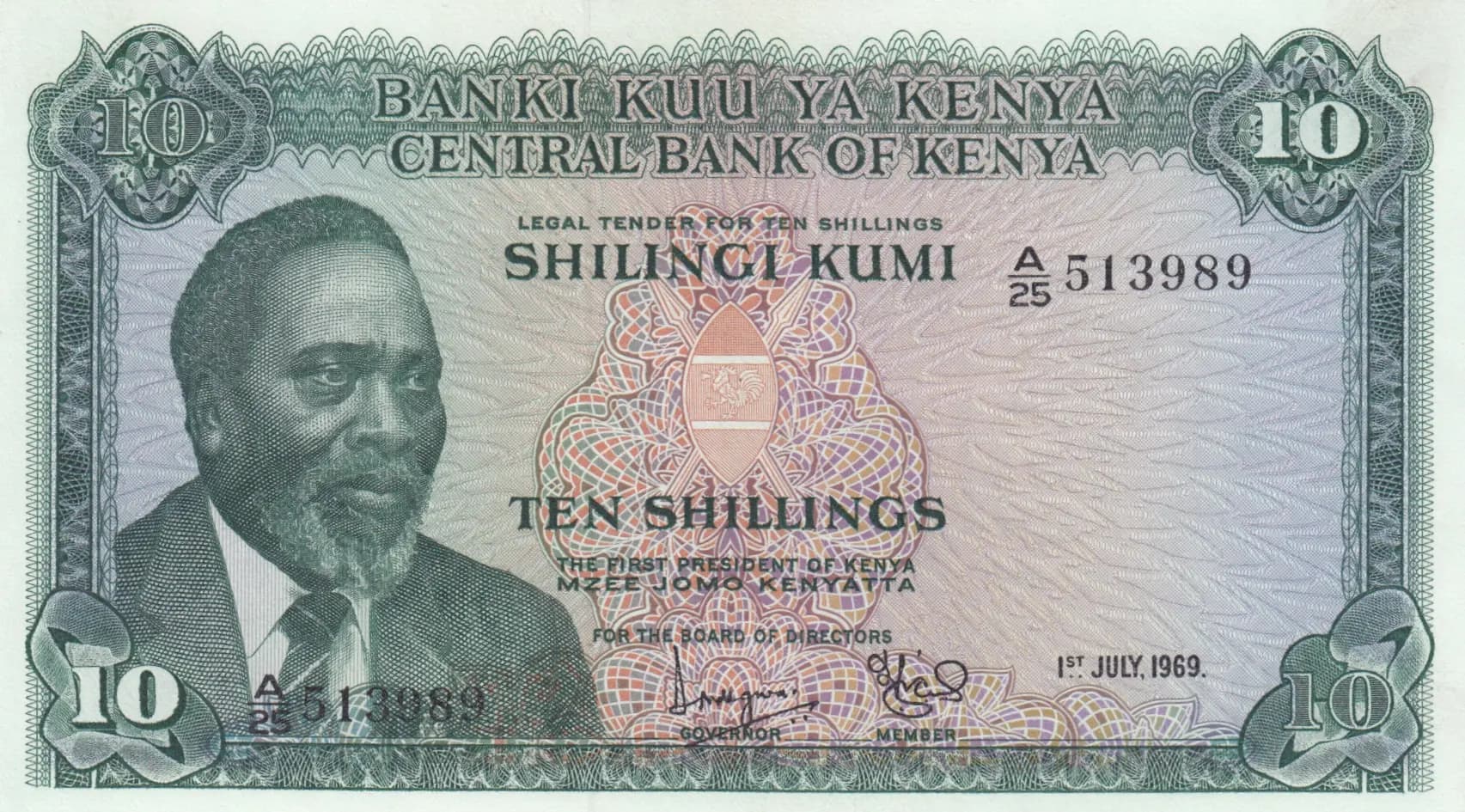
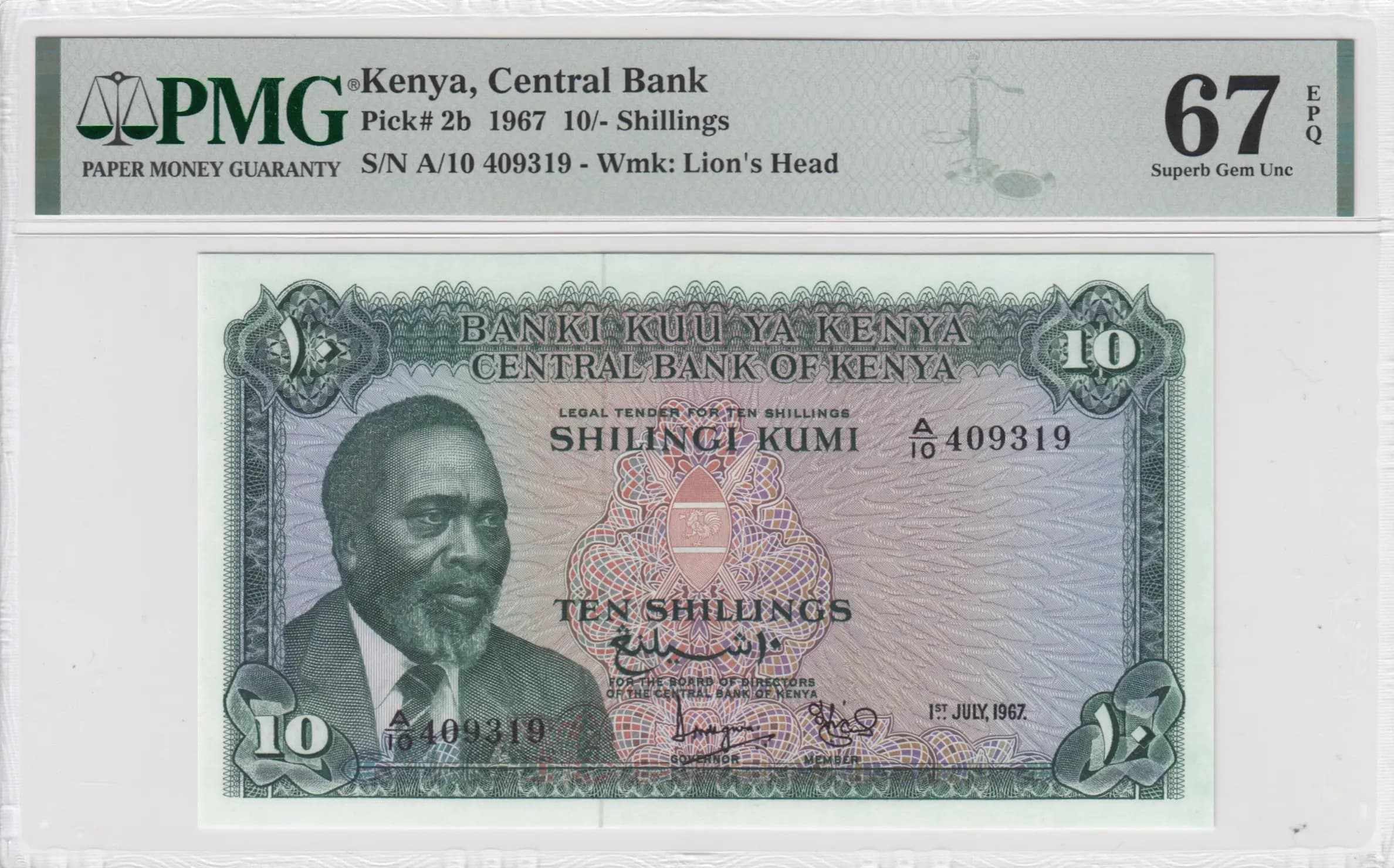
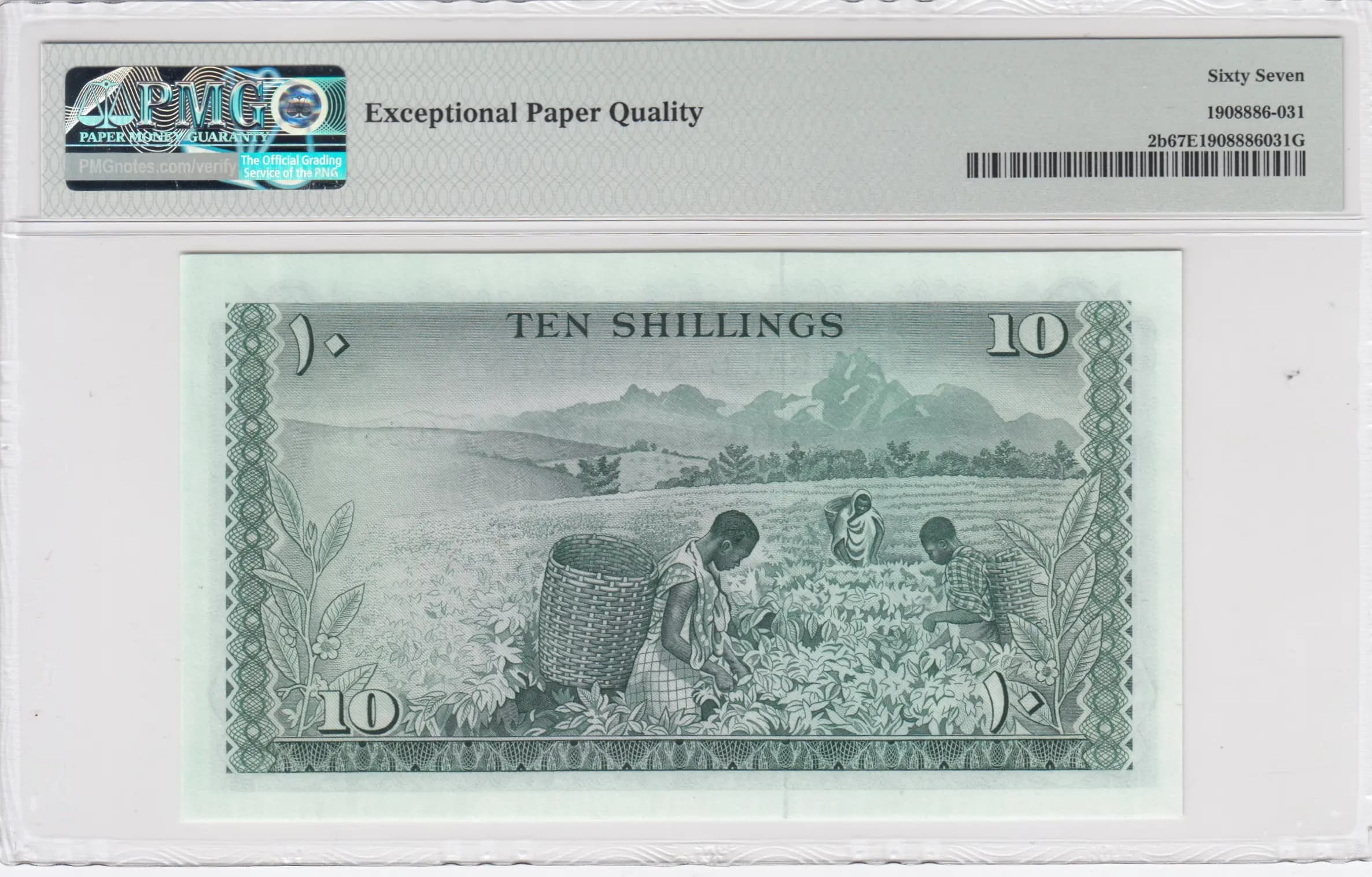
A pristine example of Kenya's first-issued 10 shillings note from 1967, featuring President Mzee Jomo Kenyatta in formal dress on the obverse and a striking agricultural scene depicting tea harvest workers on the reverse. The note displays exceptional condition consistent with PMG 67 EPQ grading, with crisp, sharp printing throughout, no wear or creasing, and vibrant green coloration on multicolored underprint. This early Central Bank of Kenya issue is notable for its bilingual inscriptions (English and Swahili) reflecting the newly independent nation's identity and its celebration of Kenya's agricultural heritage.
Common. The 1967 10 shillings note (P-2b) was a regular issue of the Central Bank of Kenya with substantial print runs to meet currency circulation demands in a newly independent nation. Market data from eBay shows examples selling regularly at modest prices: lower grades (VG-VF) sold for under $25, with 2019 catalog values of $27.50 for VF and $140 for UNC. While the PMG 67 EPQ grade represents an exceptionally well-preserved example (superior to most circulated or handled notes), the underlying note type itself remains common in the market. High-grade examples command premiums based on condition rarity rather than note scarcity.
Issued on July 1, 1967, just four years after Kenya's independence from British rule, this banknote represents the young nation's establishment of its own currency system under the newly formed Central Bank of Kenya. The portrait of President Mzee Jomo Kenyatta, Kenya's first president, symbolizes national identity and leadership during a critical period of post-colonial nation-building. The reverse's depiction of tea harvest workers with mountainous landscape reflects Kenya's economic foundation in agricultural production, particularly tea cultivation, which became a cornerstone of the post-independence economy.
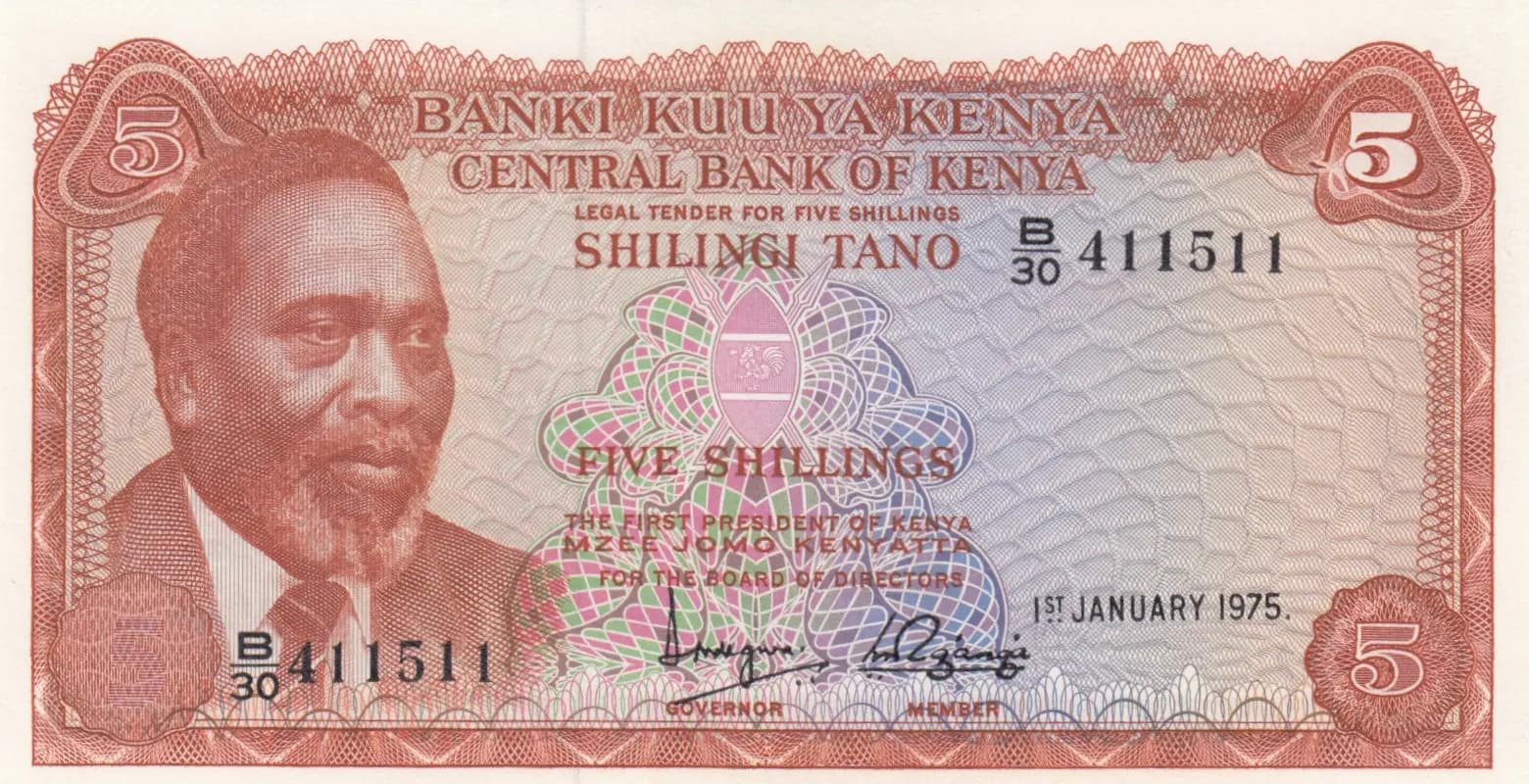
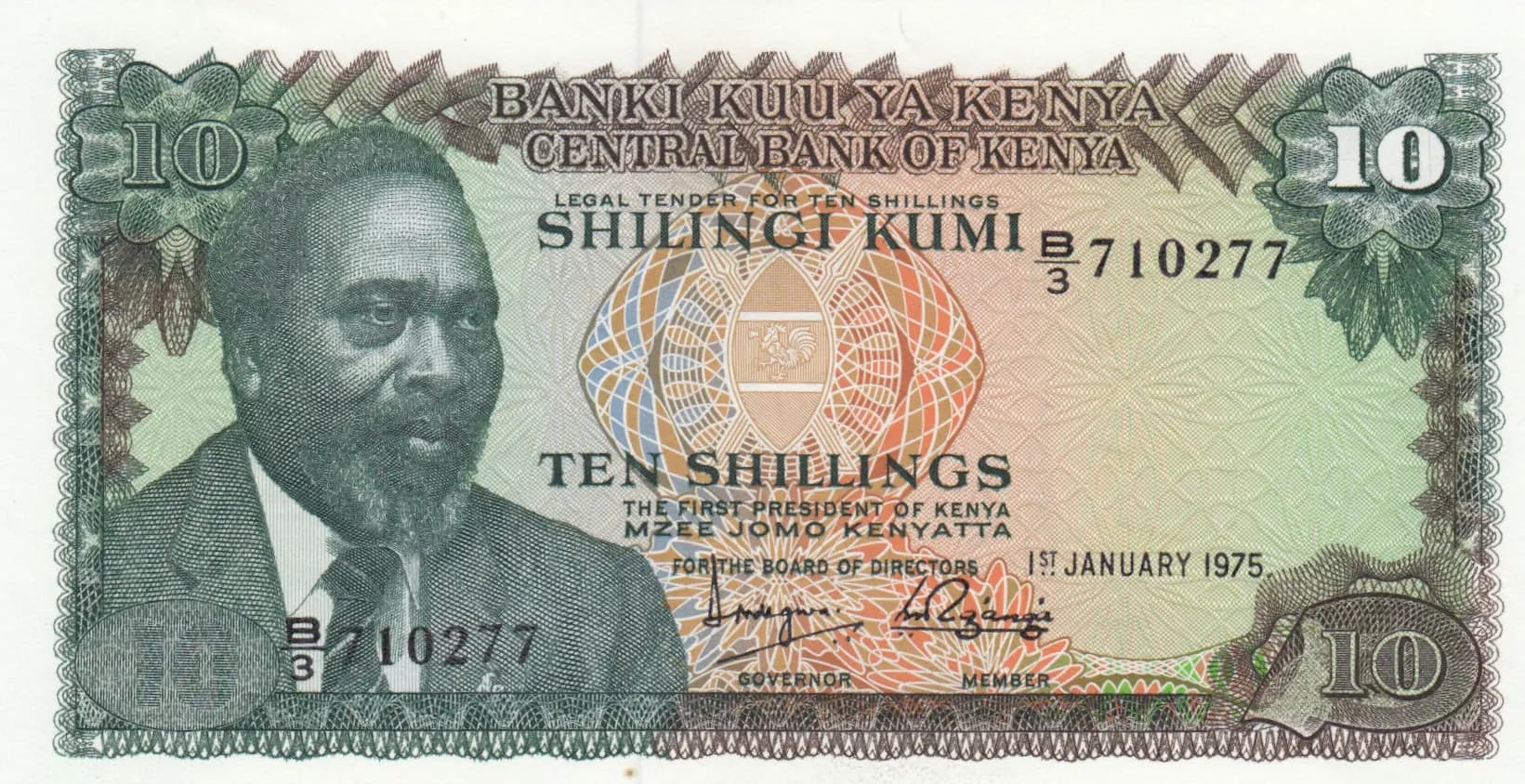
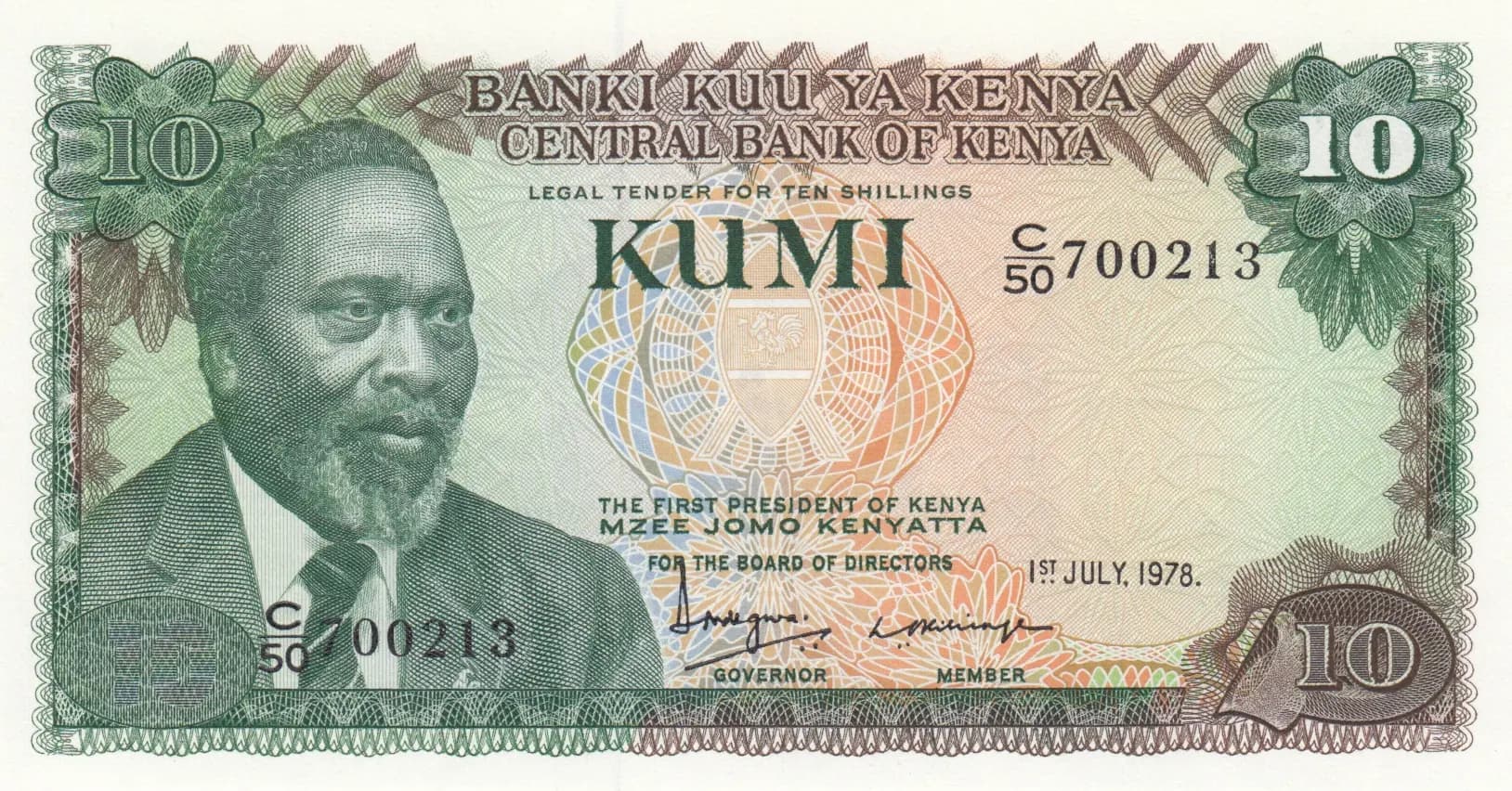
The obverse features a formal left-facing portrait of President Mzee Jomo Kenyatta in Western business attire (suit and tie), positioned on the left side of the note. A prominent heraldic coat of arms—representing the newly sovereign nation—occupies the center of the note with shield patterns and geometric ornamentation in red/orange and black. Decorative corner elements featuring lion head motifs and intricate border patterns in geometric designs frame the note in pale and dark green. The reverse depicts a rural agricultural scene with three workers engaged in tea or crop harvesting in a mountainous landscape, executed in fine line engraving. The composition emphasizes Kenya's agricultural identity and the labor force central to the nation's economy. Ornamental diamond-shaped designs and botanical leaf patterns integrate into the borders on both sides.
Front side: 'BANKI KUU YA KENYA' (Swahili: Central Bank of Kenya), 'CENTRAL BANK OF KENYA' (English), 'LEGAL TENDER FOR TEN SHILLINGS' (English), 'SHILLINGI KUMI' (Swahili: Ten shillings), 'TEN SHILLINGS' (English), serial number 'A/10 409319', and date '1ST JULY, 1967'. Denomination numerals '10' appear in top right and bottom left corners. Back side: 'TEN SHILLINGS' (English) with denomination numerals '10' in top corners. The bilingual presentation emphasizes the post-independence identity of Kenya.
Intaglio (engraved) printing technique, characteristic of high-security banknote production of the era. The fine line work visible in the portrait, coat of arms detail, and agricultural scene reflects professional security printing standards. The note exhibits the crisp impression and dimensional depth typical of intaglio currency production, with intricate border ornamentation and security features integrated throughout the design.
This note is identified as Pick 2b, one of several cataloged varieties of Kenya's first 10 shillings issue (P-2a, P-2b, P-2cts, P-2s listed in PMG population records). The P-2b variety is distinguished by the presence of Arabic numerals at upper left and lower right corners alongside Western numerals, as noted in external catalog references. The specific serial number prefix 'A/10' and date of July 1, 1967, are consistent with first-year issue characteristics. The watermark identified as a lion's head is a defining security feature of this series.