500 fils 1952
Market Prices
1 saleAbout This Note
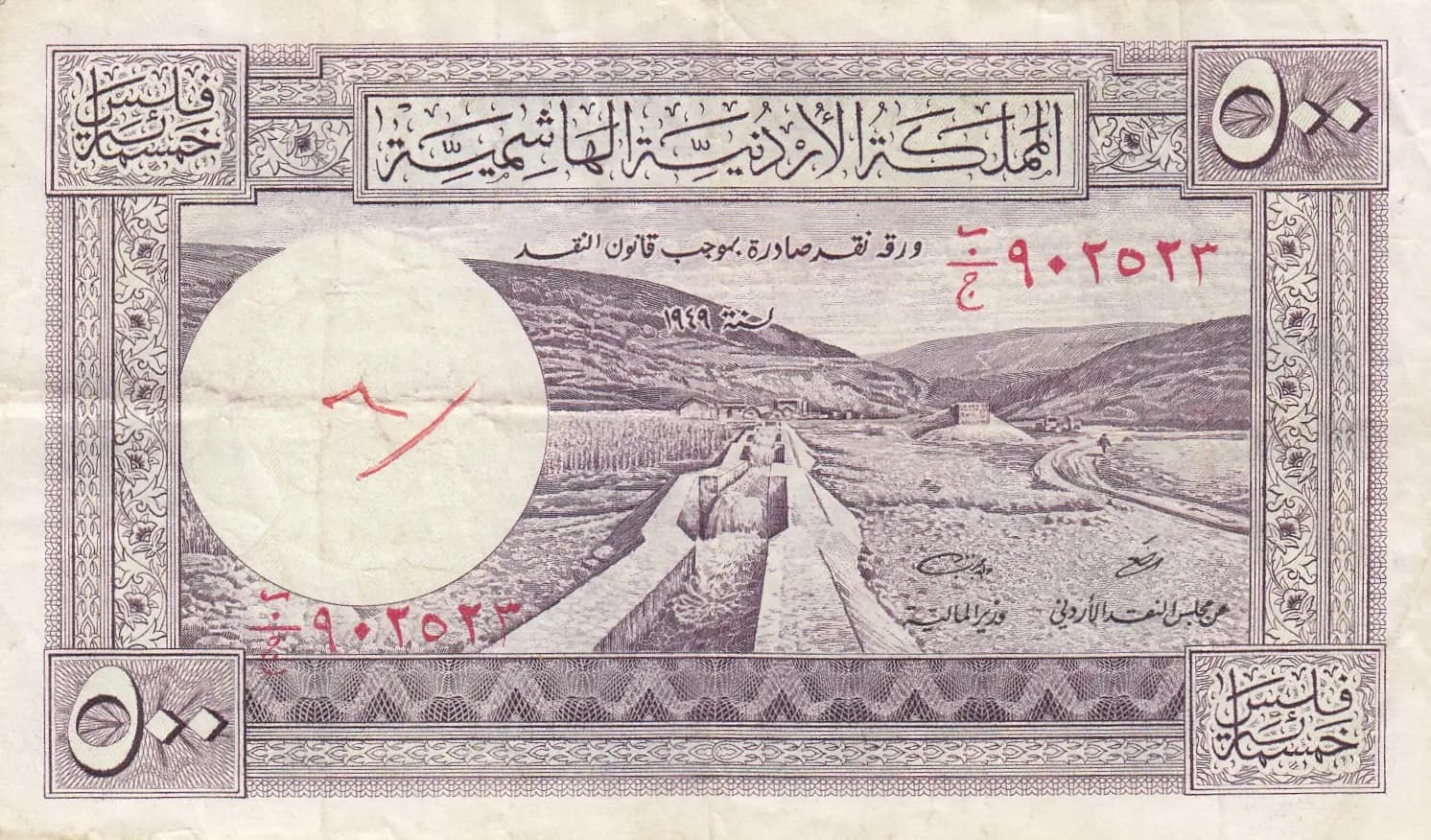
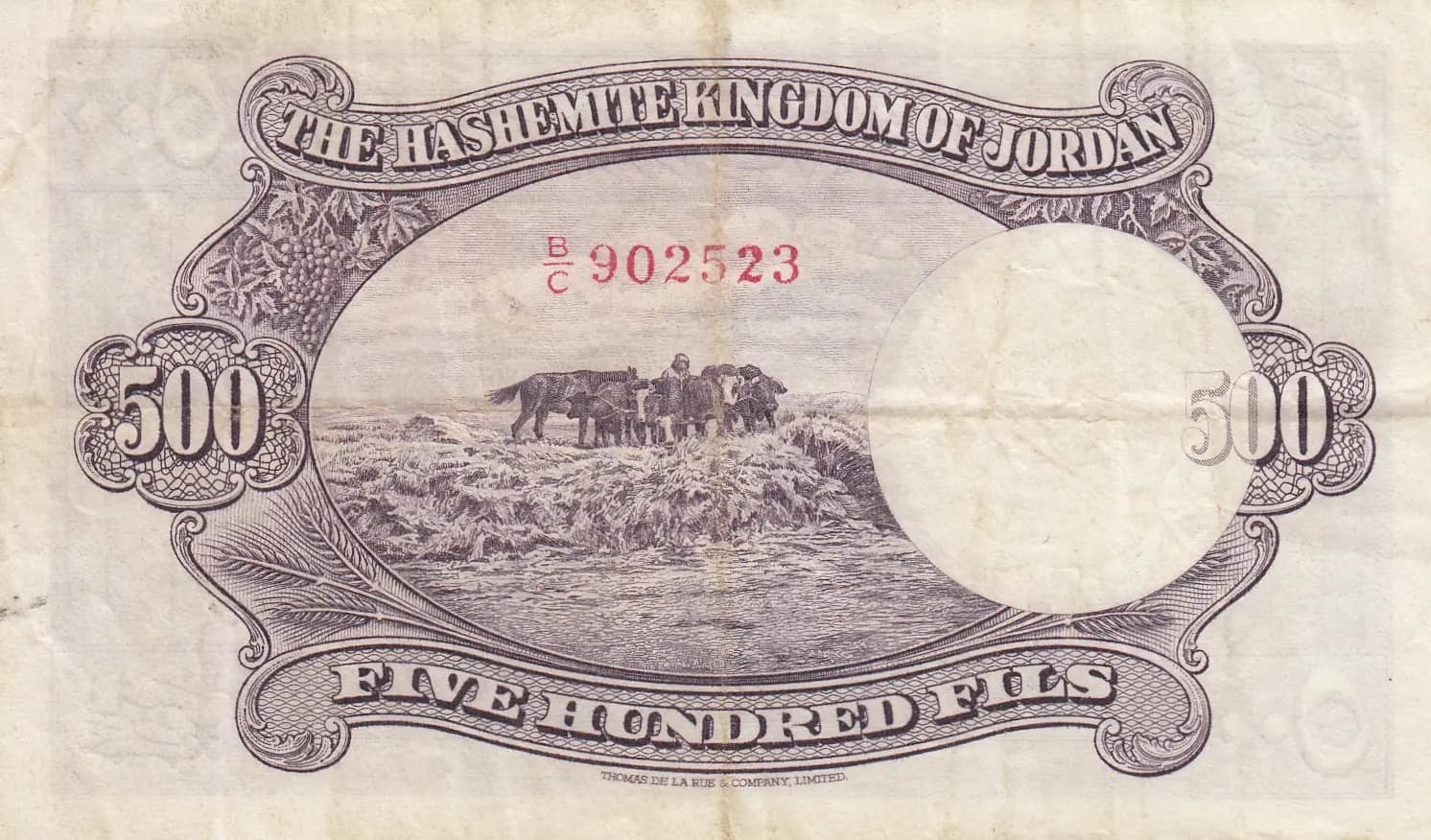
This is a VF-graded 500 Fils banknote from Jordan's 1952 issue (Legal Date 1949), printed by Thomas de la Rue and representing an important early emission of the newly independent Hashemite Kingdom. The note exhibits the characteristic purple/violet coloring and fine engraving typical of TDLR security printing, with visible circulation wear including creasing and foxing consistent with its VF grade. The dual-language design (Arabic obverse, English reverse) and rural/agricultural imagery reflect Jordan's mid-20th century economy and British colonial printing heritage.
Common. While this is an early emission from Jordan's independence period, the eBay price tracking data shows a VF specimen selling for $61 in 2021, well below the 2016 catalogue value of $175 for VF grade, suggesting actual market availability at lower prices. The note exists in multiple catalogued varieties (P-5Aa, P-5Ab, P-5Ac, P-5As documented by PMG), indicating reasonable print quantities. Early Jordanian issues are generally accessible to collectors, and this denomination and grade level are not reported as scarce.
Issued in 1952 during the early years of the Hashemite Kingdom of Jordan (independent from 1946), this banknote depicts scenes of irrigation systems and agricultural labor reflecting the nation's economy-building period. The irrigation canal and cultivated fields vignette on the obverse symbolize the critical role of water management in Jordan's arid landscape, while the reverse's depiction of pack animals and handlers illustrates the continuing importance of traditional transport infrastructure. The bilingual English-Arabic presentation underscores Jordan's transition from British mandate territory to independent state while maintaining Western security printing standards.
The obverse features a landscape vignette depicting an irrigation canal bordered by cultivated agricultural fields with mountains visible in the background and rural structures in the middle distance, symbolizing Jordan's agricultural development. The reverse presents a rural scene with multiple figures accompanied by pack animals (likely camels or horses) in a desert landscape, illustrating traditional commerce and transport. Both sides employ ornate decorative borders featuring floral and geometric patterns with ornamental cartouches. The watermark, visible as a large circular impression (likely depicting King Hussein based on PMG records), appears on the left of the obverse and right of the reverse. The color scheme of purple/violet with gray and cream toning is characteristic of TDLR's mid-century banknote production.
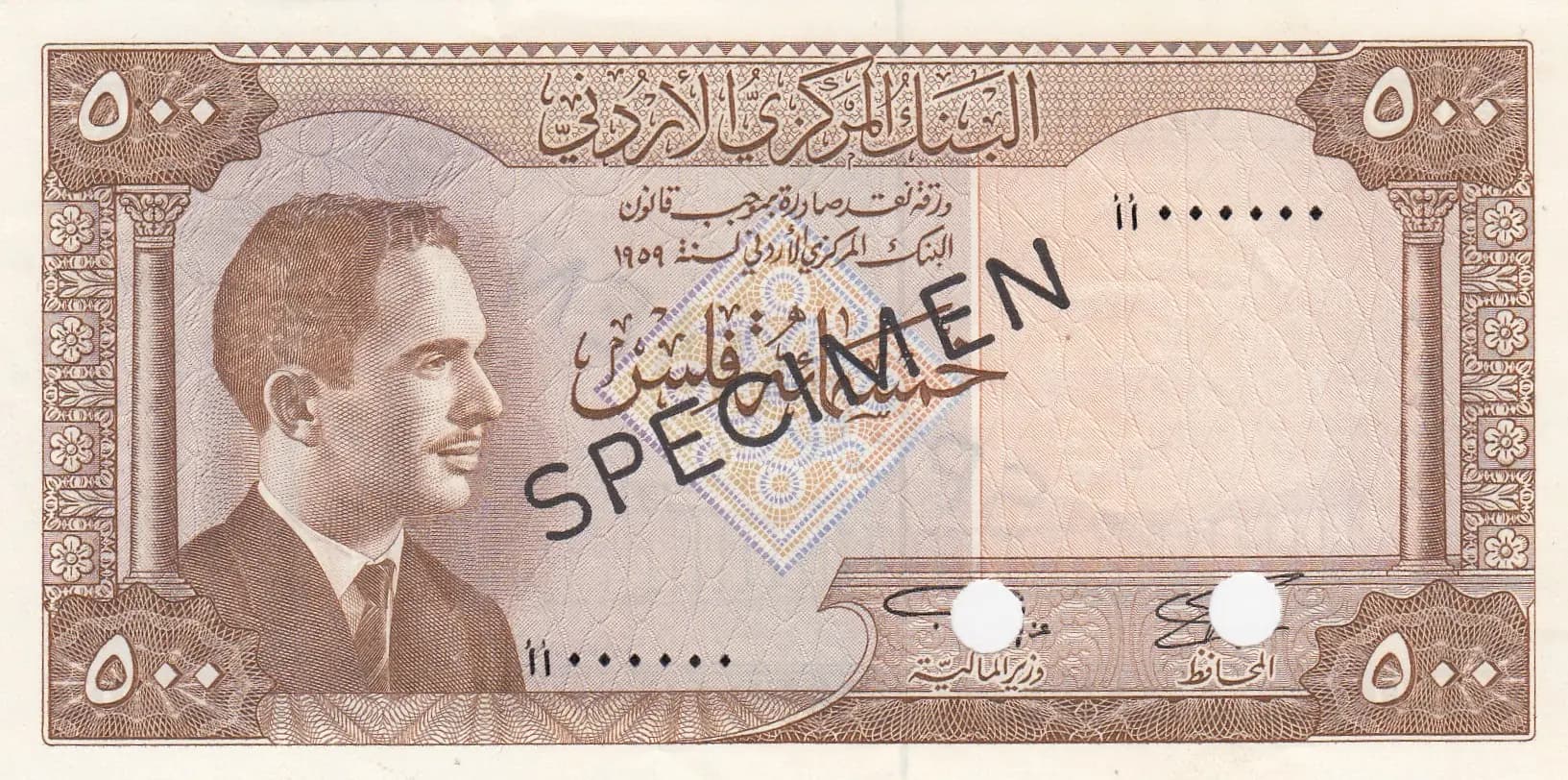
OBVERSE: 'الملكة العربية الهاشمية' (The Hashemite Kingdom); 'ورق تقصارة بموجب قانون النقد' (Banknote issued under currency law); Serial number 252539 (in red); Date marking 1959. REVERSE: 'THE HASHEMITE KINGDOM OF JORDAN' (English header); '500' and 'FIVE HUNDRED FILS' (denomination in English cartouches); Serial number 'B C 902523' (in red); 'THOMAS DE LA RUE & COMPANY, LIMITED' (printer attribution).
Intaglio (engraved) printing by Thomas de la Rue & Company, Limited, London, as evidenced by the fine line engraving visible throughout the ornamental borders, the detailed landscape vignettes, and the crisp security features. The professional quality of the border work and vignette execution is consistent with TDLR's reputation as a leading British security printer. Security features include an embedded watermark featuring King Hussein and fine-line engraved patterns throughout designed to prevent counterfeiting.
This note is catalogued as Pick P-5Ac, one of five documented varieties for the base Pick number P-5. The serial number prefix 'B C' visible on the reverse and the date marking of 1959 on the obverse (though the legal date is L.1949) may indicate this as a specific printing variety. TDLR printer attribution is confirmed. The note appears to be from a standard circulation printing rather than a special issue or limited variant, based on the absence of exceptional markings or overprints in the visual analysis.