1 dinar 1952
Market Prices
3 salesAbout This Note
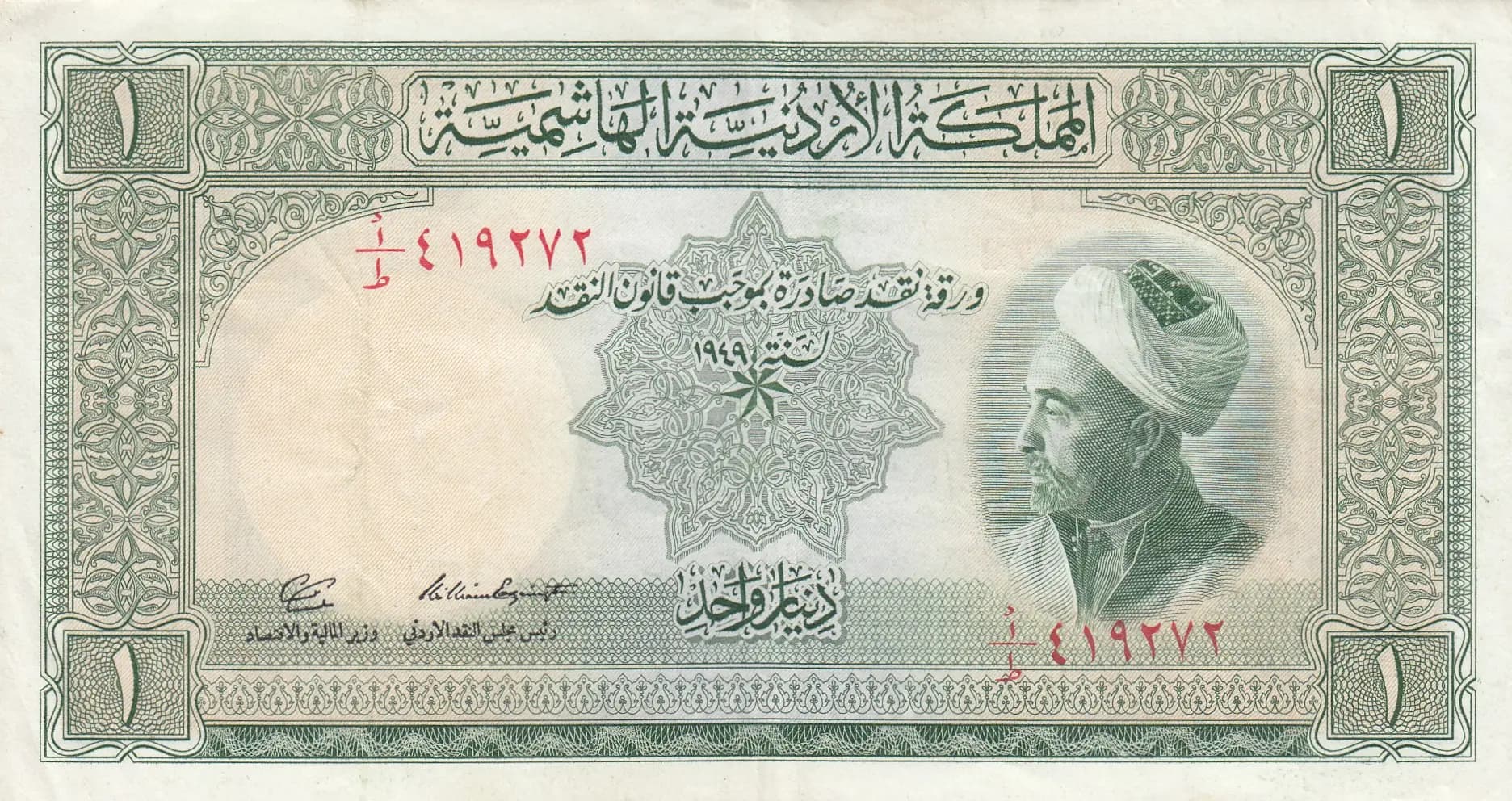
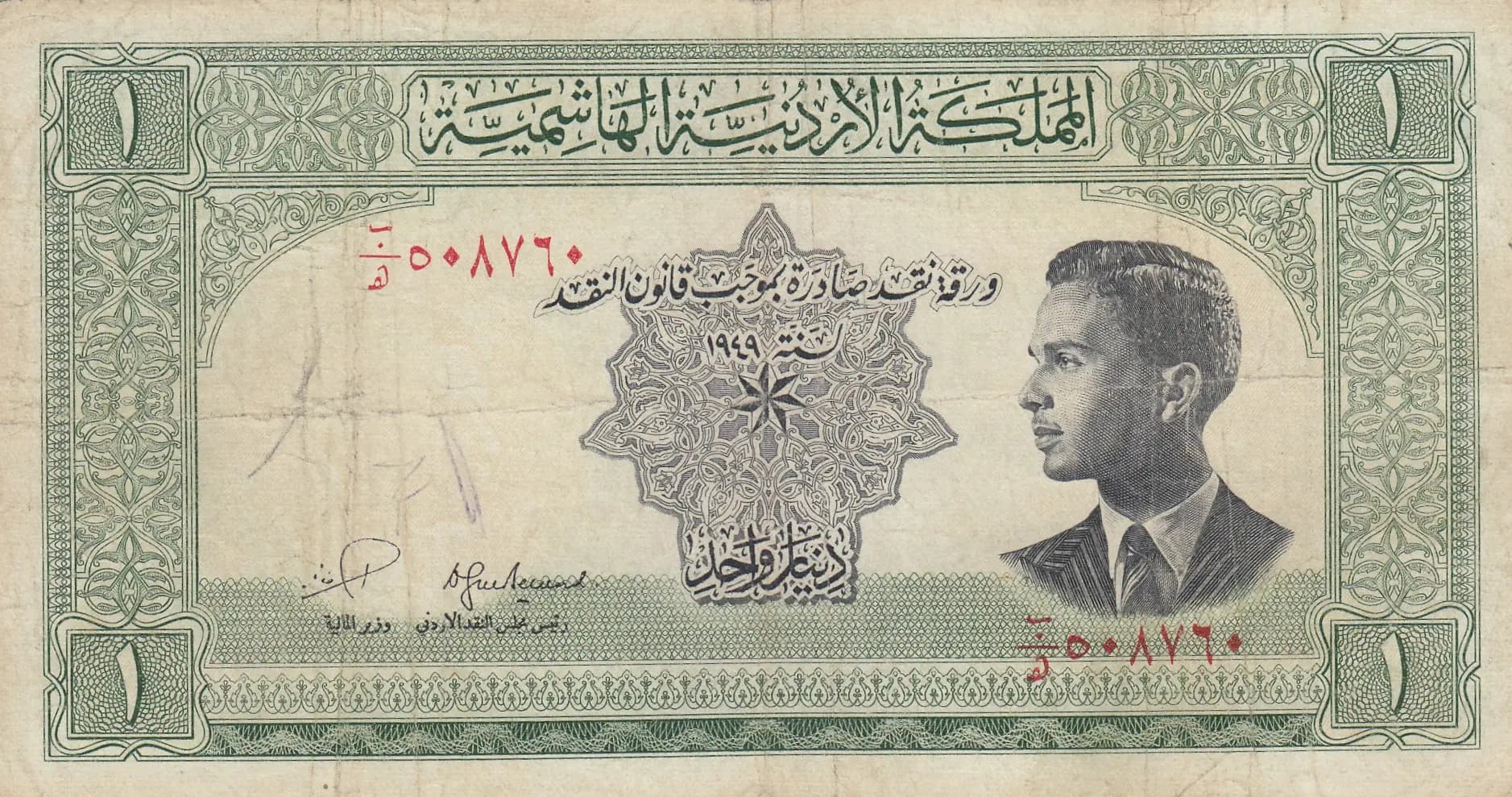
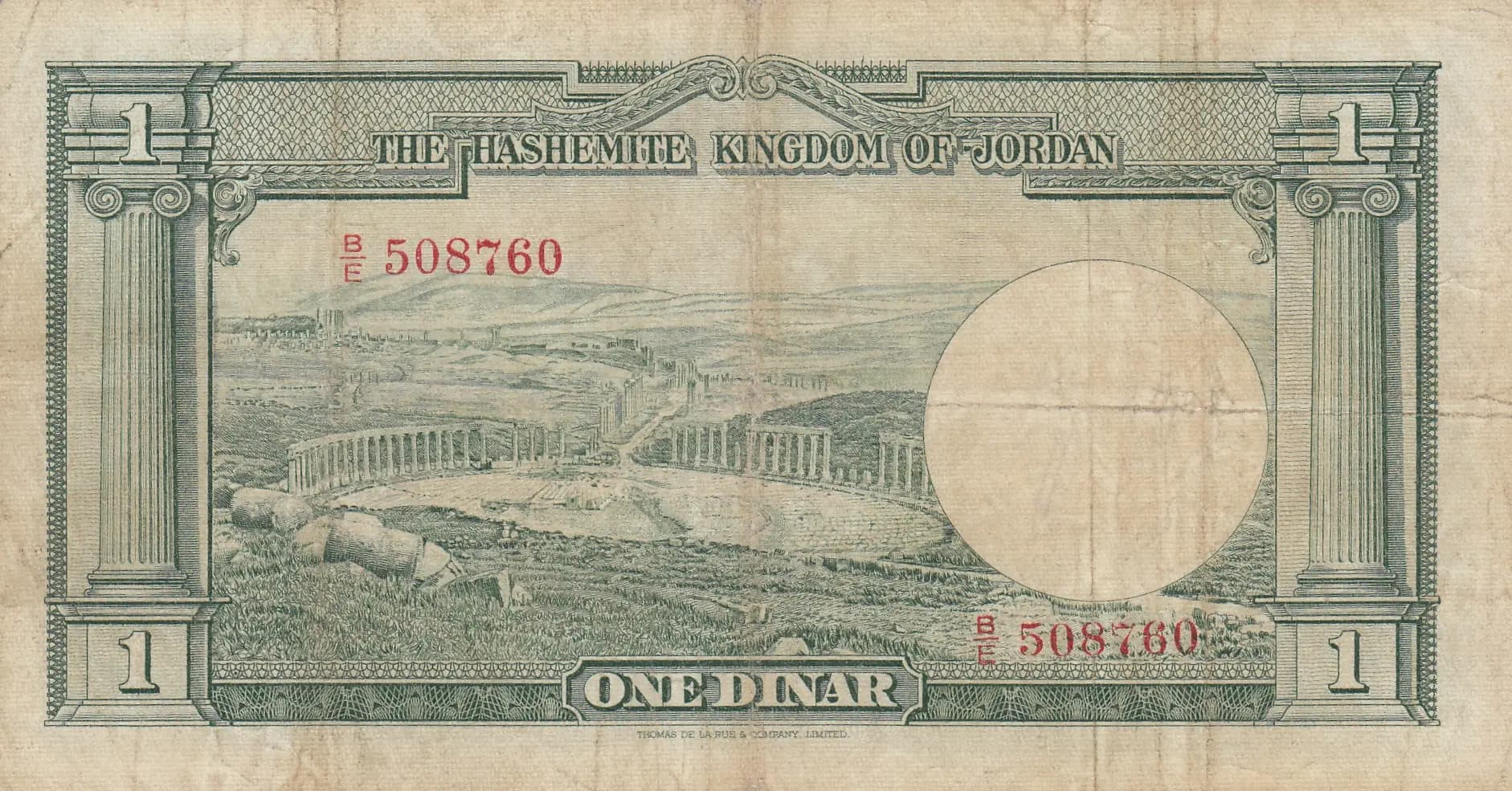
This is a Fine-graded 1 Dinar note from Jordan's 1949 Monetary Law issue, printed by Thomas De La Rue in 1952. The note displays the characteristic green and black color scheme with King Hussein's formal portrait on the obverse and detailed engraving of the Jerash forum ruins on the reverse. Despite visible creasing, foxing, and circulation wear throughout, the note retains clear inscriptions and well-defined security features, making it a representative example of Jordan's early post-independence currency.
Common. The eBay price history shows consistent sales activity with notes in F condition selling for approximately $144.55 (2019) and VF notes for $31-$99.99, indicating steady collector demand but established market pricing without scarcity premiums. The catalog value of $50 for VG condition and $125 for VF reflects a note that is widely available in the collector market. This was a standard circulation issue from a major printing operation, and the note does not appear in PMG's population report as a scarce variant.
This note was issued during the early years of the Hashemite Kingdom of Jordan's independence, under the Monetary Law of 1949. The obverse features King Hussein II, who ruled during this formative period of nation-building, while the reverse depicts the Jerash (Gerasa) forum—one of the Decapolis cities and a symbol of Jordan's rich classical heritage. The bilingual Arabic-English inscriptions reflect Jordan's status as a newly sovereign state establishing its identity in the post-World War II era.
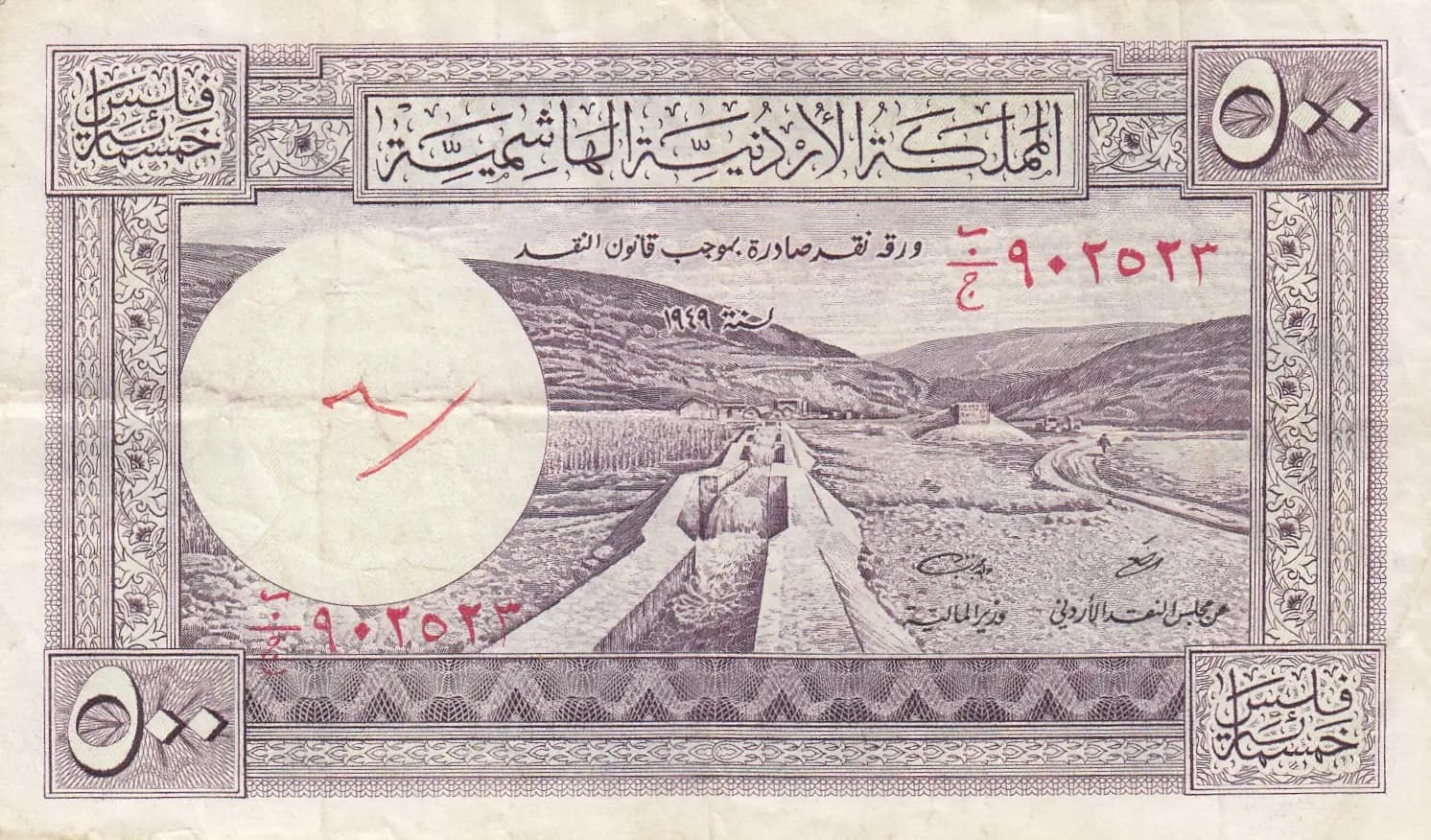
The obverse features a three-quarter profile portrait of King Hussein II positioned at right, depicted in formal Western-style suit and tie characteristic of mid-20th century official portraiture. Behind the portrait is a large ornate Islamic geometric star medallion pattern, and the entire design is framed by an elaborate rectangular border of Islamic geometric patterns in green. The reverse displays a detailed engraved landscape of the Jerash forum ruins, featuring multiple standing classical Corinthian columns arranged in rows within a mountainous valley landscape. The architectural ruins are flanked by ornamental Corinthian column designs on the left and right borders, with distant cityscape visible on the horizon. Both sides feature red-ink serial numbers and denomination numerals in corners.
OBVERSE: الجمهورية الأردنية الهاشمية (The Hashemite Kingdom of Jordan); وثيقة بموجب قانون النقد الصادر بسنة ١٩٤٩ (Document issued pursuant to the Monetary Law of 1949); Serial number: ٥٠٠٨٧٦ (500876, appearing twice). REVERSE: THE HASHEMITE KINGDOM OF JORDAN; ONE DINAR; Serial number: B 508760 (appearing twice); THOMAS DE LA RUE & COMPANY, LIMITED (printer's mark); Denomination numeral: 1
Intaglio engraving (steel plate engraving) executed by Thomas De La Rue & Company, Limited, London—the premier security printer of the era. The fine linear detail work, intricate cross-hatching creating tonal depth, and complex border designs characteristic of the architectural and portraiture elements are consistent with high-security banknote production standards of the early 1950s. The red-colored serial numbers indicate selective color printing applied during the intaglio process.
This is cataloged as Pick P-6a, with the serial number prefix 'B' visible on the reverse. The note displays the standard 1949 Monetary Law designation (L. 1949) with 1952 issuance. The visual analysis indicates serial numbers in both Arabic (٥٠٠٨٧٦) on the obverse and English alphanumeric format (B 508760) on the reverse, consistent with the bilingual design standard for this issue. No overprints or unusual signatures are evident from the visual inspection. PMG records indicate one cataloged variant for this base Pick number, suggesting this represents the primary variety for the P-6a designation.