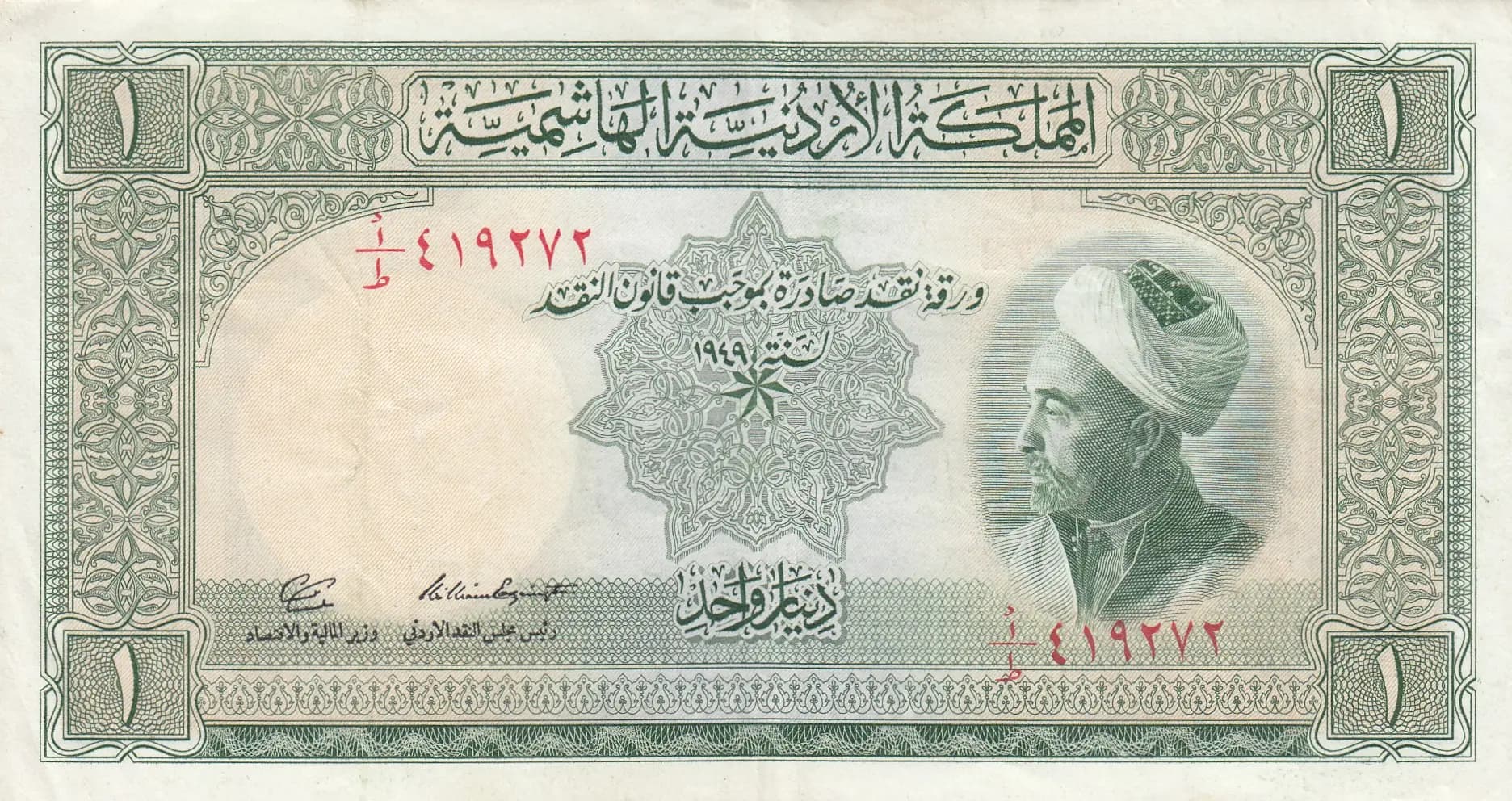
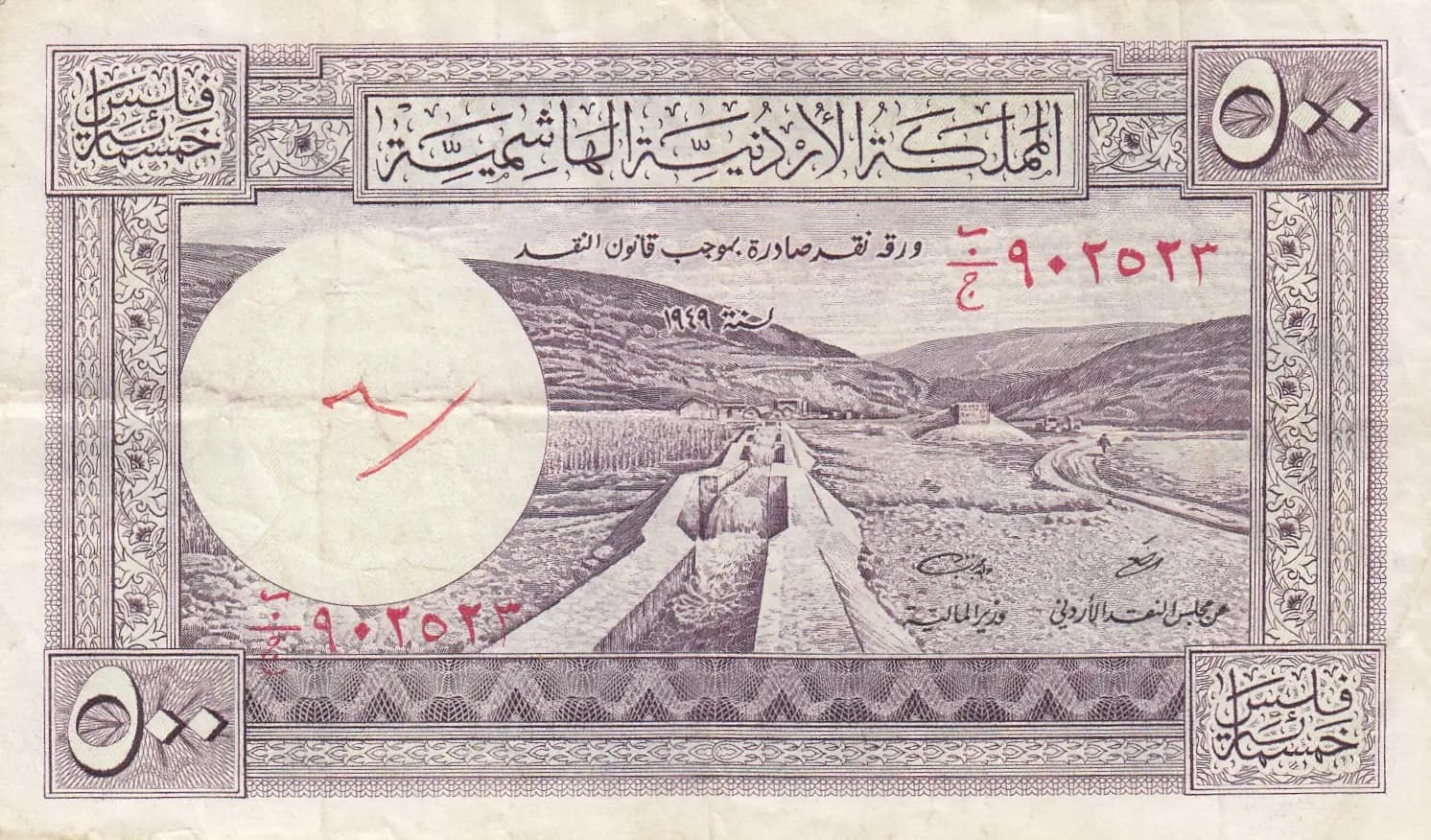
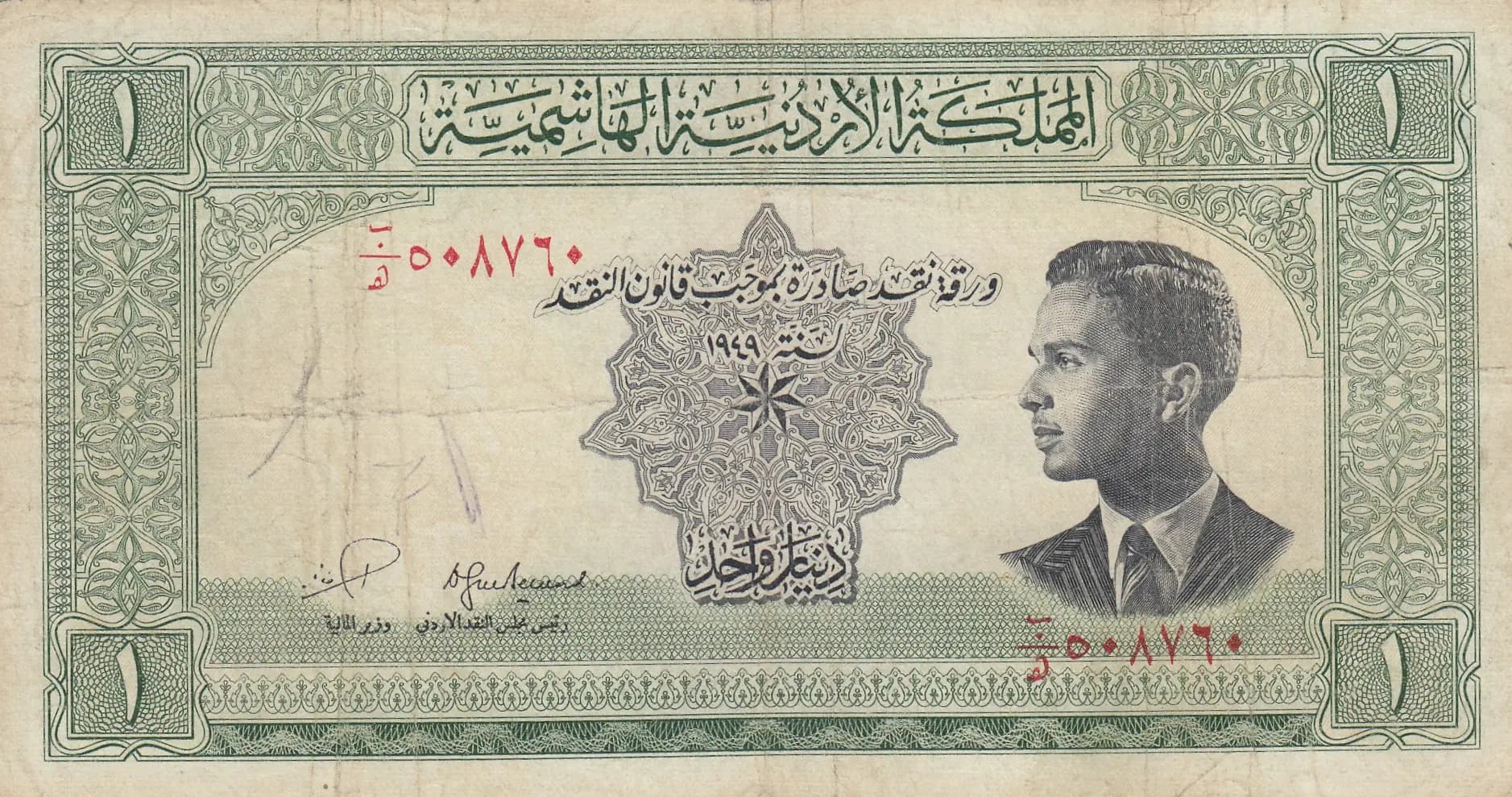
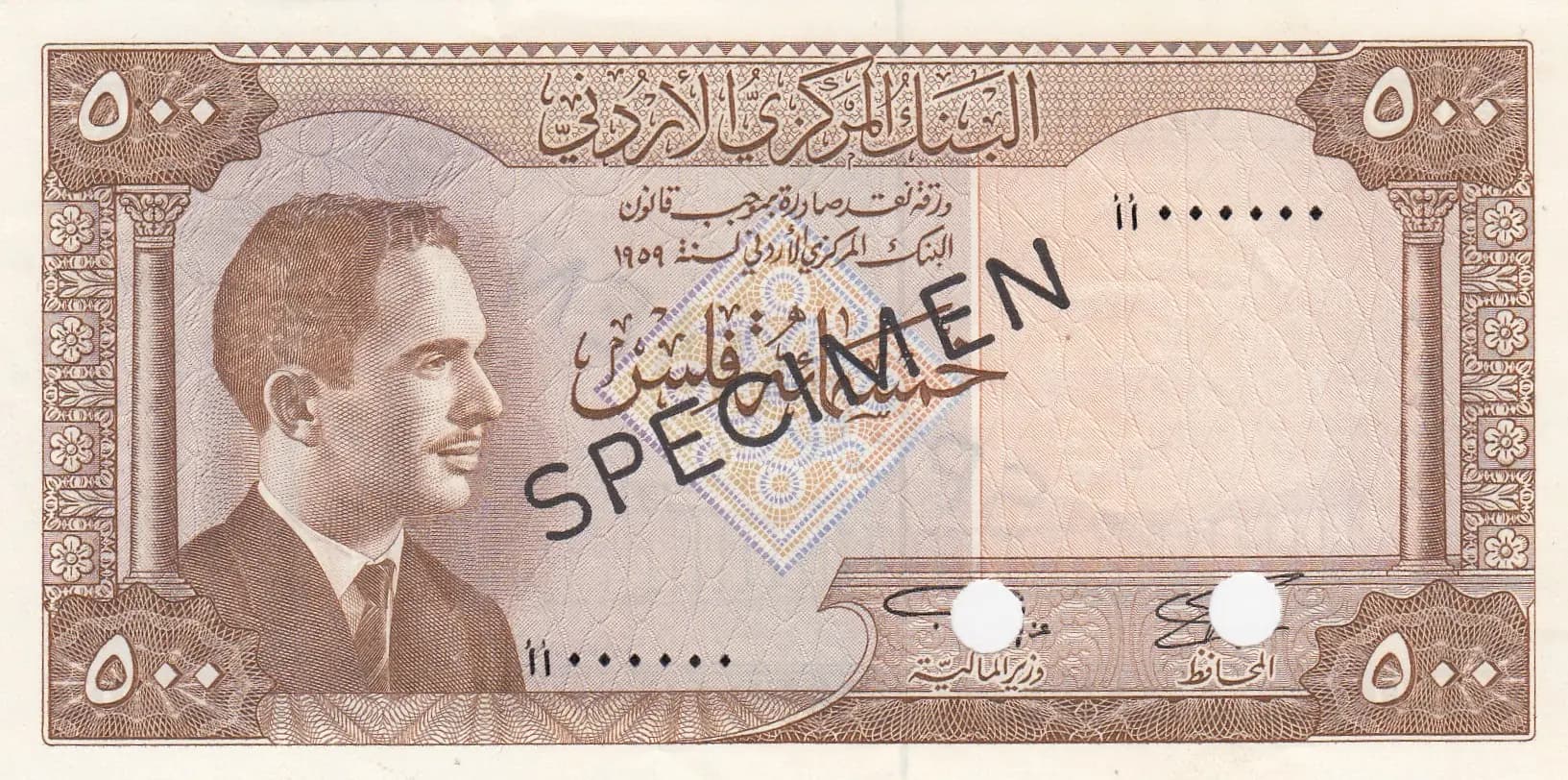
1 dinar 1965 specimen
Market Prices
About This Note
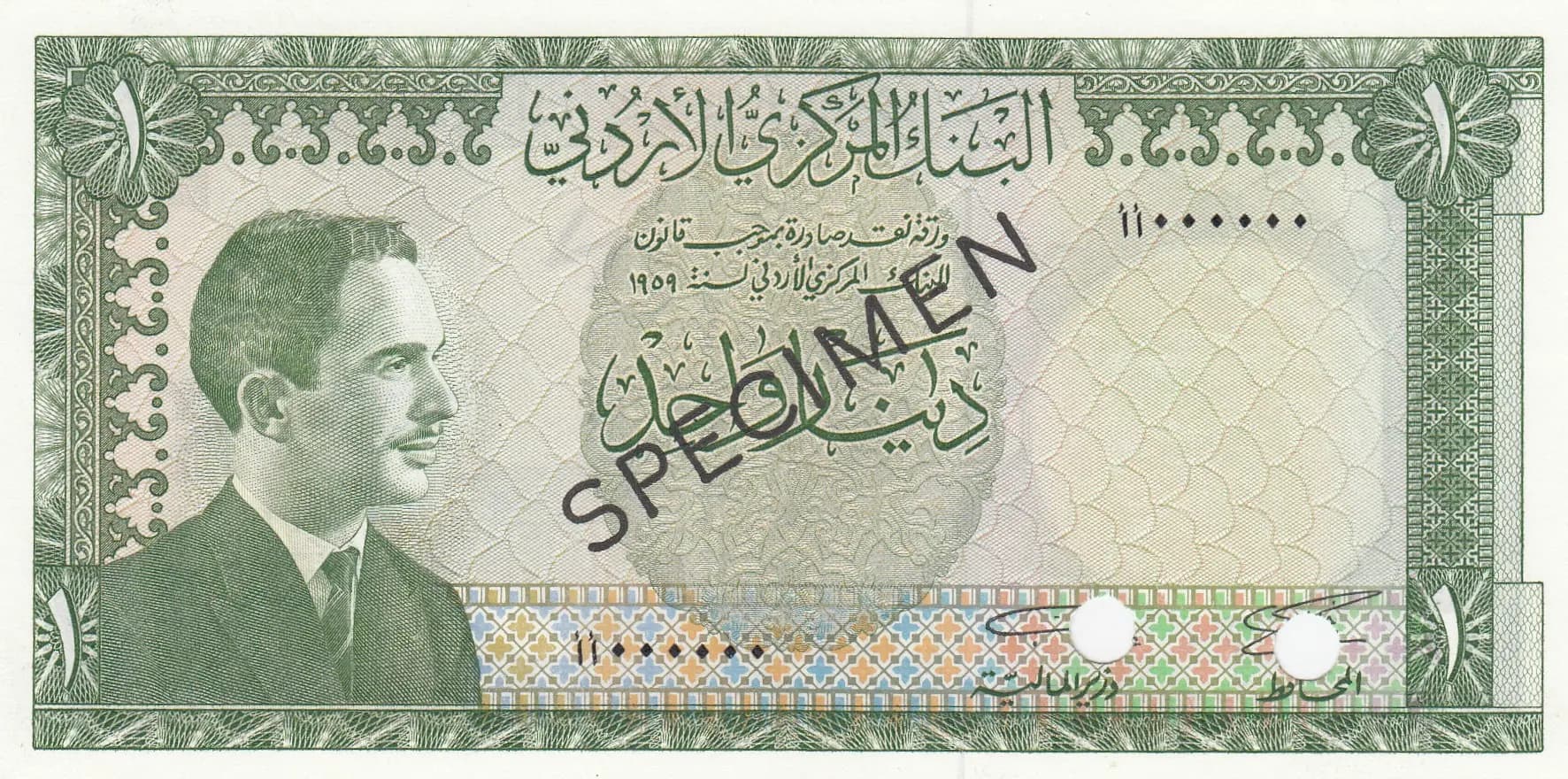
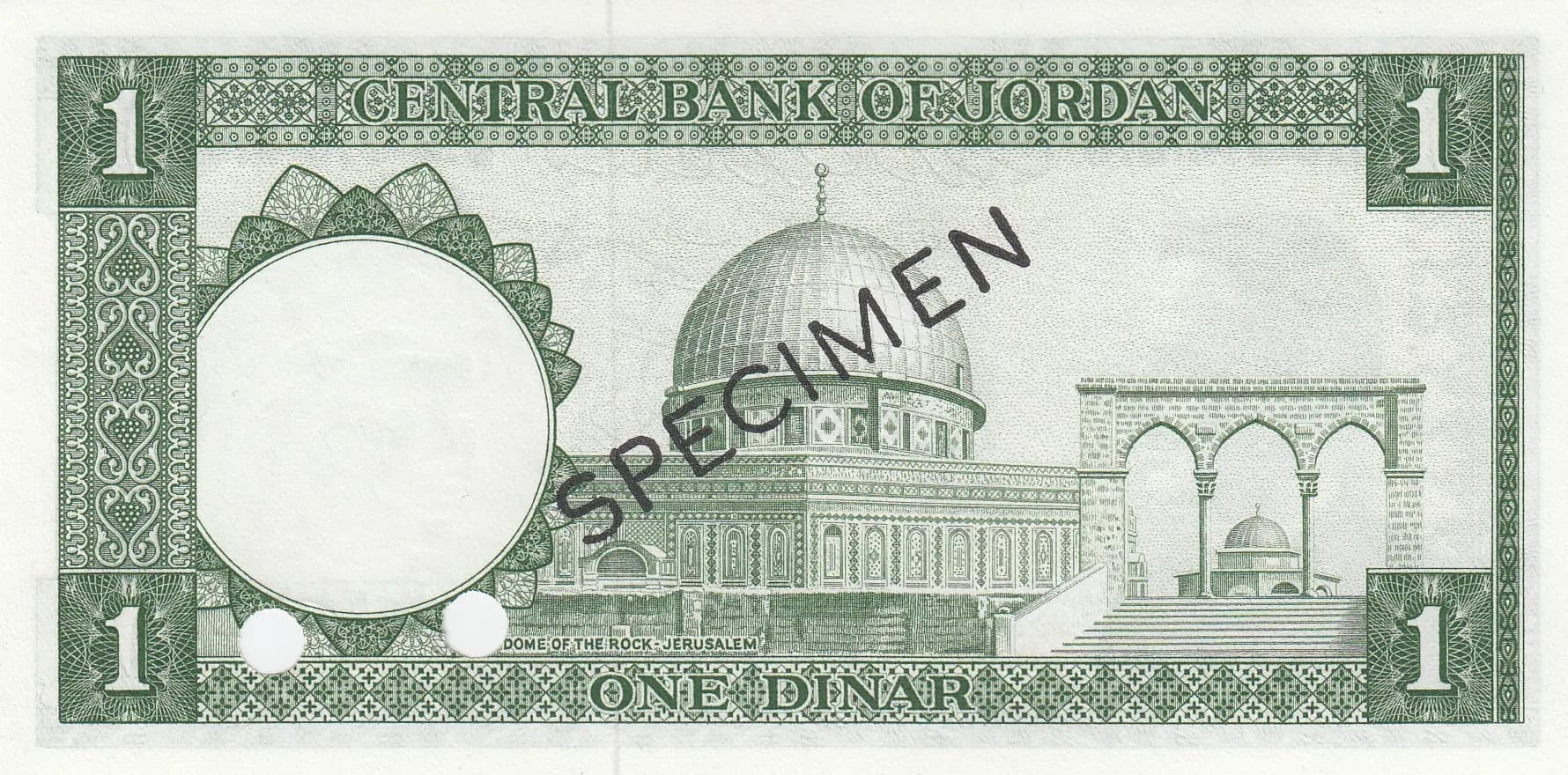
This is a 1965 specimen note from the Central Bank of Jordan featuring King Hussein II in profile on the obverse and the iconic Dome of the Rock in Jerusalem on the reverse. Printed in green on multicolored underprint with fine line engraving throughout, the note displays the characteristic SPECIMEN overprint and remains in uncirculated condition with no visible wear, folds, or creases. The specimen designation and Law of 1959 date marking make this an important reference example of Jordan's early post-independence currency design.
Common. While this is a specimen note, which are typically less common than circulation issues, the eBay market data shows these notes trading consistently in the $35-75 USD range for UNC examples, with catalog values around $500 reflecting the specimen designation premium. The wide availability of listed examples and modest market prices indicate this specimen variety was produced in sufficient quantities to be readily available to collectors. Specimen notes from this series do not command extreme premiums, suggesting they were not produced in severely limited quantities.
Issued under the Law of 1959, this 1 dinar note represents the Central Bank of Jordan's early currency during the reign of King Hussein II, a period of nation-building following Jordan's independence. The prominent depiction of the Dome of the Rock on the reverse reflects the religious and cultural significance of Jerusalem to Jordan during this era, particularly given Jordan's control of East Jerusalem from 1948 to 1967. The formal portraiture of King Hussein and the sophisticated security printing techniques demonstrate Jordan's commitment to establishing a modern, internationally-recognized monetary system.
The obverse features a formal portrait of King Hussein II positioned in profile facing right, dressed in Western formal business attire (suit and tie), rendered in fine line engraving. The portrait is framed by ornate decorative borders with floral and geometric patterns characteristic of Islamic design. Arabic text identifying the Central Bank of Jordan and Ministry of Finance appears in the upper portion. The base of the obverse features elaborate geometric Islamic patterns in blue, orange, and green. The reverse showcases a detailed architectural rendering of the Dome of the Rock in Jerusalem as the central focal point, with supporting columns, decorative arches, and the distinctive golden dome rendered in fine detail. An ornate Islamic geometric arch design frames an empty circular space on the left side, while the right side shows the full architectural elevation. The design combines Islamic artistic traditions with Western banknote security printing standards.
Front side: 'البنك المركزي الأردني' (Central Bank of Jordan), 'وزارة المالية' (Ministry of Finance), 'دينار' (Dinar), 'SPECIMEN' (English overprint), '1959' (Law date), '11000000' (numeric marking). Back side: 'CENTRAL BANK OF JORDAN' (English), 'DOME OF THE ROCK - JERUSALEM' (English), 'ONE DINAR' (English), 'SPECIMEN' (English overprint), '1' (denomination numeral).
The note was produced using intaglio (line engraving) printing, evidenced by the fine line work, detailed guilloche patterns, ornamental borders, and precise architectural rendering visible throughout both sides. The printer is identified as TDLR (Thomas De La Rue) in the PMG population data, one of the world's premier security printers. The multicolor effect was achieved through traditional multi-stage intaglio printing with careful registration of color plates.
This note is cataloged as Pick P-10s, the 's' designation indicating it is a specimen note. The PMG population report identifies two variants under the base Pick number P-10: P-10a and P-10s, both printed by TDLR. The specimen overprint and the absence of a serial number are defining characteristics of this variety. The 1959 law date with Arabic numeral 1909 is consistent with earlier issues in this series, distinguishing it from later P-14 notes without the law date marking.