1 dinar 1949
Market Prices
3 salesAbout This Note
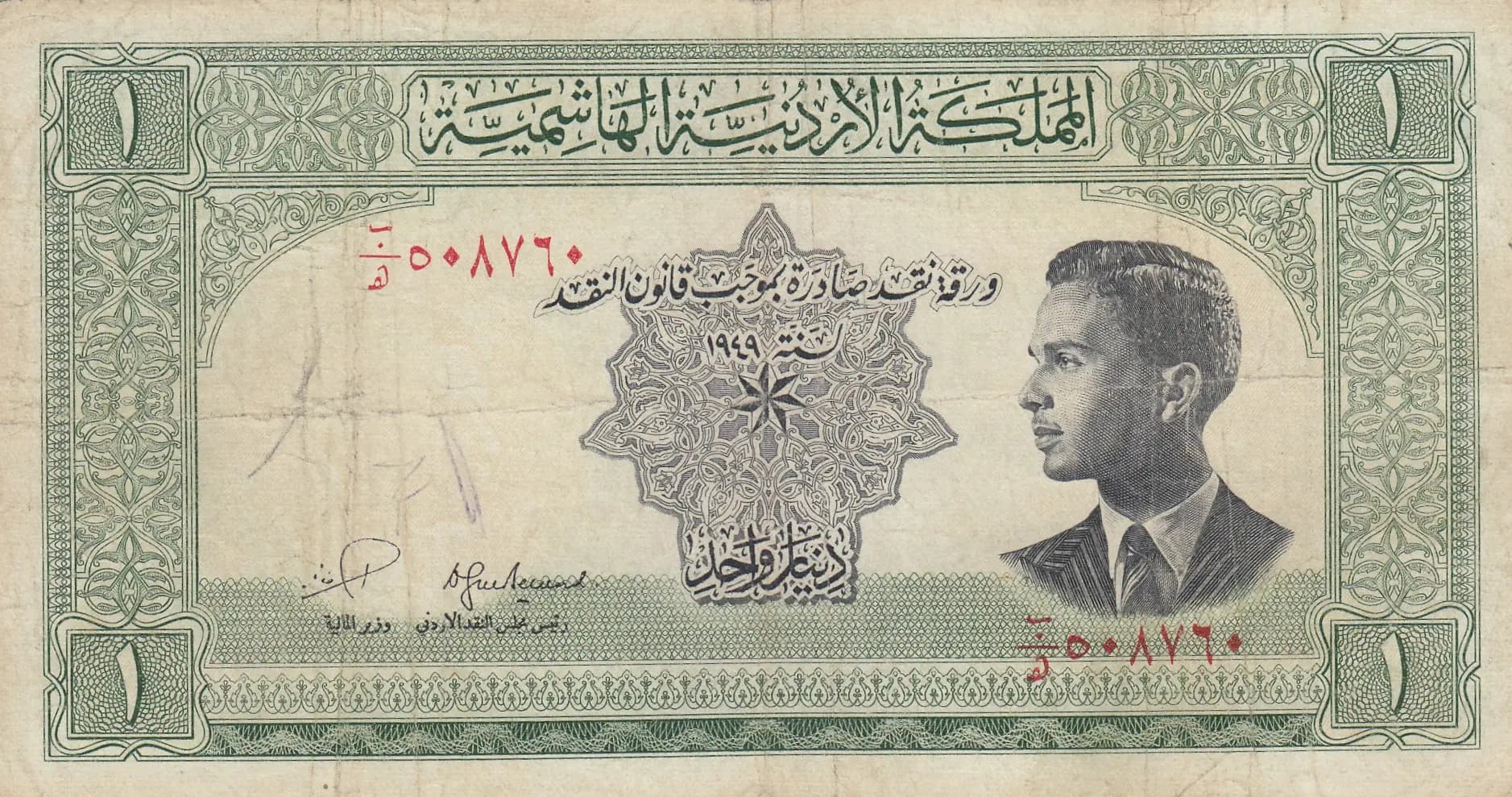
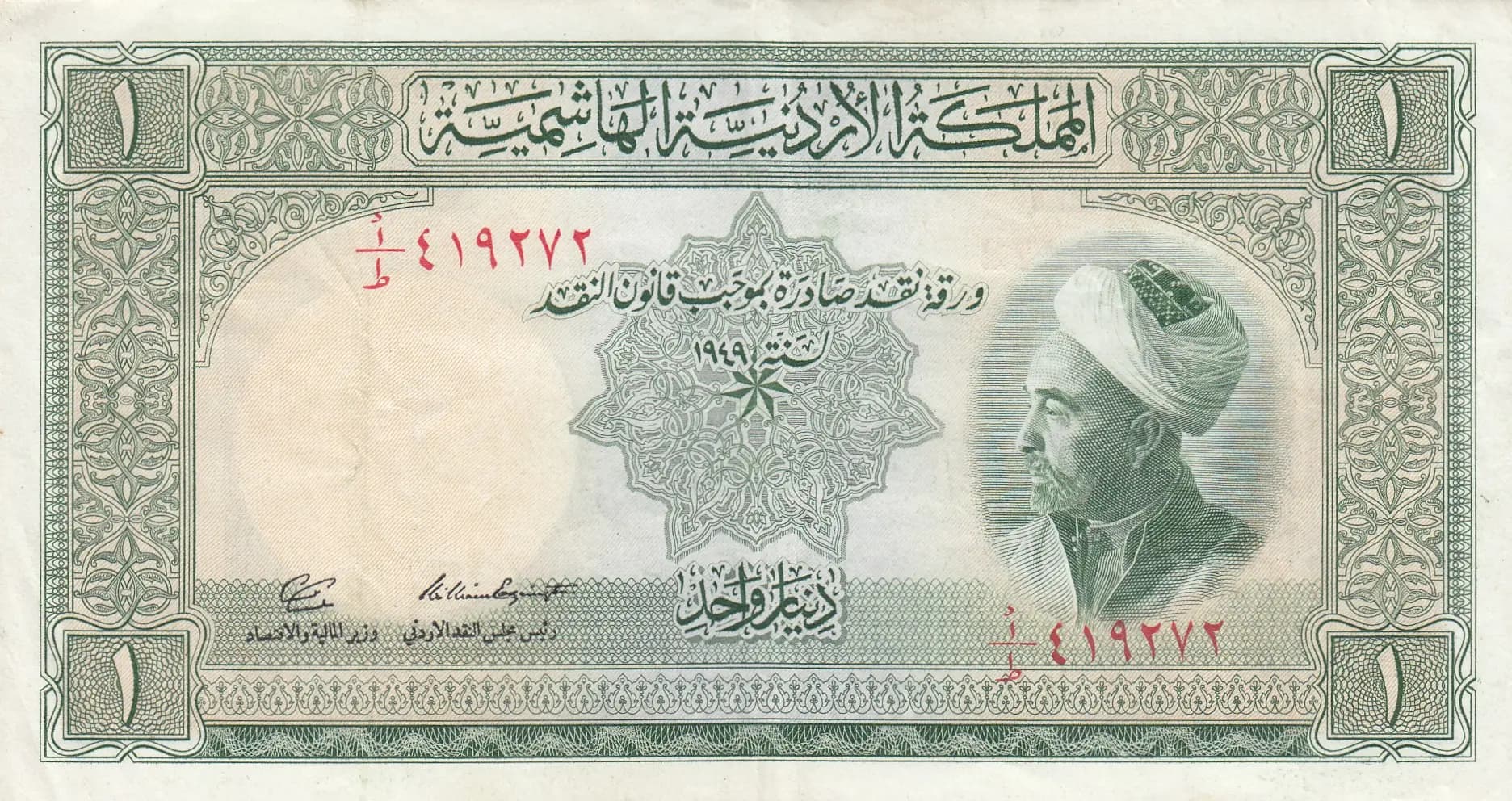
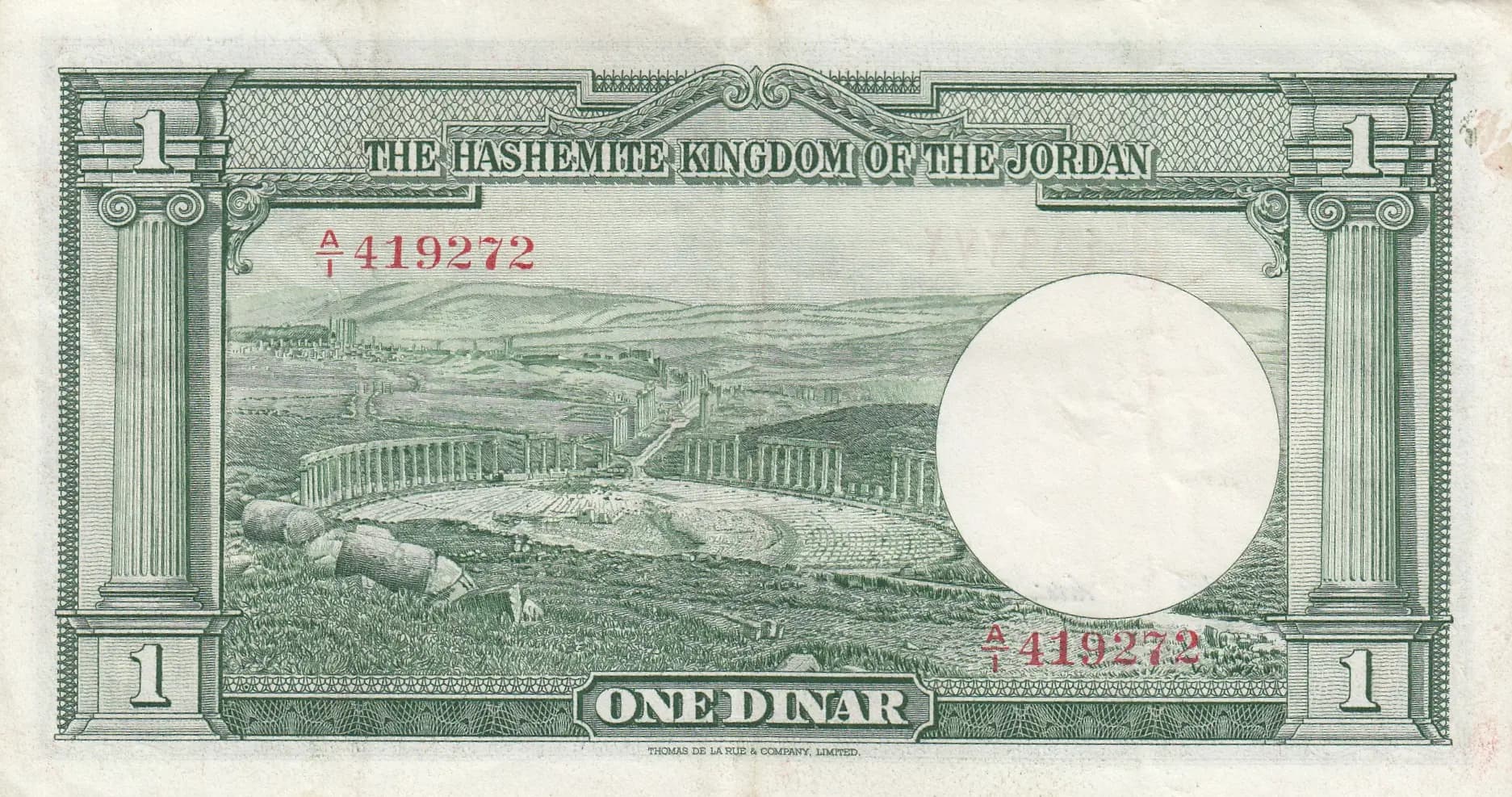
This is a VF-graded 1 Dinar note from Jordan's first independent currency issue (1949), printed by Thomas De La Rue. The obverse features an elegant engraved portrait of King Abdullah I in traditional dress within an ornate Islamic geometric frame, while the reverse showcases a detailed landscape engraving of the classical ruins at Jerash (Gerasa), one of the finest Greco-Roman sites in the Middle East. The note displays excellent color preservation with green and black printing on a cream background, minimal wear consistent with its VF grade, and sharp engraving throughout.
Common. The eBay price data indicates typical market values for this note in VF condition ranging from approximately $270–$350, which is consistent with catalogued values and represents a standard collectible banknote rather than a scarce issue. Although it is the first independent currency of Jordan and historically significant, the print run was substantial enough that examples remain readily available in the numismatic market. The availability of multiple graded examples and regular sales activity confirm this is not a rare variety.
This note was issued following Jordan's independence from the British Mandate in 1946, representing the young Hashemite Kingdom's assertion of sovereignty through its own currency. The prominent placement of King Abdullah I—the founding monarch who unified the East Bank territories—on the obverse reflects the centrality of the monarchy to Jordan's national identity. The reverse's depiction of Jerash, one of the Decapolis cities from the Greco-Roman period, symbolizes Jordan's historical and cultural heritage, connecting the modern state to the classical civilizations that flourished in the Levantine region.
The obverse features a right-facing profile portrait of King Abdullah I Ibn Hussein, rendered in meticulous intaglio engraving with fine detail in his beard, traditional white turban (agal), and formal dress. The portrait is framed by a large ornamental sunburst medallion with intricate Islamic geometric patterns characteristic of 1940s-50s banknote design. The border consists of elaborate geometric and floral motifs in the Islamic tradition, reflecting the cultural identity of the newly independent state. The reverse displays a landscape engraving of the Forum at Jerash (ancient Gerasa), depicting the characteristic Corinthian columns, surrounding classical structures, and the Jordanian hillside terrain. Classical column designs flank the composition, reinforcing the archaeological significance of the depicted site. The overall design employs a two-color printing scheme of green and black on cream paper.
Front side: 'الجمهورية الأردنية الهاشمية' (The Hashemite Kingdom of Jordan) at top; 'وزارة المالية' (Ministry of Finance) below the portrait; Arabic numerals '٤٤١٩٢٧٢' representing part of the serial number. Reverse side: 'THE HASHEMITE KINGDOM OF THE JORDAN' in English at top; '1' appearing in top corners; 'ONE DINAR' at bottom center; 'THOMAS DE LA RUE & COMPANY, LIMITED' indicating the printer; serial number 'A4419272' visible on reverse.
Intaglio engraving (line engraving and possibly steel plate etching) executed by Thomas De La Rue & Company, Limited, London—the noted British security printer. The fine detail visible in the portrait, the intricate geometric borders, and the complex landscape scene on the reverse are characteristic of high-quality intaglio work. The sharp, crisp lines and depth of the engraving, combined with the color separation between green and black elements, indicate traditional banknote engraving techniques refined over decades by De La Rue.
This note is catalogued as P-2b in the Pick numbering system. The visual analysis shows the characteristic features of the 1949 issue with handwritten red serial numbers (A4419272), which was standard for this first issue. The series includes variants P-2a, P-2b, and P-2s1 according to PMG population data. The 'b' designation typically indicates a secondary printing or variant within the 1949 issue series. The visible serial number prefix 'A' and the handwritten format are consistent with the P-2b variety.