10 dinars 1965 specimen
Market Prices
About This Note
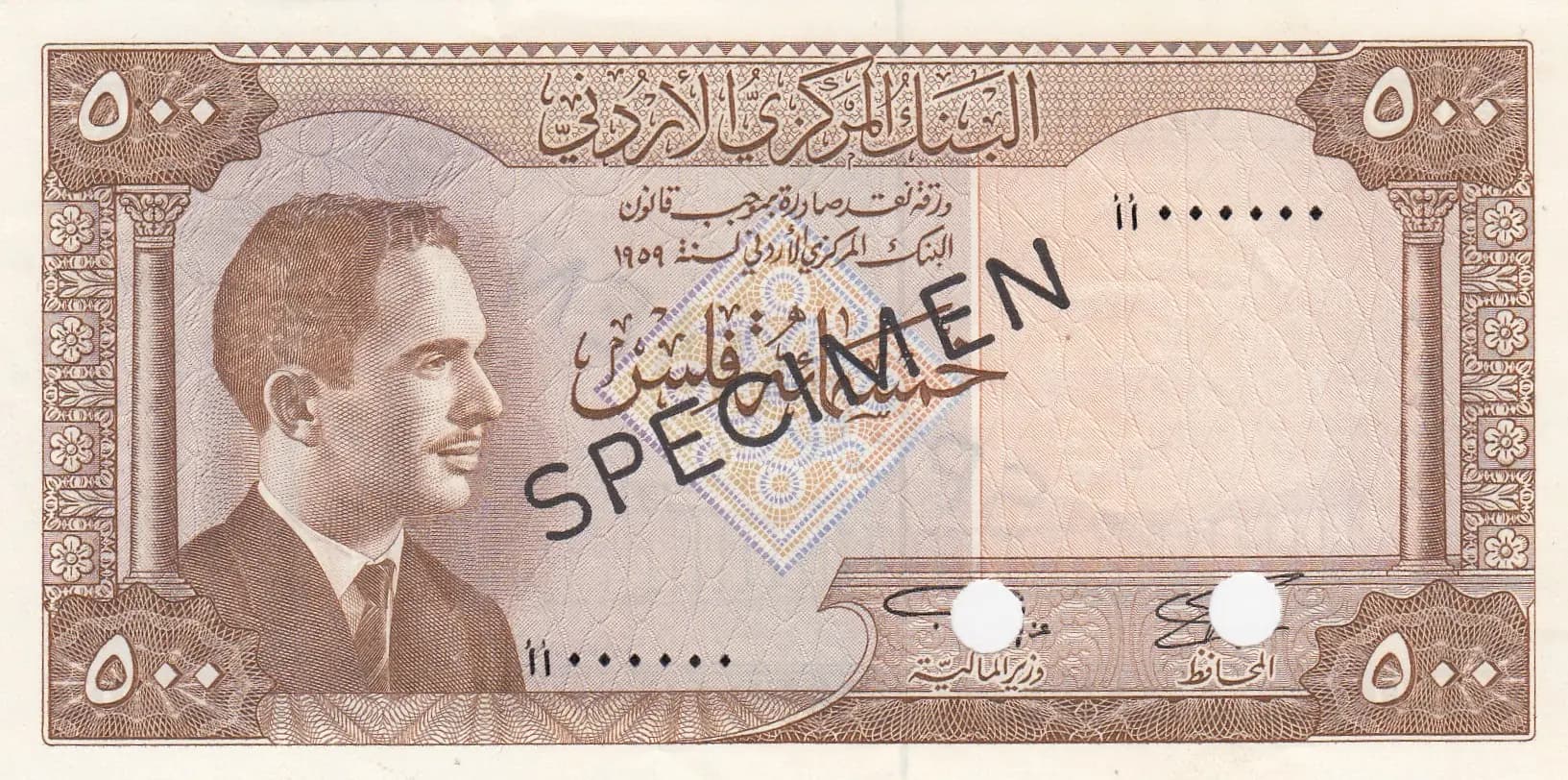
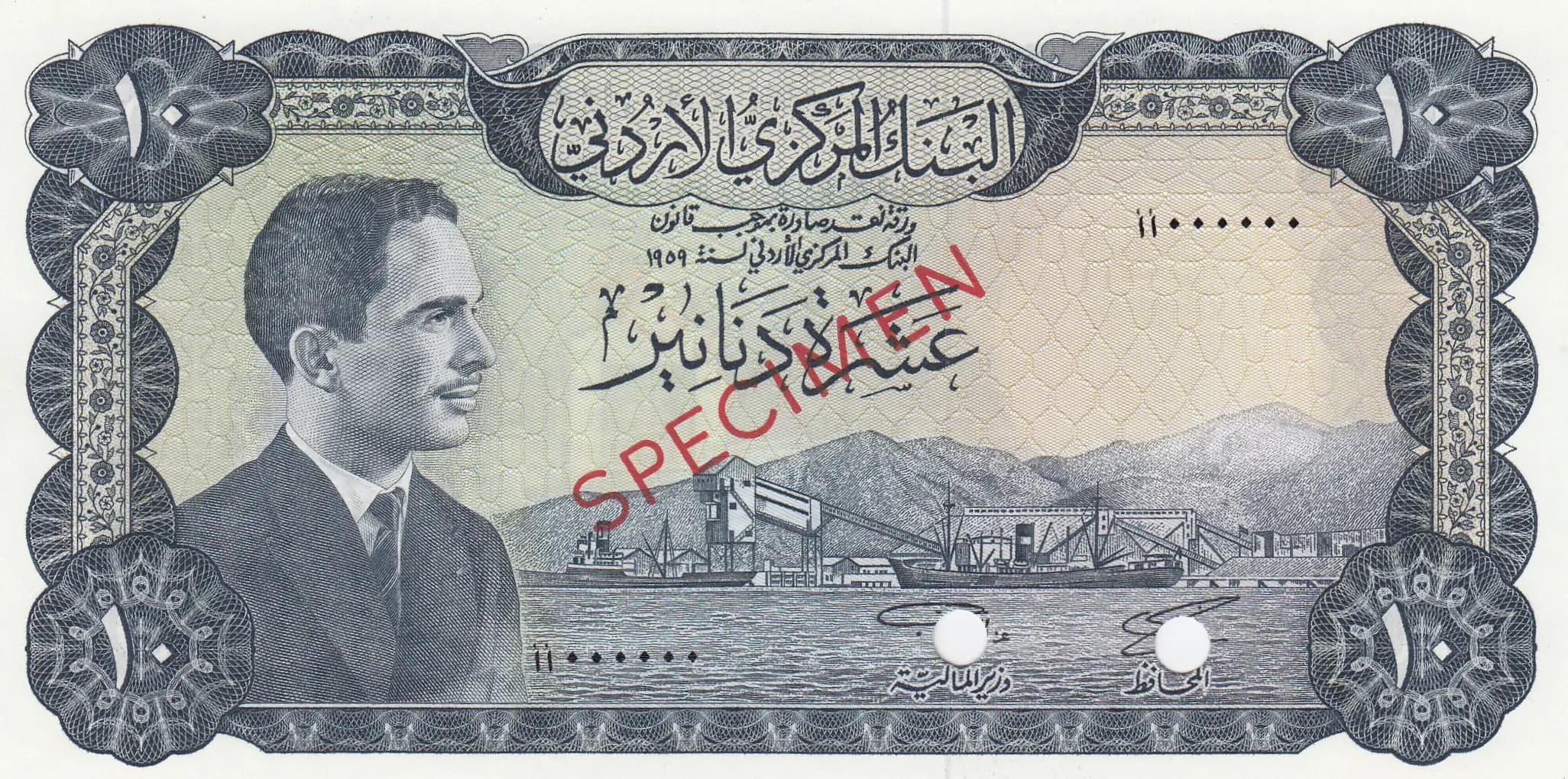
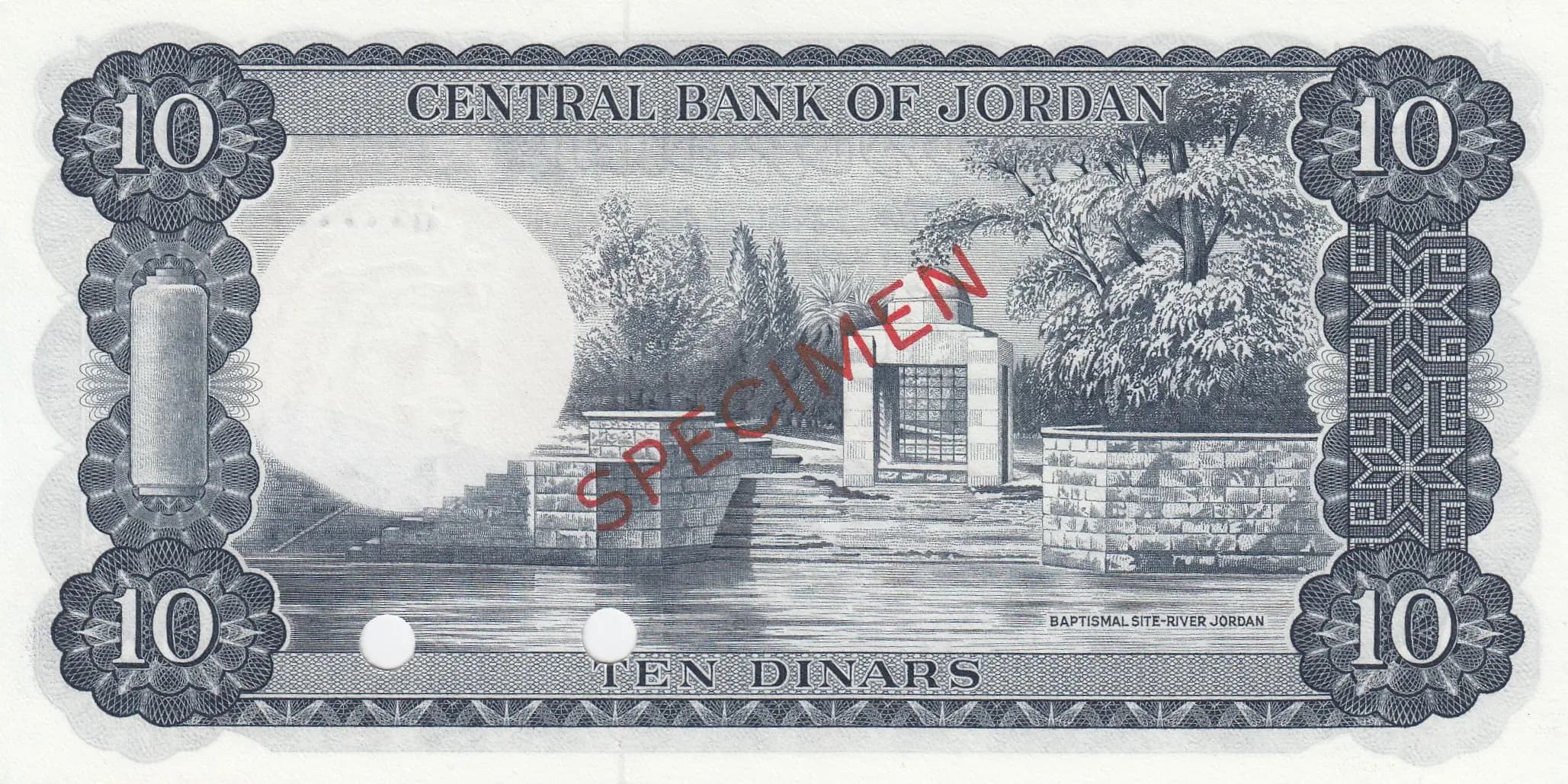
This is a 1965 specimen note of the Central Bank of Jordan's 10 Dinars, graded UNC and cataloged as Pick P-12s. The note features King Hussein in formal business attire on the obverse, with a detailed engraving of a cargo vessel at the Port of Aqaba, while the reverse depicts the baptismal site on the River Jordan with its distinctive columned monument structure. As a specimen note with diagonal red 'SPECIMEN' overprint and two blank circular security feature areas, this example exhibits exceptional clarity and sharp printing with no signs of wear, making it a desirable early Jordan issue.
Common. While this is a specimen note (which are generally produced in limited quantities for security purposes), eBay market data shows UNC examples trading in the range of $25-$2,490 USD with most catalog values around $750 (2019). The wide price variance suggests varying demand by collector base, but the consistent availability and absence of reported scarcity in PMG population data indicate this specimen is not particularly rare. Specimen notes of this era from Jordan remain accessible to collectors.
Issued under the Law of 1959 but printed in 1965, this note reflects Jordan's modernization period under King Hussein II, with imagery celebrating the nation's economic development and religious significance. The Port of Aqaba depicted on the front symbolized Jordan's maritime aspirations and trade connections, while the Baptismal Site of the River Jordan on the reverse emphasized the country's spiritual and historical importance to Christianity. These design choices represent Jordan's effort to project both contemporary progress and deep historical roots during the mid-1960s.
The obverse features a right-facing profile portrait of King Hussein II dressed in a Western-style business suit and tie, positioned at left, with an ornate decorative border of intricate geometric and floral patterns framing the entire note. The lower right displays a detailed engraving of a modern industrial cargo vessel with loading cranes at the Port of Aqaba, with mountainous terrain visible in the background. The reverse depicts a serene landscape scene of the River Jordan with naturalistic vegetation, dominated by a tall neoclassical monument structure featuring white columns at the baptismal site. Both sides employ the same sophisticated ornamental border design with diamond-shaped corner ornaments containing the denomination. The color scheme is predominantly dark blue/navy on cream and beige underprint with black ink detailing.
FRONT: Arabic text at top center (ornate cartouche) includes date reference 1909 (Islamic year corresponding to 1959 Law date). English 'SPECIMEN' overprint appears diagonally. BACK: 'CENTRAL BANK OF JORDAN' in English at top; denomination '10' and 'TEN DINARS' in English cartouches at upper corners; 'BAPTISMAL SITE-RIVER JORDAN' inscribed at bottom right; red diagonal 'SPECIMEN' overprint. Serial number area shows '11000000' reference marking.
Intaglio engraving on banknote paper, characteristic of high-security currency production by TDLR (Thomas De La Rue), the noted British security printer. The fine line work, ornate decorative borders, intricate geometric patterns, and sharp portrait detail are consistent with steel engraving techniques. The blank circular security feature areas at the bottom of both sides indicate provisions for additional security elements such as watermarks or security threads.
This note is cataloged as P-12s, indicating the 'specimen' variant of Pick P-12. The PMG population report shows two variants exist: P-12a (regular issue) and P-12s (specimen issue), both printed by TDLR. The 1965 printing date combined with the 1959 Law reference represents the standard variety for this catalog number. The diagonal red 'SPECIMEN' overprint and blank circular security areas are characteristic features of specimen examples from this series.