100 yen 1953
Market Prices
85 salesAbout This Note
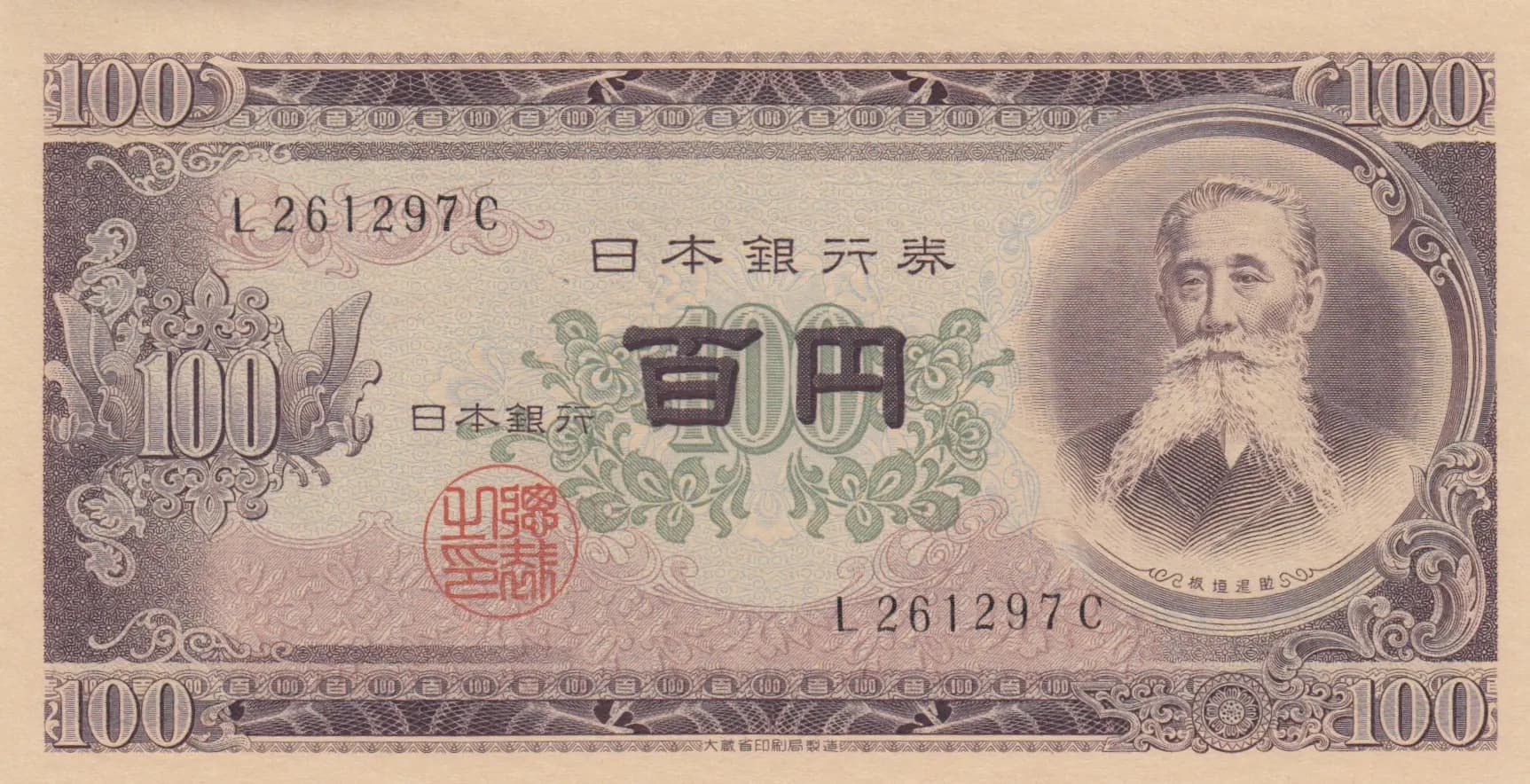
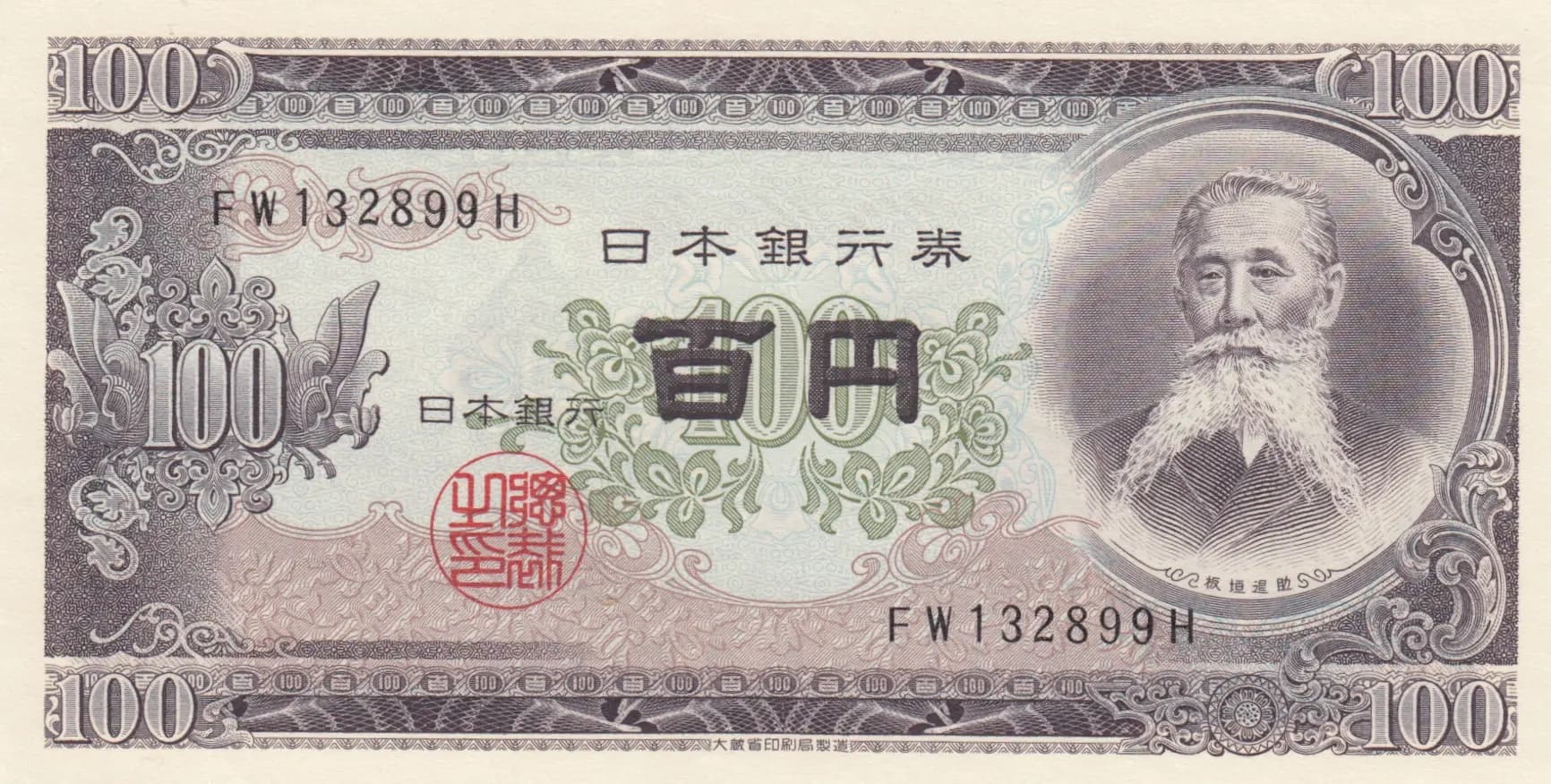
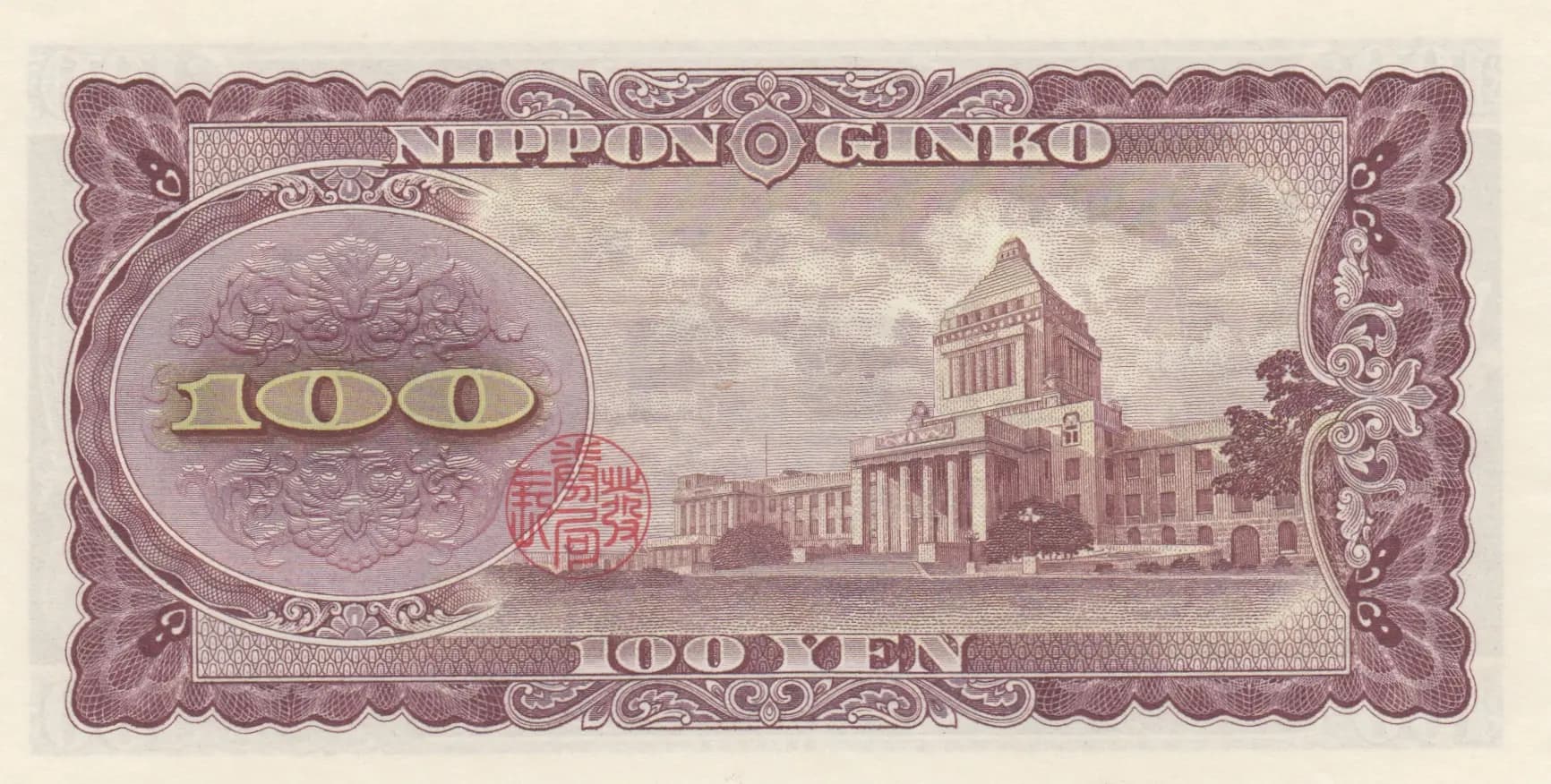
This is an uncirculated 1953 Japanese 100 yen banknote (Pick 90c) featuring a portrait of Taisuke Itagaki on the obverse and the Diet building on the reverse. The note displays pristine condition with crisp, vibrant colors—purple/mauve, green, and black—and exhibits the intricate fine-line engraving typical of post-war Japanese currency. The serial number FW132899H and double-letter prefix format are consistent with the 12 known varieties of this issue, making it a notable example of Japan's early postwar monetary reform.
Common. eBay sales data shows consistent availability with UNC examples selling for $2–$7 in recent years, and lower-graded examples frequently appearing at under $3. PMG-graded higher specimens (66–68) command $15–$35, but the absolute frequency of sales and low price points indicate robust supply. The 1953 100 yen was a regular issue with substantial print runs, and the 12 known varieties further suggest no scarcity of any single variety.
Issued in 1953, this banknote reflects Japan's stabilization period following World War II and the occupation era. The portrait of Itagaki Taisuke, a key Meiji-era political figure and advocate of parliamentary democracy, underscores the democratic values being reinforced during Japan's reconstruction. The reverse featuring the Diet building—the seat of Japanese parliamentary government—further emphasizes the nation's commitment to constitutional democracy during this pivotal period of economic and political recovery.
The obverse features a formal portrait of Taisuke Itagaki (1837–1919), a prominent Meiji-era statesman and founding member of the Liberal Party, depicted in right profile within an oval decorative frame. His long beard and formal Victorian-style clothing reflect his historical period. The reverse showcases the Japanese Diet building (Parliament building) in classical Western architectural style, complete with a distinctive domed tower/cupola, columns, and surrounding grounds with trees—a symbol of Japan's parliamentary system. Both sides employ ornate decorative borders with repeating denomination marks, red circular seals (chop marks), and intricate geometric patterns characteristic of 1950s Bank of Japan design.
Front side: '日本銀行券' (Nippon Ginko Ken) = 'Bank of Japan Note'; '百円' (Hyakuen) = '100 yen'; '100' in Arabic numerals; Serial number 'FW132899H'. Back side: 'NIPPON GINKO' (Latin characters) = 'Bank of Japan'; '100' in Arabic numerals; 'YEN' (Latin characters).
Intaglio (recess) printing, evidenced by the fine-line engraving visible throughout the design, complex geometric border patterns, and the depth and precision of the ornamental details. The note exhibits the high-security printing standards of the Bank of Japan, likely produced by the Bureau of Engraving and Printing or contracted security printer. The multi-layered decorative background patterns and intricate line work are hallmarks of intaglio currency production from this era.
This note is identified as Pick 90c, one of 12 documented varieties of the 1953 100 yen issue. The double-letter serial number prefix format ('FW' in this example) is characteristic of the series. Varieties exist based on different serial number prefix combinations; collectors distinguish between them by these prefixes. The white paper stock and brown-violet on green multicolor underprint are consistent across all varieties of this issue.