50 rials 1974
Market Prices
4 salesAbout This Note
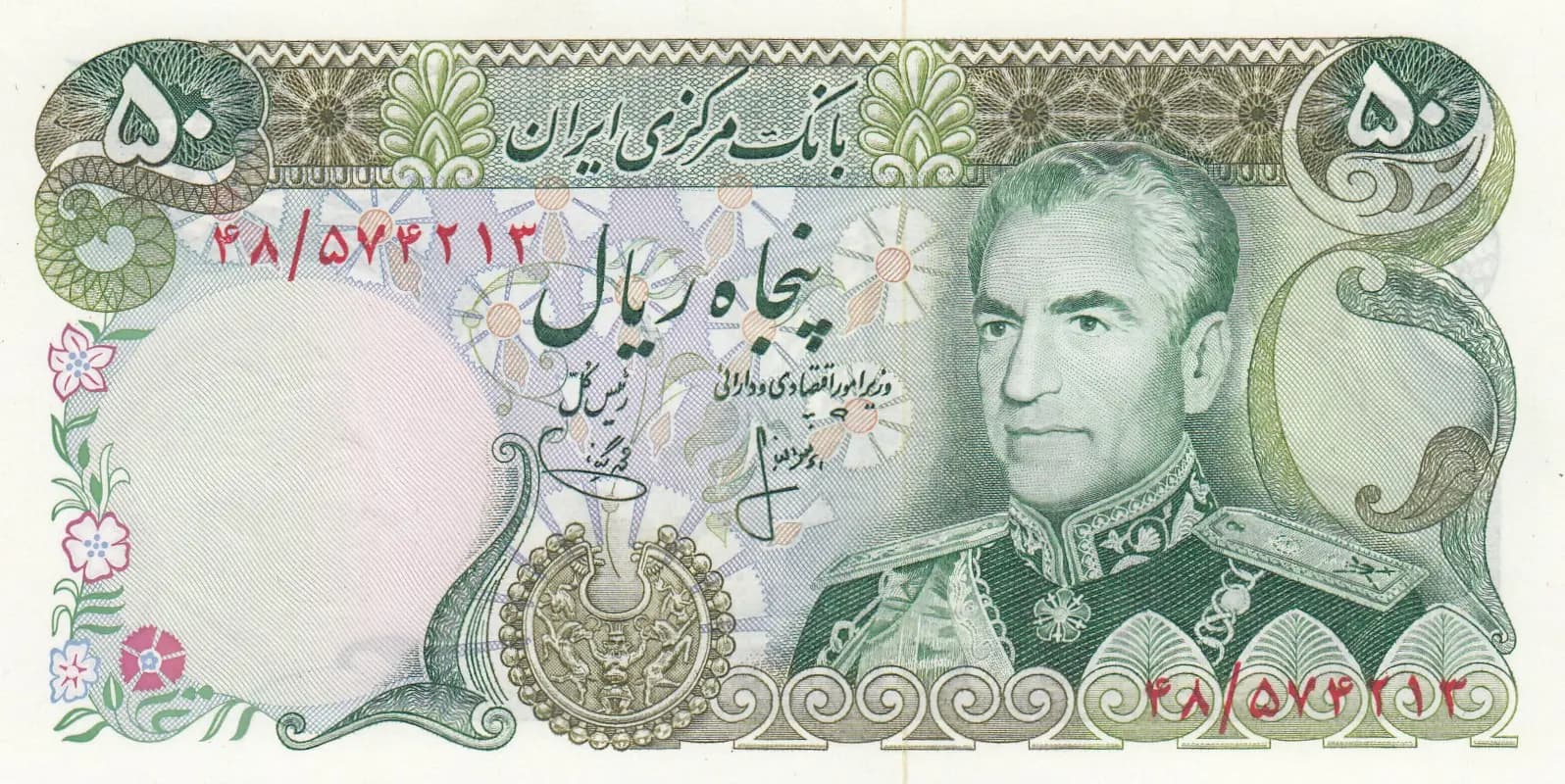
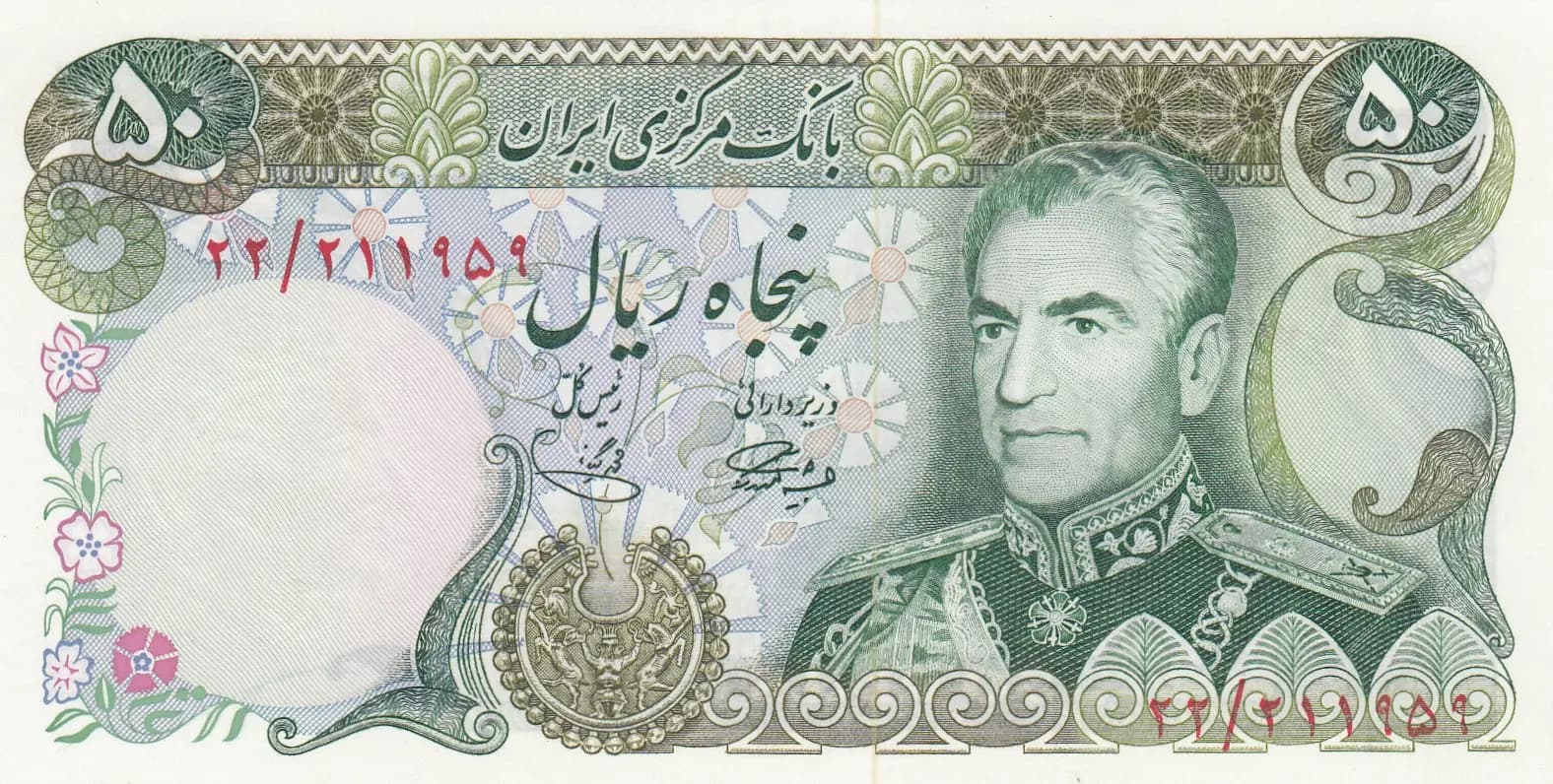
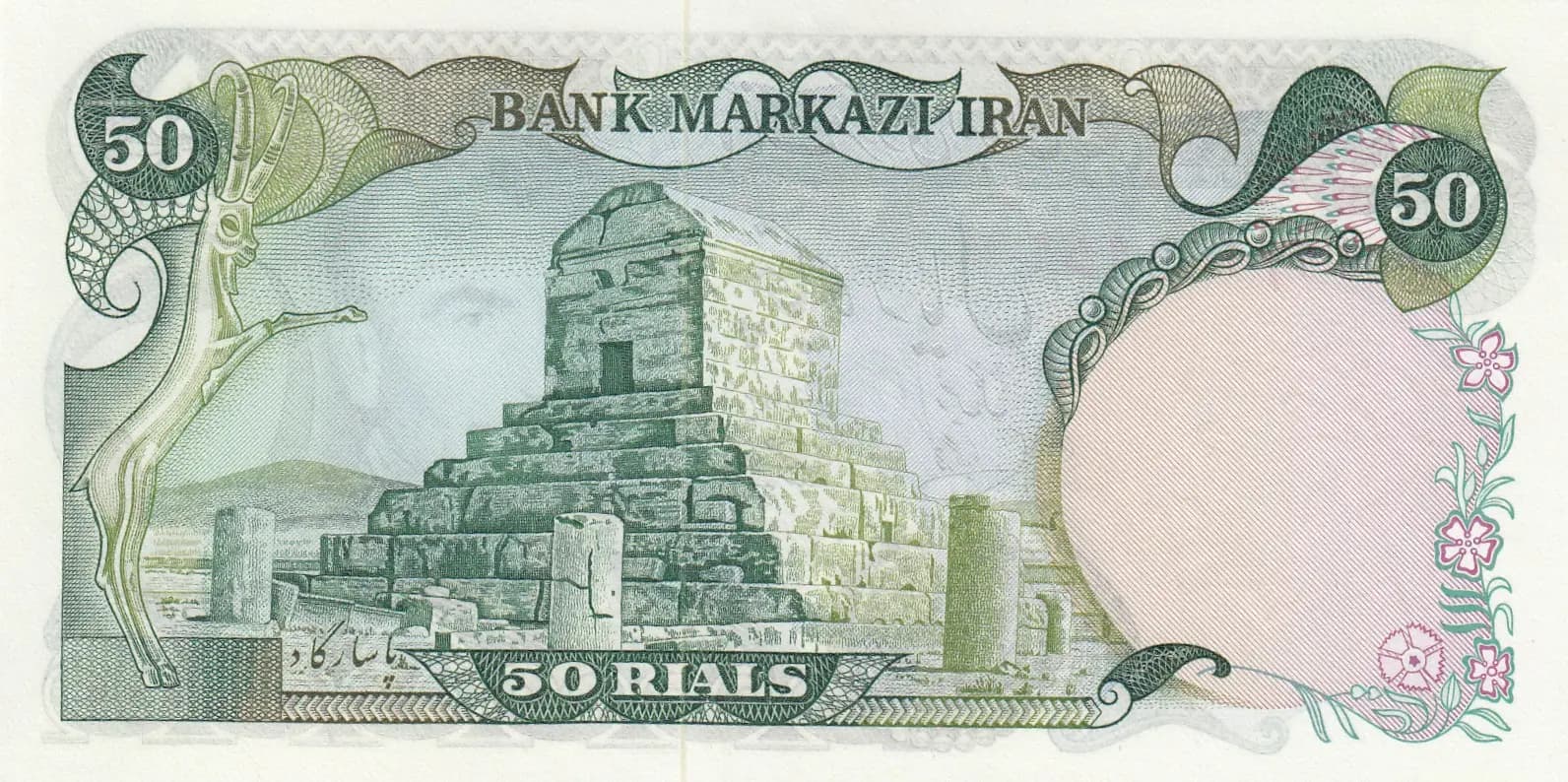
An outstanding uncirculated example of the Iranian 50 Rials from 1974, featuring a formal military portrait of Shah Mohammad Reza Pahlavi on the obverse and the historically significant Tomb of Cyrus the Great at Pasargadae on the reverse. The note displays pristine condition with crisp paper, vibrant color saturation in greens and browns, and exceptional detail in the fine-line engraving and guilloche patterns throughout, exemplifying the high-quality currency production of Iran's pre-revolutionary period.
Common. This is a standard circulation issue from the 1974-1979 series with a substantial print run. Market data from realbanknotes.com indicates eBay sales typically ranging from $2.75 to $9.00, with 2019 catalogue valuations of $12 UNC—well below the thresholds that would indicate scarcity. The existence of four documented Pick number variants (101a, 101b, 101d, 101e) further indicates this was a widely produced denomination. No evidence suggests restricted printing, recall, or limited availability.
Issued during the reign of Shah Mohammad Reza Pahlavi (1941-1979), this note represents the modernization era of Iran's currency under Bank Markazi Iran. The deliberate inclusion of Cyrus the Great's tomb on the reverse reflects the Shah's political ideology linking contemporary Iran to its pre-Islamic imperial heritage, a significant nationalist symbol during this period. The formal military dress portrait and refined security features demonstrate the Bank Markazi's commitment to producing currency worthy of Iran's perceived status as a regional power during the petroleum-rich 1970s.
The obverse features a right-facing portrait of Shah Mohammad Reza Pahlavi rendered in formal military dress with decorated shoulder insignia, positioned on the right side of the note. The composition incorporates elaborate Persian design elements including an ornamental vessel or urn in the center-left, surrounded by floral motifs in pink and green tones. Heart-shaped numeral designs incorporating the denomination frame the composition. The reverse depicts the Tomb of Cyrus the Great at Pasargadae, rendered as a crenellated stone structure with multiple architectural tiers, shown in green and brown tones. Both sides feature matching ornate decorative borders with scrollwork, geometric patterns, and floral designs characteristic of Persian aesthetic traditions. The color palette—predominantly green, beige, white, pink, and brown—creates visual harmony across the denomination.
Front: 'بانک مرکزی ایران' (Bank Markazi Iran / Central Bank of Iran), 'پنجاه ریال' (Fifty Rials), '27/11/1951' (date in Persian calendar format, corresponding to 1974 Gregorian). The numeral '5' appears as a denomination marker. Back: 'BANK MARKAZT IRAN' (Bank Markazi Iran in English transliteration), '50' (denomination in corners), 'RIALS' (currency designation in English).
Intaglio engraving with fine-line guilloche patterns and complex geometric border designs. The security features include intricate watermark areas, detailed portrait engraving, and elaborate architectural rendering visible in the high-quality paper and crisp impression. Printer: TDLR (a security printer contracted by Bank Markazi Iran). The note exhibits offset printing in select center areas as observed in the visual analysis.
This note is catalogued as Pick P-101a, identified by printer TDLR. The PMG population report documents four variants of this base Pick number (101a, 101b, 101d, 101e), suggesting security features or printing characteristics differentiate varieties within the same denomination and issue period. The specific variety would be confirmed by examining serial number prefixes, security thread characteristics, and precise printing variations. Visual inspection indicates the yellow security thread mentioned in external references, consistent with 101a specifications.