5000 rupiah 1958
Market Prices
58 salesAbout This Note
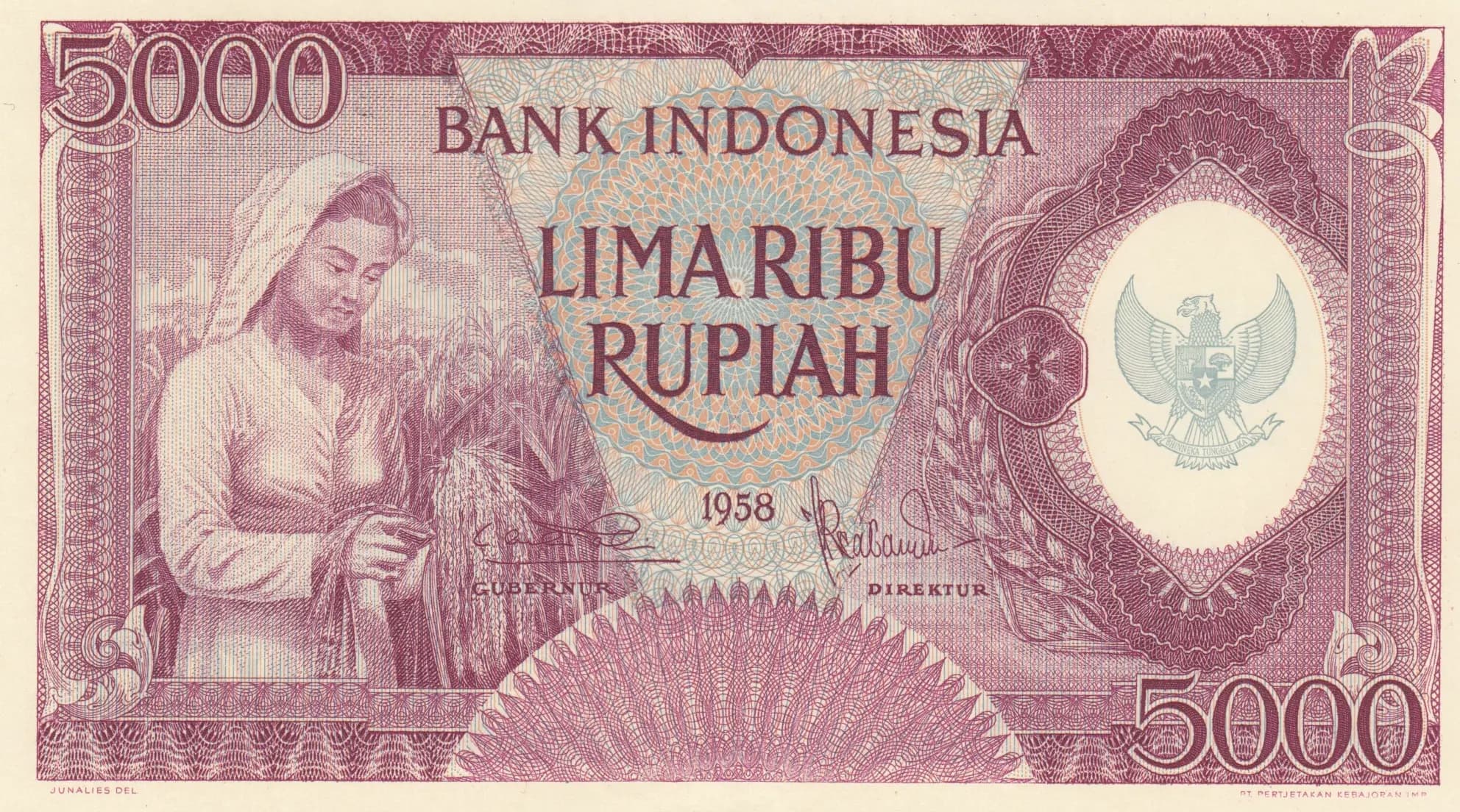
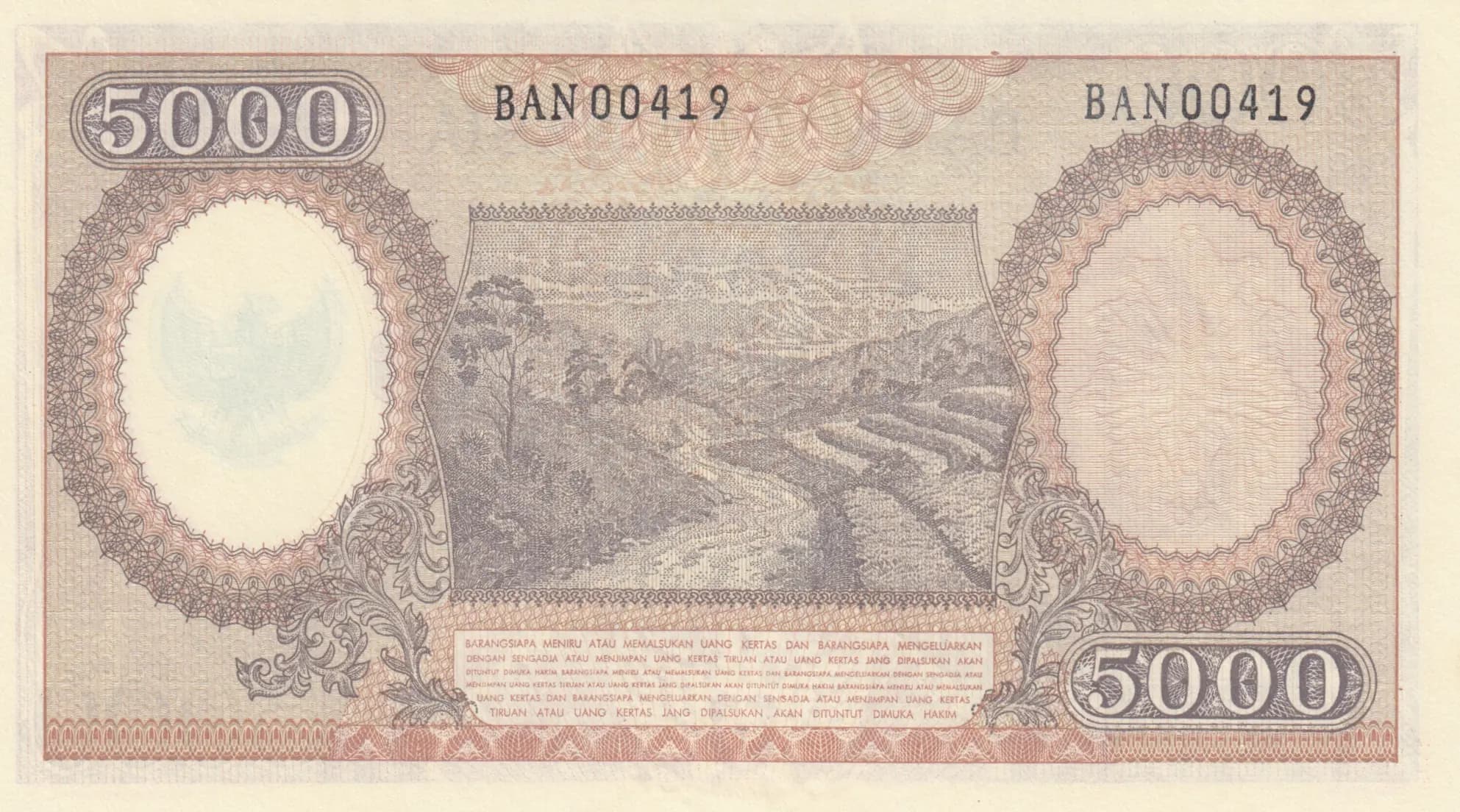
This is an exceptional example of Indonesia's 1958 5000 Rupiah note (Pick P-64) in uncirculated condition, displaying the characteristic mauve and cream color scheme with sharp, crisp impressions throughout. The front features a dignified portrait of a woman in traditional Indonesian dress engaged in textile work, complemented by the Indonesian national emblem (Garuda Pancasila) in an oval medallion, while the reverse showcases a detailed landscape vignette of rice paddies and agricultural fields representing Indonesia's agrarian heritage. As a high-denomination note from Indonesia's early independence period, this represents an important piece of the nation's numismatic history with strong collector demand, as evidenced by consistent eBay market prices ranging from $40-70 for uncirculated examples.
Common. This note trades regularly on secondary markets with consistent eBay auction results spanning from 2009 to 2026, with UNC and AUNC examples typically selling in the $40-70 range, and even high-grade certified examples (PMG 65-66) generally achieving $100-200. The extensive price history and continuous market availability indicate healthy circulation among collectors with no significant supply constraints. The 1958 denomination series was a regular issue of Bank Indonesia with substantial print runs.
Issued in 1958, just seven years after Indonesia's declaration of independence, this banknote reflects the young nation's efforts to establish its own currency identity and economic sovereignty under Bank Indonesia's authority. The imagery—a peasant woman engaged in textile production and rice terraces—deliberately celebrates Indonesia's agricultural and artisanal heritage, emphasizing the labor and traditions that formed the foundation of the newly independent state. The inclusion of the Garuda Pancasila emblem reinforces national identity and the five principles (Pancasila) upon which the Indonesian republic was founded.
The obverse (front) presents a left-aligned portrait of an Indonesian peasant woman wearing traditional dress with a distinctive head covering, depicted in the act of textile work, rendered in fine intaglio detail against a mauve background. The right side features the Garuda Pancasila—Indonesia's national emblem depicting an eagle with outstretched wings—enclosed within an oval medallion, serving as a powerful symbol of national authority. Ornamental filigree patterns and geometric designs frame the entire note, with the denomination '5000' and text identifying the issuer prominently displayed in the central area. The reverse (back) showcases a classical landscape vignette centered on the note, depicting rice terraces and agricultural fields with trees in shades of brown and tan, flanked by two large circular ornamental frames. The composition emphasizes Indonesia's agricultural wealth and rural character. Both sides incorporate fine line work, cross-hatching, and intricate engraving to create visual security features and aesthetic appeal typical of mid-20th century banknote design.
Front side: 'BANK INDONESIA' (Bank Indonesia); 'LIMA RIBU RUPIAH' (Five Thousand Rupiah); '5000' (denomination numerals); '1958' (issue year); 'GUBERNUR' (Governor); 'DIREKTUR' (Director). Back side: '5000' (denomination numerals, appearing multiple times in corners); 'BAN00419' (serial number, appearing twice); 'BARANGSAPA MEMBIRU ATAU MEMALSUKAN UANG KERTAS DAN BARANGSAPA MENGELUARKAN DENGAN SENGAJA ATAU MENGHARAP UANG KERTAS TERUSAN ATAU UANG KERTAS YANG DIPALSUKAN AKAN DIHUKUM MENURUT UNDANG-UNDANG YANG BERLAKU' (Whoever counterfeits or forges banknotes and whoever deliberately circulates or attempts to circulate forged or counterfeit banknotes shall be punished according to applicable law).
This note was produced using intaglio (copperplate engraving) printing by Pertjetakan Kebajoran, the primary Indonesian security printer of the era. The visual evidence—fine parallel lines, precise cross-hatching, detailed portrait rendering, and crisp edge definition—are characteristic of traditional intaglio techniques. The watermark featuring the Indonesian arms was incorporated during paper manufacture. The multi-color printing effect (mauve on front, brown tones on reverse) was achieved through careful registration of separate intaglio plates, a standard security printing practice of the period.
The observed serial number prefix 'BAN' is consistent with this issue. Known varieties for the 1958 5000 Rupiah exist primarily in signature combinations (Governor and Director signatures vary by appointment dates) and serial number prefixes. The specific example examined shows serial number BAN00419, representing the early range of this series. No overprints, date changes, or other distinguishing varieties are apparent in the visual analysis, suggesting this is a standard circulation variety of Pick P-64.