5 sen 1945
Market Prices
23 salesAbout This Note
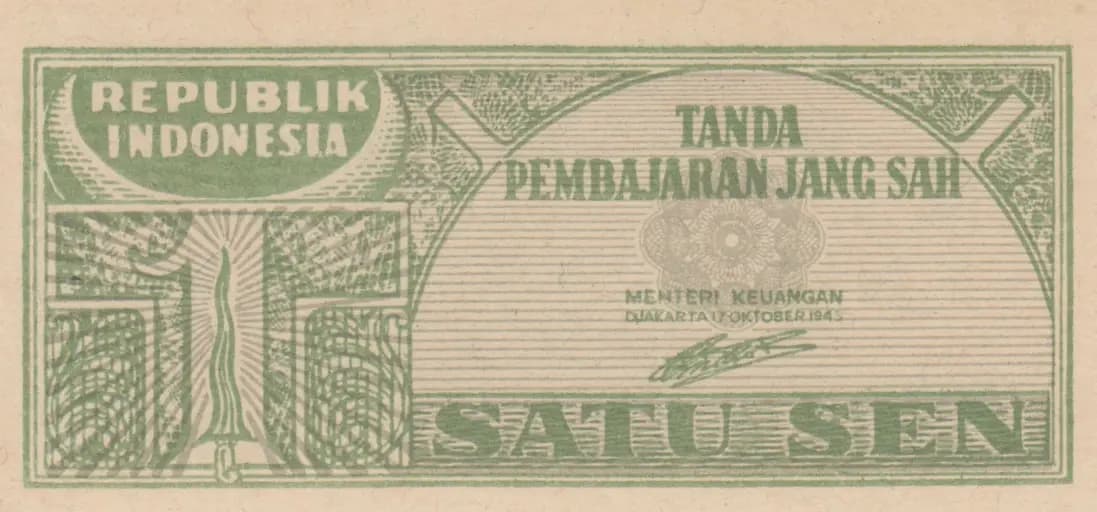
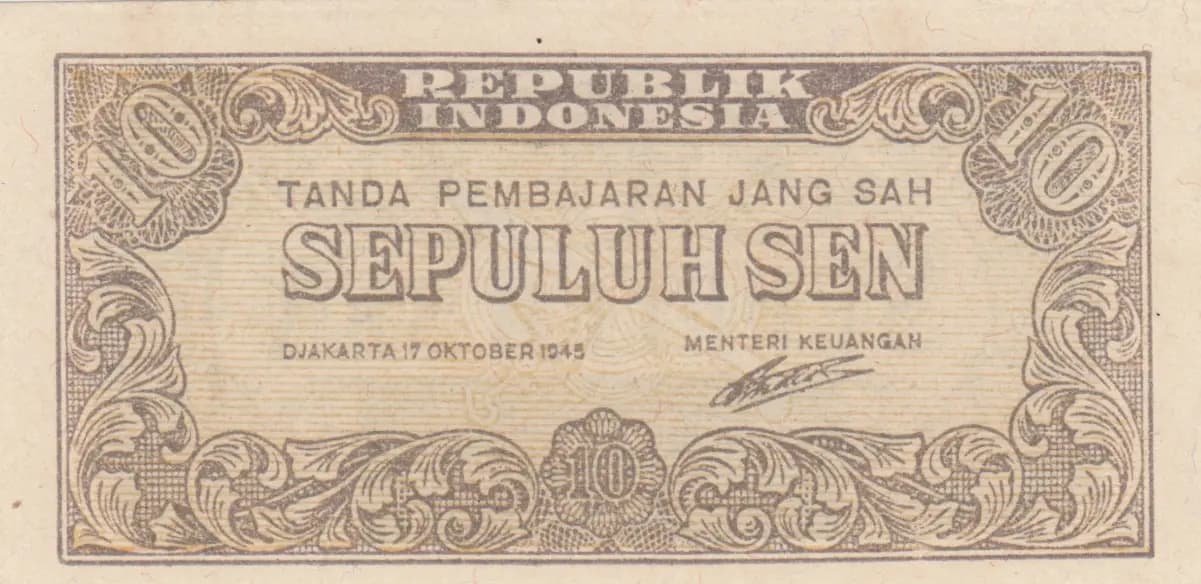
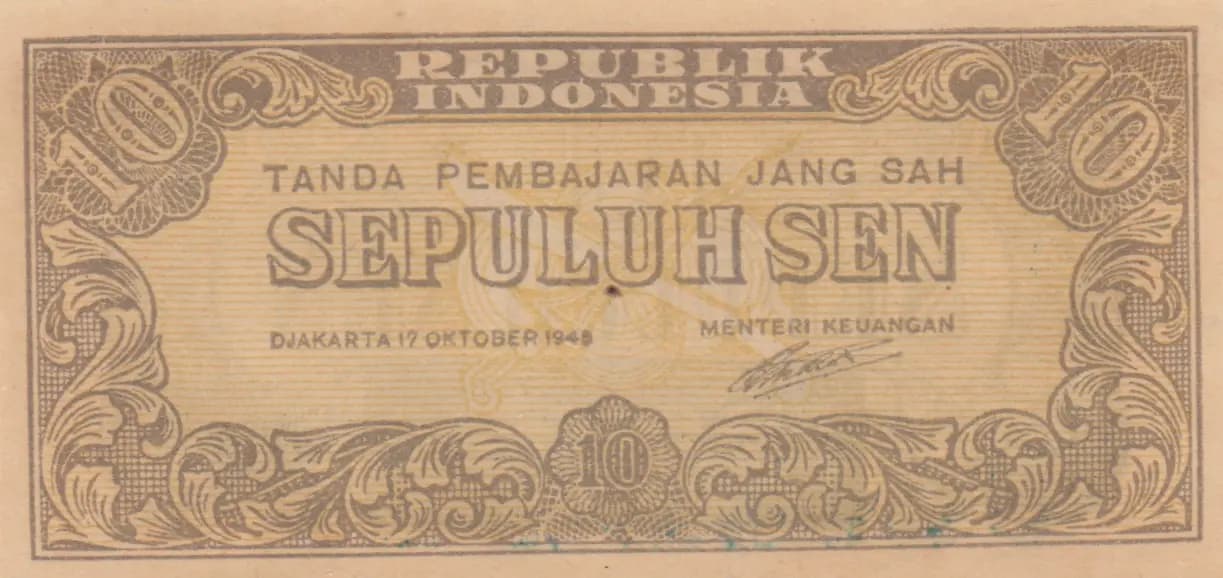
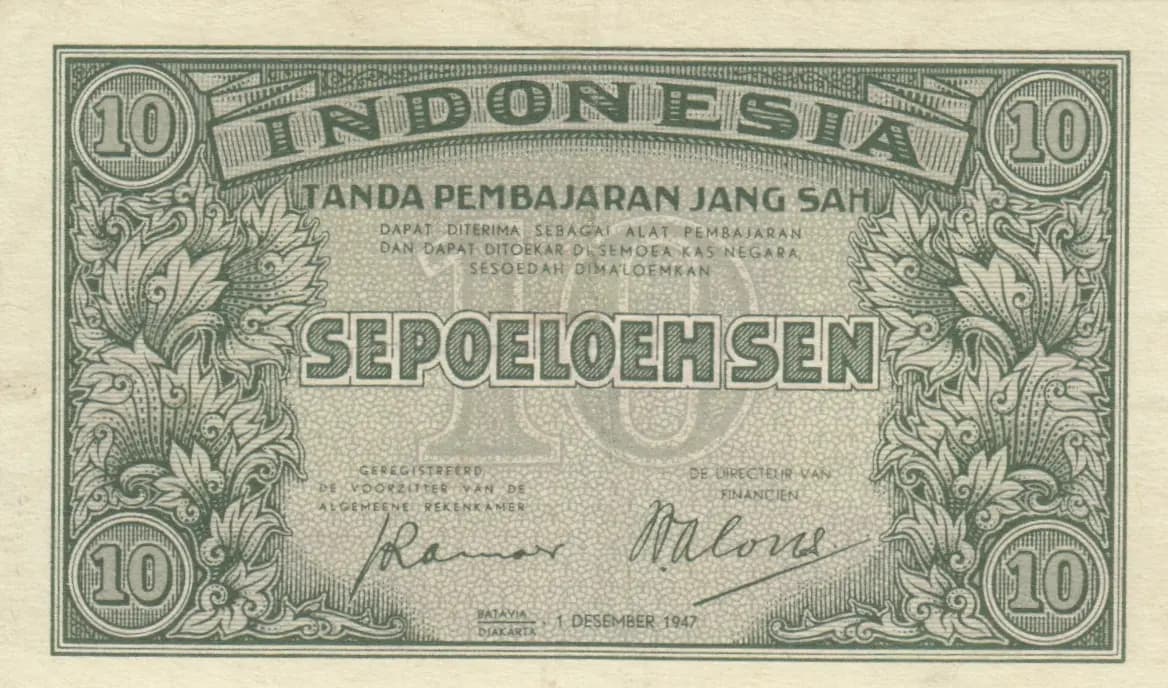
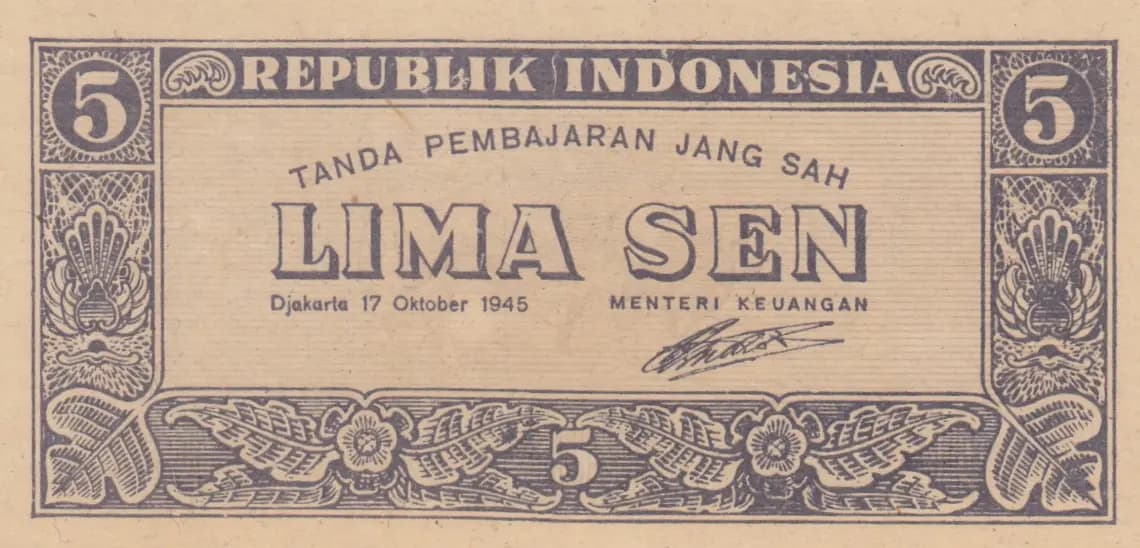
This is an exceptional example of the Indonesian Republic's first currency issue, the 5 sen note of October 17, 1945, cataloged as Pick P-14. The note displays the characteristic ornamental design of early Indonesian banknotes with decorative corner medallions, scrollwork borders, and fine intaglio printing. Despite visible age-related foxing and browning consistent with a historical specimen from nearly 80 years ago, the note retains good structural integrity and clarity of design elements, making it a significant artifact of Indonesia's independence and early monetary sovereignty.
Common. While historically significant as Indonesia's first currency issue, the 5 sen denomination was produced in substantial quantities to facilitate everyday commerce in the newly independent nation. eBay market data shows consistent sales of this note across multiple condition grades over many years (2013-2021), with UNC examples selling for $2-6.61 and even lower grades (VF, AUNC) commanding only $1-5, indicating robust supply and steady collector demand at modest price points. The note remains widely available to collectors and does not command scarcity premiums typical of genuinely rare issues.
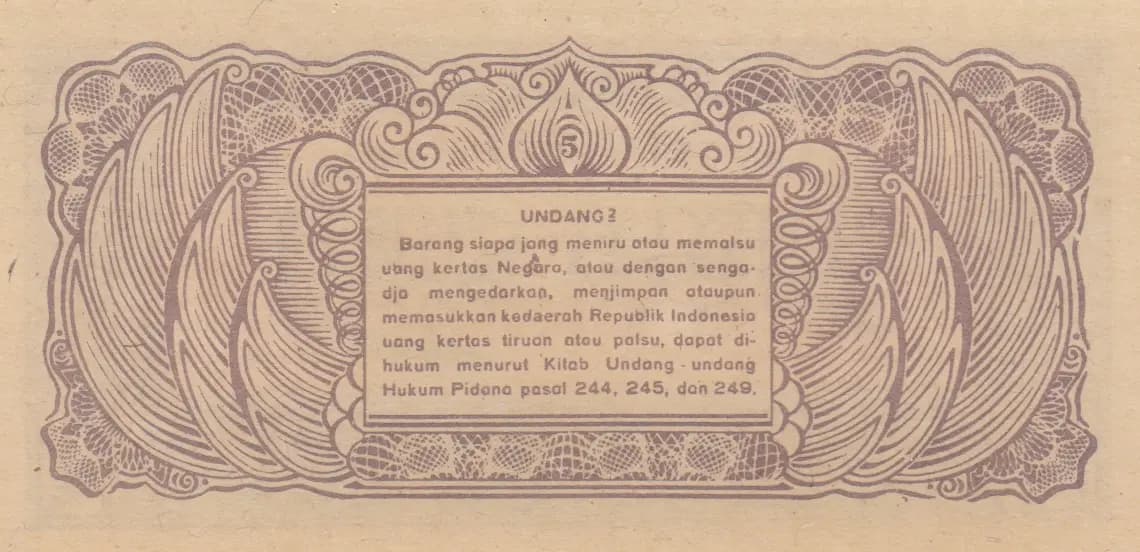
Issued just days after Indonesia declared independence on August 17, 1945, this 5 sen note represents the newly formed Republic of Indonesia's first currency, authorized by the Finance Minister in Jakarta. The formal legal tender declaration ('TANDA PEMBAJARAN JANG SAH') and criminal code warning printed on the reverse reflect the fledgling nation's efforts to establish monetary authority and legitimacy during the revolutionary period. The ornate, classical design aesthetic demonstrates the Republic's intention to project stability and governmental permanence despite the precarious political circumstances of the immediate post-war era.
The 5 sen note features a symmetrical, classically-inspired design layout characteristic of mid-20th century Indonesian banknote production. The front displays 'REPUBLIK INDONESIA' as the primary header with 'LIMA SEN' denomination prominently centered, flanked by decorative corner medallions containing the numeral 5 in ornate circular frames. The design employs elaborate ornamental scrollwork and floral botanical patterns in the borders and corner treatments. The reverse side presents a more complex ornamental frame composition with a central legal text panel surrounded by intricate decorative border work featuring curved designs and floral motifs, with the denomination numeral 5 displayed in a decorative cartouche at the top center. The color scheme utilizes tan/beige, dark gray-purple, and cream tones across the intaglio-printed surface.
FRONT SIDE: 'REPUBLIK INDONESIA' (Republic of Indonesia) — 'TANDA PEMBAJARAN JANG SAH' (Legal Tender) — 'LIMA SEN' (Five Sen) — 'Djakarta 17 Oktober 1945' (Jakarta 17 October 1945) — 'MENTERI KEUANGAN' (Minister of Finance) — Denomination numeral '5'. BACK SIDE: 'UNDANG 2' (Law/Statute 2) — 'Barang siapa jang meniru atau memalsu uang kertas Negaro, atau dengan sengadja mengedarkan, menjimpan ataupon memasukkan kedaeroh Republik Indonesia uang kertas tiruon atau palsu, dapat dihukum menurut Kilab Undang-undang Hukum Pidano pasal 244, 245, dan 249.' (Anyone who counterfeits or forges state banknotes, or intentionally circulates, keeps or brings counterfeit or forged banknotes into the territory of the Republic of Indonesia may be punished according to the Criminal Code articles 244, 245, and 249.) — Denomination numeral '5'.
The note was produced using intaglio (recess) printing, as evidenced by the fine, detailed line work visible in the ornamental designs, border scrollwork, and the crisp impression of the numerals and text. This high-security printing method was standard for government currency production and provides inherent anti-counterfeiting protection through the difficulty of replicating the intricate engraved details. The printer for this early Indonesian issue is not definitively identified in the available catalog data, though early Republican notes were produced through various government and security printing facilities during the transitional period of 1945-1946.
The specific variety designation for this Pick P-14 note cannot be definitively determined without examination of serial numbers, signature variants, or printer marks visible on the actual specimen. The PMG population report references variants P-141a through P-141h for related 1000 Rupiah notes with Pick cataloging, suggesting that multiple printing varieties exist within the early Indonesian currency series. However, without clear visibility of serial number prefixes, signature blocks, or printer identification marks in the provided visual analysis, the exact variety (if applicable to this 5 sen denomination) remains unspecified. Collectors should examine serial numbers and any mint marks for variety classification.