1 sen 1945
Market Prices
32 salesAbout This Note
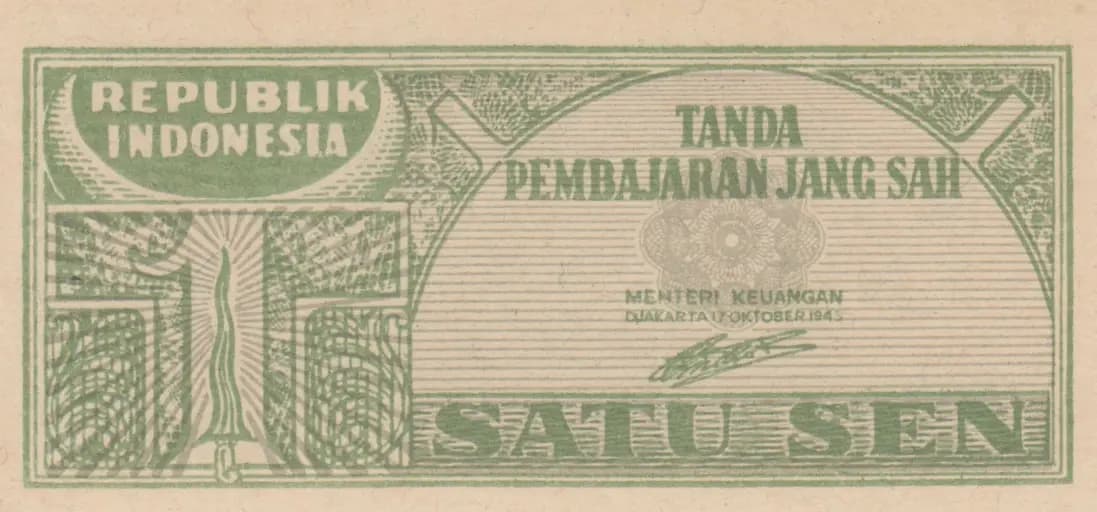
This is an uncirculated example of Indonesia's first currency issue, the 1 sen note from October 1945, featuring elegant green ornamental designs on a cream background. The note exhibits pristine condition with no wear, creases, or damage, displaying the fine line engraving and geometric sunburst patterns that characterize this historically significant emergency currency. As one of the Republic of Indonesia's earliest monetary instruments issued just weeks after independence, this UNC specimen represents an important piece of numismatic history from a nation's formative period.
Common. While this is an early issue from the Republic of Indonesia's first weeks, the eBay market data shows consistent sales in the $5-$25 range across multiple condition grades (UNC, AUNC, VF, PMG graded examples), with dozens of sales recorded over a 14-year period. The 2016 catalog value for UNC is listed as $2, and more recent UNC examples have sold for $5-$15, indicating substantial availability in the collector market. The small denomination and likely large print run typical of 1-sen denominations support a common classification despite the historical significance.
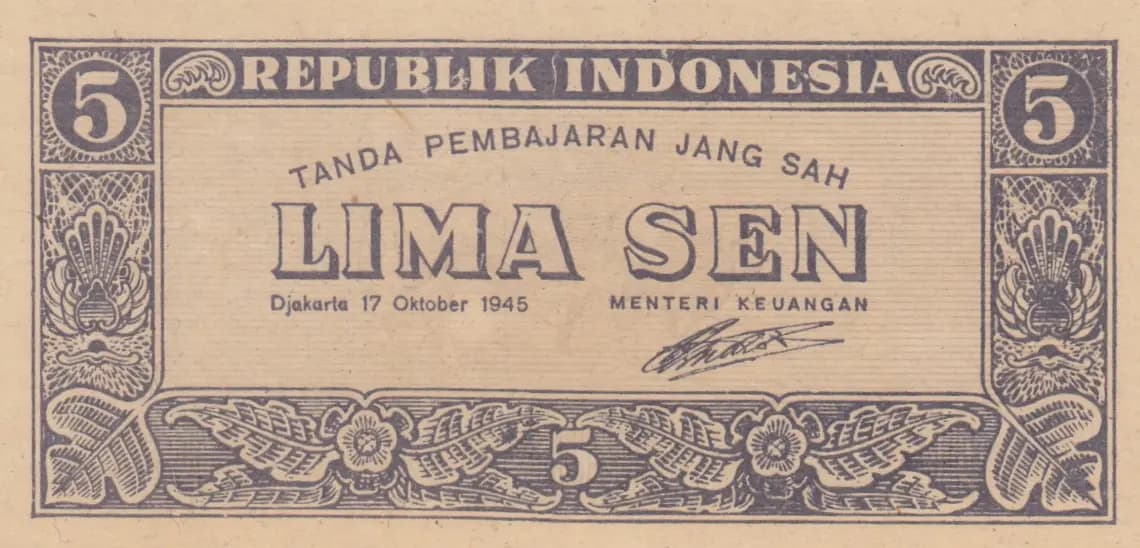
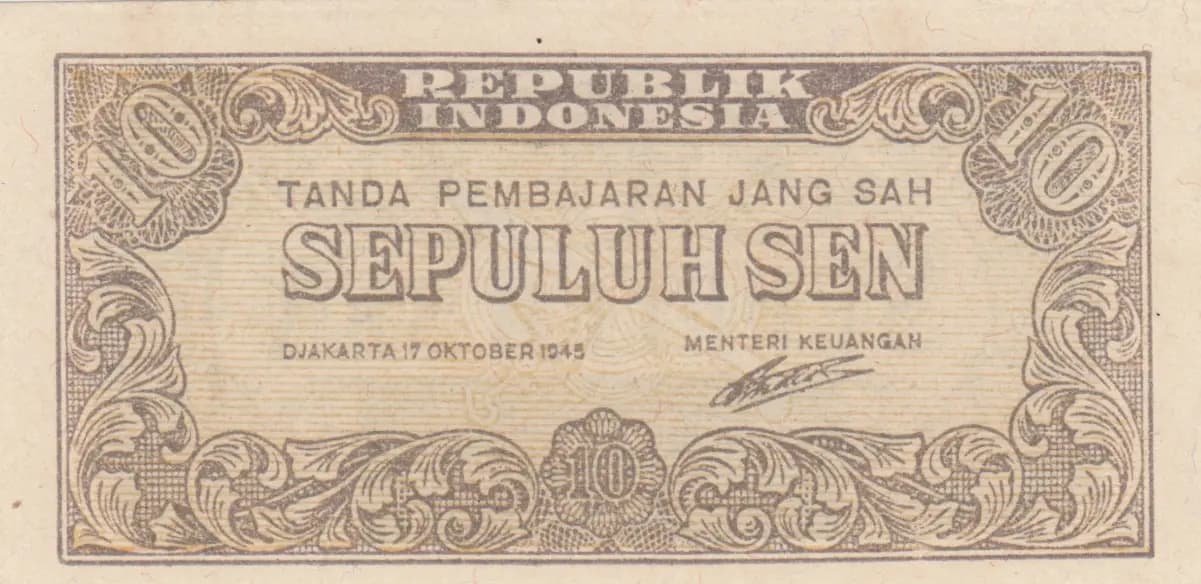
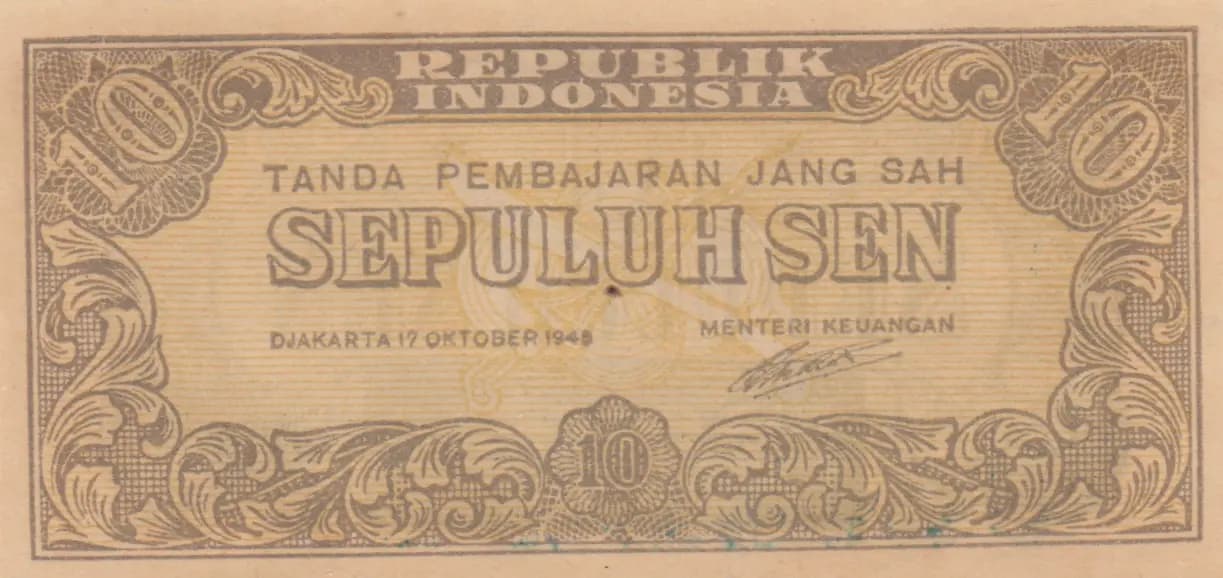
This 1 sen note was issued on October 17, 1945, just days after Indonesia declared independence from the Netherlands on August 17, 1945. The note bears the oval seal of 'Republik Indonesia' and is countersigned by the Minister of Finance (Menteri Keuangan), reflecting the new nation's urgent need to establish its own monetary system during the revolutionary period. The Jakarta date (Djakarta U Oktober 194-) and Indonesian-language inscriptions emphasize the sovereignty of the fledgling republic during its critical first weeks of existence.
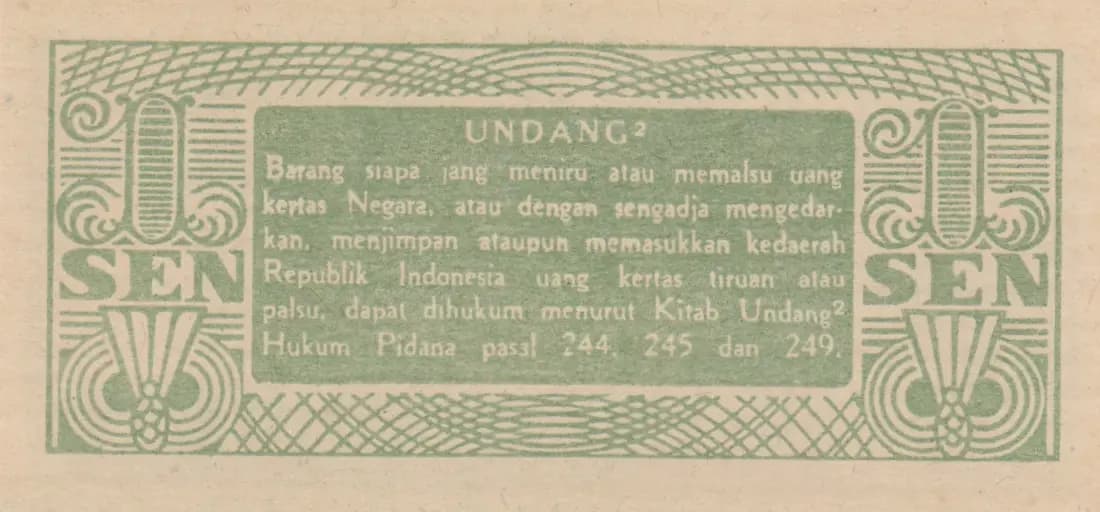
The 1 sen note features a symmetrical ornamental design typical of mid-20th century currency production. Both sides employ intricate geometric patterns, with radiating sunburst designs and spiral ornaments positioned in the corners and flanking a central rectangular text box on the reverse. The front displays the denomination 'SATU SEN' prominently with the Republic of Indonesia's official seal, while the back contains the legal counterfeit warning. The note employs a restrained two-color printing scheme of green and black on a cream/beige paper stock. No portrait or specific landmark is depicted; instead, the design relies entirely on abstract ornamental geometry and typography to convey official authority and deter counterfeiting—a practical choice for an emergency currency issued during the revolutionary period.
FRONT SIDE: 'SATU SEN' (One sen) - the denomination; 'REPUBLIK INDONESIA' (Republic of Indonesia) - issuing authority in oval seal; 'TANDA PEMBAJARAN JANG SAHI' (Official means of payment) - legal tender declaration; 'MENTERI KEUANGAN' (Minister of Finance) - authorizing official; 'DJAKARTA U OKTOBER 194-' (Jakarta in October 194-) - date and place of issue. BACK SIDE: 'SEN' (Sen) - denomination repeated on both left and right sides; 'UNDANG²' (Laws/Regulations) - heading for the legal warning; 'Barang siapa jang meniru atau memalsu uang kertas Negara, atau dengan sengaja mengedarkan, menjimpan ataupun memasukkan kederuh Republik Indonesia uang kertas tiruan atau palsu, dapat dihukum menurut Kitab Undang² Hukum Pidana pasal 244, 245 dan 249.' (Whoever counterfeits or forges state banknotes, or deliberately circulates, keeps or brings into the territory of the Republic of Indonesia counterfeit or false banknotes, can be punished according to the Penal Code articles 244, 245 and 249) - anti-counterfeiting warning.
The note was produced using intaglio line engraving, evidenced by the fine line work visible throughout the ornamental designs and the sharp definition of the geometric patterns. The intricate radiating sunburst patterns and decorative borders are characteristic of hand-engraved security printing typical of currency production in the 1940s. The visual analysis confirms fine line engraving as the primary security feature. The specific printer for this issue is not definitively documented in the Pick catalog or PMG records provided, though JEZ is noted as printer for the variant P-13a (5 Gulden); the identity of the printer for the P-13 sen denomination remains uncertain.
The Pick catalog lists this as P-13, with three known variants catalogued by PMG: P-130a (5 Roepiah), P-131s (10 Roepiah), and P-13a (5 Gulden), indicating that the base Pick number encompasses multiple denominations from this 1945 issue. The observed specimen appears to be the standard 1 sen variety (P-13) without obvious overprints or signature variations visible from the images. No specific serial numbers, date variations, or printer marks are clearly distinguishable in the provided visual analysis to further narrow the variety, though future examination might reveal signature variants or printer identifications consistent with other notes from this series.