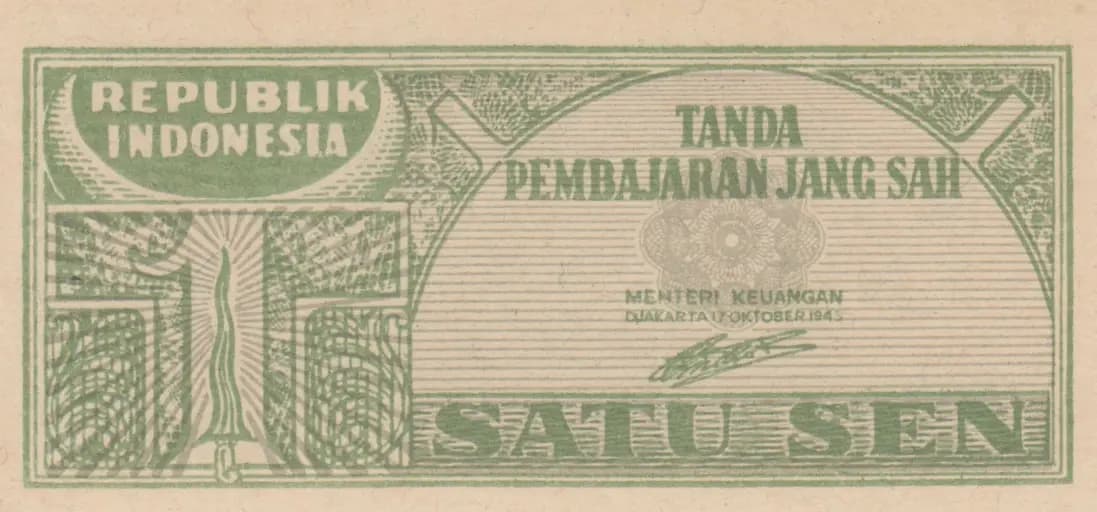
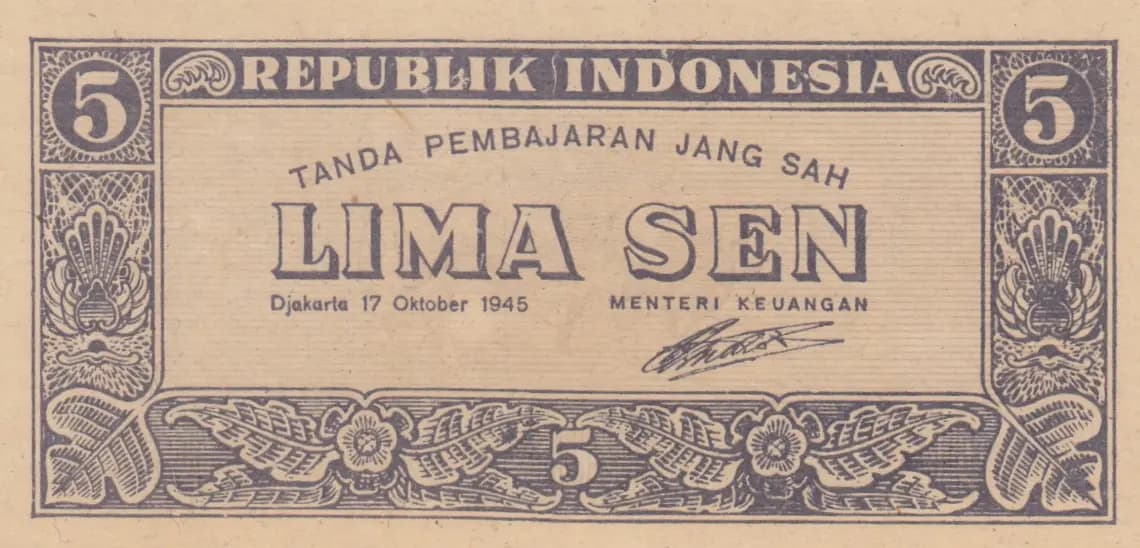
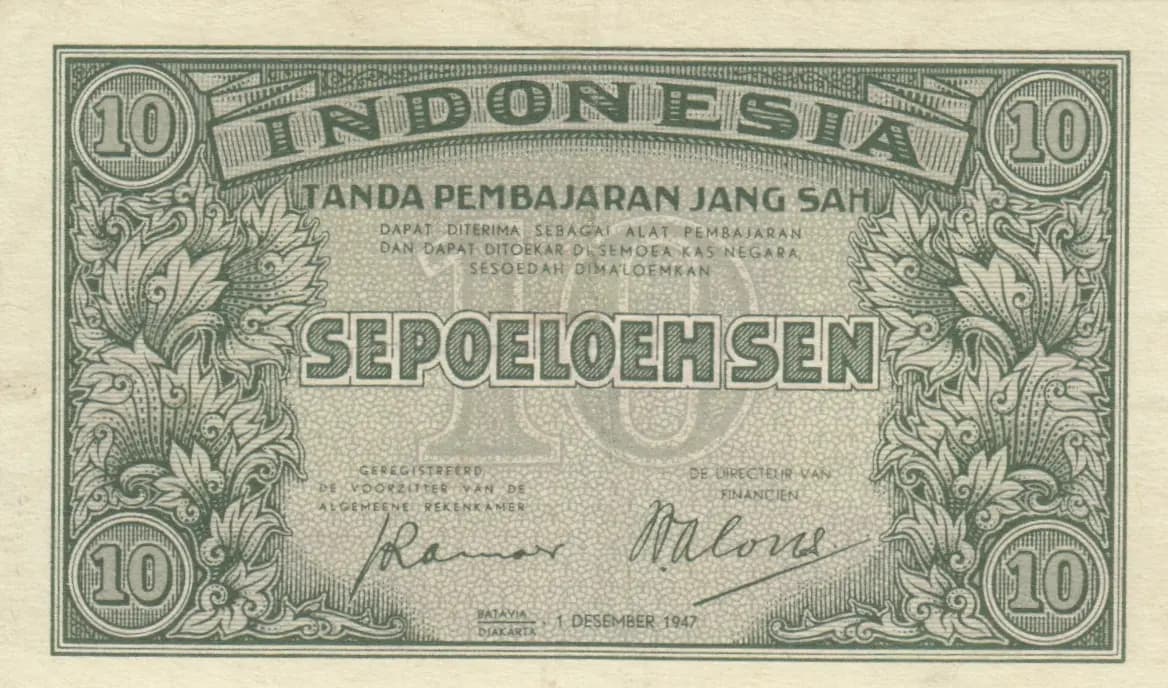
10 sen 1945
Market Prices
18 salesAbout This Note
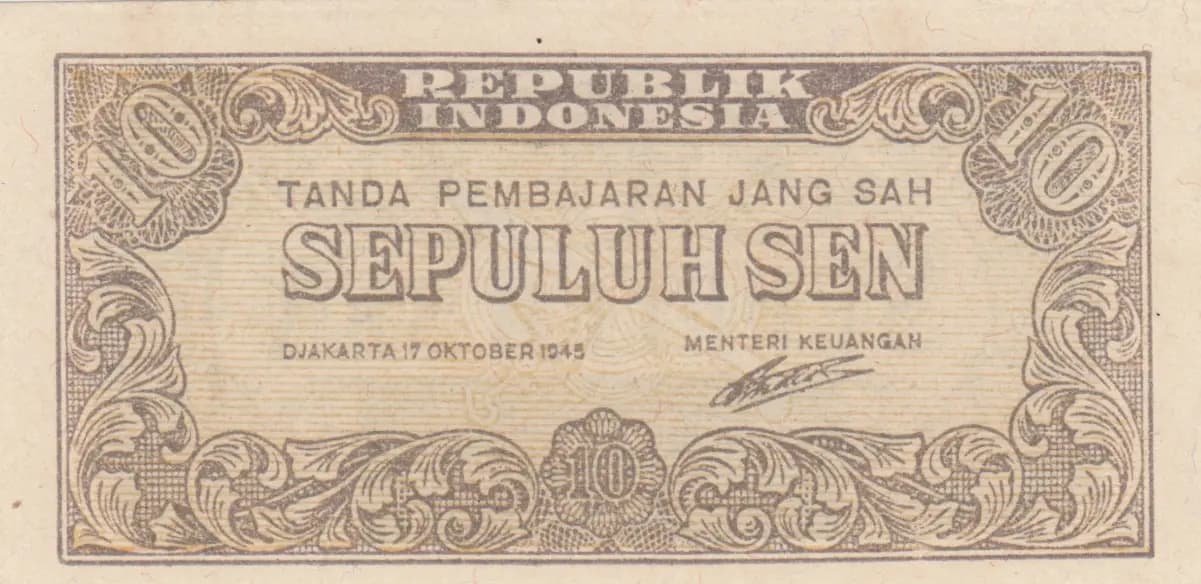
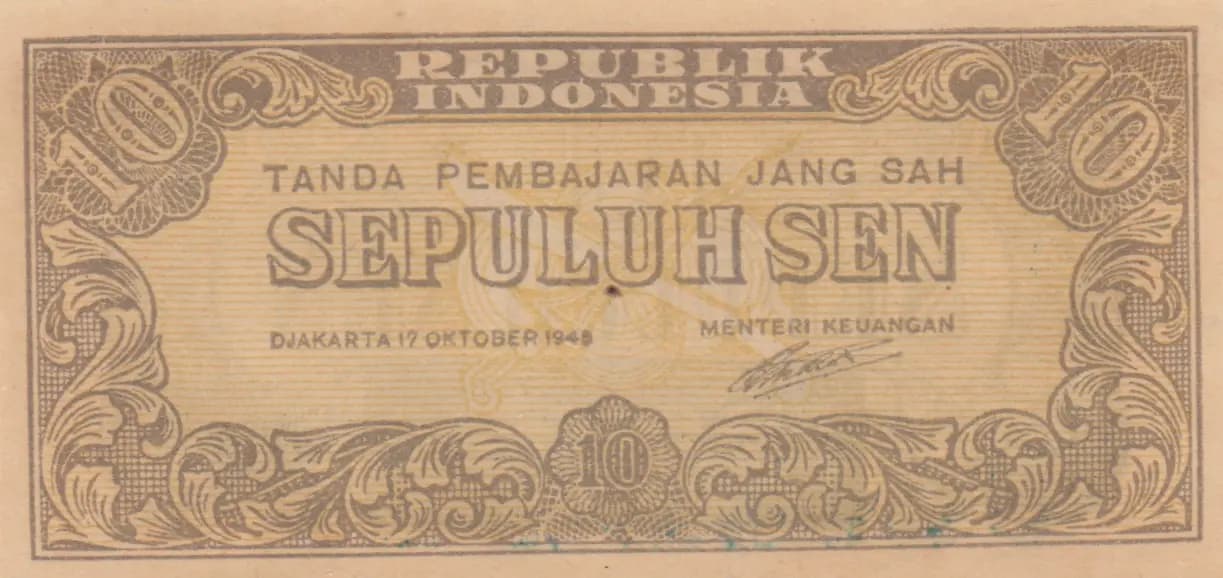
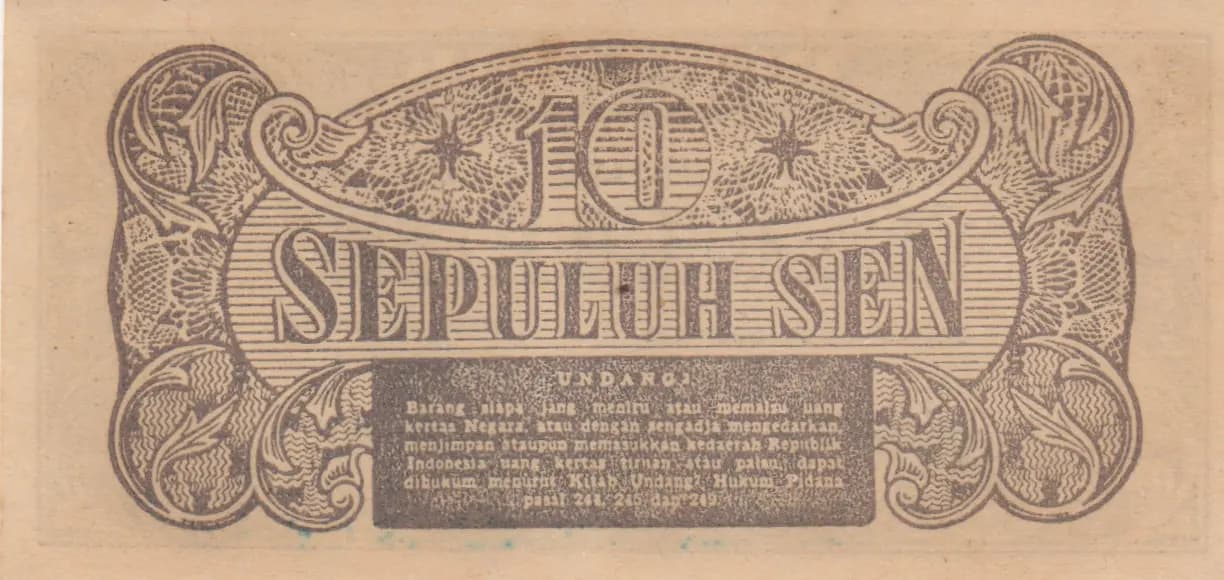
This is an Indonesian 10 Sen note from October 17, 1945, representing one of the earliest currency issues of the newly independent Republic of Indonesia. The note displays excellent condition with clear, legible printing in brown and gray tones on a tan/beige background, featuring ornate decorative borders and oval denomination medallions characteristic of early Indonesian currency design. This UNC specimen is notable as a historically significant example of Indonesia's immediate post-independence monetary system, with no visible wear, creases, or tears.
Common. The eBay price tracking data shows consistent sales ranging from $2.99 to $36 depending on grade, with most UNC and near-UNC specimens selling in the $5–$20 range. The 2016 catalog value for UNC condition is listed at $3, indicating widespread availability. While historically significant as an early independence issue, the note was produced in sufficient quantity to be readily obtainable by collectors today. No evidence of scarcity in the PMG or eBay markets.
Issued on October 17, 1945—just days after Indonesia's declaration of independence on August 17, 1945—this banknote represents the Republic's first attempt to establish its own currency independent of Dutch colonial authority. The inscription 'REPUBLIK INDONESIA' and 'DJAKARTA 17 OKTOBER 1945' directly commemorate this pivotal moment in Indonesian history. The note's design with traditional Indonesian ornamental elements reflects the new nation's cultural identity and sovereignty.
The note features a classical engraved design with no portraits or specific named landmarks. The primary design elements are ornamental rather than figural: elaborate scrollwork borders in all four corners with symmetrical floral and geometric patterns, creating a frame around the composition. The denomination '10' is prominently displayed in ornate oval cartouches in both the upper corners of the obverse and the center upper portion of the reverse. The tan/beige background with brown and gray printing creates a sophisticated, traditional appearance typical of early 20th-century currency design. The fine line engraving throughout provides visual depth and complexity to the ornamental patterns.
FRONT SIDE: 'REPUBLIK INDONESIA' (Republic of Indonesia) — official issuer; 'TANDA PEMBAJARAN JANG SAH' (Valid Payment Certificate / Legal Tender); 'SEPULUH SEN' (Ten Sen) — denomination in words; 'DJAKARTA 17 OKTOBER 1945' (Jakarta October 17, 1945) — issue date and location; 'MENTERI KEUANGAN' (Finance Minister) — signatory authority. BACK SIDE: '10' (Arabic numeral denomination); 'SEPULUH SEN' (Ten Sen) — denomination repeated; '[Terms and conditions/legal text]' (UNDANG- indicating statutory/legal basis) — fine print stating legal authority for the note, partially legible.
Intaglio/steel plate engraving, evidenced by the fine line patterns, detailed scrollwork, and the dimensional quality of the ornamental design visible in the images. The security features include complex border patterns and fine horizontal line work typical of contemporary security printers. The specific printer is not definitively documented in available catalogs for this Pick number variant, though early Indonesian currency often utilized Dutch or German printers.
This note is cataloged as Pick P-15b (10 Sen, 1945). The Pick catalog indicates at least one variant (P-15a, identified as 25 Gulden by the PMG population report, though this appears to be a cataloging reference). The specific 'b' designation suggests a known variety distinction, likely related to printing differences, series variations, or watermark/security feature differences. Without access to the original Pick catalog's detailed variety descriptions, the precise distinction between P-15a and P-15b cannot be definitively stated from the visual analysis alone. Serial number visibility and signature variations are potential distinguishing features typical of this period.