500 rupiah 1958
Market Prices
14 salesAbout This Note
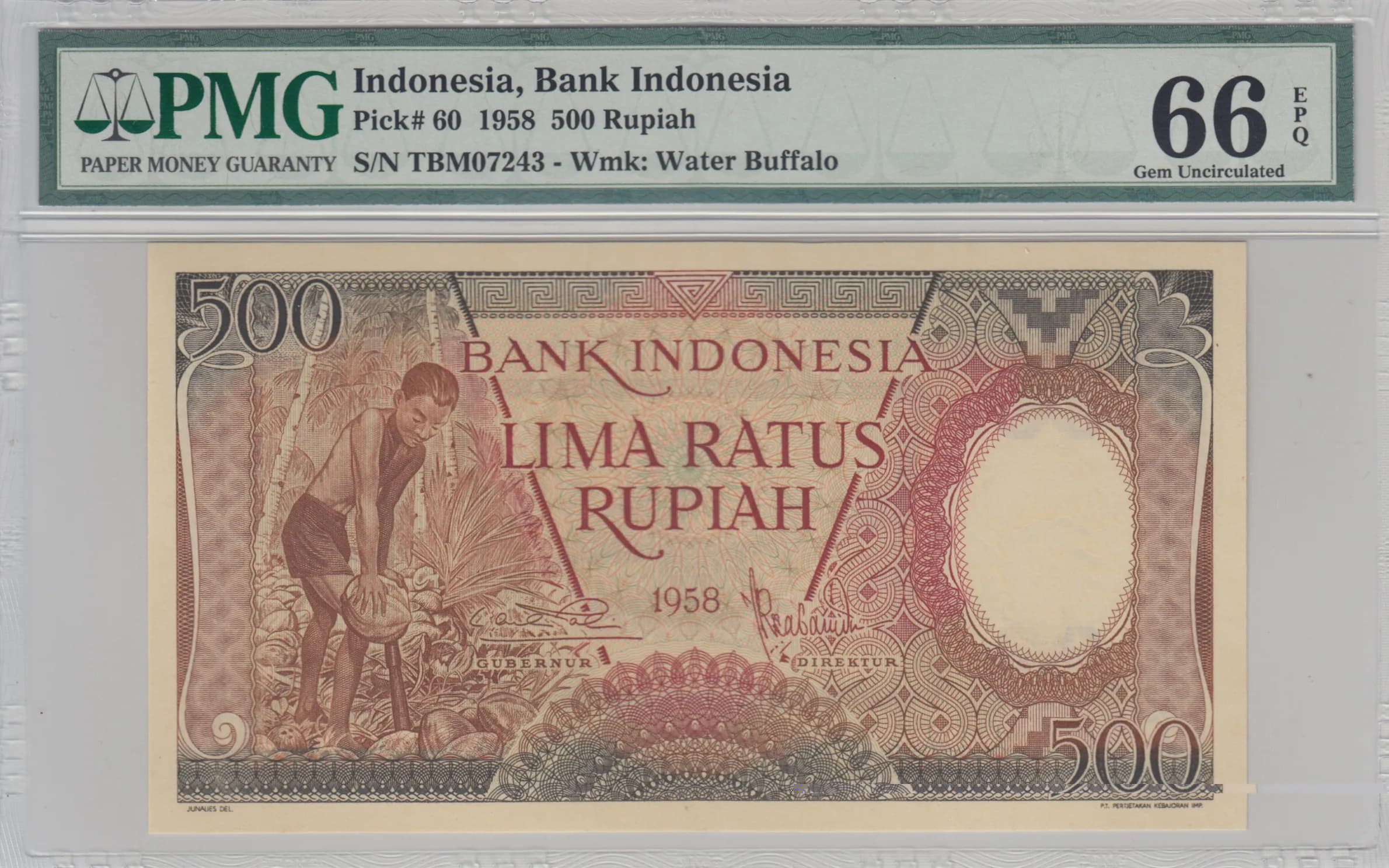
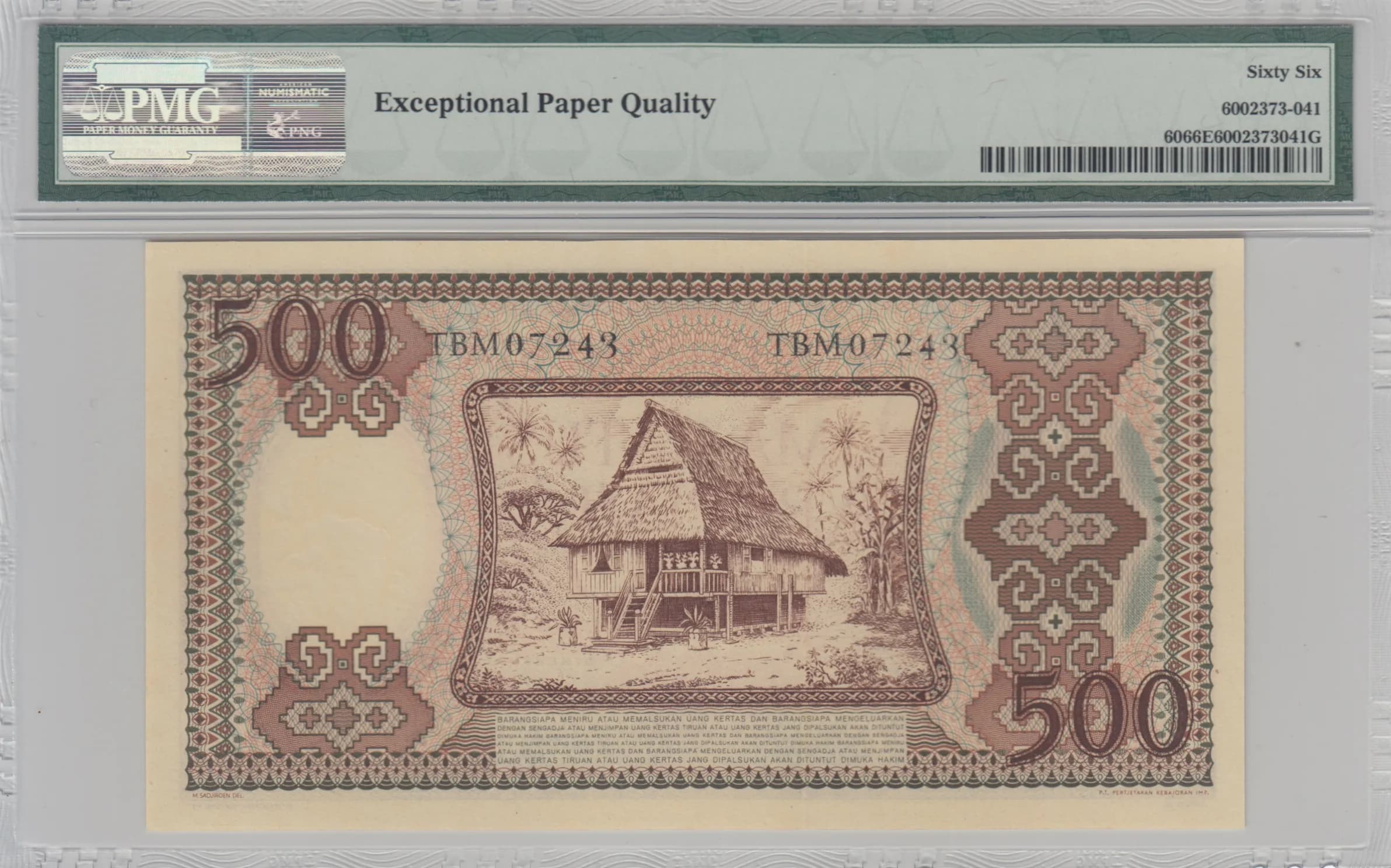
This 500 Rupiah note from 1958 is a gem uncirculated example graded PMG 66 EPQ, showcasing exceptional preservation with vibrant brown, red-brown, and green colors throughout. The note features an engaging obverse design depicting a man in traditional Indonesian dress working with coconuts alongside ornate geometric borders, while the reverse displays a beautifully detailed traditional Minahasan elevated stilt house surrounded by tropical vegetation. This condition grade represents museum-quality preservation with exceptional paper quality, making it a standout example of this early Bank Indonesia issue.
Common. This note trades actively on secondary markets with eBay sales history demonstrating consistent availability across multiple condition grades from Fine to Gem Uncirculated (66 EPQ). Recent comparable sales show PMG 66 examples selling in the $140-170 range (2020-2025), with lower grades ranging from $8 to $70 depending on condition. The 2016 catalog value of $20 for UNC examples, combined with frequent market appearances and moderate price points, clearly indicates this is a standard, regularly-available issue from the early Bank Indonesia period. Print runs for this denomination and year were substantial enough to maintain consistent market supply.
Issued in 1958, this banknote reflects Indonesia's early years as an independent nation, following the country's declaration of independence in 1945. The reverse imagery—a traditional Minahasan (Celebes) elevated house—celebrates the nation's rich indigenous architectural heritage and regional diversity. The obverse figure engaged in coconut work represents Indonesia's agricultural economy and traditional crafts, themes central to the new nation's identity and economic foundation during this formative period.
The obverse features a portrait of a man in traditional Indonesian dress shown in profile, positioned on the left side and depicted engaged in coconut processing or agricultural work, symbolizing the nation's agricultural heritage. The reverse showcases a detailed architectural vignette of a traditional Minahasan elevated house (rumah boyang or similar regional structure) characteristic of North Celebes (Sulawesi), rendered with careful attention to the distinctive stilt construction, thatched roof, and tropical surroundings including palm trees and vegetation. Both sides are framed by ornate decorative borders incorporating geometric patterns including Greek key designs, diamond motifs, and cross patterns rendered in black line work. The color palette transitions between brown and reddish tones on the obverse to incorporate sage green elements on the reverse, creating visual balance. The watermark area is indicated by an oval medallion/cartouche on the right side of the obverse.
FRONT SIDE: 'BANK INDONESIA' (Bank Indonesia - issuing authority); 'LIMA RATUS RUPIAH' (Five Hundred Rupiah - denomination in Indonesian); '500' (Arabic numerals indicating denomination); '1958' (year of issue); 'GUBERNUR' (Governor - signature line); 'DIREKTUR' (Director - signature line). BACK SIDE: '500' (Arabic numerals indicating denomination, appears twice); 'TBM07243' (Serial number, appears twice at top of central vignette); Additional fine print text appears along the bottom of the central design but is not legible at standard viewing resolution.
Intaglio (copperplate/steel engraving) printing, as evidenced by the fine line work, intricate geometric patterns, and detailed architectural vignette observable throughout both sides. The note was printed by Pertjetakan Kebajoran (Kebajoran Printing Company), an Indonesian printer used for early Bank Indonesia currency production. The fine detail work, precise border patterns, and security design elements (including the watermark area and elaborate geometric ornamentation) are characteristic of traditional intaglio security printing methods employed for currency during this era.
This specific note is identified as Pick 60, with serial number TBM07243. The 'TBM' prefix appears to be consistent with Bank Indonesia serial numbering conventions of the period. No overprints, date variations, or alternative design states are evident in the visual analysis. The note represents the standard 1958 issue type without reported major varieties affecting collector value, though individual serial number prefixes may exist. The PMG 66 EPQ grade with exceptional paper quality represents this note as a high-end example of a common type rather than a distinct variety.