50 rupiah 1959
Market Prices
39 salesAbout This Note
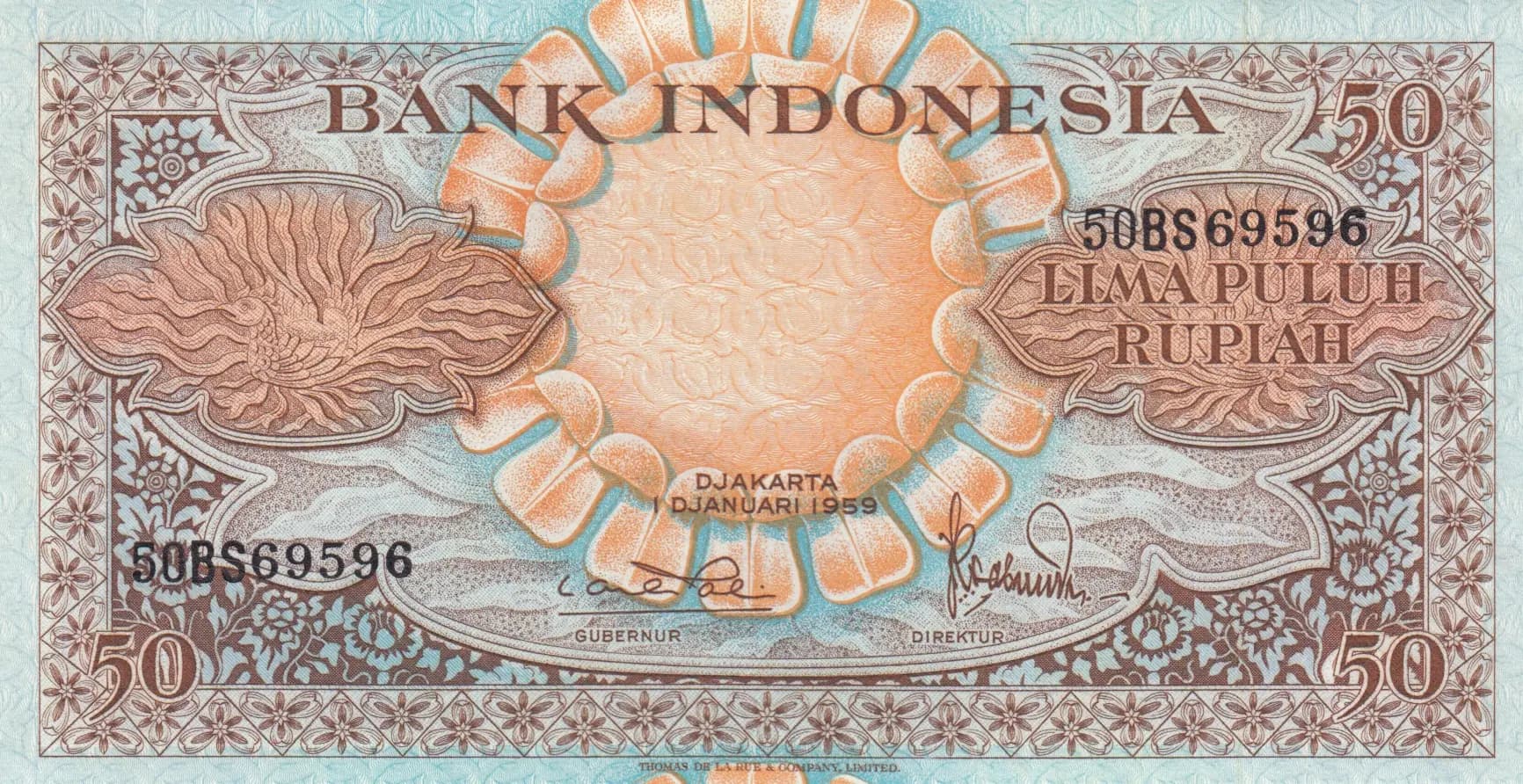
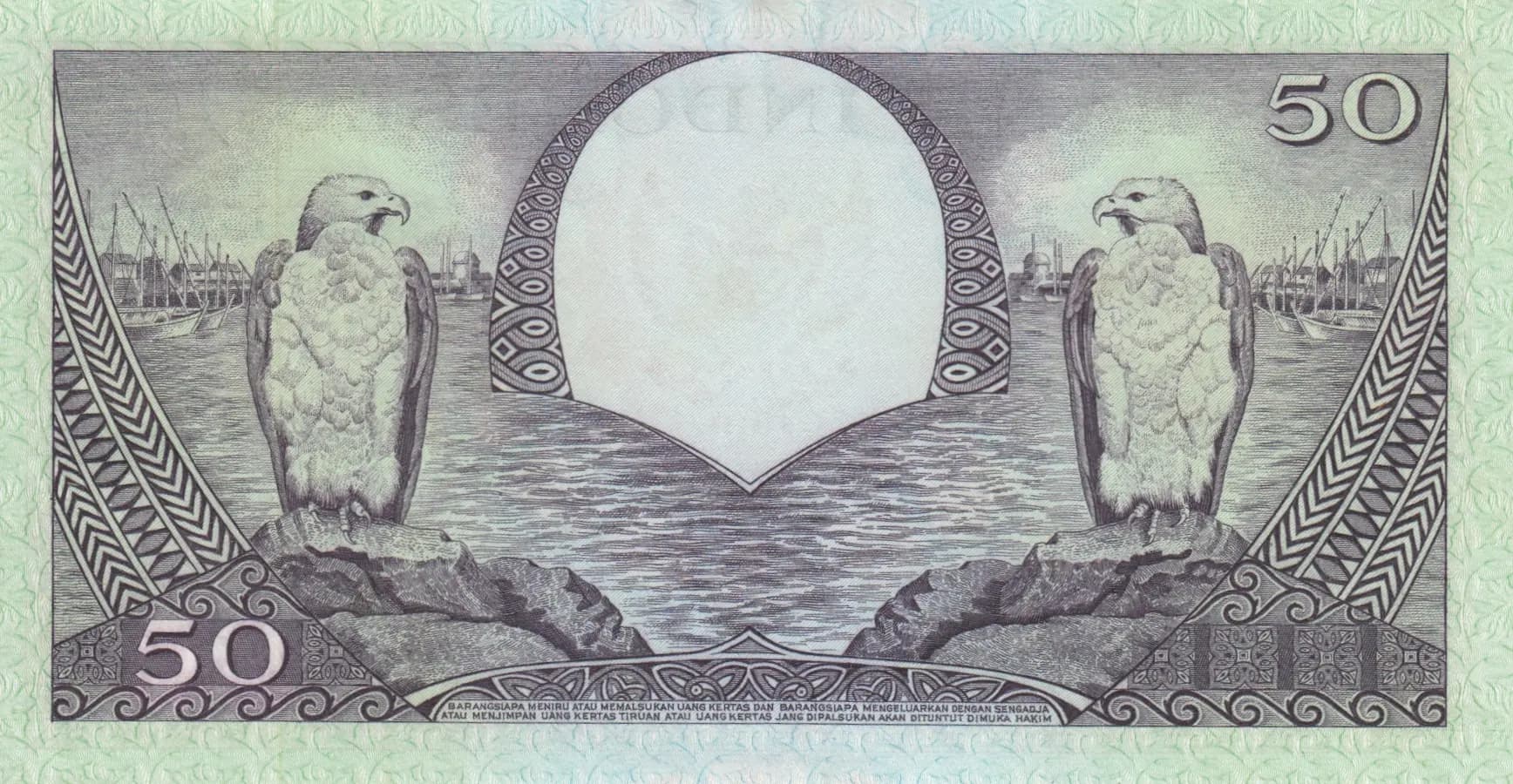
This 1959 Bank Indonesia 50 rupiah note (Pick P-68) presents an exceptional example of early Indonesian currency design, rendered in uncirculated condition with crisp printing and vibrant colors throughout. The obverse features an elaborate sunflower medallion in orange and turquoise within ornate brown and beige borders, while the reverse displays two white-bellied sea eagles flanking a harbor scene with sailing vessels—imagery reflecting Indonesia's maritime heritage and post-independence national symbolism. The note's pristine state, sharp engraving detail, and rich color palette make it an attractive example of Thomas de la Rue's mid-20th century security printing craftsmanship.
Common. EBay price tracking data shows consistent market prices ranging from $3.50 to $29.99 for UNC examples, with most sales between $5–$20. PMG-graded examples (PMG 64–67) typically sell in the $16–$124 range, with the higher prices reflecting premium grades rather than rarity. The catalog 2016 values list UNC at only $3.50. While the 1959 date gives it some historical interest, this was a regular issue from Bank Indonesia with adequate circulation, and no evidence of restricted print runs or recalls exists. The consistent availability in the secondary market confirms common status.
Issued in January 1959, just eight years after Indonesian independence (1951), this banknote reflects the young nation's efforts to establish a distinctive national currency identity under Bank Indonesia. The prominent eagles (Garuda) on the reverse and the harbor/maritime imagery symbolize Indonesia's significant seafaring traditions and economic importance as a vast archipelago, while the sunflower motif on the obverse represents agricultural wealth and national symbolism during the early Sukarno era.
The obverse features a large central floral medallion—specifically a stylized sunflower with orange petals and turquoise detailing—surrounded by ornate geometric and botanical corner ornaments in a color palette of brown, beige, orange, turquoise, and light green. The reverse depicts two white-bellied sea eagles (Haliaeetus leucogaster), Indonesia's national bird, standing on rocky bases and flanking a maritime harbor scene featuring sailing vessels, docked boats, and coastal architecture. A large blank oval cartouche is centered between the eagles, flanked by chevron patterns and decorative line work. The overall design employs ornate borders throughout in geometric patterns characteristic of security printing. The note is dated Jakarta, January 1959, and signed by the Governor and Director of Bank Indonesia.
FRONT: 'BANK INDONESIA' (Bank Indonesia); 'LIMA PULUH RUPIAH' (Fifty rupiah); 'DJAKARTA DJANUARI 1959' (Jakarta January 1959); 'GUBERNUR' (Governor); 'DIREKTUR' (Director); 'THOMAS DE LA RUE & COMPANY, LIMITED' (printer identification); Serial number '50BS869596'; Denomination '250' and '50' in corners. BACK: Denomination '50' in corners; Warning text in Indonesian: 'BARANGSIAPA MEMILIKI ATAU MEMALSUKAINGUANG KERTAS DAN BARANGSIAPA MENGELUARKAN DENGAN SENGAJA TAPI MEMULIMPAH UANG KERTAS TIUAH ATAU UANG KERTAS JANG DIPALSUKAN AKAN DIHUKUM AKAN DIHUKUM DENGAN HUKUMAN UANG KERTAS JANG DIPALSUKAN AKAN DIHUKUM AKAN DIHUKUM DENGAN HUKUMAN' (Whoever possesses or forges paper money and whoever knowingly circulates forged or counterfeit paper money will be punished with [monetary penalties]).
Intaglio engraving on multiple colors (multicolor), executed by Thomas de la Rue & Company, Limited, the renowned London security printer. The intricate engraved decorative patterns, fine line work throughout borders and ornamental details, and the layered color printing technique (brown/beige/orange/turquoise on obverse; gray/purple/light green on reverse) are characteristic of high-security banknote production of the era. The crisp impressions and fine detail work visible in both eagle designs and the harbor scene indicate professional intaglio plate work.
Serial number observed: 50BS869596, indicating the B series variety. PMG population reports one cataloged variant for Pick P-68 printed by TDLR (Thomas de la Rue). The note exhibits the standard January 1959 date. No overprints or significant signature varieties are apparent from the visual analysis. The blank oval cartouche on the reverse is a standard design feature, not indicative of a special variety.