50 rupiah 1958
Market Prices
10 salesAbout This Note
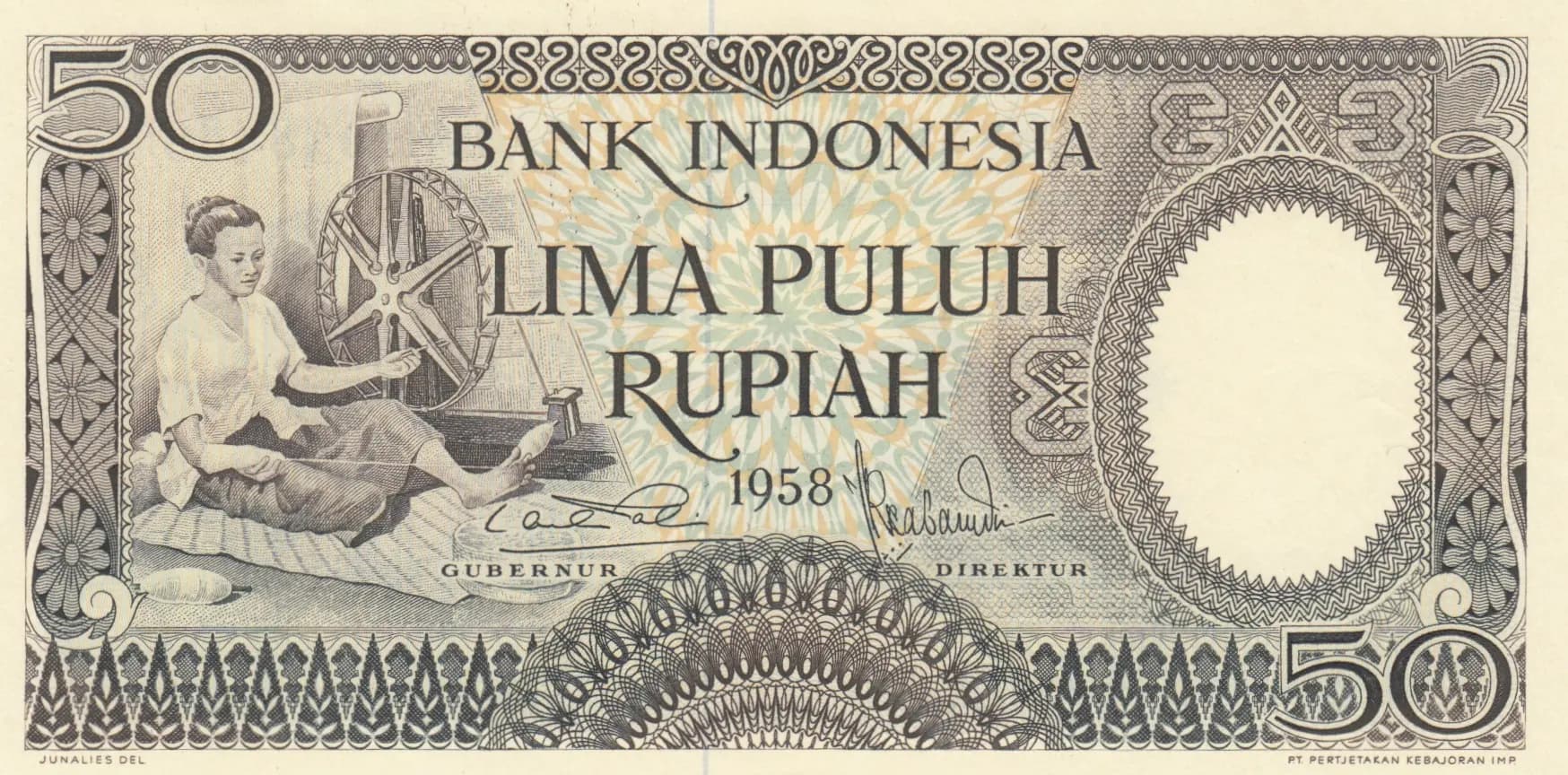
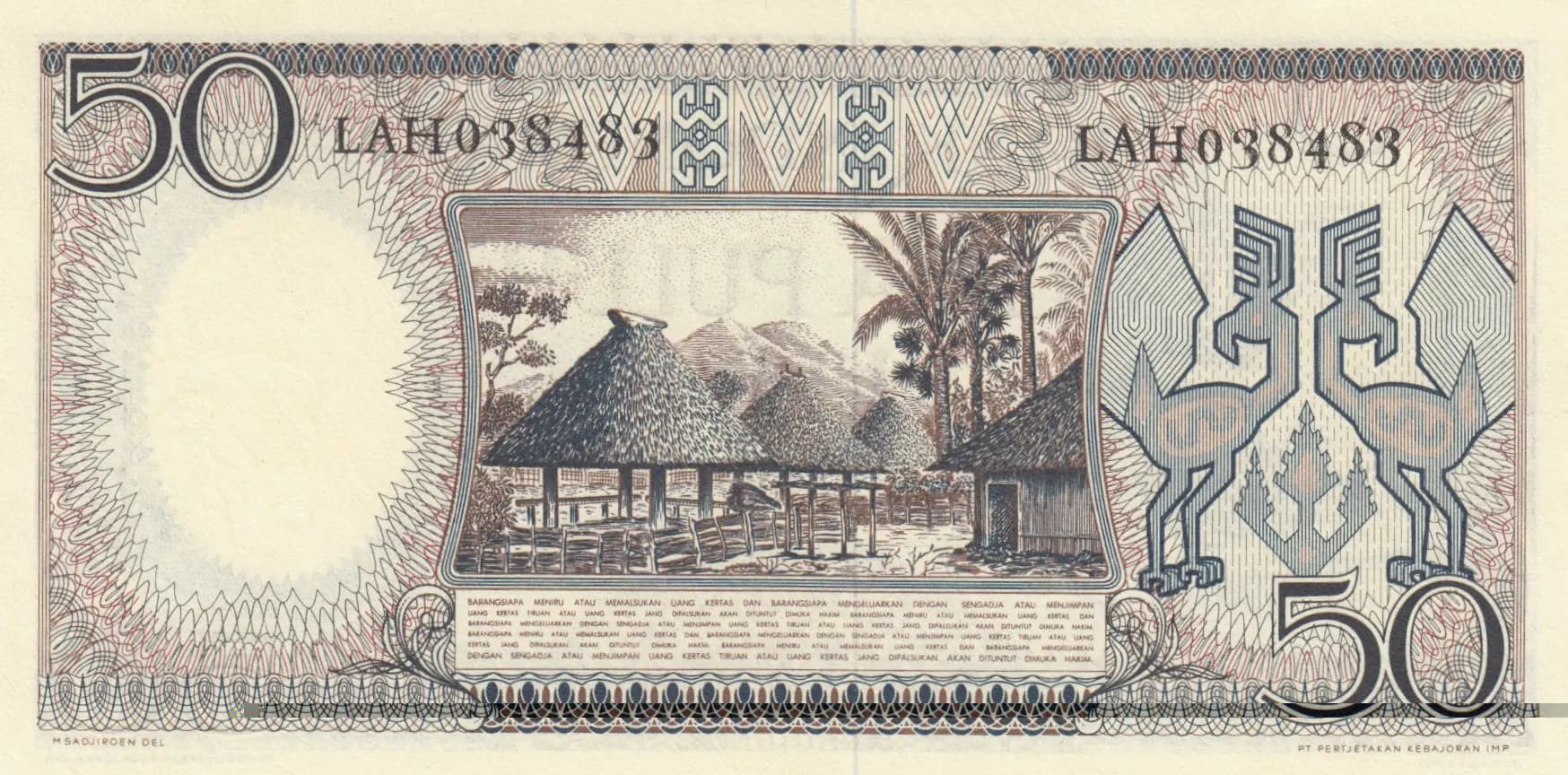
This is an exceptionally well-preserved example of the Indonesia 50 Rupiah 1958 (P-58), presented in Uncirculated condition with crisp detail throughout and no visible wear or handling marks. The note showcases Bank Indonesia's post-independence currency artistry, featuring an engraved portrait of a woman at a textile loom on the obverse and a traditional Indonesian thatched-roof structure set in a tropical landscape on the reverse. The intricate line-work engraving, dual artist credits (Junalies Del and M Sadjiroen Del), and printer attribution to Pertjetakan Kebajoran demonstrate the high production standards of early Indonesian banknotes.
Common. The eBay market data provided shows consistent sales activity across multiple condition grades from 2012-2023, with UNC examples regularly selling in the $4-$31 range (averaging around $15-$22 for true UNC). The 2016 catalog value of $3 for UNC further confirms this is a commonly circulated issue without scarcity premiums. Print runs for 50 Rupiah notes from this period were substantial, and the note was not recalled or withdrawn from circulation in limited quantities. The consistent availability and modest pricing across all recent market transactions indicate this is a readily available note for collectors.
Issued in 1958, this note represents Bank Indonesia's early republican currency during the post-independence period under President Sukarno. The obverse imagery—a woman engaged in traditional textile work—reflects the nationalist emphasis on indigenous Indonesian culture and artisanal craftsmanship. The reverse depicts a traditional Indonesian communal structure (pendopo or meeting house) within a tropical landscape, symbolizing the nation's cultural heritage and village-centered society during a period when Indonesia was consolidating its identity following independence in 1945.
The obverse features an engraved vignette of a woman in traditional Indonesian dress operating a weaving loom or textile-making apparatus, positioned on the left side of the note and serving as the primary design element. The woman's portrait reflects nationalist imagery celebrating indigenous Indonesian craftsmanship and cultural heritage. Ornate decorative borders frame the entire note with geometric patterns and floral medallion designs in the corners. The denomination '50' appears prominently in large numerals in the top left and bottom right corners. A large circular decorative design element occupies the right side. The reverse presents a detailed landscape illustration of a traditional thatched-roof Indonesian structure (likely a pendopo or village meeting house) set within a tropical environment featuring palm trees and distant mountains. The composition emphasizes Indonesia's natural and cultural landscape. Both sides employ repetitive fine line engraving patterns as security features, with legal warning text integrated throughout the background design. Serial numbers appear in two locations on the reverse. The color scheme consists primarily of black and cream/beige with light brown tones, typical of 1950s banknote production.
FRONT: '50' (denomination); 'BANK INDONESIA' (issuing authority); 'LIMA PULUH RUPIAH' (Fifty Rupiah in Indonesian); '1958' (issue year); 'GUBERNUR' (Governor); 'DIREKTUR' (Director); 'JUNALIES DEL' (artist credit - Junalies del.); 'PT PERJETAKAN KEBAIJORAN IMP' (PT Printing Kebaijoran Imp - printer identification). BACK: '50' (denomination); 'LAH038483' (serial number, appears twice); 'M SADJIROEN DEL' (artist credit - M. Sadjiroen del.); 'PT PERJETAKAN KEBAIJORAN IMP' (printer); 'BARANGSIAPIA MIBIRU ATAU MEMBAURKAN UANG KERTAS DAN BARANGSIAPIA MENGELUARKAN DENGAN SENGAJA ATAU MEMBIARKAN BEREDAR UANG KERTAS YANG DIPALSUKAN AKAN DIHUKUM MENURUT HUKUM YANG BERLAKU' (Anyone who counterfeits or knowingly permits counterfeit banknotes to circulate shall be punished according to applicable law - repeated throughout background as security measure).
Intaglio engraving (line engraving), as evidenced by the fine, intricate line-work throughout the design, detailed portrait rendering, and delicate geometric patterns that characterize high-security banknote production of the era. The note was produced by Pertjetakan Kebajoran (PT Printing Kebaijoran), Indonesia's primary security printer for early republican currency. The dual artist credits (Junalies Del for the obverse and M Sadjiroen Del for the reverse) indicate the engraving work was executed by skilled Indonesian engravers. The repetitive legal warning text integrated throughout the background represents an early form of security printing employed by Bank Indonesia.
The observed variety features serial number prefix 'LAH' with the specific serial number LAH038483. Bank Indonesia 1958 50 Rupiah notes exist with various serial number prefixes corresponding to different printing batches. The signature lines are present for 'GUBERNUR' (Governor) and 'DIREKTUR' (Director), though specific signature identification would require closer examination. No overprints, commemorative markings, or unusual varieties are evident in this example. This appears to be a standard issue note from the regular production run with no known premium varieties identified for P-58.