5 rupiah 1958
Market Prices
41 salesAbout This Note
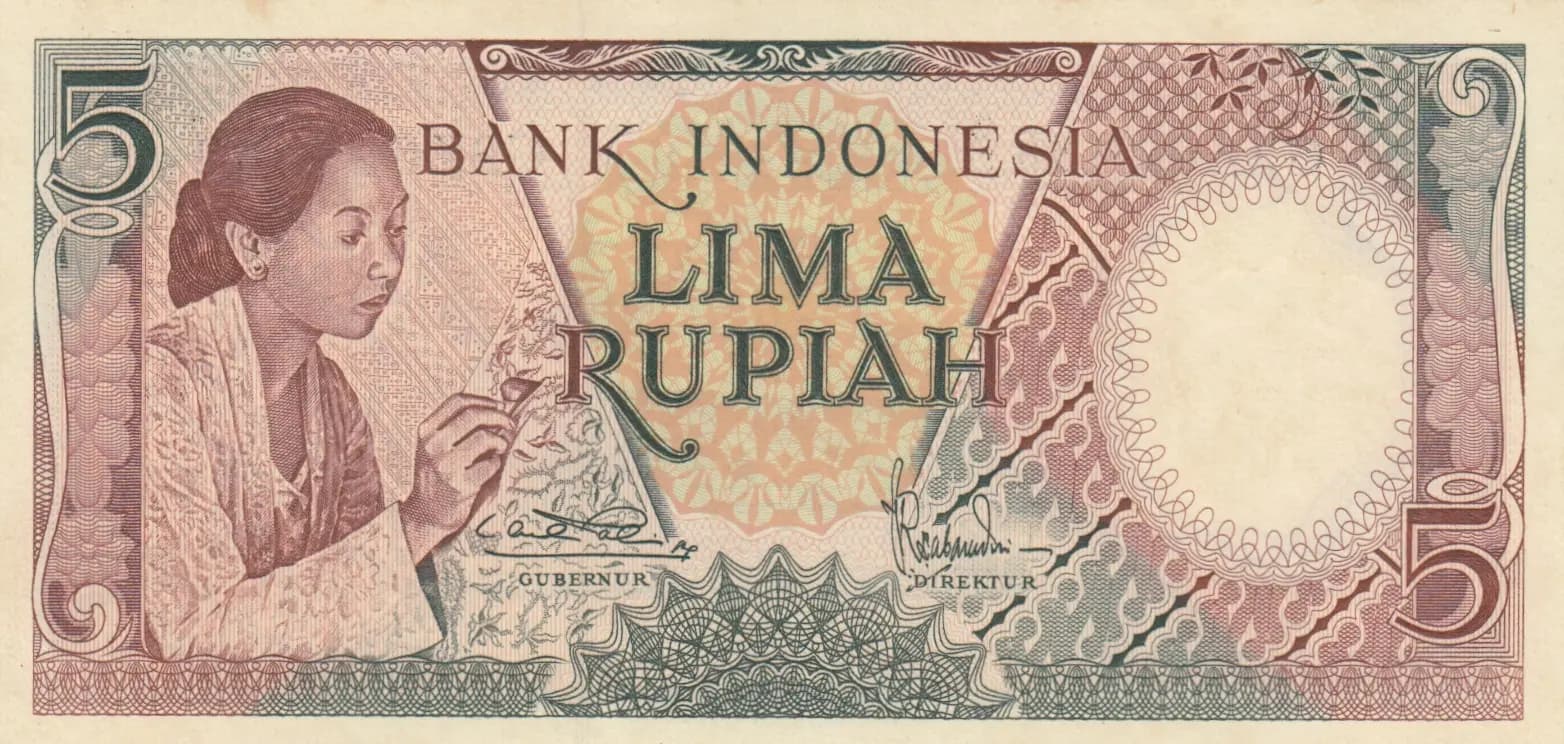
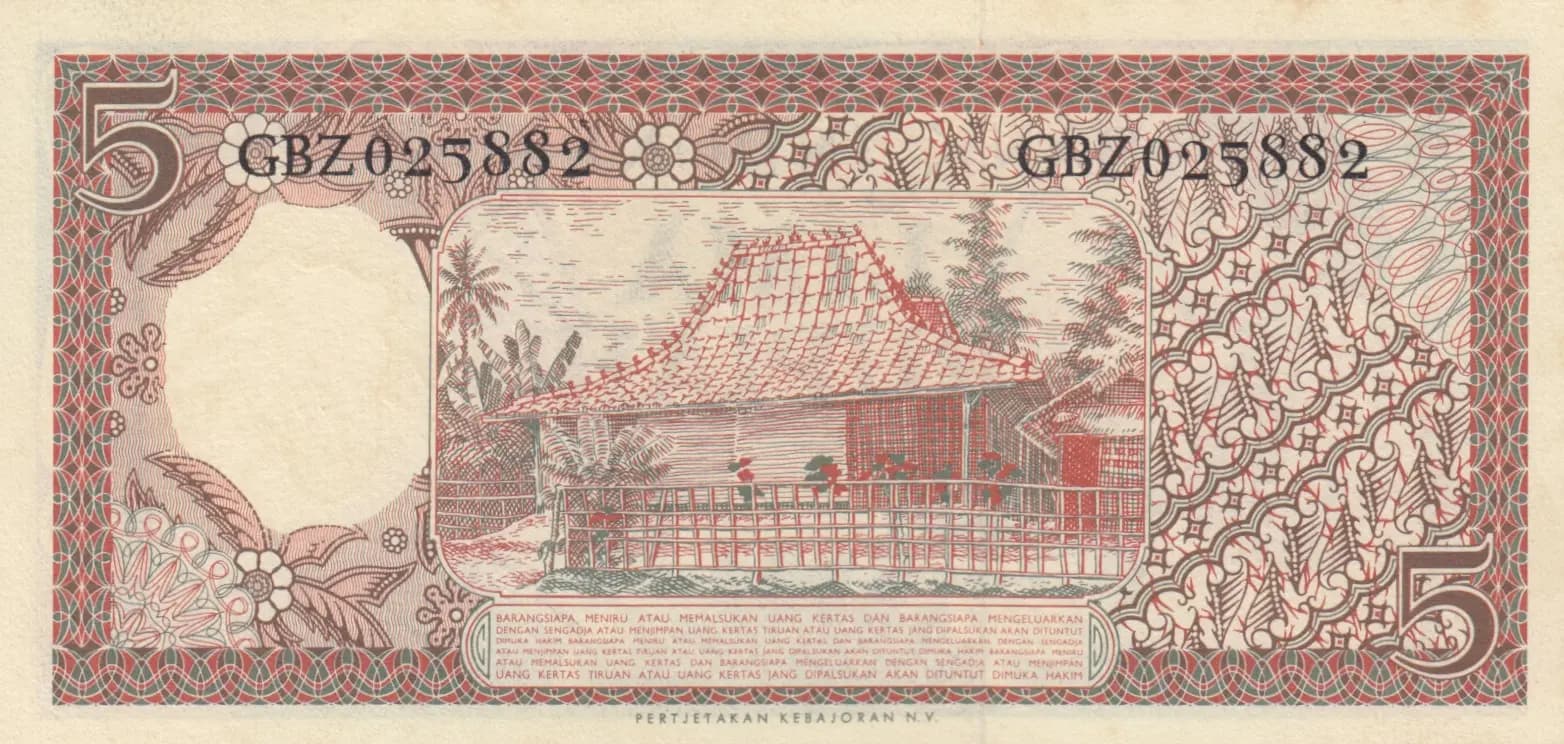
This is an AU-graded Indonesia 5 Rupiah note from 1958, presented in exceptional near-uncirculated condition with minimal signs of age or handling. The obverse features an elegantly engraved portrait of a woman in traditional Indonesian dress, rendered in brown and green tones with intricate decorative borders, while the reverse depicts a detailed tropical landscape centered on a traditional Indonesian house with distinctive peaked roof, surrounded by palm trees. The note displays outstanding engraving quality throughout with no visible wear, folds, or creases, making it a desirable example of early Indonesian currency from the post-independence period.
Common. The eBay market data shows consistent sales activity across multiple condition grades over more than a decade, with most examples in UNC condition selling for under $10 and AU/AUNC grades typically bringing $2-7. Print run for this denomination appears to have been substantial, and the note is readily available in the numismatic market. The pricing trend reflects typical behavior for common post-WWII banknotes from accessible countries.
Issued in 1958 by Bank Indonesia during the early years of the nation's independence (Indonesia declared independence in 1945), this note represents the formative period of the country's monetary system. The imagery—a woman performing traditional batik textile work and an architectural example of Indonesian vernacular building—reflects the bank's deliberate choice to emphasize cultural heritage and national identity during a period of nation-building and economic establishment following the end of colonial rule.
The obverse features a carefully engraved three-quarter profile portrait of an Indonesian woman facing left, depicted wearing traditional dress including an elaborate head covering and ornate garments with detailed textile patterns. She is positioned at the left side of the note, with 'BANK INDONESIA' and 'LIMA RUPIAH' inscriptions prominently displayed in the center in a formal serif typeface. The design is framed by ornamental borders composed of intricate scrollwork, floral motifs, and geometric patterns in the classical style typical of mid-20th century central bank currency. The reverse depicts a romanticized tropical landscape scene centered on a traditional Indonesian house (likely representing Javanese or Sundanese vernacular architecture) with a characteristically peaked, ornately-tiled roof. The architectural structure is surrounded by lush tropical vegetation including prominent palm trees, with a wooden bridge or railing visible in the foreground. The entire design is enclosed in an elaborate decorative cartouche with geometric and floral border elements. Color palette across both sides features brown, reddish-brown, green, and cream tones with darker gray/black for line work and detail.
FRONT: 'BANK INDONESIA' (Bank Indonesia), 'LIMA RUPIAH' (Five Rupiah), signature lines labeled 'GUBERNUR' (Governor) and 'DIREKTUR' (Director), denomination numeral '5'. BACK: Serial number 'GBZ025882' (appears twice), 'PERTJEKAAN KEBAJORAN N.Y' (Pertjetakan Kebajoran printing house, New York), counterfeiting warning text in Indonesian: 'Barangsiapa meniru atau memalsukan uang kertas dan barangsiapa mengeluarkan dengan sengaja atau mempunyai uang kertas atau uang logam tiruan yang dimulai demi keamanan negara atau dalam niatan untuk mengedarkannya akan dihukum menurut undang-undang' (Whoever counterfeits or produces counterfeit currency, or intentionally issues or possesses counterfeit currency with intent to circulate it for national security purposes or with intent to circulate it, shall be punished according to law), denomination numeral '5'.
Intaglio engraving (line engraving), evidenced by the extremely fine line work, intricate detail in portraits and decorative elements, and the characteristic sharp precision visible throughout the design. The note was printed by Pertjetakan Kebajoran (identified on the reverse), a prominent security printer. The complexity of the engraved patterns, fine lines in the portrait rendering, and detailed background work are all hallmarks of classical intaglio production methods employed by high-security currency printers during this period.
The observed serial number is GBZ025882 with prefix 'GBZ'. This note represents the standard Regular Issue of 1958. Varieties for this Pick number typically include different serial number prefixes and potentially different signature combinations (representing different governors and directors of Bank Indonesia during the issue period). No overprints or significant variations are evident from the visual analysis of this particular specimen.