5 rupiah 1957
Market Prices
About This Note
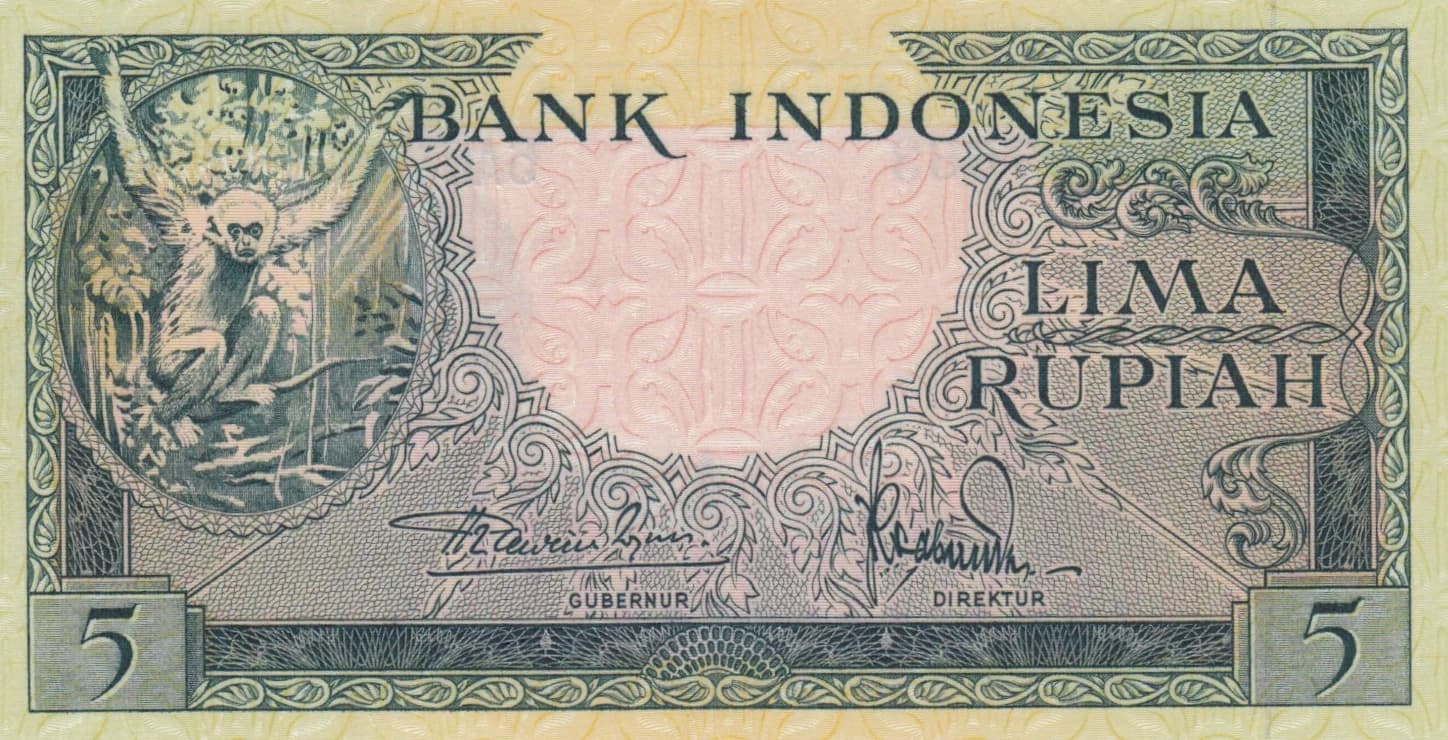
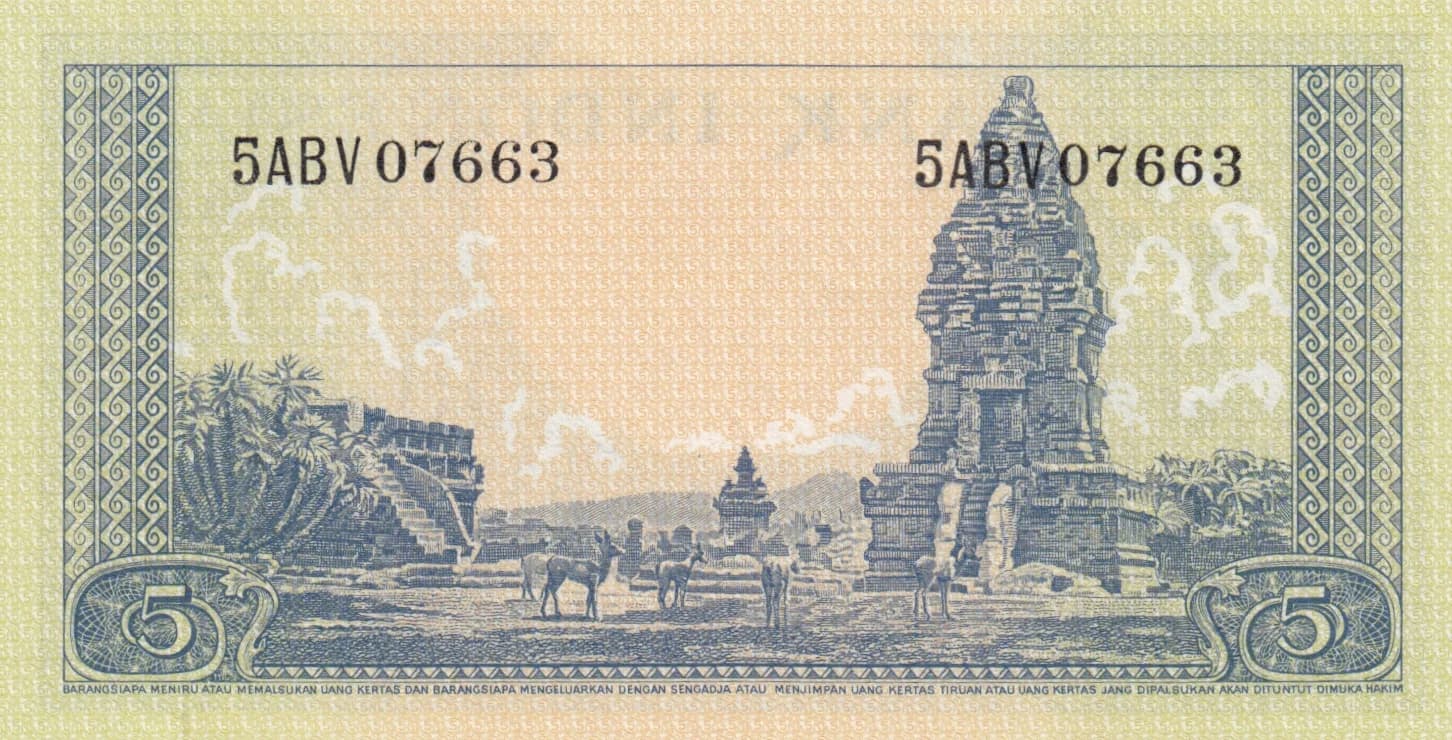
A beautiful example of Indonesia's 1957 5 Rupiah note (Pick P-49) in uncirculated condition, featuring an engraved primate among tropical foliage on the obverse and the iconic Prambanan temple complex on the reverse. The note exhibits crisp printing, vibrant color saturation across cream, pink, and blue tones, and intricate ornamental borders with no visible wear, creasing, or circulation marks characteristic of high-grade specimens.
Common. Market evidence from eBay sales tracking shows UNC specimens selling between $23.50–$50.00 USD, well below the $100–$250+ threshold that would indicate scarcity. The 2016 catalog value of $500 for UNC appears to be an outlier inconsistent with current market activity. Low denomination notes from 1957 were produced in significant quantities to support everyday commerce in a newly independent nation. The availability of multiple eBay listings at modest prices confirms this is a regularly encountered note in the collector market.
Issued during Indonesia's early post-independence period under Bank Indonesia's authority, this 1957 note reflects the nascent nation's cultural identity through its depiction of native wildlife (the orangutan) and Hindu-Buddhist architectural heritage (Prambanan temple in Java). The inclusion of both modern banking authority text and traditional Indonesian imagery underscores the nation's transition to monetary sovereignty following independence from Dutch colonial rule in 1945.
The obverse features a detailed engraved illustration of an orangutan positioned among tropical foliage on the left side, symbolizing Indonesia's unique biodiversity. The denomination '5' appears in decorative boxes in the bottom corners. The note is dominated by ornate Art Deco-influenced scrollwork borders and an embossed floral or decorative pattern filling the central rose-pink area. The reverse depicts the Prambanan temple complex, a 10th-century Hindu temple in Central Java, shown as a tall candi (stone gateway tower) with intricate architectural detailing, flanked by additional smaller temple structures in the background. The foreground includes period-appropriate figures of people and horses, with palm trees and distant mountains completing the landscape composition. Serial numbers appear in the upper corners, and comprehensive anticounterfeiting text is integrated into the reverse design.
OBVERSE: 'BANK INDONESIA' (Bank Indonesia); 'LIMA RUPIAH' (Five Rupiah); 'GUBERNUR' (Governor); 'DIREKTUR' (Director); '5' (denomination numeral). REVERSE: Serial number '5ABV07663' (appears in both upper corners); '5' (denomination in decorative circular elements at bottom corners); Counterfeiting warning text: 'BARANGSIAPA MENIRU ATAU MEMALSUKAN UANG KERTAS DIRI BARANGSIAPA MENGELUARKAN DENGAN SENGAJA ATAU MENJIJIMPAN UANG KERTAS TIRUAN ATAU UANG KERTAS JANG DIPALSUKAN AKAN DIHUKUM DIMUKA HAKIM' (Anyone who counterfeits or forges banknotes, or whoever knowingly issues or holds counterfeit or forged banknotes will be punished before a judge).
Intaglio (engraved) printing, evidenced by the crisp fine-line engraving visible throughout both sides, the embossed central pattern on the obverse, and the detailed landscape rendering on the reverse. The precise registration of the decorative borders and the clarity of facial details on the orangutan and background figures are characteristic of high-quality intaglio work. Bank Indonesia's note printer for this era was typically Thomas De La Rue or similar security printers employed for early Indonesian currency issues.
This specimen displays serial number prefix '5ABV,' indicating a specific printing batch or series. The signature lines for GUBERNUR (Governor) and DIREKTUR (Director) are present but specific signatory identification would require higher magnification imaging. Early Indonesian 5 Rupiah notes (1957) may exhibit minor variations in serial number prefixes and signature combinations depending on the specific print run and issuing period within the year. No major varieties or overprints are evident in this specimen.