5 rupiah 1950
Market Prices
6 salesAbout This Note
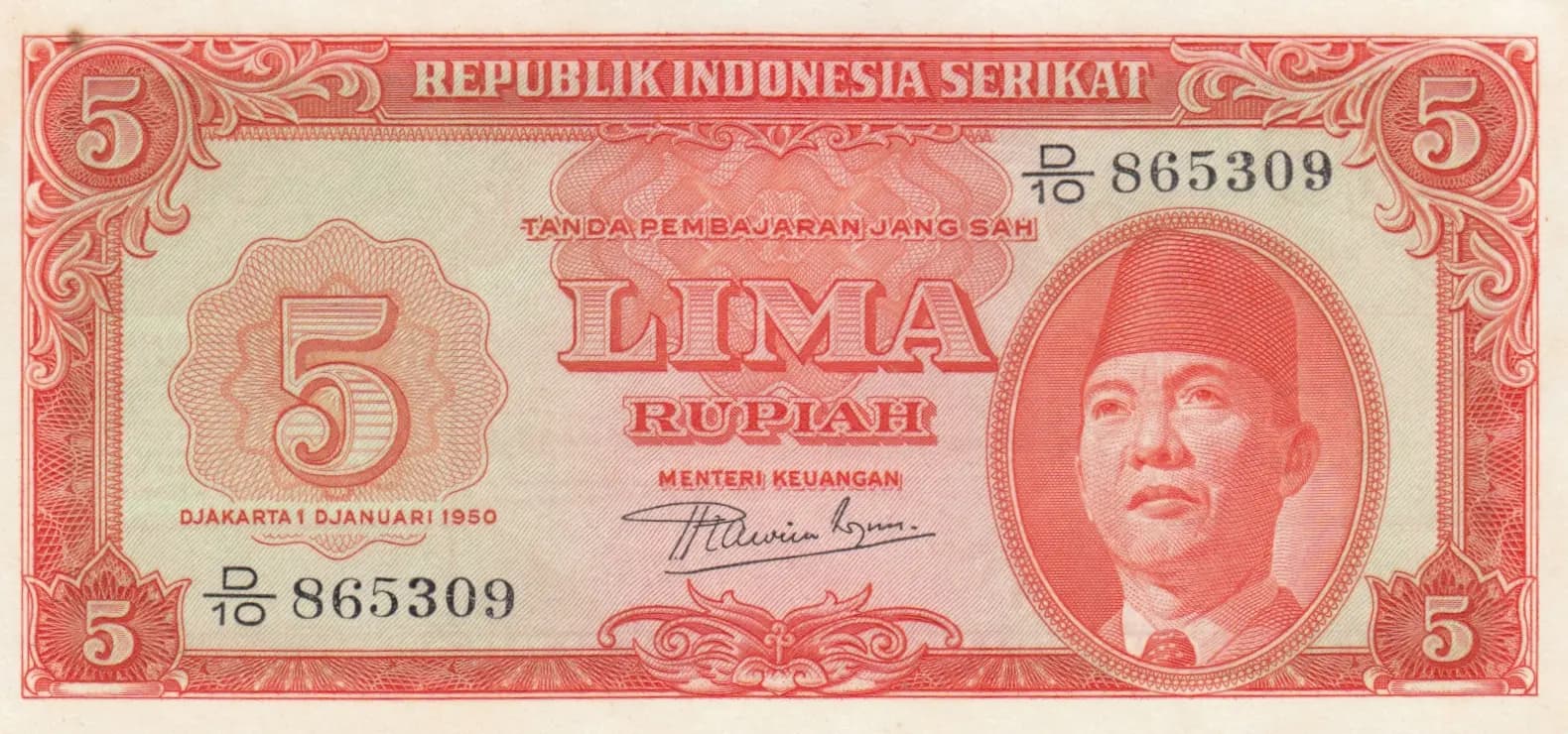
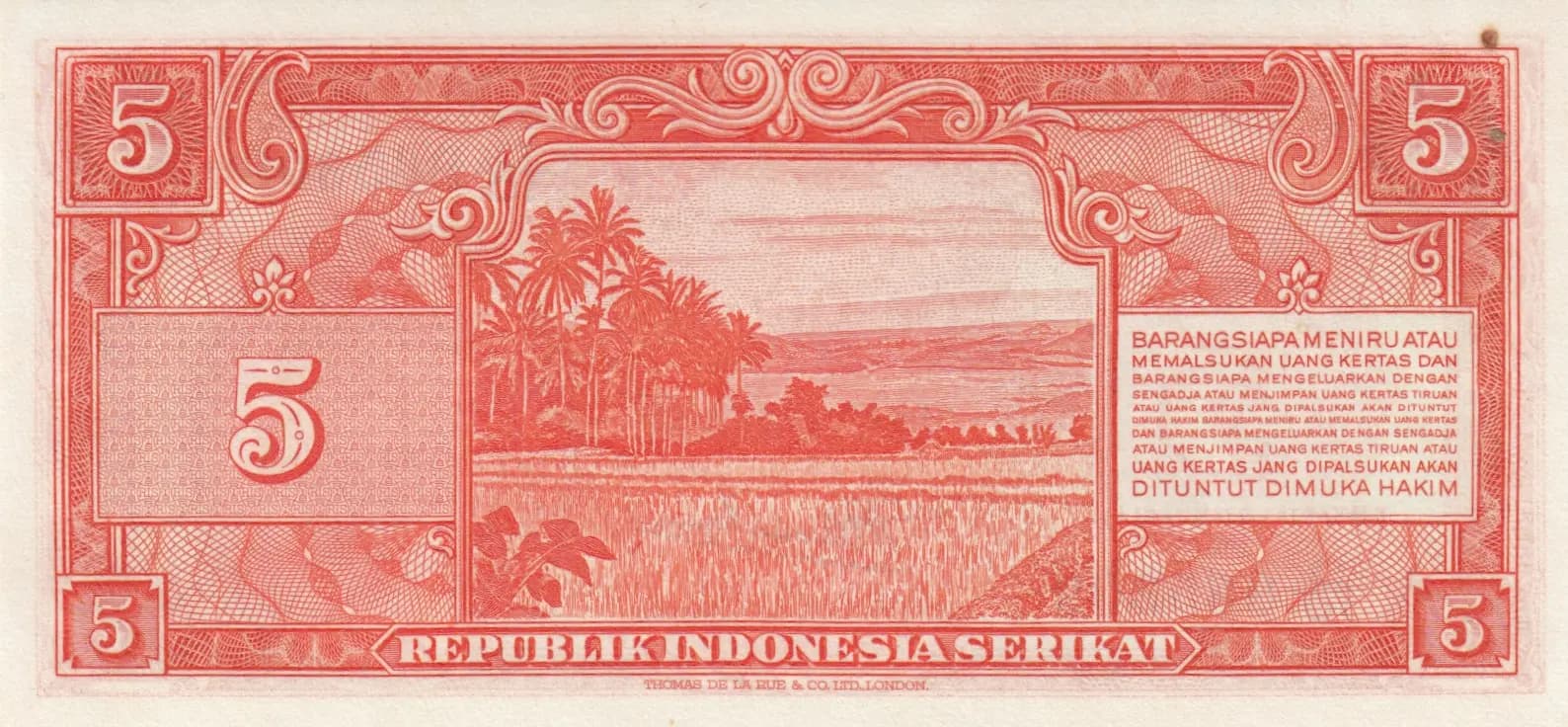
This is an exceptional example of the 1950 Indonesia 5 Rupiah (Pick P-36) issued by the Republik Indonesia Serikat, graded UNC and displaying pristine condition with no visible wear, creases, or damage. The note features vibrant red and pink coloring with fine engraved detail throughout, displaying a profile portrait of President Sukarno on the obverse and an evocative landscape scene with palm trees and agricultural fields on the reverse. This early post-independence Indonesian note represents an important transitional piece in numismatic history, printed by the renowned security printer Thomas de la Rue of London.
Common. This denomination and issue date represent a standard regular-issue banknote with no known restrictions, limited print runs, or recalls. Market data from realbanknotes.com indicates catalog values of only $20 for UNC specimens as of 2016, with eBay transactions for similar grades ranging from $57 to $200, typical pricing for common early-issue notes in strong condition. The Republik Indonesia Serikat issued these notes for normal circulation without rarity constraints.
This 5 Rupiah note was issued on January 1, 1950, marking the formal establishment of the Republik Indonesia Serikat (United States of Indonesia) following the Dutch recognition of Indonesian independence. The portrait of Dr. Ir. Achmed Soekarno commemorates the nation's first president and founding father, while the reverse's depiction of rice fields and palm trees reflects the agricultural foundation of the newly independent nation's economy. The use of the formal title 'Republik Indonesia Serikat' and the Jakarta date demonstrate this note's significance as an official monetary instrument of Indonesia's earliest sovereign period.
The obverse features an ornate classical design centered on a right-facing portrait of President Dr. Ir. Achmed Soekarno wearing a formal hat, contained within an intricate circular medallion frame. The portrait is positioned on the right side of the note and is surrounded by elaborate scrollwork and floral decorative borders. The denomination '5' appears in ornamental frames at multiple locations, including corner positions with scalloped circular frames, emphasizing the note's value. The reverse depicts a serene tropical landscape dominated by tall palm trees set against a shoreline or river, with agricultural fields and distant hills visible in the background. The entire design is rendered in fine line engraving with intricate crosshatching and parallel line work, characteristic of high-security banknote production. All borders feature decorative scrollwork and fine detail lines consistent with early 20th-century Western security printing standards.
FRONT SIDE: 'Republik Indonesia Serikat' (United States of Indonesia) — the issuing authority; 'Tanda Pembajaran Jang Sah' (Legal Tender) — statement of validity; 'Lima Rupiah' (Five Rupiah) — denomination; 'Menteri Keuangan' (Minister of Finance) — responsible official; 'Djakarta 1 Djanuari 1950' (Jakarta 1 January 1950) — issue date; 'P 865309' — serial number. BACK SIDE: 'Republik Indonesia Serikat' (United States of Indonesia) — repeated issuer identification; 'Barangsiapa meniru atau memalsukan uang kertas dan barangsiapa mengeluarkan dengan sengaja atau menimpan uang kertas tiruau atau uang kertas yang dipalsukan akan di tuntut di muka hakim' (Anyone who counterfeits or forges banknotes and anyone who intentionally circulates or possesses counterfeit or forged banknotes will be prosecuted in court) — anti-counterfeiting warning; 'Thomas De La Rue & Co. Ltd. London.' (printer's imprint).
Intaglio engraving (letterpress/line engraving), executed by Thomas de la Rue & Co. Ltd., London, the world's leading banknote security printer of the period. The note exhibits characteristic features of intaglio printing: fine parallel lines forming backgrounds, detailed crosshatching, crisp portrait detail, and raised tactile surface effects visible in the engraved areas. The multi-color red and pink printing with cream background demonstrates advanced color registration typical of de la Rue's production methods. No visible security threads or modern anti-counterfeiting features are present, consistent with 1950 security standards.
The observed specimen displays serial number 'P 865309', indicating the P-series printing block. The issue date of '1 Djanuari 1950' (using older Dutch-influenced spelling conventions with 'Dj' for modern 'J') is consistent with the earliest printings of this denomination. No major varieties (such as signature variants, date variations, or overprints) are documented for Pick P-36. The standard variety identification for this pick number would be based on serial number prefixes and signatures of the Minister of Finance, though these details are not clearly legible in the provided imagery.