25 rupiah 1964
Market Prices
62 salesAbout This Note
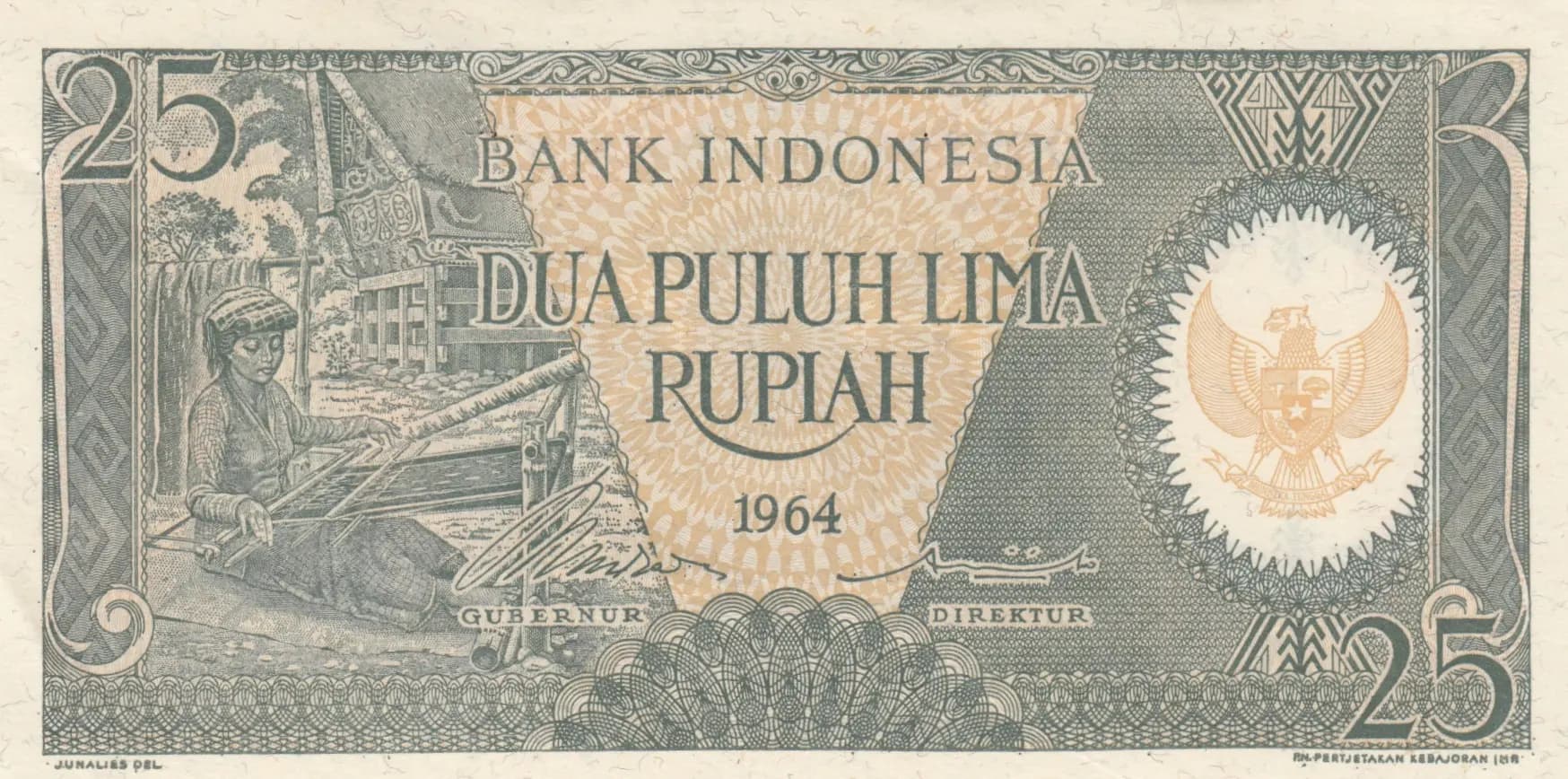
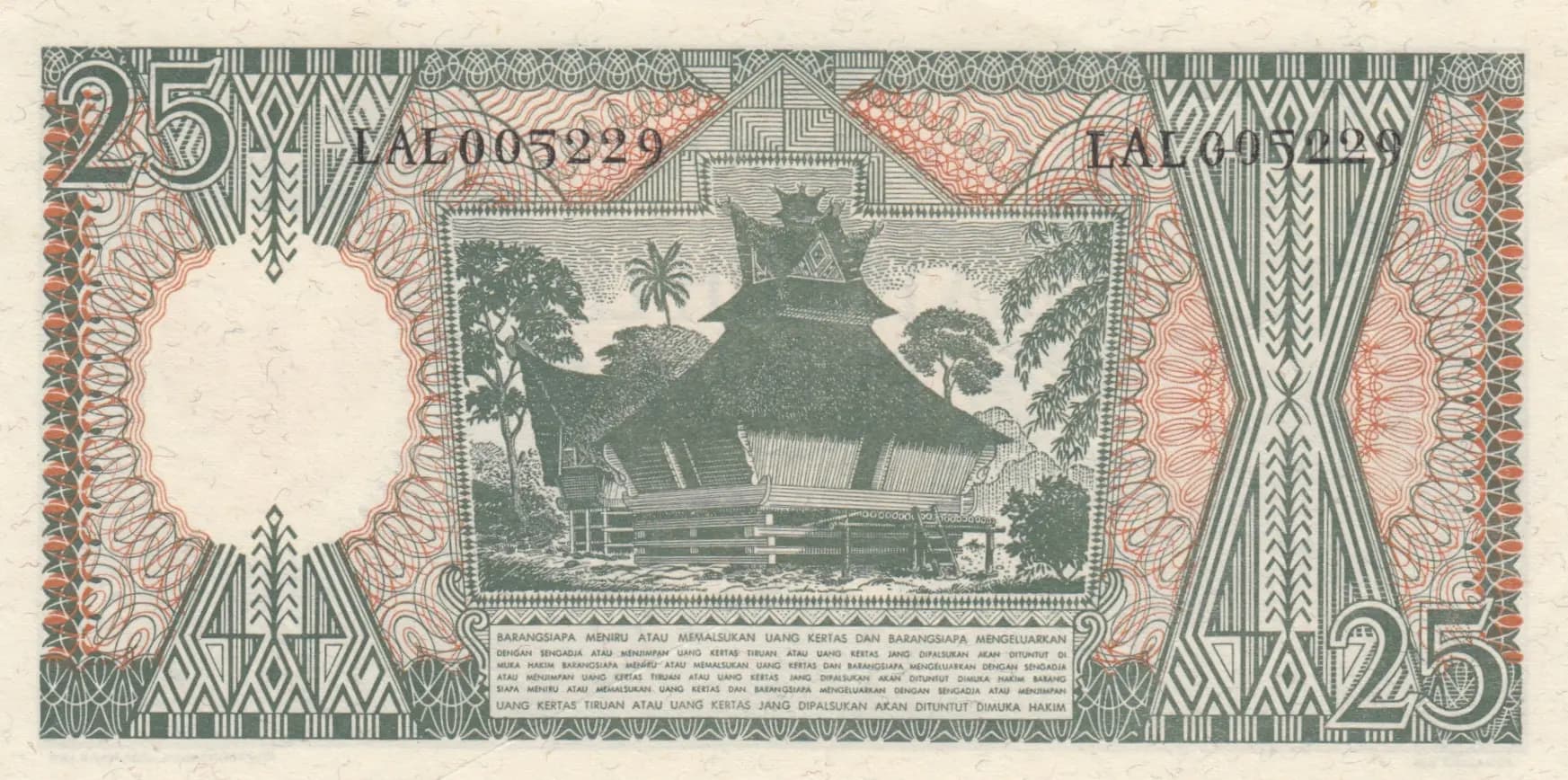
This 1964 Indonesia 25 rupiah note (Pick-95) presents an excellent AU example of Bank Indonesia's mid-century currency design, featuring vibrant green and cream coloring with detailed engraved portraits and architectural imagery. The obverse displays a Batak woman weaver at left with the Indonesian national coat of arms (Garuda Pancasila) at right, while the reverse showcases a traditional Batak house in tropical landscape setting. The note exhibits expected aging characteristics including light yellowing and patina consistent with a nearly 60-year-old banknote, with no major tears or severe creasing observed.
Common. This 25 rupiah note is widely available to collectors. The eBay market data spanning from 2011 to 2024 demonstrates consistent and regular sales of this note across all condition grades, with typical prices ranging from $1.60 to $10.50 for circulated examples and UNC specimens. Even professionally graded PMG examples (grades 64-68) regularly sell in the $11-$45 range, indicating substantial supply in the collector market. The high frequency of sales transactions over more than a decade confirms this as a standard, readily obtainable banknote rather than a scarce issue.
Issued in 1964 during Indonesia's post-independence consolidation period under President Sukarno, this note celebrates Indonesia's diverse indigenous cultures through its depiction of Batak weaving traditions and regional architecture. The prominent display of the Garuda Pancasila coat of arms underscores the newly unified nation's commitment to national identity, while the focus on traditional crafts and vernacular architecture reflects the era's emphasis on cultural heritage and rural development during Indonesia's early nation-building phase.
The obverse features a detailed engraved portrait of a Batak woman in traditional dress and headwear, depicted working at a traditional weaving loom on the left side, with tropical architectural elements visible in the background including palm trees and a regional building structure. The center contains a large cream-colored oval cartouche with denomination and issuer information. The Garuda Pancasila (the mythical eagle and national emblem of Indonesia) appears prominently on the right within a sunburst oval vignette. The reverse displays a well-rendered central vignette of a traditional Batak house with distinctive peaked roof and regional architectural style, set within a tropical landscape with vegetation and palm trees, enclosed in an ornate rectangular frame with complex geometric and floral border patterns in green and red/orange tones. Denomination '25' appears in ornate frames at all four corners of the obverse.
FRONT: 'BANK INDONESIA' (Bank Indonesia), 'DUA PULUH LIMA RUPIAH' (Twenty-Five Rupiah), '1964' (year of issue), 'GUBERNUR' (Governor), 'DIREKTUR' (Director), 'BM-PERUSAHAAN KEBAIJAKAN' (printer information - Pertjetakan Kebajoran). BACK: Serial number 'VAL005229', identifier 'LAG 5449', denomination '25' (repeated). Large legal disclaimer text reading: 'BARANGSIAPA MENIRU ATAU MEMALSUKAN UANG KERTAS DAN BARANGSIAPA MENGELUARKAN DENGAN SENGAJA ATAU MENGIMPUM UANG KERTAS TIRURAN ATAU UANG KERTAS JANG DIPALSUKAN AKAN DITUNTUT DI MUKA PENGADILAN' (Whoever counterfeits or forges banknotes and whoever deliberately issues or hoards counterfeit or forged banknotes will be prosecuted in court).
Intaglio (engraving/recess printing) executed by Pertjetakan Kebajoran, the noted Indonesian security printer. The visual analysis confirms characteristic features of this period's intaglio production: intricate engraved line work throughout both sides, complex geometric border patterns, multiple layers of fine detail in portraits and architectural vignettes, and the crisp, detailed rendering of the Garuda Pancasila emblem with sunburst effects. Multi-color printing (green, red/orange, cream, black) suggests sequential color registration typical of mid-20th century banknote production.
This specific example carries serial number VAL005229 with identifier marking LAG 5449. Standard varieties for the 1964 25 rupiah issue relate to signature combinations (Governor and Director signatures varied across printing runs) and serial number prefixes, though these do not substantially affect collector value. The note appears to be a standard printing without notable overprints or error variations. No rare printing varieties have been documented for Pick-95.