25 rupiah 1952
Market Prices
10 salesAbout This Note
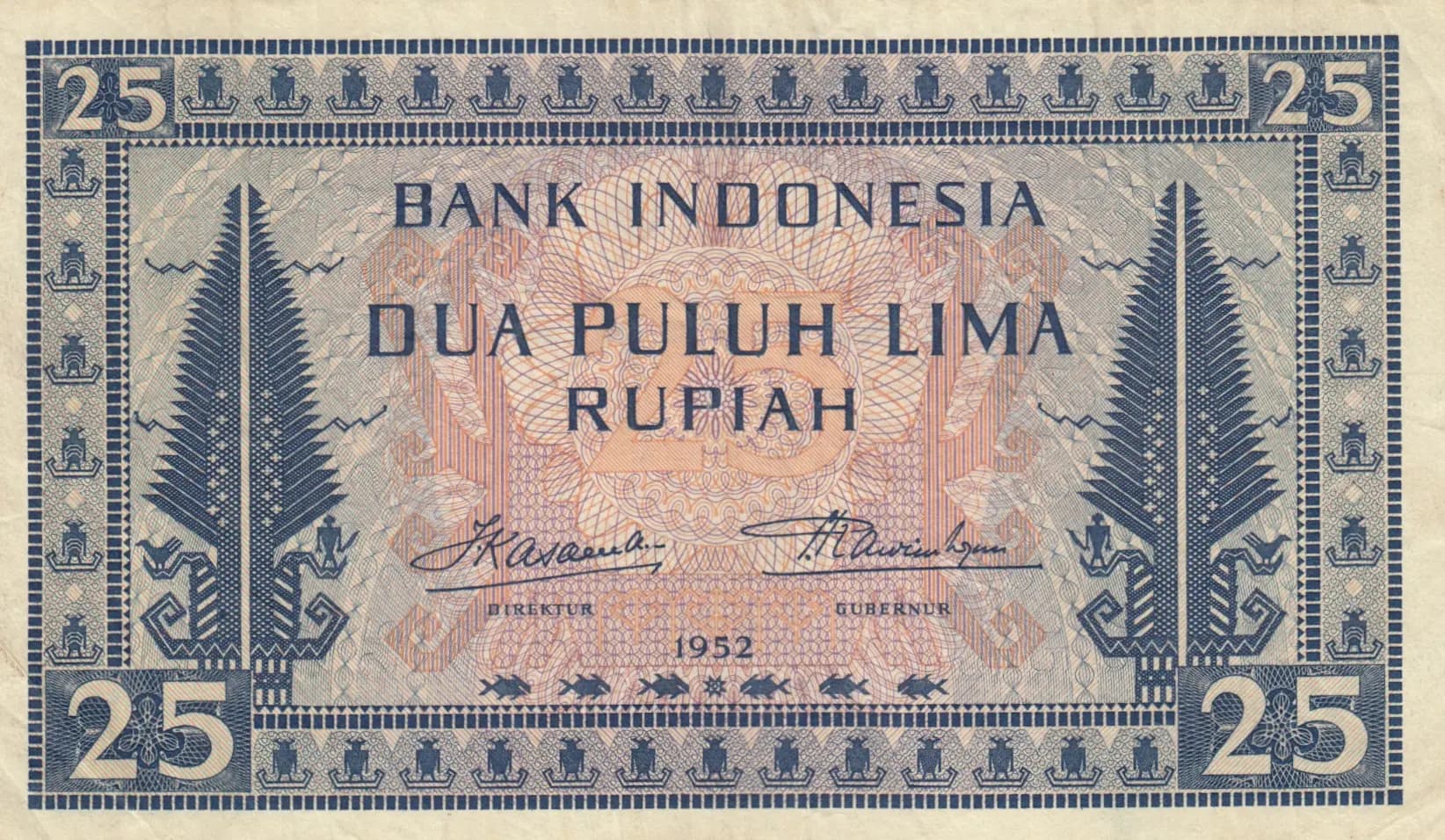
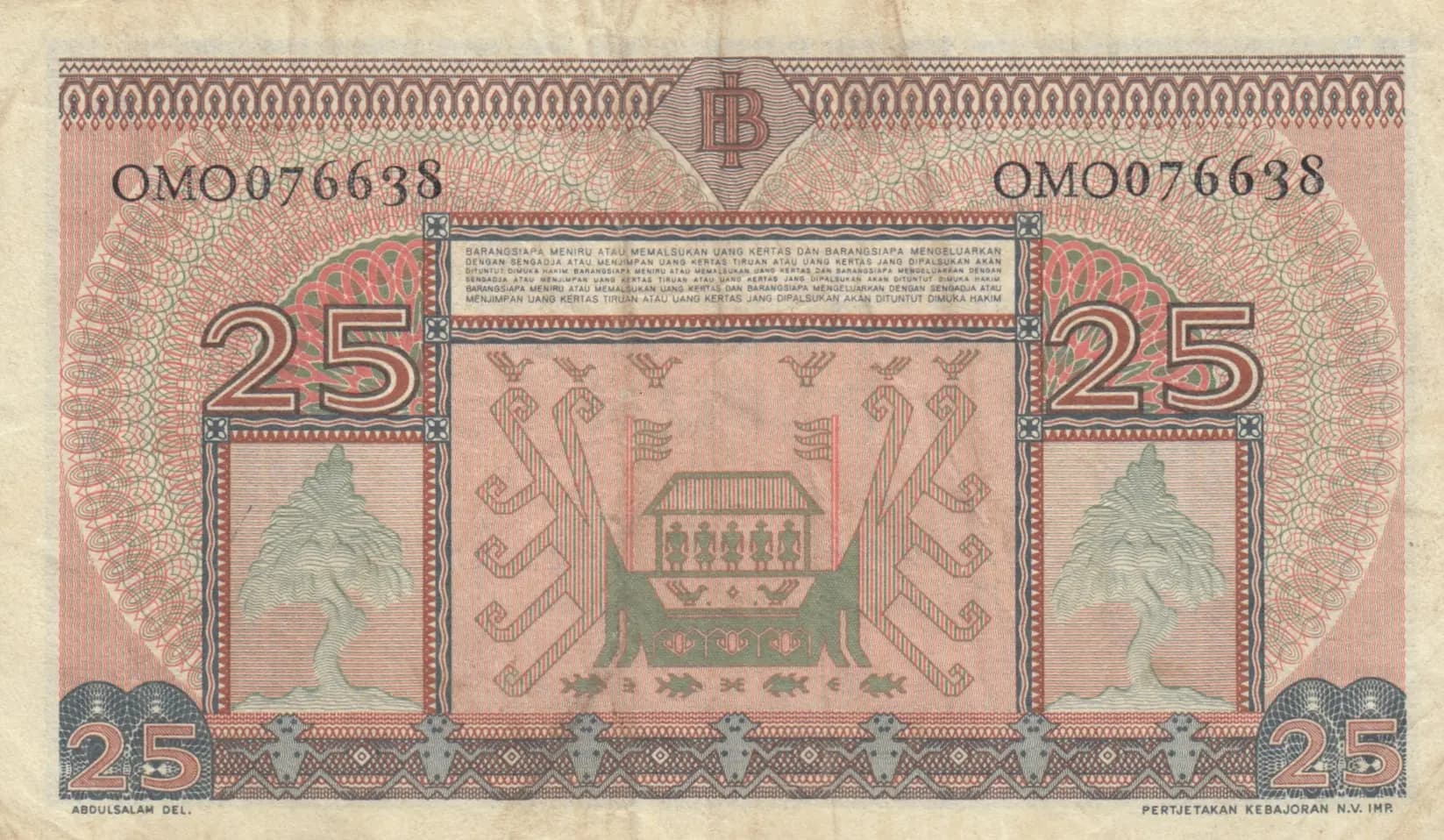
This is a Bank Indonesia 25 Rupiah note from 1952 (Pick P-44b) in VF condition, featuring the distinctive batik-inspired design characteristic of Indonesia's early post-independence currency. The obverse displays an elegant blue and beige color scheme with ornate geometric and architectural motifs, while the reverse showcases red/pink and green tones with a traditional Indonesian pavilion flanked by two figures in traditional dress. The note exhibits expected wear from circulation including creasing and age-related discoloration, consistent with a mid-20th century circulated specimen.
Common. eBay historical sales data demonstrates consistent availability in the secondary market, with VF-graded examples selling for $22.50 in 2016 and UNC specimens reaching $126.84 in 2023, indicating healthy supply for the grade range. The 2016 catalogue value for VF ($6) aligns with typical pricing for common early Indonesian currency issues. The absence of records indicating a short print run, recall, or restricted issuance period, combined with regular market circulation of both lower and higher grades, confirms this as a common issue for its vintage.
Issued in 1952 by Bank Indonesia during the early years of the newly independent Indonesian nation, this note reflects the country's cultural heritage through its incorporation of traditional Indonesian architectural elements and batik-inspired decorative patterns. The design choice emphasizing indigenous cultural motifs rather than colonial imagery symbolized Indonesia's break from Dutch rule and assertion of national identity. The traditional pavilion structure depicted on the reverse represents the architectural legacy of the Indonesian archipelago during a formative period of nation-building.
The 25 Rupiah note features a sophisticated dual-sided design emphasizing traditional Indonesian aesthetic principles. The obverse presents a formal composition with stylized temple-like architectural structures in vertical borders flanking the central text area, decorated with repeating crown symbols and geometric stepped/zigzag patterns suggesting batik motifs. The reverse depicts a central traditional Indonesian pavilion (likely representing a joglo or similar regional architecture) as the focal point, with two figures in traditional Indonesian dress positioned symmetrically on either side, appearing to present or frame the structure. Both sides incorporate elaborate guilloche patterns and fine geometric ornamental borders throughout, with stylized aquatic symbols visible at the bottom center of each side. The color differentiation between obverse (blue/beige) and reverse (red-green) aids in visual identification while maintaining design coherence.
FRONT: 'Bank Indonesia' (English/Latin); 'Dua Puluh Lima Rupiah' (Indonesian - Twenty-Five Rupiah); '25' (denomination in numerals, four corners); '1952' (year of issue); 'Direktur' (Director - signature line); 'Gubernur' (Governor - signature line). BACK: '25' (denomination in numerals, four corners); Serial number 'OMO0766638'; 'Abdulsalam Del.' (artist/engraver signature); 'Pertjetakan Kebajaoran N.V. Ihr' (Kebajaoran Printing N.V., printer); Legal warning text regarding counterfeiting penalties in Indonesian language.
This note was produced using intaglio (engraved) printing, evident from the fine line work, detailed guilloche patterns, cross-hatching, and the multiple layers of intricate decorative elements visible throughout both sides. The printer identified as 'Pertjetakan Kebajaoran N.V.' (Kebajaoran Printing) executed the printing. The security features consist primarily of sophisticated line work and ornamental complexity rather than modern security threads or watermarks, reflecting printing technology standards of the early 1950s. The engraver credited as 'Abdulsalam Del.' designed the reverse composition.
This specimen is identified as Pick P-44b, the specific variety designation for the 1952 issue. The serial number OMO0766638 is consistent with 1952 production batches. The signatures identified as 'Direktur' and 'Gubernur' are standard for this issue, though specific officer identification would require cross-reference with Bank Indonesia records. No overprints or significant variants are visible. The 'Abdulsalam Del.' credit on the reverse indicates this specific engraver's work, which may be consistent across the P-44b variety.