25 rupiah 1968
Market Prices
46 salesAbout This Note
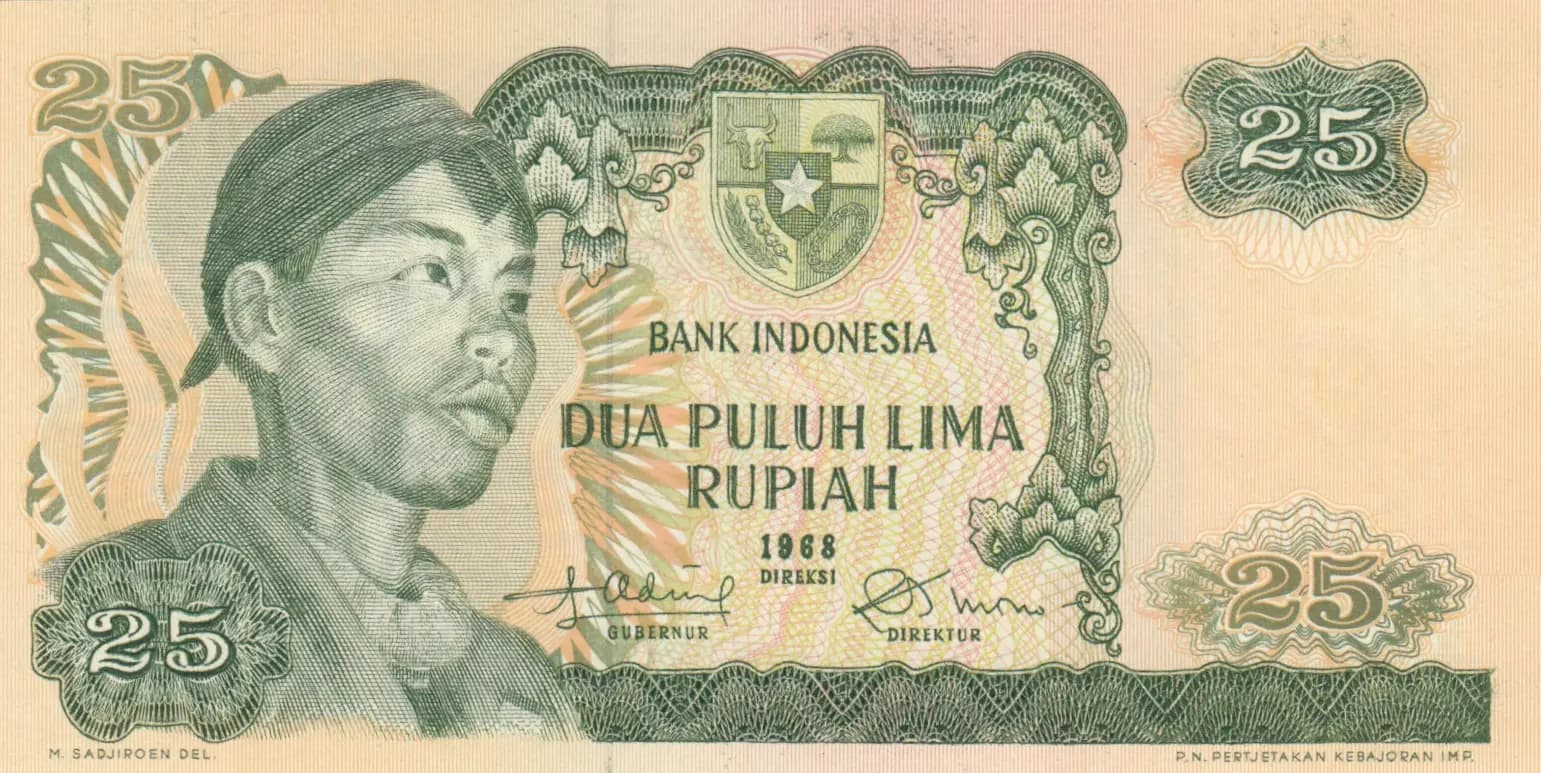
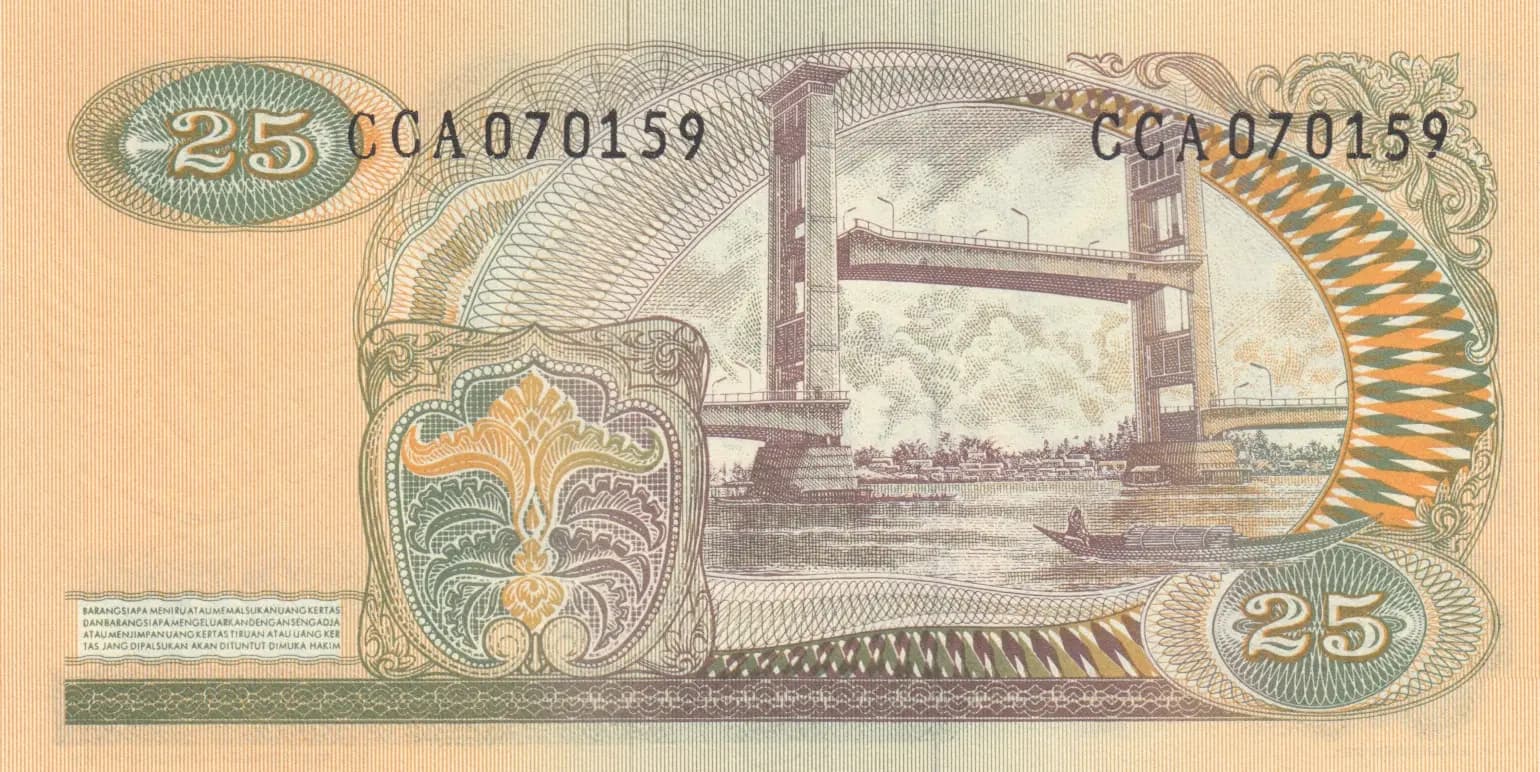
This UNC example of the Indonesia 25 Rupiah 1968 (P-106) displays exceptionally crisp printing with sharp detail throughout both obverse and reverse. The note features a green and tan color scheme with intricate engraving of General Sudirman in profile on the front and the iconic Ampera lift bridge spanning the Musi River on the back. The uncirculated condition with no visible wear, creasing, or staining makes this a desirable collector specimen, particularly as PMG-graded examples in the 65-67 range have consistently sold for $15-$50 on the secondary market.
Common. The 1968 25 Rupiah (P-106) is a regular issue banknote with substantial print runs typical of low-denomination currency in daily circulation. eBay price data spanning 2012-2026 consistently shows ungraded examples in EF-UNC condition selling for $2-$8, with PMG-graded examples (65-67) ranging from $15-$50. The abundance of comparable sales data and consistent pricing indicates this is a common note for numismatists and collectors. No evidence exists of a recalled series, short print run, or scarcity. The denomination itself—a low value even in 1968—suggests high mintage to meet circulating demand.
Issued in 1968 by Bank Indonesia during the Suharto era's early consolidation of power, this note commemorates General Sudirman, the legendary Indonesian independence fighter and first commander of the Indonesian National Armed Forces (TNI). The reverse depicts the Ampera lift bridge—a symbol of modern Indonesian engineering and development completed in 1965 over the Musi River in Palembang, South Sumatra, representing the nation's post-independence progress and infrastructure modernization.
The obverse features a left-facing portrait of General Sudirman, rendered in fine engraving detail, positioned at the left side of the note. The center contains the Indonesian national coat of arms (Garuda Pancasila) with its distinctive shield containing a star, surrounded by ornate decorative wreaths and floral motifs. The reverse presents the Ampera suspension bridge as its dominant central design element—a two-tower lift bridge spanning the Musi River at Palembang, a landmark of modern Indonesian infrastructure. Both sides employ symmetrical ornamental panels with botanical and floral designs in decorative frames. The denomination '25' appears in all four corners in circular or oval frames, reinforcing the note's value through multiple visual cues. The color palette of green, tan, beige, and cream with subtle brown/maroon accents creates a harmonious, classic appearance typical of 1960s Indonesian currency design.
Front side: '25' (denomination), 'BANK INDONESIA' (issuing authority), 'DUA PULUH LIMA RUPIAH' (Twenty-Five Rupiah in Indonesian), '1968' (year of issue), 'DIREKSI' (Director), 'GUBERNUR' (Governor), 'M SADJIROEN DEL' (engraver/artist signature), 'P.N. PERDJATAKAN KEBAJORAN IMP' (Printer: P.N. Pertjetakan Kebajoran). Back side: '25' (denomination in multiple locations), 'CCA070159' (serial number), Legal warning text: 'BARANG SIAPA MENEMUKAN UANG SESUAI UNDANG-KERTAS DAN BARANG APA MENGELLUAT SENG ANG ANE SENDIA AT MELIMPAN UANG KERTAS ATAP UANG KER TAS JANG DIFALSUKAN AKAN DITUNTUT DIMUKA HAKIM' (Whoever finds money in accordance with the law, counterfeits money, or knowingly possesses counterfeit currency will be prosecuted before a judge).
Intaglio (engraved) printing on security-grade banknote paper, executed by Pertjetakan Kebajoran (P.N. Pertjetakan Kebajoran). The fine line engraving is evident throughout both sides, with complex geometric cross-hatching patterns, intricate borders, and detailed portraiture characteristic of high-security intaglio currency production. The crisp registration and sharp detail in the UNC example indicates skilled production on modern presses with premium substrates and inks.
This example carries the serial number 'CCA070159' visible on both obverse and reverse. The signature block includes 'M SADJIROEN DEL' as the engraver and printer attribution to 'P.N. PERDJATAKAN KEBAJORAN IMP.' Known varieties for P-106 relate to serial number prefixes (CCA, CCB, etc.) and signature combinations for the Director and Governor positions, which changed over the note's production period. This particular example represents the standard 1968 printing. No overprints, security features beyond standard engraving, or anomalies are noted in the visual analysis.