2 1/2 rupiah 1963
Market Prices
About This Note
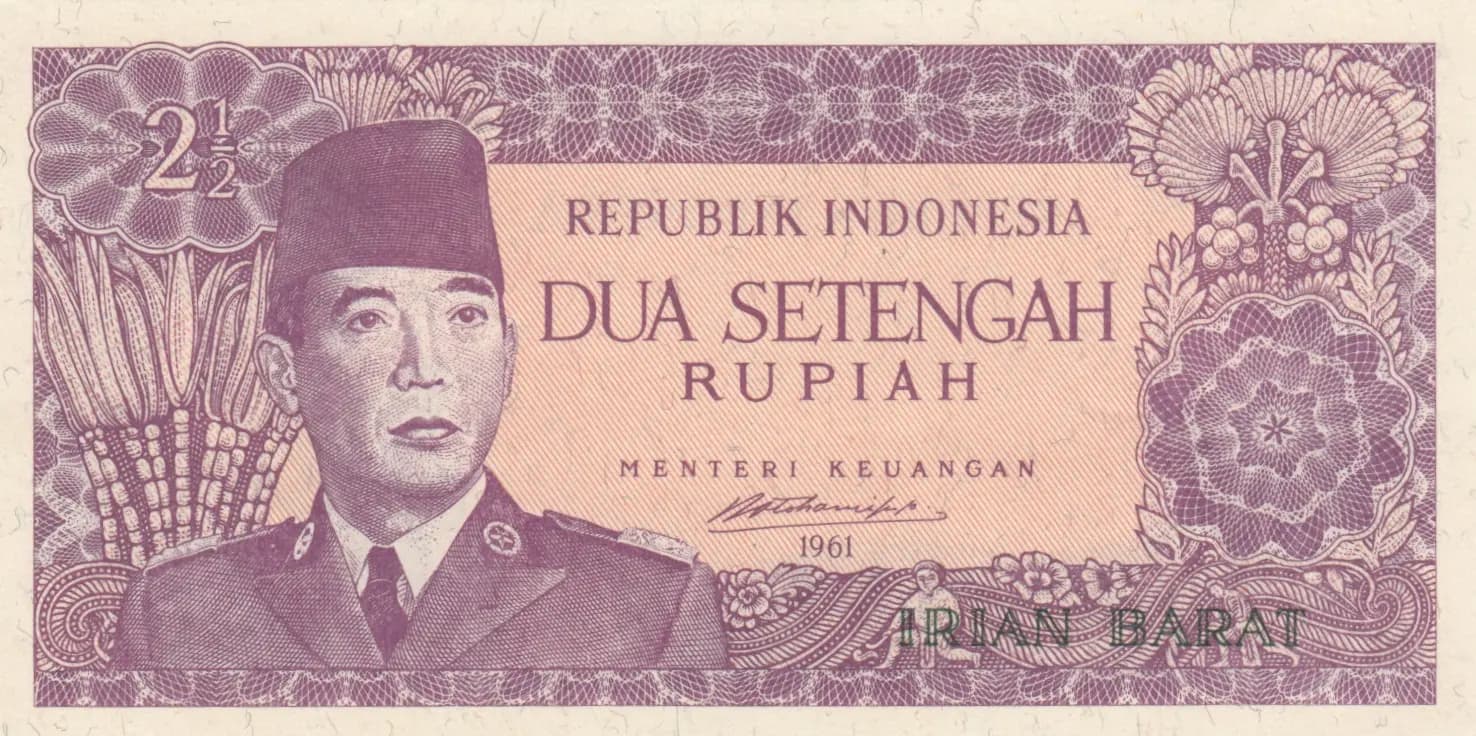
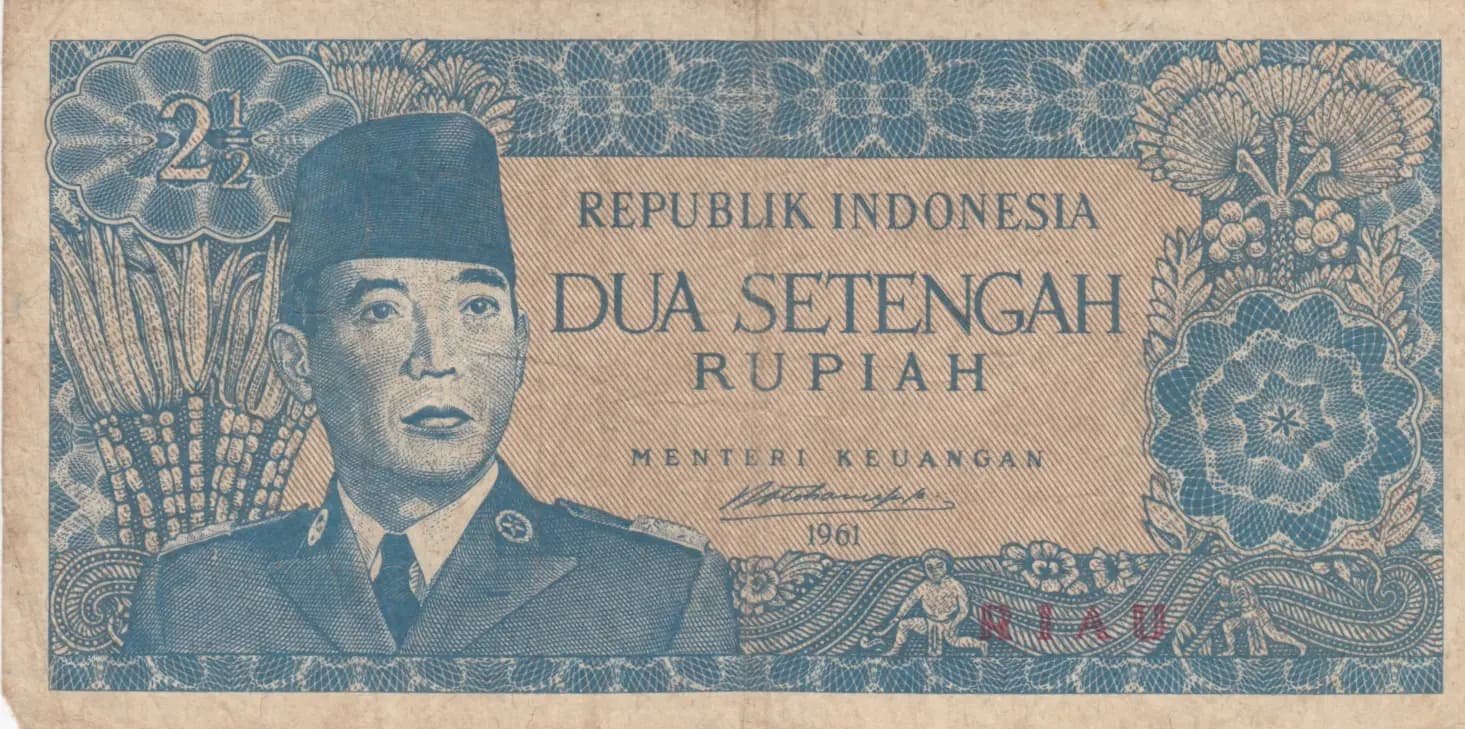
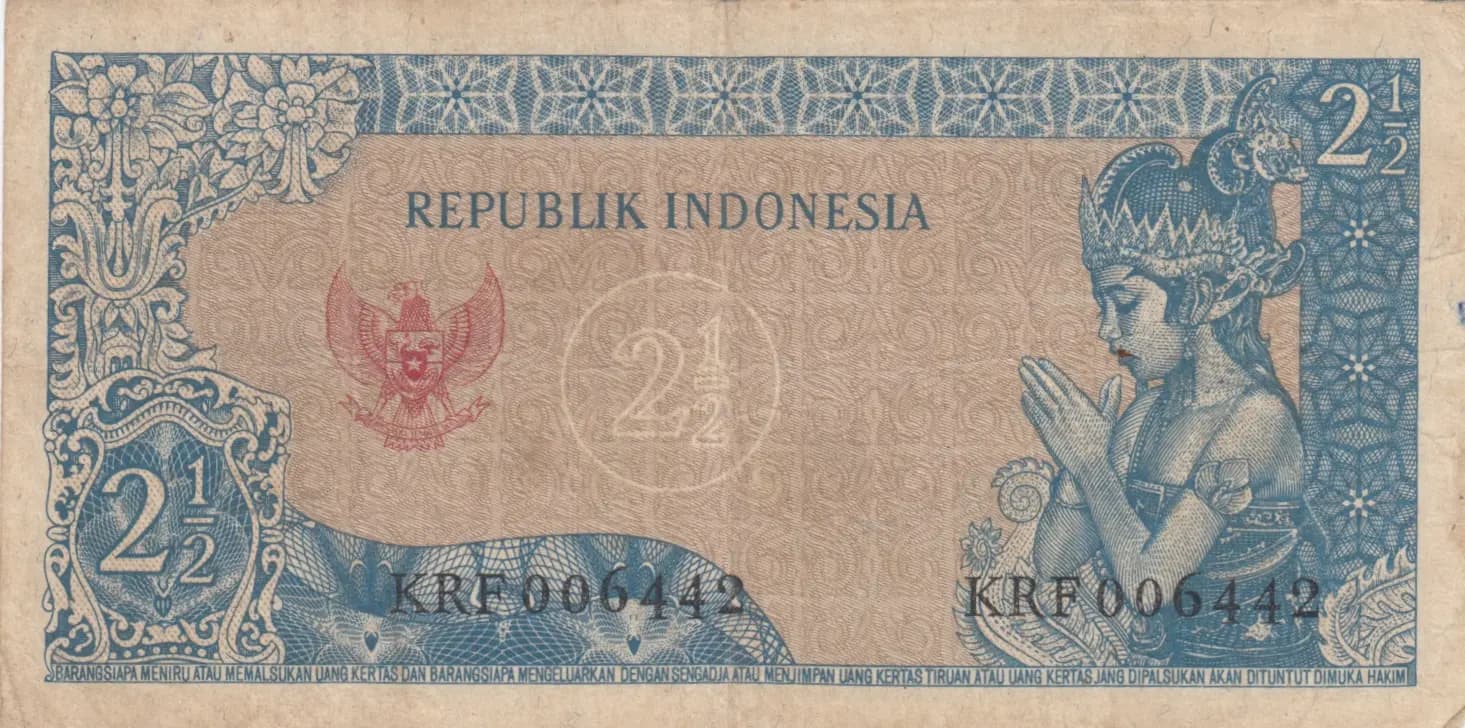
This 2½ Rupiah note from 1963 issued by the Riau Archipelago represents a fascinating regional currency from Indonesia's early post-independence period. The note displays the characteristic teal and cream color scheme with fine engraved detail work throughout, featuring a military-uniformed male portrait on the obverse and a traditionally-dressed female figure on the reverse. In Fine condition, the note shows age-appropriate toning and wear consistent with its 60+ year history, with intact surfaces and legible inscriptions including the anti-counterfeiting warning on the reverse.
Common. The eBay market data shows multiple listings across various condition grades ranging from $1.49 to $120 USD, with the majority of recent sales in the $2-5 range for circulated examples, indicating substantial supplies remain in collectors' hands. Regional Indonesian notes from 1963, while historically interesting, do not appear to have been produced in extremely limited quantities, and the availability of multiple examples at modest price points confirms common status.
The Riau Archipelago regional banknote series reflects Indonesia's complex post-colonial monetary reorganization in the early 1960s. The military figure depicted on the obverse and the traditional Indonesian female portrait on the reverse exemplify the nationalist iconography of Sukarno-era Indonesia, emphasizing both military authority and cultural heritage. This 1963 issue predates the major currency redenomination reforms that would follow, making it a snapshot of a transitional period in Indonesian numismatic history.
The obverse features a three-quarter portrait of a male military officer wearing the traditional peci (Indonesian cap) and military uniform with visible insignia, positioned prominently on the left side against an elaborate background of floral and geometric decorative patterns with ornamental corner elements and peacock or fan-like motifs. The reverse displays a profile portrait of a woman in traditional Indonesian dress with an ornate headdress on the right side, complemented by the Garuda Pancasila national emblem (rendered in red/pink tones) in the central cream-colored area, surrounded by intricate floral and geometric border designs. Both sides prominently display the denomination '2½' in multiple locations, with the reverse carrying the legally-mandated counterfeiting warning text.
FRONT: '2½' (denomination), 'REPUBLIK INDONESIA' (Republic of Indonesia), 'DUA SETENGAH RUPIAH' (Two and a half rupiah), 'MENTERI KEUANGAN' (Minister of Finance), '1961' (date reference). BACK: 'REPUBLIK INDONESIA' (Republic of Indonesia), '2½' (denomination), 'KRF006442' (serial number), 'BARANGSÍAPA MENIRU ATAU MEMALSUKAN UANG KERTAS DAN BARANGSÍAPA MENGELUARKAN DENGAN SENGAJA ATAU MENJIMPAN UANG KERTAS TIRUANATAAU UANG KERTAS JANG DÍPALSUKAN AKAN DITUNTUT DIMUKA HAKIM' (Whoever counterfeits or forges banknotes and whoever deliberately issues or keeps counterfeit or forged banknotes will be prosecuted in court).
Intaglio engraving (copperplate), as evidenced by the fine line work, intricate background patterns, elaborate decorative elements, and the precise detail visible throughout both sides of the note. The consistent depth of impression, detailed emblem rendering, and ornate corner work are characteristic of high-quality security printing typical of central bank note production in the early 1960s.
The observed serial number prefix 'KRF' and the specific serial number sequence 'KRF006442' visible on both sides of the reverse should be documented. The date reference '1961' printed on the obverse while the catalogue designation is 1963 suggests either a design plate carryover or a multi-year printing run. No overprints or significant variations are apparent from the visual analysis, though comparative study with other known examples of this Pick number would be necessary to identify additional varieties.