2 1/2 rupiah 1963
Market Prices
2 salesAbout This Note
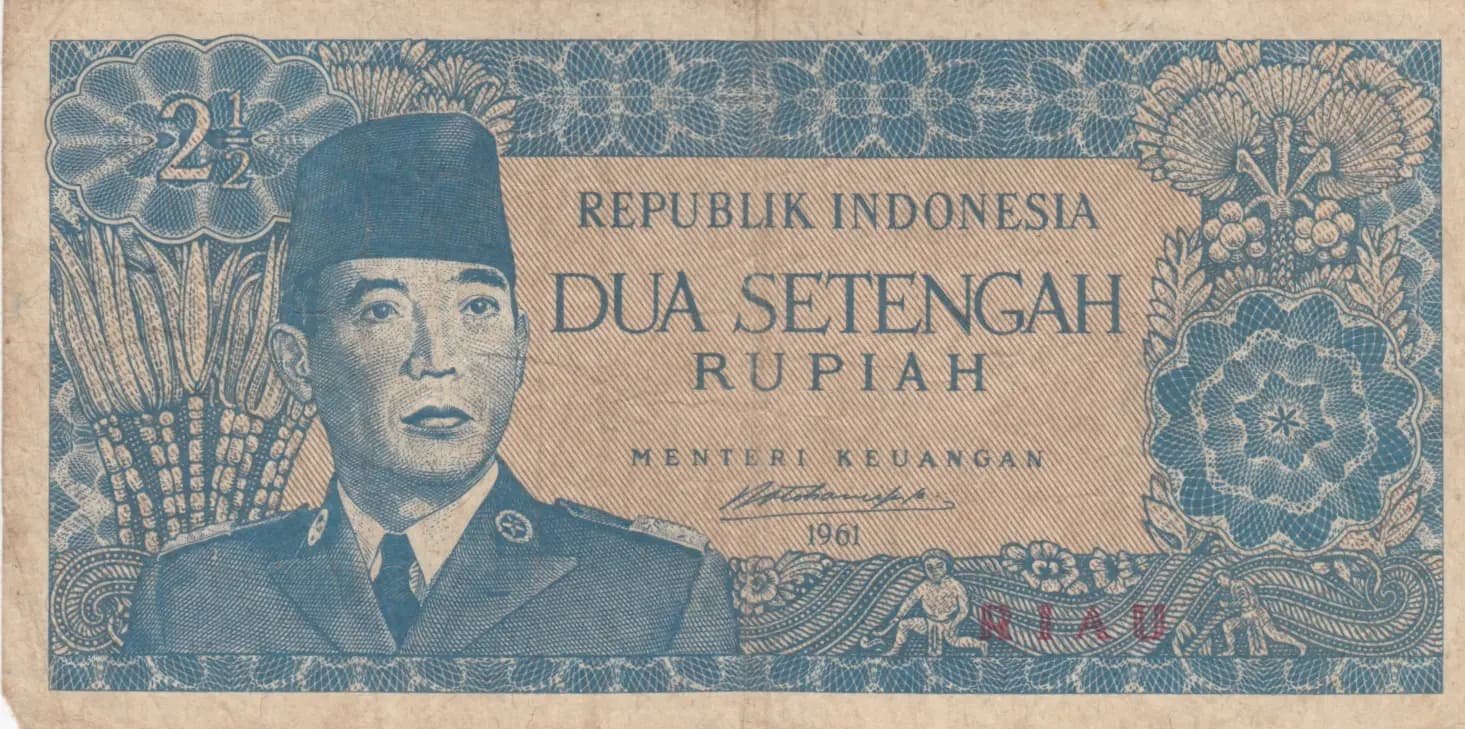
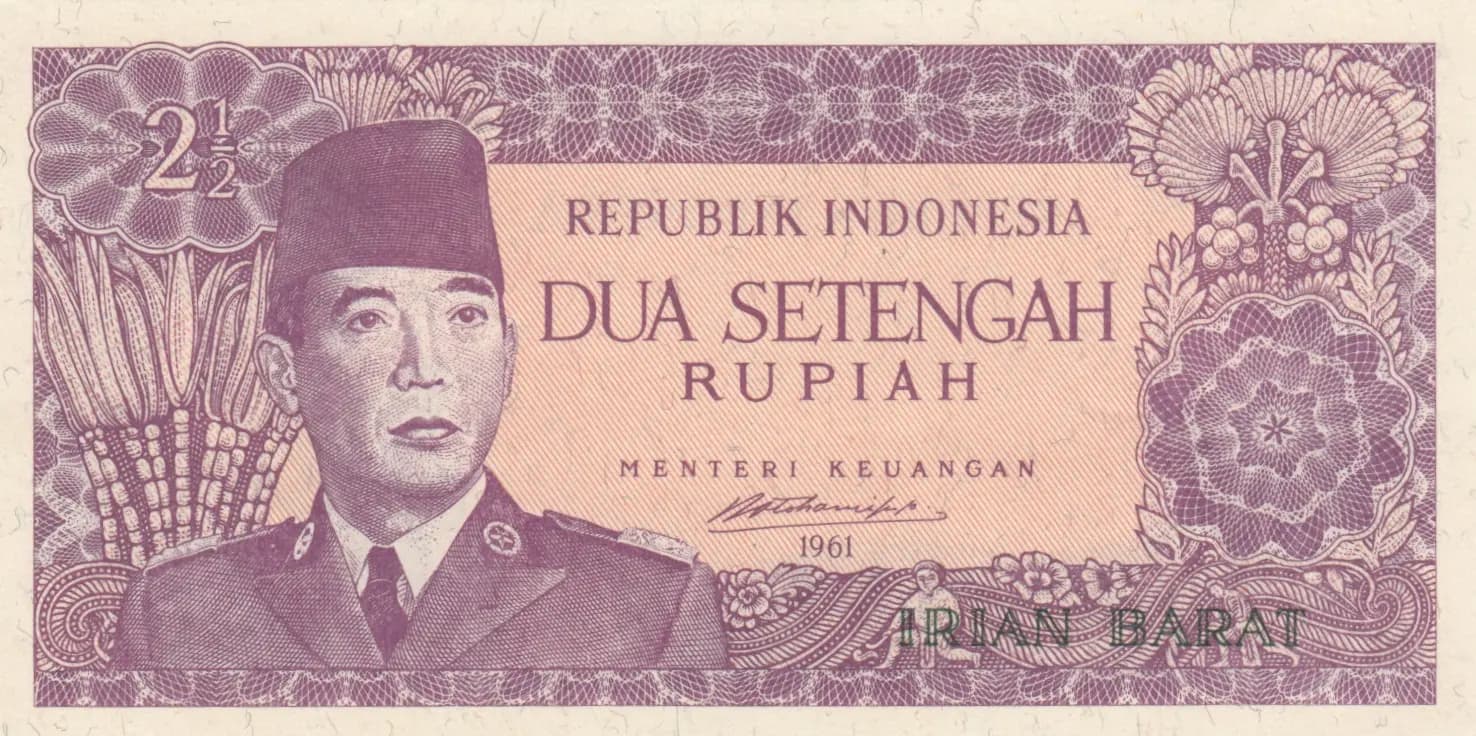
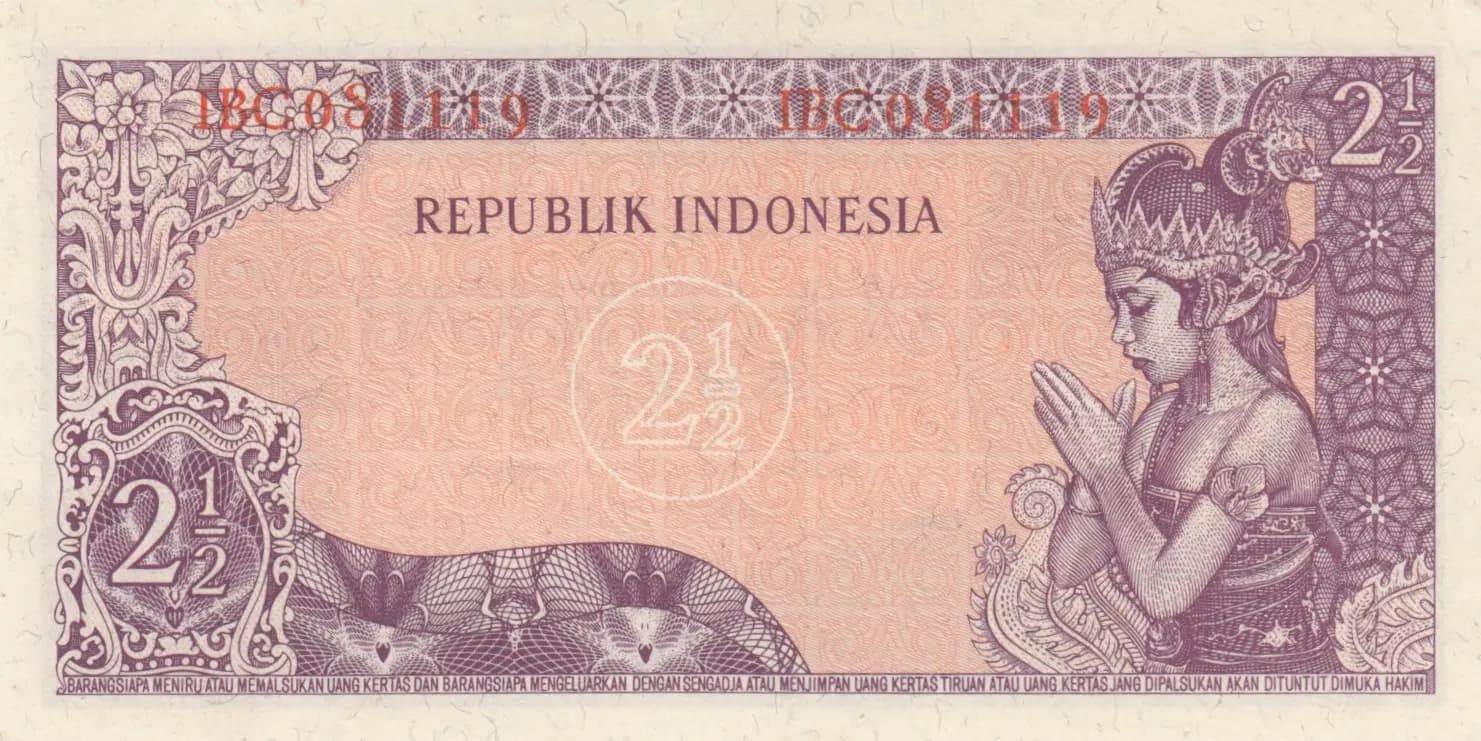
This 2½ Rupiah note from 1963, issued by Irian Barat (West Papua), represents an interesting regional currency from Indonesia's transitional period. The note displays strong AU condition with visible wear including creasing and age-related discoloration, featuring intricate engraving of a military-uniformed portrait on the obverse and a classical allegorical female figure on the reverse. The presence of red stamp overprints and the regional issuer designation make this a notable example of Indonesia's decentralized currency experiments in the early 1960s.
Common. While this is a regional issue from a specific short-lived issuing authority (Irian Barat), the eBay market data indicates relatively modest price realization: PMG 55 specimens sold for approximately $237.50 (2020) and UNC examples for $225.50 (2015), well below the $500+ threshold that would indicate scarcity. The 2008 catalog valuations (UNC: $35) and the steady but unspectacular auction results suggest this note, while historically interesting, circulated in sufficient quantities to remain common among collectors. The AU condition grade assigned is appropriate but does not elevate rarity status.
This banknote was issued during 1963 for Irian Barat (West Iranian/West Papua), following Indonesia's assertion of sovereignty over the former Dutch New Guinea territory in 1961. The military-uniformed figure on the obverse likely represents an Indonesian nationalist leader or military official central to the Irian Barat territorial claims, while the allegorical female figure on the reverse evokes classical imagery symbolizing the nation or regional prosperity. The red overprints visible on the note suggest administrative or security markings applied during circulation, reflecting the complex political and administrative transitions occurring in this newly incorporated Indonesian territory.
The obverse features a three-quarter facing portrait of a male figure wearing a peci (traditional Indonesian military cap) and military uniform with visible rank insignia, positioned on the left side. The portrait is surrounded by ornate floral medallions and decorative scrollwork in purple, mauve, beige, and pink tones. The denomination '2½' appears in the upper left corner with 'REPUBLIK INDONESIA' and 'DUA SETENGAH RUPIAH' prominently displayed. The reverse depicts a classical allegorical female figure in profile wearing traditional dress with decorative hair ornaments, positioned on the right side of the design. A large circular medallion containing the denomination '2½' dominates the center, flanked by symmetrical ornamental borders featuring intricate scrollwork, fan-like and shell-like motifs. An anti-counterfeiting warning text fills the lower portion of the reverse. The overall composition reflects 1960s Indonesian banknote design aesthetics with classical European-influenced allegorical imagery combined with Indonesian nationalist symbolism.
FRONT SIDE: '2½' (denomination in numerals) | 'REPUBLIK INDONESIA' (Republic of Indonesia) | 'DUA SETENGAH RUPIAH' (Two and a half rupiah) | 'MENTERI KEUANGAN' (Minister of Finance) | '1961' (year) | 'IRIAN BARAT' (West Iran/West Papua). BACK SIDE: '2½' (denomination in numerals) | 'REPUBLIK INDONESIA' (Republic of Indonesia) | 'BARANGSSIAPA MENULIS ATAU MEMALSUIKAN UANG KERTAS DAN BARANGSSIAPA MENGELUARKAN DENGAN SENGAJA ATAU MENJIMPUN UANG KERTAS TIRUAN ATAU UANG KERTAS JANG DIPALSUKAN AKAN DITUNTUT DIMUKA HAKIM' (Whoever forges or falsifies banknotes and whoever circulates forged or falsified banknotes intentionally or hoards them will be prosecuted before a judge).
Intaglio/engraving process, characteristic of security banknote production from this era. The note exhibits fine line intricate printing patterns in the background, detailed portrait engraving, and complex decorative patterns typical of anti-counterfeiting measures employed by Indonesian currency printers. The precision of the fine line work, ornamental borders, and portrait rendering suggests professional security printing facilities, likely by the Bank of Indonesia's authorized security printer.
The noted red stamp overprints visible on the reverse suggest this specimen may represent a later administrative overprint variety, possibly applied during currency administration transitions or security measures. The print date shown as 1961 with 1963 catalog date indicates potential production run spanning multiple years. No specific signature varieties are clearly legible in the visual analysis, but the 'MENTERI KEUANGAN' (Minister of Finance) designation suggests varieties may exist based on different finance ministers' terms during this period. Serial number detail is insufficiently visible for variety classification based on provided imagery.