2 1/2 rupiah 1968
Market Prices
49 salesAbout This Note
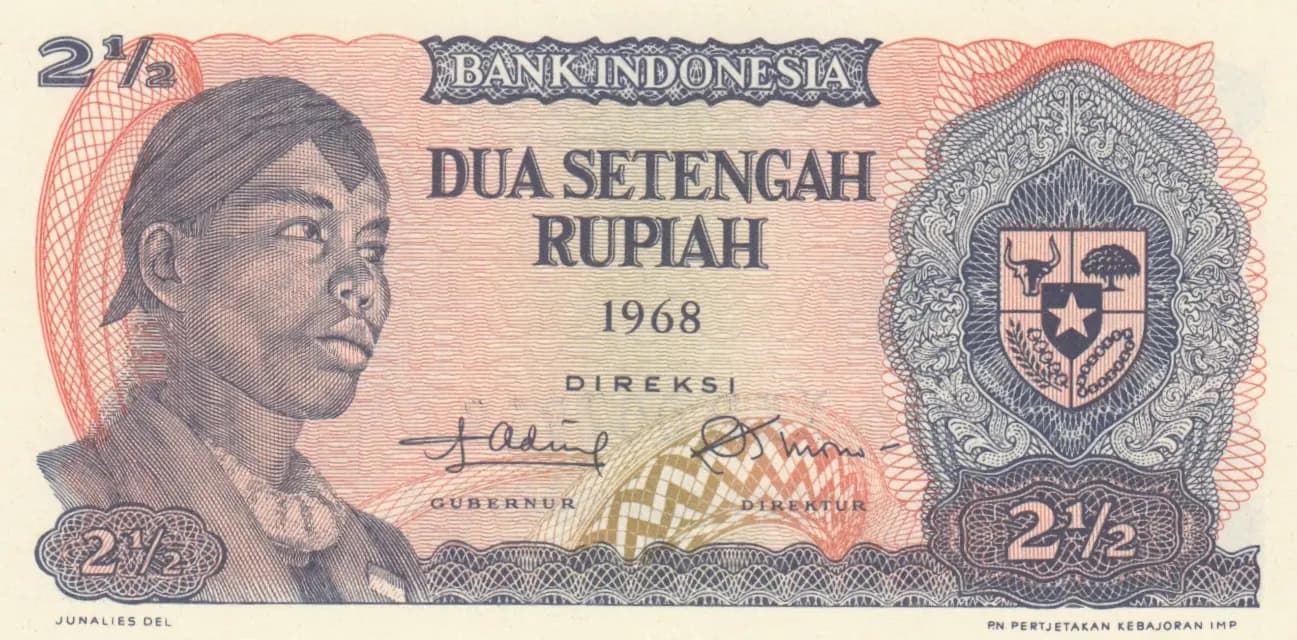
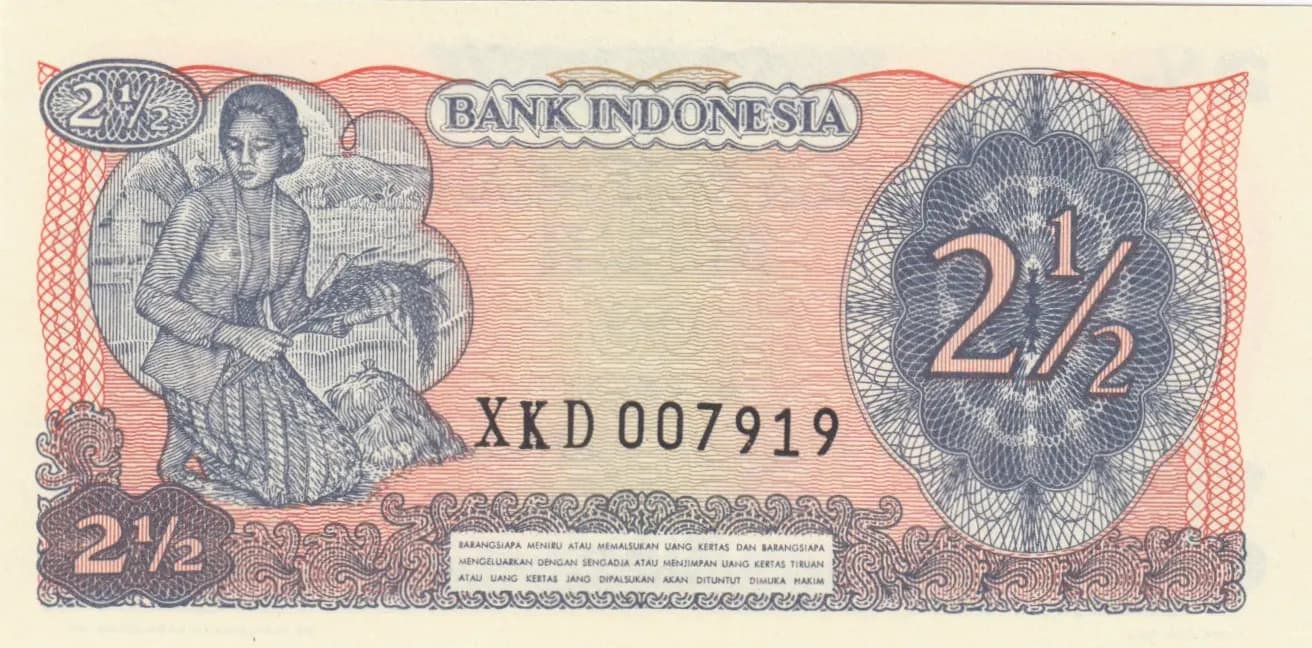
This is an Indonesian 2½ Rupiah note from 1968 (Pick P-103) in Uncirculated condition, featuring a striking portrait of General Sudirman in profile on the obverse and a seated female figure on the reverse. The note exhibits excellent preservation with crisp printing, clear design elements, and no visible wear, displaying the characteristic red, dark blue, and cream color palette typical of this issue with fine guilloche security patterns throughout.
Common. This note is a standard circulation issue from Indonesia's early independence period with no indication of limited print runs, recall status, or rarity. The eBay market data overwhelmingly supports this assessment, with UNC examples consistently selling in the $2.00-$5.50 range (recent sales at $2.01 in 2025 and $2.25 in 2020), well below the threshold indicating scarcity. Even premium PMG-graded examples (65-67) typically sell between $12.50-$45.00, suggesting broad availability. The 2019 catalog value of $2.25 for UNC further confirms this as an abundant, common note in the collector market.
Issued during Indonesia's post-independence period under Bank Indonesia's authority, this 1968 denomination note reflects the nation's early monetary development. The prominent placement of General Sudirman, a revered Indonesian military and independence leader, underscores his national significance, while the reverse depicts a seated woman engaged in rice harvesting—symbolizing Indonesia's agrarian economy and cultural identity during this formative era of the nation's development.
The obverse features a left-facing profile portrait of General Sudirman, a celebrated Indonesian independence leader and military figure, rendered in fine engraved detail on the left side of the note. The right side displays the Indonesian national coat of arms—a complex heraldic emblem featuring a shield with a star, crescent, and other symbolic elements within an elaborate decorative frame. The note employs a beige/cream background with red and dark blue color printing, surrounded by intricate guilloche border patterns and corner emblems containing the 2½ denomination. The reverse depicts a seated woman in period dress shown in three-quarter view, positioned on the left-center portion, symbolizing the agricultural heritage of Indonesia. A large oval medallion on the right contains additional decorative elements and denomination markings. Both sides feature complex fine-line engraving and security patterns throughout, with 'BANK INDONESIA' and denomination text centrally positioned.
FRONT SIDE: 'BANK INDONESIA' (Bank Indonesia), 'DUA SETENGAH RUPIAH' (Two and a Half Rupiah), '1968' (year of issue), 'DIREKSI' (Directors), 'GUBERNUR' (Governor), 'DIREKTUR' (Director), '2½' (denomination), 'JUNALIES DEL' (artist signature), 'PN PERJETAKAN KEBAJORAN IMP' (PN Printing Kebayoran - printer). REVERSE SIDE: 'BANK INDONESIA' (Bank Indonesia), '2½' (denomination appearing multiple times), Serial number 'XKD 007919', and a lengthy counterfeiting deterrent text: 'BARANGSIAPAMENUP ATAU MEMALSUKAN UANG KERTAS DAN BARANGSIAPA MENGELUARKAN DENGAN SENGAJA ATAU MEMNJAMAN UANG KERTAS TIBUAN ATAU UANG SERTIAS JANO DIPALSUKAN AKAN DITUNTUT DIMUKA HAK' (Whoever forges or falsifies banknotes and currency, and whoever intentionally issues or lends forged banknotes or securities shall be prosecuted under the law).
This note was produced using traditional intaglio (engraving) printing by Pertjetakan Kebajoran (PN Printing Kebayoran), the designated state printer for Bank Indonesia. The visual characteristics—including the fine guilloche background patterns, intricate line work, crisp portrait definition, and complex security patterns—are all hallmarks of intaglio printing technology. The multi-color application (red and dark blue on cream background) was achieved through successive intaglio impressions, a standard technique for high-security banknote production of the 1960s era.
The observed specimen bears the serial number prefix 'XKD' with number 007919. The note is signed by the printer (Junalies Del signature visible on obverse). No specific major varieties are documented for this Pick P-103 issue; however, collectors typically encounter minor variations in serial number prefix combinations. The condition appears to be a standard uncirculated example with no evidence of overprints, replacements, or other variety-defining characteristics.