2 1/2 rupees 1956
Market Prices
55 salesAbout This Note
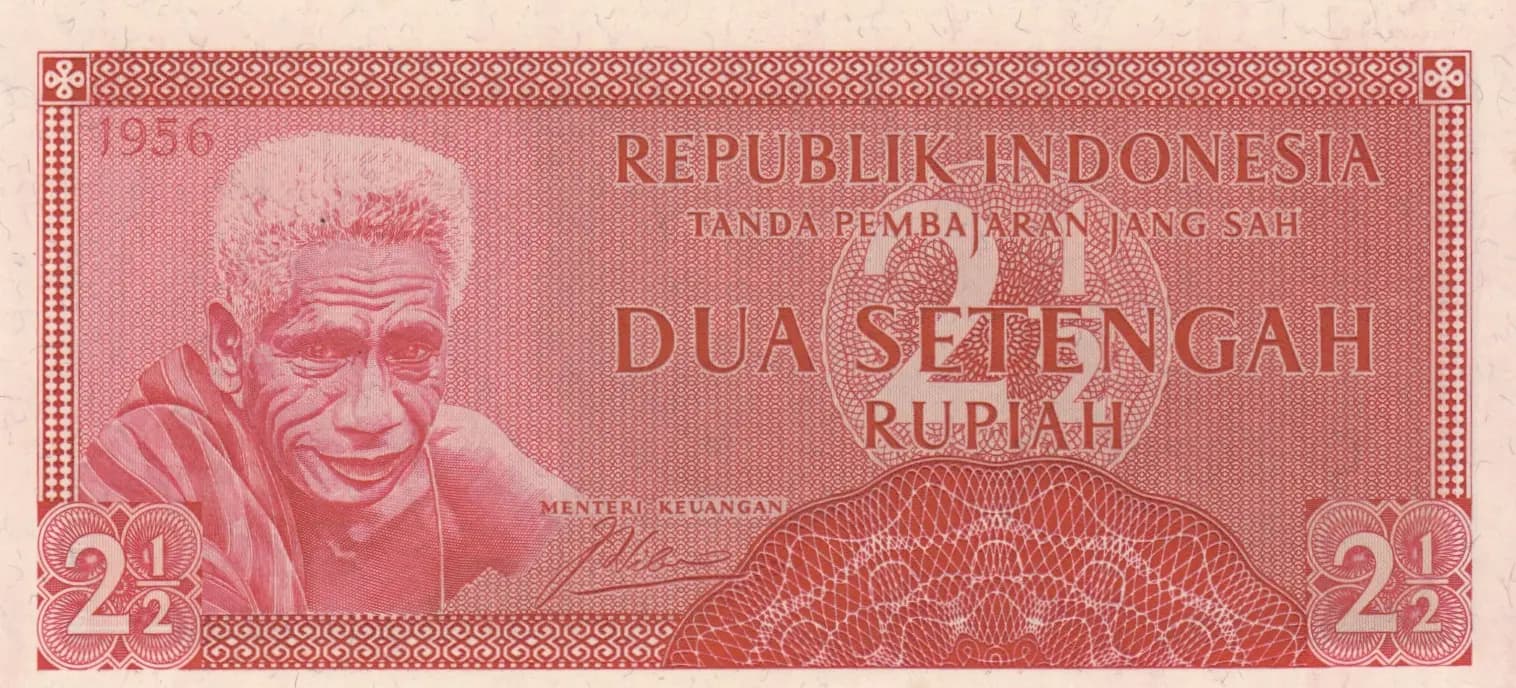
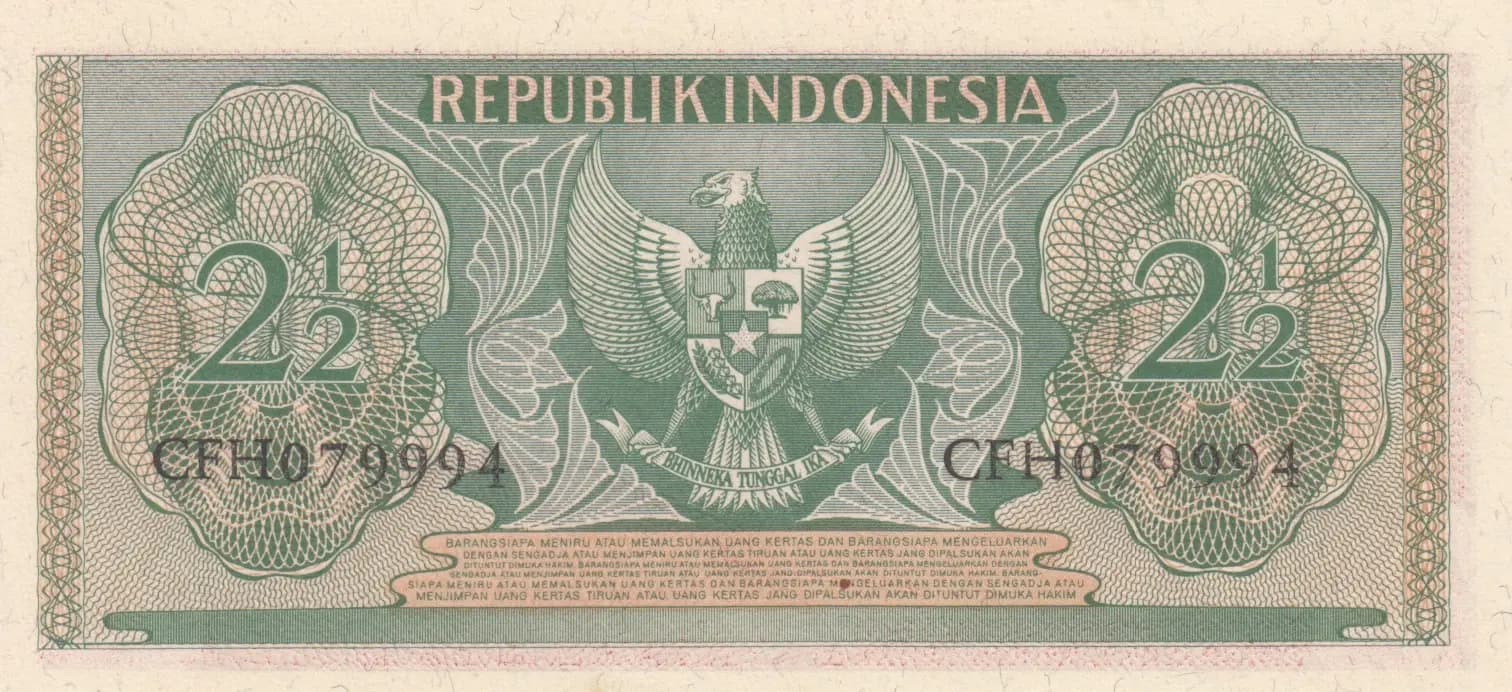
This Indonesian 2½ Rupiah note from 1956 presents a classic mid-20th century design in exceptional uncirculated condition. The obverse features a striking portrait of an elderly Rotinese man in rose/pink tones with ornate geometric borders, while the reverse displays the Indonesian national coat of arms (winged eagle) against a green/teal background. The note exhibits sharp detail with fine line engraving throughout and minimal age-related wear, making it an attractive example of early Republican-era Indonesian currency.
Common. The eBay price tracking data shows consistent sales of UNC examples between $0.99 and $6.91 over the past decade, with most transactions in the $1-$4 range. The 2016 catalogue value for UNC condition was $1.25, confirming modest collector value. Print run data for this Pick-75 denomination suggests adequate circulation, and the regular appearance on auction platforms indicates no significant scarcity. Higher-graded examples (PMG 66-67) command $10-$38, but standard UNC examples remain affordable and readily available in the secondary market.
Issued during the early years of the Indonesian Republic (established 1945), this 1956 note reflects the nation's developing monetary independence following Dutch colonial rule. The prominent display of the national coat of arms featuring the Garuda eagle on the reverse symbolizes national sovereignty and identity. The inclusion of warnings against counterfeiting on the back underscores the government's efforts to establish currency credibility during this formative post-independence period.
The obverse features a three-quarter profile portrait of an elderly Rotinese man positioned at the left side of the note, recognizable by his lined facial features and distinctive ethnographic representation. His image reflects the Indonesian government's deliberate inclusion of indigenous cultural representations in early post-independence currency design. The reverse centers on the Garuda Pancasila—Indonesia's national coat of arms featuring a winged eagle clutching a shield—symbolizing national unity and sovereignty. Denomination numerals appear in ornate circular frames on both sides. The color palette shifts from warm rose/pink tones on the obverse to cool green/teal on the reverse, both with cream/off-white accents and elaborate geometric border treatments characteristic of 1950s security printing design.
FRONT: 'REPUBLIK INDONESIA' (Republic of Indonesia), 'TANDA PEMBAJARAN JANG SAH' (Legal tender), 'DUA SETENGAH' (Two and a half), 'RUPIAH' (Rupiah), 'MENTERI KEUANGAN' (Minister of Finance), '1956' (year of issue), '2½' (denomination). BACK: 'REPUBLIK INDONESIA' (Republic of Indonesia), '2½' (denomination), 'BARANGSIAPA MENIRU ATAU MEMALSUKAN UANG KERTAS DAN BARANGSIPA MENGELUARKAN UANG SENDIRIAN ATAU MENUNJUAL UANG KERTAS YANG PALSU ATAU UANG KERTAS JANG DIPALSUKAN AKAN DITUNTUT DIMUKA HAKIM... MENJIMPAN UANG KERTAS TIRUAN ATAU UANG KERTAS JANG DIPALSUKAN AKAN DITUNTUT DIMUKA HAKIM' (Whoever counterfeits or forges banknotes and whoever issues or sells counterfeit or forged banknotes will be prosecuted before a judge... Whoever keeps counterfeit or forged banknotes will be prosecuted before a judge).
Intaglio engraving (offset lithography combined with fine line engraving), evidenced by the sharp detail, fine line work visible in borders and background patterns, and the crisp denomination numerals in ornate frames. The precision of the portraiture and complex geometric patterns suggest printing by a professional security printer experienced in currency production, consistent with early Indonesian Republic currency standards. No printer attribution mark is clearly visible in the visual analysis, though Indonesian notes from this period were produced by Bank Indonesia's printing facilities or contracted security printers.
The Pick-75 catalog number covers the standard 1956 design. Known varieties for Indonesian 2½ Rupiah notes include signature variants and subtle printing differences across different production runs. Without visible serial numbers, date variants, or signature blocks clearly readable in the provided images, a more specific variety determination cannot be confirmed. The note should be examined for signature combinations and any printer marks to determine the exact production variety within the 1956 issue. Reference Pick-73 for comparison of earlier related designs.