1000 rupiah 1959
Market Prices
74 salesAbout This Note
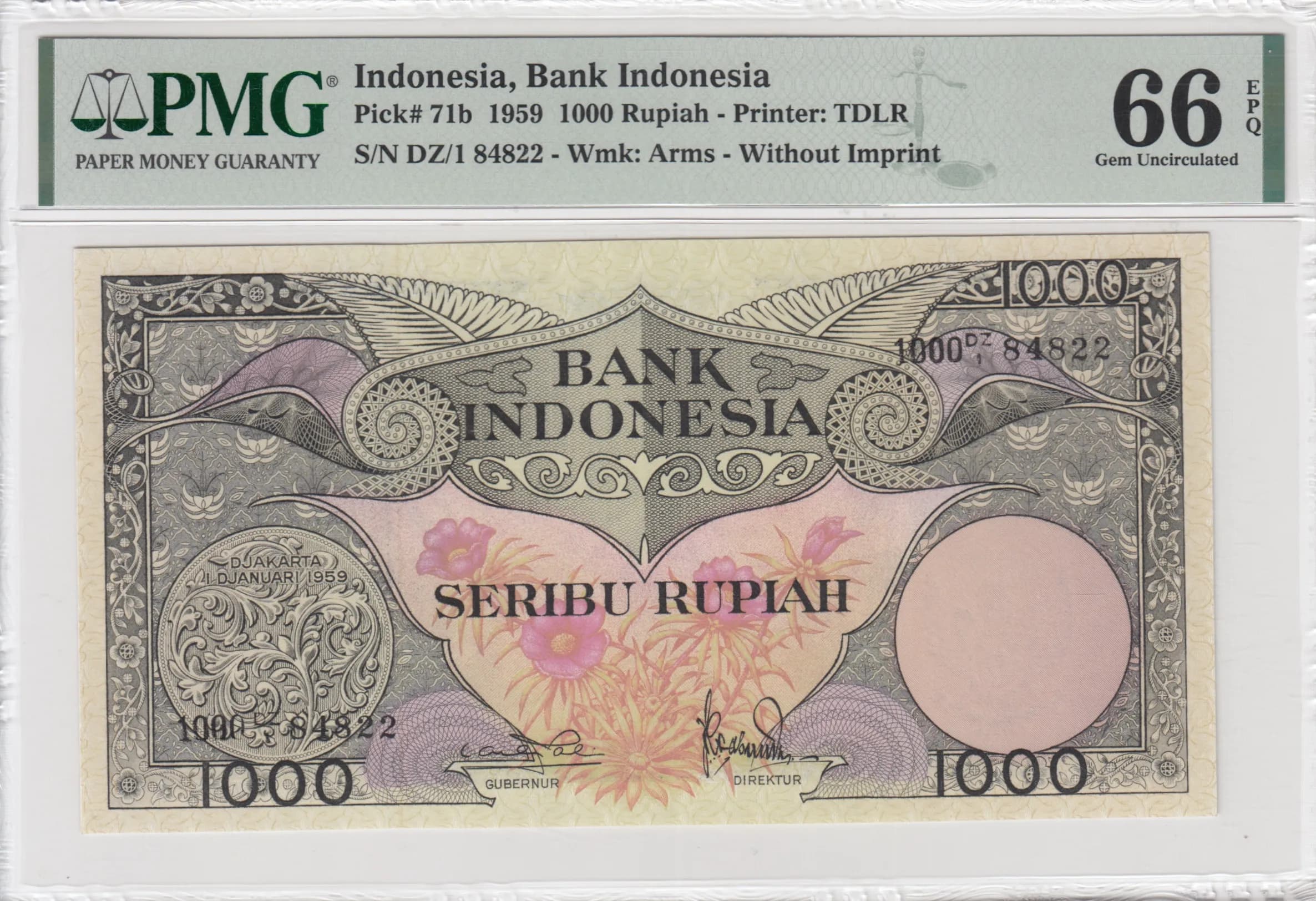
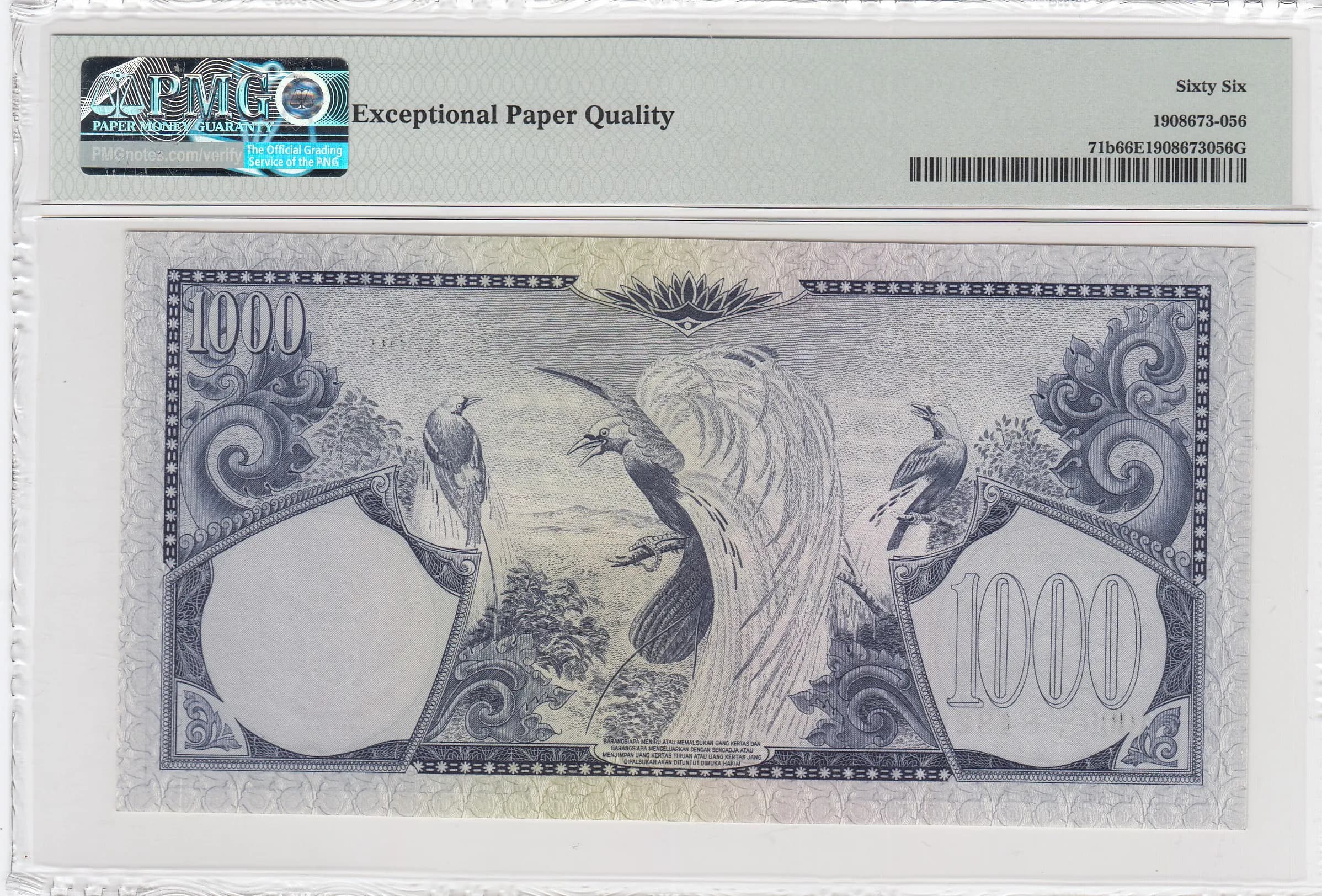
This is an exceptionally well-preserved 1959 Indonesian 1000 Rupiah banknote (Pick P-71b) graded PMG 66 EPQ, showcasing the early post-independence currency design of Bank Indonesia. The note displays pristine condition with no circulation wear, featuring intricate ornamental engraving work characteristic of Thomas de la Rue's production. The obverse presents elegant floral motifs in pink and gray tones, while the reverse displays a striking central bird (Bird of Paradise) composition with supporting ornamental elements—design elements reflecting Indonesia's natural heritage during the nation's formative years.
Common. This is a regular issue note from a major currency system with substantial print runs during 1959. The eBay price data provided shows consistent market activity with numerous sales across multiple grades ranging from $10 to $1150 (the latter being an exceptional PMG 68 specimen). PMG 66 examples—matching this note's grade—have sold regularly for $70–$160 range, indicating robust collector supply at this grade level. The denomination (1000 Rupiah) was a standard circulating value, not a special commemorative or limited issue. There are no indicators of recall, short print runs, or rarity factors.
This 1000 Rupiah note was issued on January 4, 1959, during a pivotal period in Indonesian history shortly after the country's transition to a unitary republic under President Sukarno. The prominence of natural imagery—particularly the Birds of Paradise on the reverse and floral elements on the obverse—reflects Indonesia's emphasis on national identity through its rich biodiversity and cultural heritage. The ornate, classical engraving style and London production by Thomas de la Rue represents the technical standards Bank Indonesia maintained during the early years of its currency management.
The obverse features Bank Indonesia's institutional identity prominently framed within an elaborate rectangular cartouche at the top center. Below this, the denomination 'SERIBU RUPIAH' is displayed with decorative pink floral elements (appearing to be stylized flowers and foliage) integrated into the design. A large circular medallion with pink fill occupies the right portion of the note, originally intended to feature a portrait or significant national symbol. The entire design is framed by ornate scrollwork and decorative borders in gray tones on a cream background. The reverse showcases a central composition featuring the Bird of Paradise (Indonesia's national symbol) with its characteristic long, flowing tail feathers prominently displayed, flanked by additional birds and ornamental foliage. The engraving displays fine linework typical of high-security currency production. Circular ornamental frames containing the denomination occupy the left and right sides of the reverse. The note incorporates an Arms watermark as a security feature.
FRONT SIDE: 'BANK INDONESIA' (Bank of Indonesia), 'SERIBU RUPIAH' (One Thousand Rupiah), 'DJAKARTA 4 DJANUARI 1959' (Jakarta 4 January 1959), '1000' (denomination numerals in all corners), 'GUBERNUR' (Governor—signature line), 'DIREKTUR' (Director—signature line), 'DZ/I 84822' (serial number). BACK SIDE: '1000' (denomination numerals in all four corners). Note: The historical spelling 'DJAKARTA' reflects the Dutch-influenced transliteration conventions used in Indonesia during 1959.
Intaglio engraving (recess printing), executed by Thomas de la Rue, London, as indicated in the catalog data. The fine detail work visible throughout both sides—particularly the intricate scrollwork borders, feather detail on the Bird of Paradise, and delicate floral patterns—is characteristic of intaglio production. No modern security features such as security threads, holograms, or advanced anti-counterfeiting measures are present, consistent with 1950s currency production standards. The watermark (Arms) was incorporated into the paper during manufacture.
This specimen is identified as Pick P-71b (variant 'b'), indicating there are multiple recognized varieties of the 1959 1000 Rupiah note. The serial number prefix 'DZ/I' and the specific date of issue (4 January 1959) may help collectors identify the specific printing or release batch. The signature lines for 'GUBERNUR' (Governor) and 'DIREKTUR' (Director) would have been completed with actual signatures during currency production; variations in these signatures represent an identifiable variety characteristic. No visible overprints or secondary printing marks are apparent on this specimen. Collectors should note that the 'b' designation suggests comparison specimens exist under Pick P-71a or other variant designations, likely differing in signatures, serial number prefixes, or minor design details.