1000 rupiah 1952
Market Prices
12 salesAbout This Note
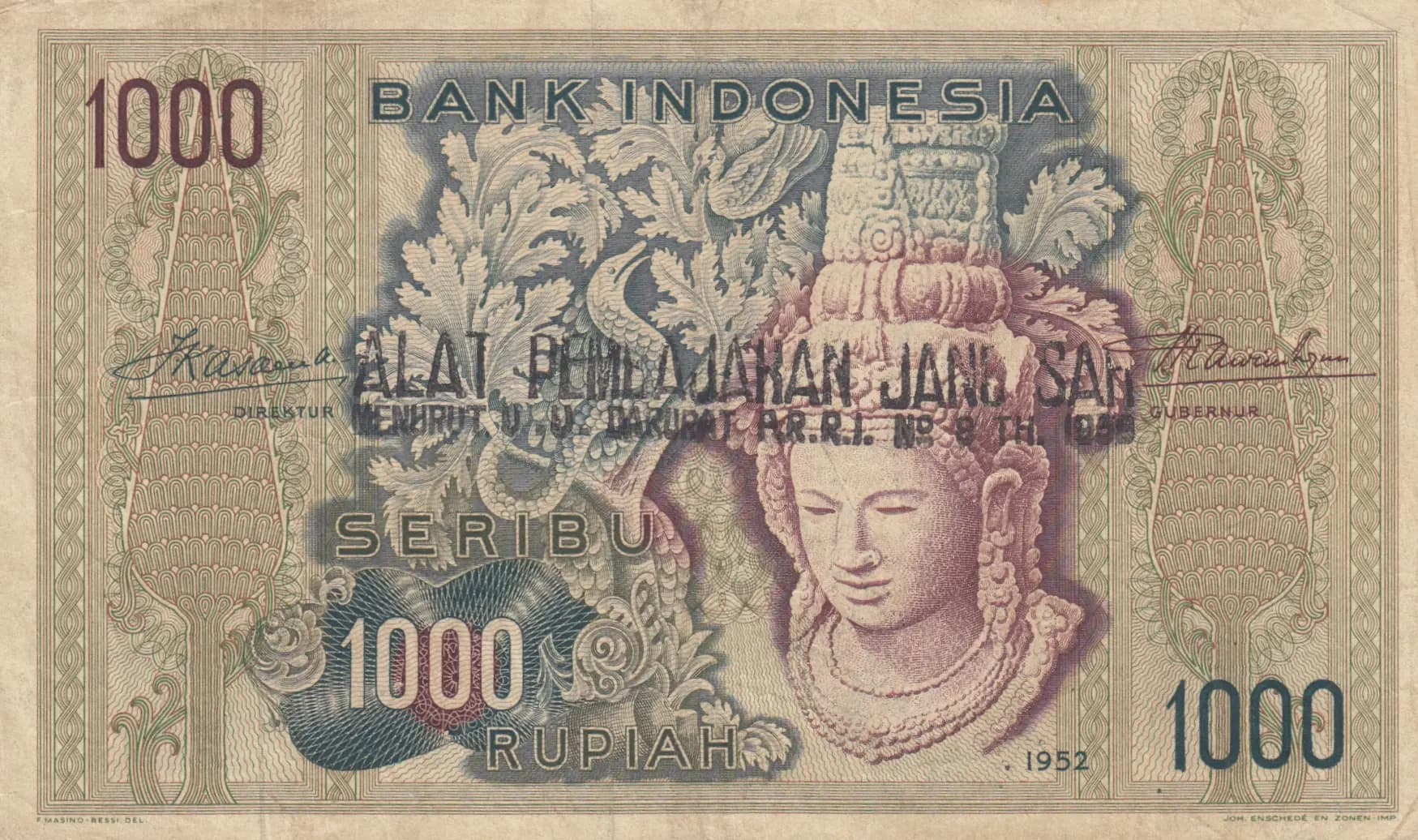
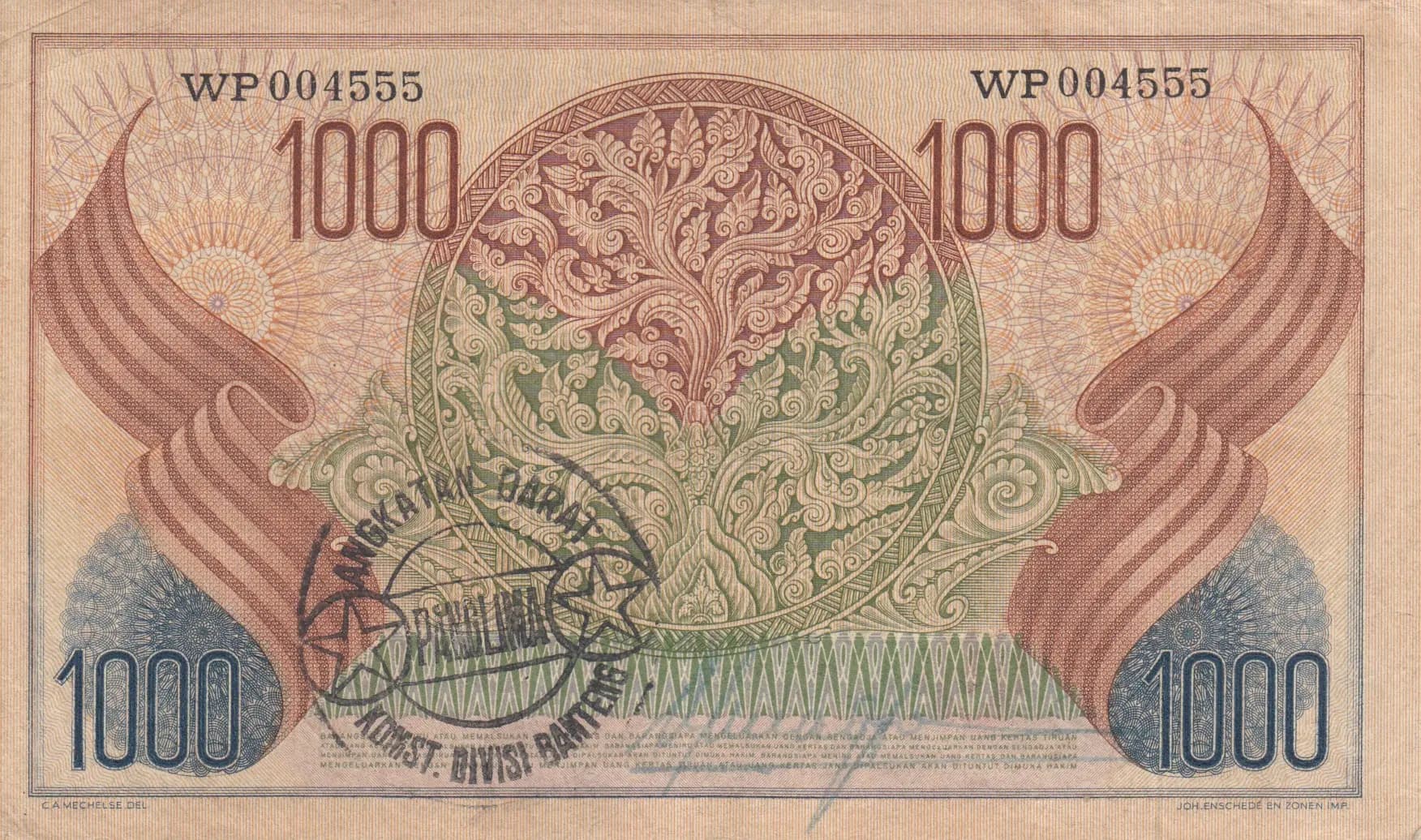
This Indonesia 1000 Rupiah note from 1952 (Pick-48) is a notable early post-independence issue featuring an exquisite carved stone relief portrait of a woman in traditional dress on the obverse and an elaborate ornamental design on the reverse. The note is graded VF and shows clear evidence of significant overprinting with handwritten marks across both sides, suggesting it may be a specimen or bank-marked authentication example. The aged, yellowed paper and fine engraving quality are consistent with the note's 70+ year history, making it an interesting example of Bank Indonesia's early currency design.
Common. The eBay transaction history shows consistent availability at modest prices ($31.50–$105 for VF specimens across multiple sales from 2014–2023), indicating steady collector demand without scarcity premiums. The 2016 catalog valuation of $17.50 for VF further supports a common classification. Indonesia's early post-independence currency was produced in reasonable quantities, and this Pick number remains readily available in the numismatic market. No evidence of a limited print run or recall status.
Issued in 1952, just four years after Indonesia's independence from the Netherlands (1948), this banknote represents the early consolidation of the Bank Indonesia as the nation's central bank and sole currency issuer. The ornate carved relief portrait of a woman wearing traditional ornaments and pearl necklaces reflects Indonesia's cultural heritage and artistic traditions, while the elaborate decorative motifs on the reverse showcase traditional Indonesian design elements—both choices symbolizing the young nation's assertion of cultural identity during the post-colonial period. The Dutch printer Johan Enschede's production of this design demonstrates the international cooperation required for currency production at that time.
The obverse features a commanding central portrait of a woman rendered as a carved stone relief, wearing elaborate traditional Indonesian ceremonial dress including an ornately decorated headdress adorned with jewels and a tiered arrangement of pearl necklaces across her chest. The portrait is framed by symmetrical ornamental borders with geometric and floral patterns characteristic of traditional Indonesian architectural ornamentation. The reverse displays an equally intricate carved ornamental design featuring symmetrical scrollwork, spirals, and botanical elements in a traditional Indonesian artistic style, with the design occupying the entire central field. The color palette employs warm peachy-tan backgrounds, cream, soft green, blue-gray, and burgundy accents, with fine line engraving and hatching throughout creating sophisticated texture and depth. Denomination numerals appear in all four corners of both sides.
FRONT SIDE: 'BANK INDONESIA' (Bank Indonesia - issuing authority); '1000' (denomination in numerals, appearing upper left and lower right); 'SERIBU RUPIAH' (One Thousand Rupiah - denomination in Indonesian language); '1952' (year of issue); 'ALAN EMILIA IKAN JAM SAT' (overprinted text, purpose unclear—possibly a specimen or authentication mark). BACK SIDE: 'WP004555' (serial number, appearing upper left and upper right); '1000' (denomination numerals in all four corners); Additional fine print text present but largely obscured by overprinting.
Intaglio (engraved) printing on banknote-quality paper, executed by Johan Enschede of the Netherlands. The note exhibits the characteristic fine line work, intricate border patterns, and detailed sculptural relief rendering typical of high-security intaglio currency production. Multiple passes would have been required to achieve the color variations observed (green, blue-gray, burgundy, and cream overprints on the base peachy-tan stock). The fine hatching patterns and repetitive background textures are hallmarks of engraved plate work.
The most significant variety indicator on this specific note is the presence of extensive overprinting with handwritten markings ('ALAN EMILIA IKAN JAM SAT' and additional signatures/annotations) across both obverse and reverse sides. This suggests the note may be a specimen example, a bank-marked test note, or an authentication/documentation variant rather than a standard circulation note. The serial number WP004555 should be cross-referenced against known serial number ranges if further variety classification is desired. Standard varieties for Pick-48 (1952 issue) typically include signature varieties and serial number prefix variations, which would require direct comparison with the unoverprinted base note to fully catalog.