100 rupiah 1960
Market Prices
29 salesAbout This Note
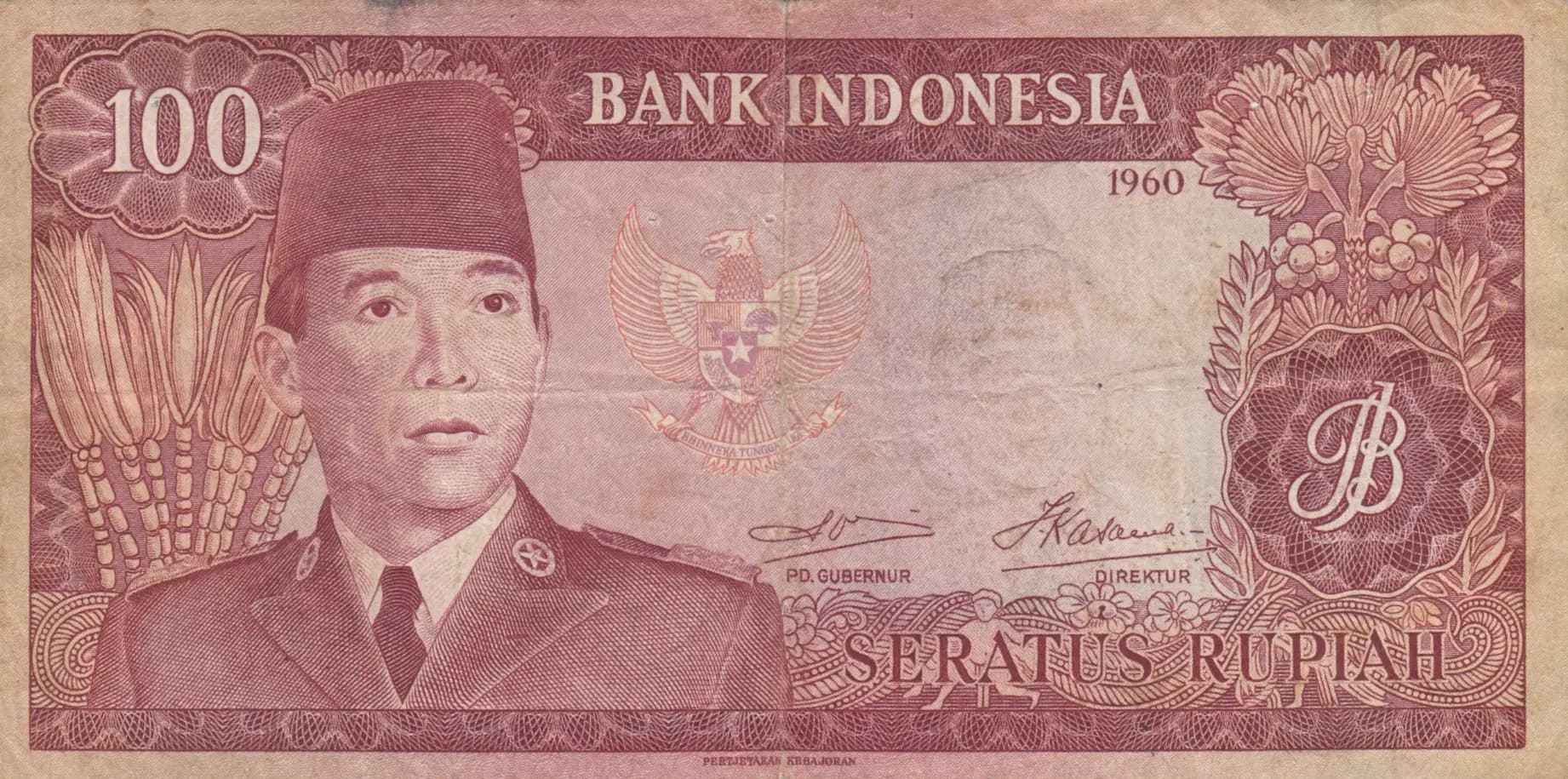
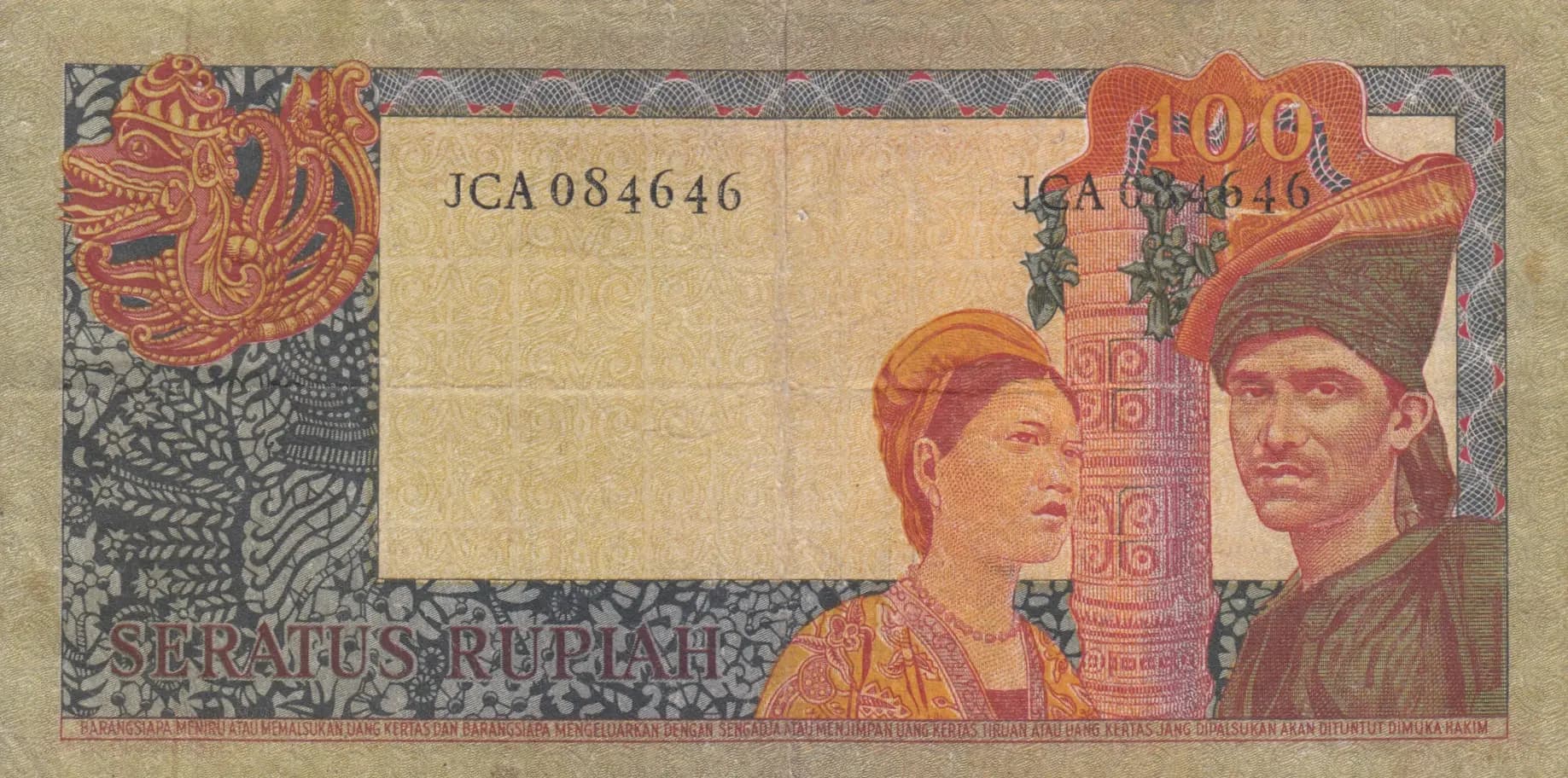
This is a 100 Rupiah banknote from 1960 (Pick P-86a) issued by Bank Indonesia, graded in Fine condition. The note features President Sukarno in formal military dress on the obverse and traditional Indonesian dancers on the reverse, with the iconic Garuda Pancasila national emblem prominently displayed. The note shows moderate circulation wear with visible creasing, light staining, and age-related discoloration typical of notes from this era, but maintains sound structural integrity.
Common. This is a regular issue from 1960 with substantial circulation. The eBay price tracking data shows consistent sales of Fine condition examples in the $7-21 range over multiple years (2016-2021), with an average around $10-13 for F-grade notes. Even higher grades (PMG 64-66) typically sell for $50-100, indicating a readily available note in the collector market. The denomination and 1960 date represent a standard early post-independence issue with no evidence of limited print run or special scarcity.
This note was issued during the early years of Indonesia's independence under President Achmed Soekarno, reflecting the nation's post-colonial identity through nationalist imagery. The Garuda Pancasila emblem on the front and the traditional dancer figures on the reverse emphasize Indonesian cultural heritage and national pride during this formative political period of the early Sukarno era.
The obverse features a formal portrait of President Achmed Soekarno positioned at left, depicted wearing formal military-style clothing with a distinctive fez-style hat, shown in three-quarter profile facing left. The central design incorporates the Garuda Pancasila, Indonesia's national coat of arms, with wings spread and containing a shield with a star. Ornate decorative elements frame the composition, including fan and shell motifs in the corners and geometric ornamental borders. The reverse displays two portrait busts representing traditional Indonesian dancers—a woman on the left and a man on the right, both shown in profile and wearing traditional dress with head coverings. Between them stands an architectural structure resembling a traditional temple or tower with vertical divisions and ornamental details. The upper left corner features ornate decorative patterns in red and dark colors with batik-style motifs and geometric border designs in dark blue and navy. Serial number 'JCA 084646' appears at the top of the reverse.
FRONT SIDE: '100' (denomination in numerals); 'SERATUS RUPIAH' (One Hundred Rupiah in Indonesian); 'BANK INDONESIA' (Bank Indonesia); '1960' (year of issue); 'PD. GUBERNUR' (Governor); 'DIREKTUR' (Director); 'PERJALANAN KEBAJAKAN' (Journey of Policy). BACK SIDE: 'JCA 084646' (serial number, appears twice); '100' (denomination); 'SERATUS RUPIAH' (One Hundred Rupiah); 'BARANGSIAPA DI MANA ATAU MEMALSUKAN UANG KERTAS DAN BARANGSIAPA MENGELUARKAN DENGAN SENGAJA NAMA METIMPAN UANG KERTAS TIRUNAN ATAU UANG KERTAS JANG DIPALSUKAN AKAN DITUNTUT DIMUKA HAKIM' (Whoever in any place forges banknotes and whoever deliberately issues counterfeit or forged banknotes will be prosecuted in court).
Intaglio line engraving, characteristic of high-security banknote printing of the period. The note exhibits fine detailed line engraving throughout the design with intricate background patterning, decorative borders, and portrait details rendered through traditional engraving techniques. The printer is identified as Pertjetakan (Pertjetakan Negara/State Printing Works of Indonesia), which produced Indonesian currency during this period.
This example bears the serial number prefix 'JCA' with serial number 084646. The note is identified as Pick P-86a, the standard 1960 issue. No specific overprints, replacement notes, or error varieties are evident from the visual analysis. The watermark features Sukarno's portrait, consistent with Bank Indonesia's standard security features for this denomination and period.