100 rupiah 1959
Market Prices
77 salesAbout This Note
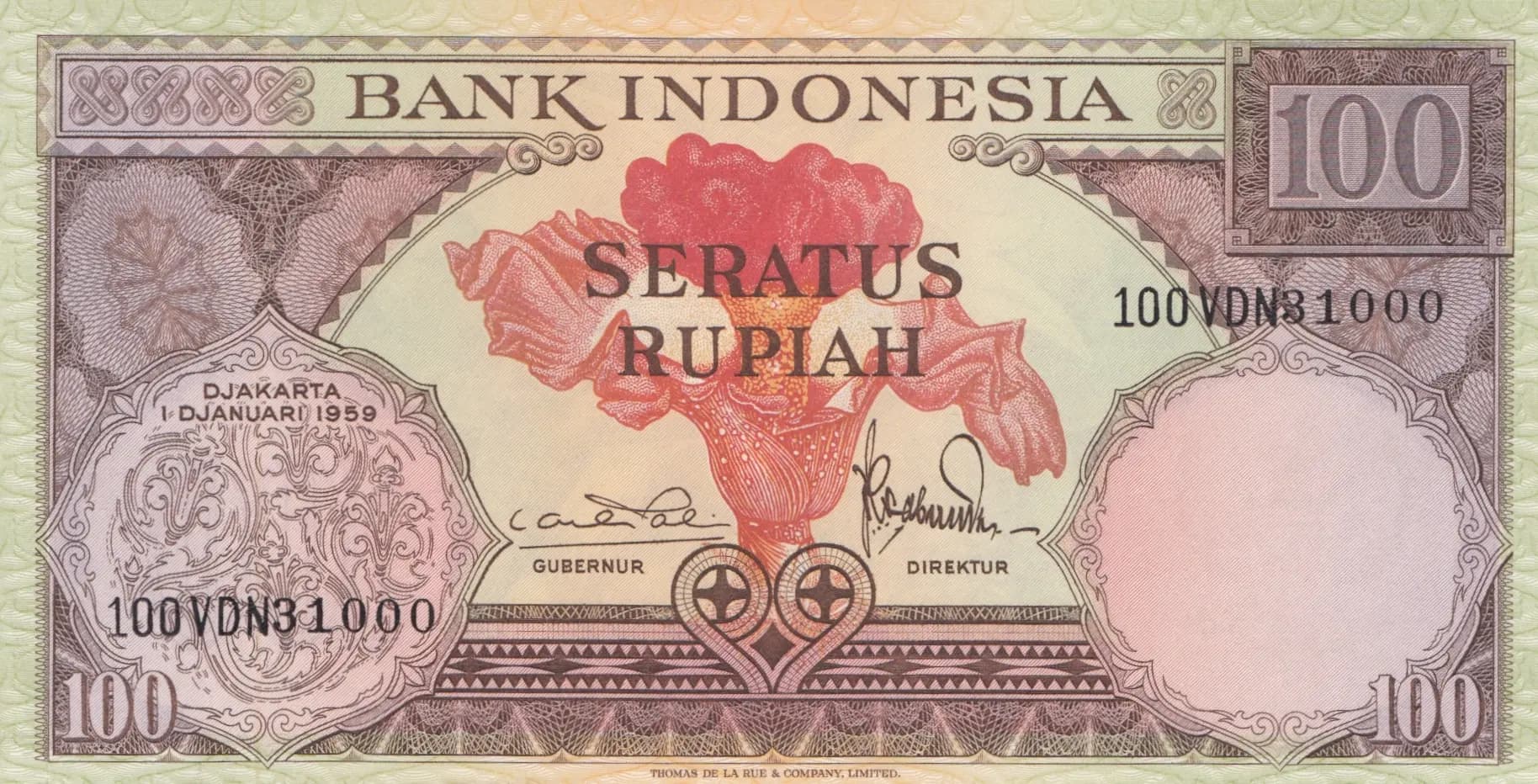
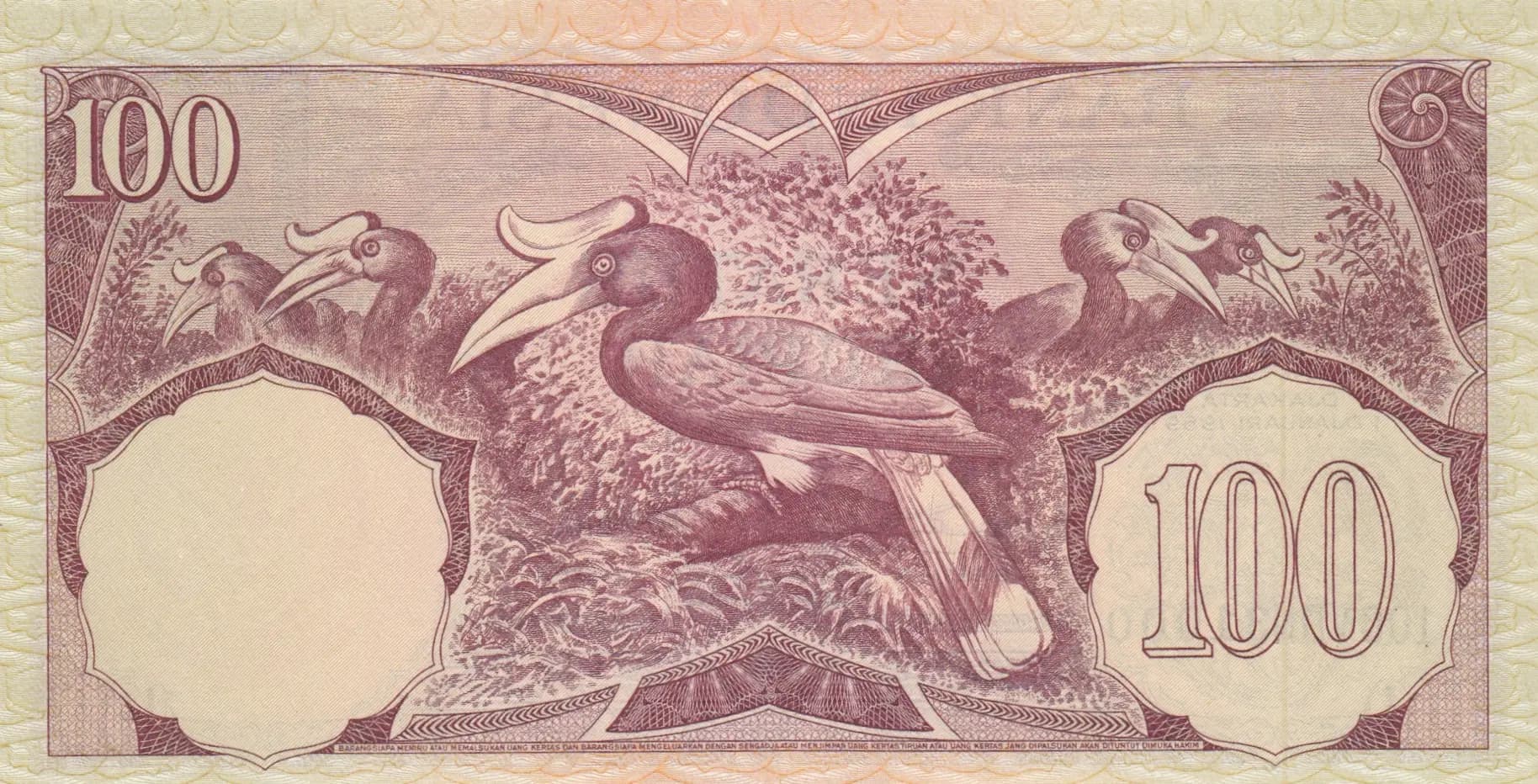
This is an exceptional example of Indonesia's 1959 100 Rupiah note (Pick P-69), printed by Thomas de la Rue in London. The note displays the characteristic design featuring a vibrant red Rafflessia flower on the obverse and three rhinoceros hornbills among foliage on the reverse, rendered in rich brown and mauve tones. In AU condition, this note shows virtually no wear with pristine surfaces, sharp margins, and excellent color saturation—making it a desirable specimen for collectors of early Indonesian currency and Southeast Asian numismatics.
Common. Despite its historical significance and attractive design, the 1959 100 Rupiah (Pick P-69) is a relatively common banknote in the secondary market. This assessment is strongly supported by eBay price data showing consistent sales in the $10–$50 range across multiple condition grades from 2009 to 2025, with even exceptional graded specimens (PMG 68) only occasionally commanding premiums above $100. The note had a substantial print run appropriate for its denomination during Indonesia's early post-independence period. Current catalog values listed at $3.50 for UNC condition (2016) further confirm common status. Most collectors of Indonesian notes can acquire this Pick number without difficulty.
Issued on January 1, 1959, this banknote represents Indonesia's transition period following independence from the Dutch (declared 1945, recognized 1949) and the establishment of Bank Indonesia's authoritative currency control. The selection of endemic Indonesian flora and fauna—the giant Rafflessia patma (world's largest flower) and the rhinoceros hornbill—reflects the young nation's emphasis on its natural heritage and biodiversity as symbols of national identity and sovereignty. This early series, produced by the respected London printer Thomas de la Rue, demonstrates Indonesia's effort to establish a modern, professionally-printed currency befitting its status as an independent nation.
The obverse features a large, ornately-framed Giant Rafflessia Patma flower (Rafflesia arnoldii species group) in rich red tones as the central motif, symbolizing Indonesia's unique tropical biodiversity. The flower is surrounded by intricate geometric border patterns in brown and mauve. Below the flower are two signature lines labeled 'GUBERNUR' (Governor) and 'DIREKTUR' (Director), with handwritten signatures visible on this specimen. The date and issuing location appear in an ornamental cartouche on the left. The reverse depicts three Rhinoceros Hornbills (Buceros rhinoceros), shown in profile among stylized foliage and vegetation, rendered with fine detail to capture feather textures and the birds' distinctive long, curved beaks. Large denomination numerals '100' appear in decorative frames flanking the central bird motif. The overall design employs classical intaglio engraving techniques with fine-line work throughout, characteristic of Thomas de la Rue's high-security banknote production standards.
FRONT: 'BANK INDONESIA' (Bank Indonesia); 'SERATUS RUPIAH' (One Hundred Rupiah); 'DJAKARTA 1 DJANUARI 1959' (Jakarta, 1 January 1959); 'GUBERNUR' (Governor); 'DIREKTUR' (Director); Serial number '100 VDN31000'. BACK: '100' (Denomination numeral, appearing in decorative cartouches on left and right sides). Note: The spelling 'DJAKARTA' and 'DJANUARI' reflects the Dutch-influenced Indonesian orthography standard of the 1950s era.
Intaglio/engraved printing, executed by Thomas de la Rue & Company, London—one of the world's foremost security printers. The visual evidence of deep, finely-detailed line work, precise geometric borders, and the exceptional color registration visible in the specimen are hallmarks of intaglio production. The multicolor underprint technique (visible as background gradations in the cream/beige base) combined with the primary color overlays (browns, mauves, reds) indicates sophisticated multi-pass intaglio printing with careful color registration. The fine feather rendering on the hornbills and the delicate botanical details of the Rafflessia demonstrate the precision capabilities of de la Rue's engraving facilities.
Serial number '100 VDN31000' visible on this specimen indicates the VDN prefix variety. The 1959 100 Rupiah is known to exist with various serial number prefixes and signatures representing different Bank Indonesia leadership terms. The specific Governor and Director signatures present on this note would identify the issuing period within 1959, though early Indonesian notes of this era are not extensively catalogued by signature varieties in the major references. No major overprint varieties or watermark variants are documented for this Pick number—the design remained consistent throughout its circulation period. The note should bear the watermark of the Indonesian national arms as documented in catalog references.