100 rupiah 1958
Market Prices
55 salesAbout This Note
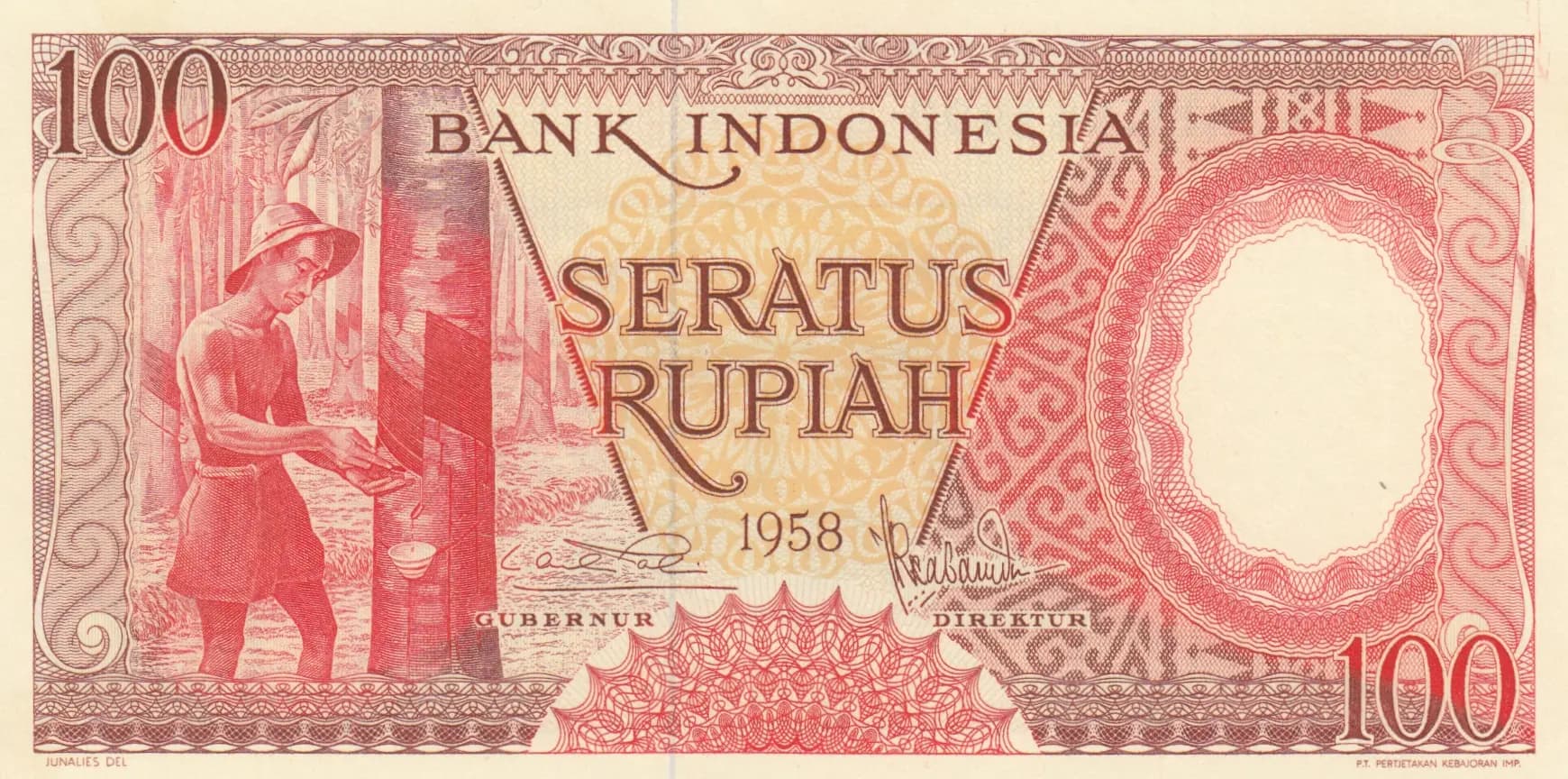
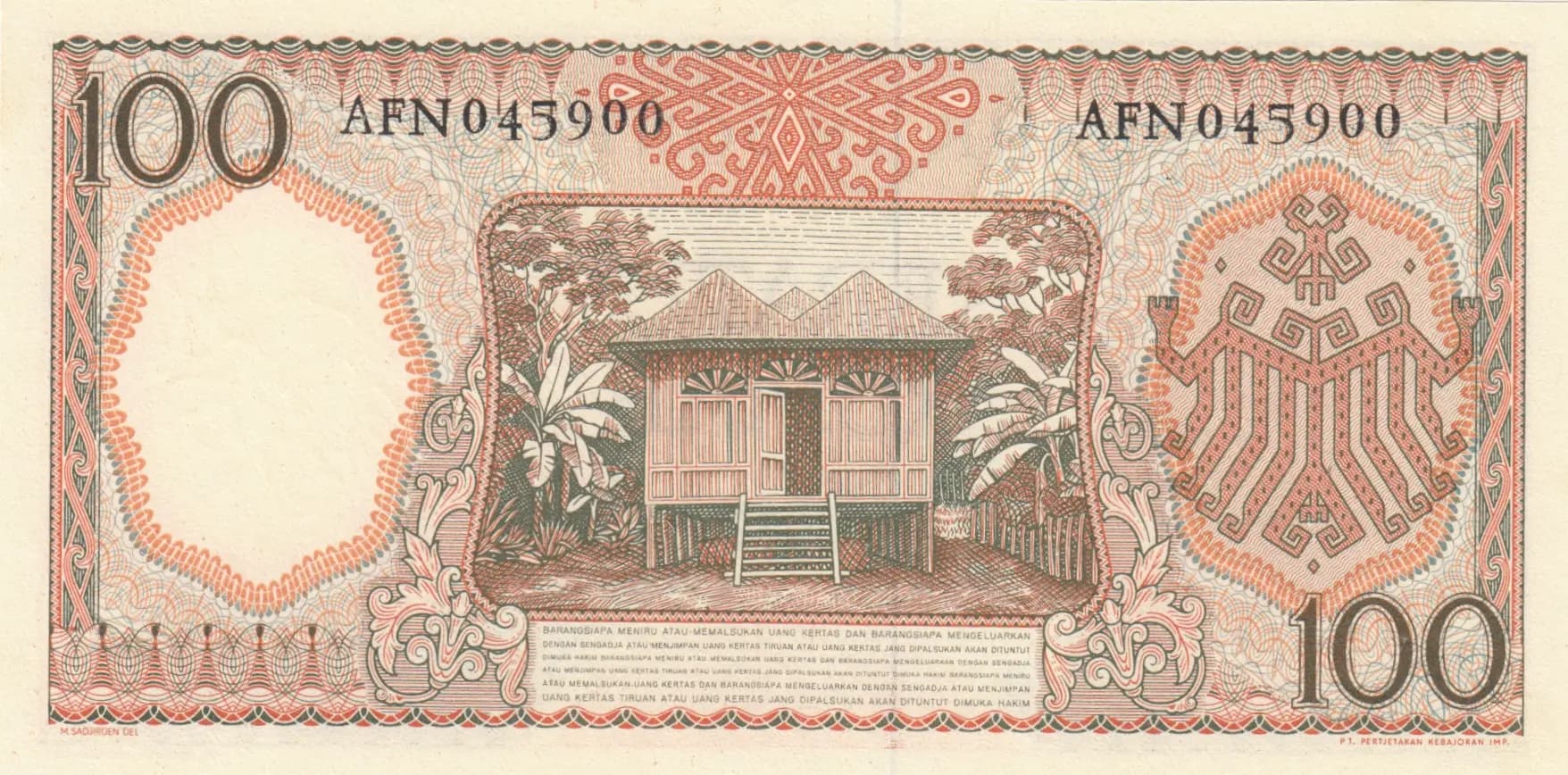
This 1958 Bank Indonesia 100 Rupiah note (Pick P-59) presents an excellent example of early Indonesian currency design in uncirculated condition. The obverse features a portrait of a worker in traditional Indonesian dress engaged in labor, while the reverse depicts a distinctive traditional Indonesian house with characteristic steep pyramidal roof and tropical vegetation. The note exhibits crisp, sharp printing with no signs of wear, creases, or circulation, making it an appealing specimen for collectors of Indonesian numismatic material.
Common. The eBay market data provided shows numerous sales of this note across a wide range of conditions (from Fair to PMG 66) at relatively modest prices, with UNC examples consistently selling in the $3–$16 range in recent years, and even the highest-graded PMG 66 specimens achieving $31–$42 when demand was elevated (2019). The 2016 catalog valuation of $2.50 for UNC confirms this as a frequently encountered note in the market. This indicates a substantial original print run with no scarcity factors. The note is straightforward and commonly available to collectors.
This note was issued during a formative period of the Indonesian Republic, just three years after the country achieved full sovereignty in 1956. The imagery reflects the national economic focus of the era: the obverse's depiction of a worker on a rubber plantation emphasizes Indonesia's important agricultural and extractive industries, while the reverse's traditional Indonesian house symbolizes national cultural identity and the agrarian foundation of the young nation's economy. These designs were part of Bank Indonesia's effort to create a distinctly Indonesian aesthetic for its currency, moving away from colonial-era iconography.
The obverse presents a dignified portrait of an Indonesian laborer positioned at left-center, shown wearing traditional dress including a distinctive hat and long-sleeved garment, depicted in a working pose that emphasizes the nation's productive capacity—likely representing work in rubber plantations, which were economically vital to Indonesia. The design is framed by elaborate ornamental borders featuring scrollwork and geometric patterns characteristic of classical banknote engraving. The center displays the denomination and institutional information with ornate lettering. Empty oval cartouches flank the central portrait area, a design convention of the era. The reverse features a meticulously rendered traditional Indonesian wooden house (rumah) with a dramatic steep pyramidal roof and vertical wooden slatting, flanked by tropical vegetation including palm fronds, symbolizing the nation's cultural heritage and agrarian identity. The entire composition employs an integrated color scheme of reddish-pink, mauve, brown, and maroon tones, unified through intricate fine-line engraving work.
Front side: '100' (denomination in numerals), 'BANK INDONESIA' (issuing authority in English), 'SERATUS RUPIAH' (one hundred rupiah in Indonesian), '1958' (year of issue), 'GUBERNUR' (Governor - title for signatory), 'DIREKTUR' (Director - title for signatory), 'JUNALIES DEL' (artist/engraver attribution), 'PT. PERJETAKAN KEBANARAN IMP.' (printing company attribution: PT. Pertjetakan Kebajoran). Back side: '100' (denomination, repeated in all four corners), 'AFN045900' (serial number, printed twice), 'M. SAUGREM DEL' (artist/engraver attribution for reverse design), 'PT. PERJETAKAN KEBANARAN IMP.' (printing company attribution), plus additional fine-print Indonesian regulatory/legal text partially visible.
This note was produced using traditional intaglio (engraved) printing techniques by PT. Pertjetakan Kebajoran (Kebajoran Printing Works), as attributed on both sides of the note. The visual evidence of fine line work, intricate decorative patterns, detailed portraiture, and complex security borders all reflect classic steel-plate engraving methods. The sharp definition of the portrait, the elaborate scrollwork, and the fine hatching patterns throughout are characteristic of high-quality intaglio production. No evidence of lithographic or letterpress techniques is apparent; this is a professionally executed security-printed banknote typical of Bank Indonesia's standards for this period.
The observed serial number prefix 'AFN' is noted on this specimen (AFN045900). Different serial number prefixes and signature combinations exist for this issue, as is typical for the 1958 series. The specific signatures of the Governor and Director would identify the precise variant within the 1958 100 Rupiah issue. No overprints, color variations, or anomalies are apparent on this example. Collectors typically differentiate 1958 issues by signature combinations and prefix letters, though these variations do not materially affect value.