10 rupiah 1958
Market Prices
50 salesAbout This Note
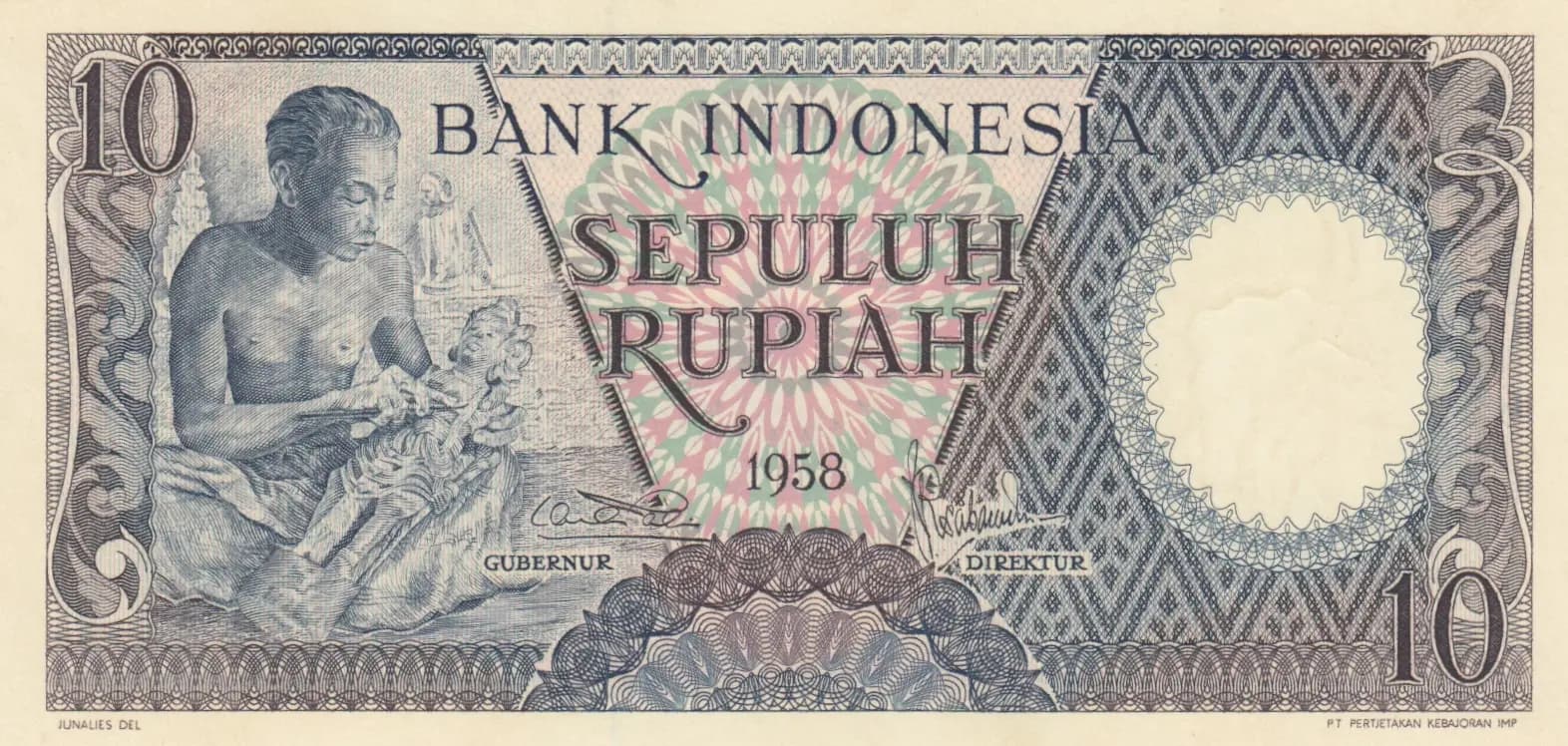
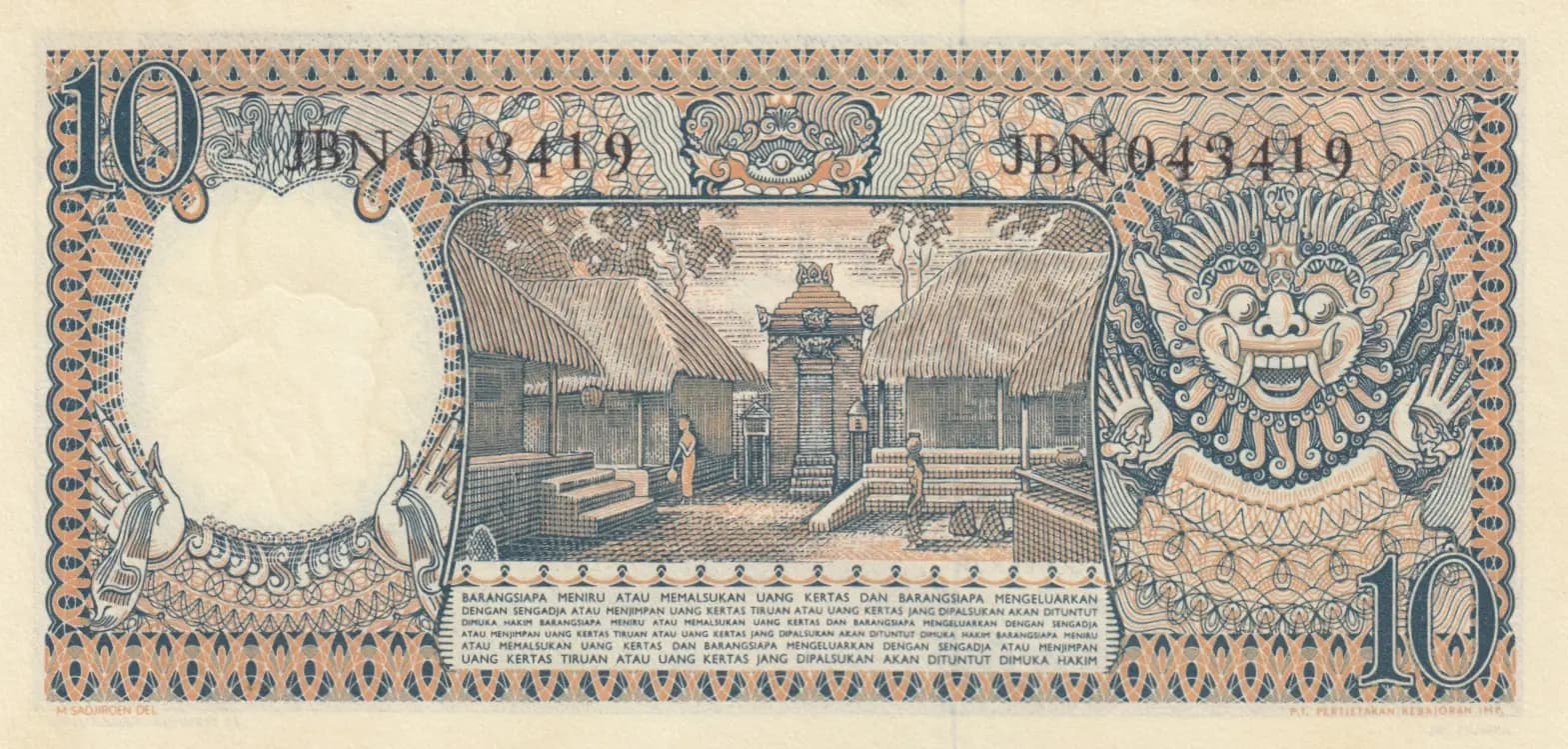
This is an uncirculated 1958 Bank Indonesia 10 rupiah note (Pick P-56) featuring exceptional preservation and pristine condition throughout. The obverse displays a classically-styled male portrait in profile alongside ornate decorative rosette patterns and cornucopia designs, while the reverse showcases traditional Indonesian cultural imagery including a temple architecture and prominent Balinese mask motif. As an early post-independence Indonesian banknote from the first decade of the nation's currency system, this note represents an important transitional period in Indonesian monetary history and remains collectible despite common circulation status.
Common. This note appears with relative frequency in the collector market based on consistent, modest eBay sales activity spanning from 2013 to 2026, with UNC examples routinely selling between $2-$8 and even PMG-graded examples in the 64-67 range commanding $9-$51. The large number of recorded sales transactions (40+ documented) and availability of multiple condition grades indicate substantial original print runs. No evidence of rarity, recalls, or limited distribution exists for this Pick number.
This 1958 note was issued during Indonesia's early years as an independent nation (independence declared 1945, recognized 1949), when the country was establishing its own monetary authority separate from Dutch colonial currency. The reverse design prominently features traditional Indonesian cultural elements—specifically temple architecture and Balinese mask imagery—reflecting the new nation's effort to assert cultural identity through its currency. The Bank Indonesia, established in 1953, used these notes to build confidence in the national currency and visually connect the monetary system to Indonesia's rich artistic and architectural heritage.
The obverse features a male portrait in classical profile pose facing rightward, rendered in fine engraved detail without shirt, demonstrating the artistic style of early Indonesian currency design. The portrait is flanked by ornate cornucopia (horn-of-plenty) designs and surrounded by elaborate decorative borders with scrollwork. A prominent circular rosette or medallion with intricate geometric patterns occupies the right side of the obverse. The reverse depicts a traditional Indonesian temple or shrine building with characteristic peaked tiled roof and ornamental details, set within a landscape containing vegetation and human figures, representing Indonesia's architectural heritage. A prominent Balinese demon or protective mask face with ornate crown-like headdress is featured within an elaborate decorative frame on the reverse right side. The entire note is framed by ornate borders incorporating geometric and traditional Indonesian decorative motifs. The color scheme on the obverse is predominantly blue-grey and black on cream, while the reverse employs blue and orange/cream tones, characteristic of the Pertjetakan Kebajoran printing house's output.
FRONT SIDE: '10' (denomination), 'BANK INDONESIA' (issuing authority), 'SEPULUH RUPIAH' (Ten Rupiah in Indonesian), '1958' (year of issue), 'GUBERNUR' (Governor - signature position), 'DIREKTUR' (Director - signature position), 'JUNALIES DEL' (Drawn by Junalies - artist credit), 'PT PERTETAKAN KEBANGSAAN IMP' (National Printing Company PT - printer attribution). BACK SIDE: '10' (denomination), Serial numbers 'MN084199' and 'JPN04349', Warning text repeating three times: 'BARANGSIAPA MENIRU ATAU MEMALSUKAN UANG KERTAS DAN BARANGSIAPA MENGELUARKAN DENGAN SENGAJA ATAU MEMPUNYAI UANG KERTAS JANG DIPALSUKAN AKAN DIPIDANA HUKUM' (Whoever counterfeits or falsifies banknotes and whoever deliberately issues or possesses counterfeit banknotes will be subject to legal punishment).
This note was produced using traditional engraved intaglio (copperplate) printing, evidenced by the fine, detailed line work, subtle shading variations, and precise geometric patterns throughout both sides. The intricate portraiture, ornate borders, and complex rosette designs all bear the hallmarks of steel or copper plate engraving. The printer was Pertjetakan Kebajoran (Kebajoran Printing House), as credited on the obverse. Security features rely primarily on the complexity of the engraved design itself rather than modern security threads or holograms, typical of 1950s-era currency printing.
The observed specimen features serial numbers MN084199 and JPN04349, with signatures in the GUBERNUR and DIREKTUR positions. The artist credit 'JUNALIES DEL' appears on the obverse. PMG population data indicates P-56s exists as a separate variant (100 Gulden, Printer: JEZ), though this represents a different Pick number classification. The specific serial number prefix ('MN' and 'JPN') may indicate different printing batches or production runs, but without comprehensive documentation of serial number ranges for this issue, individual variety attribution cannot be definitively established. Further research into Bank Indonesia records would be needed to determine if specific signature combinations, date variants, or serial number prefixes constitute recognized cataloged varieties.