10 rupiah 1950
Market Prices
14 salesAbout This Note
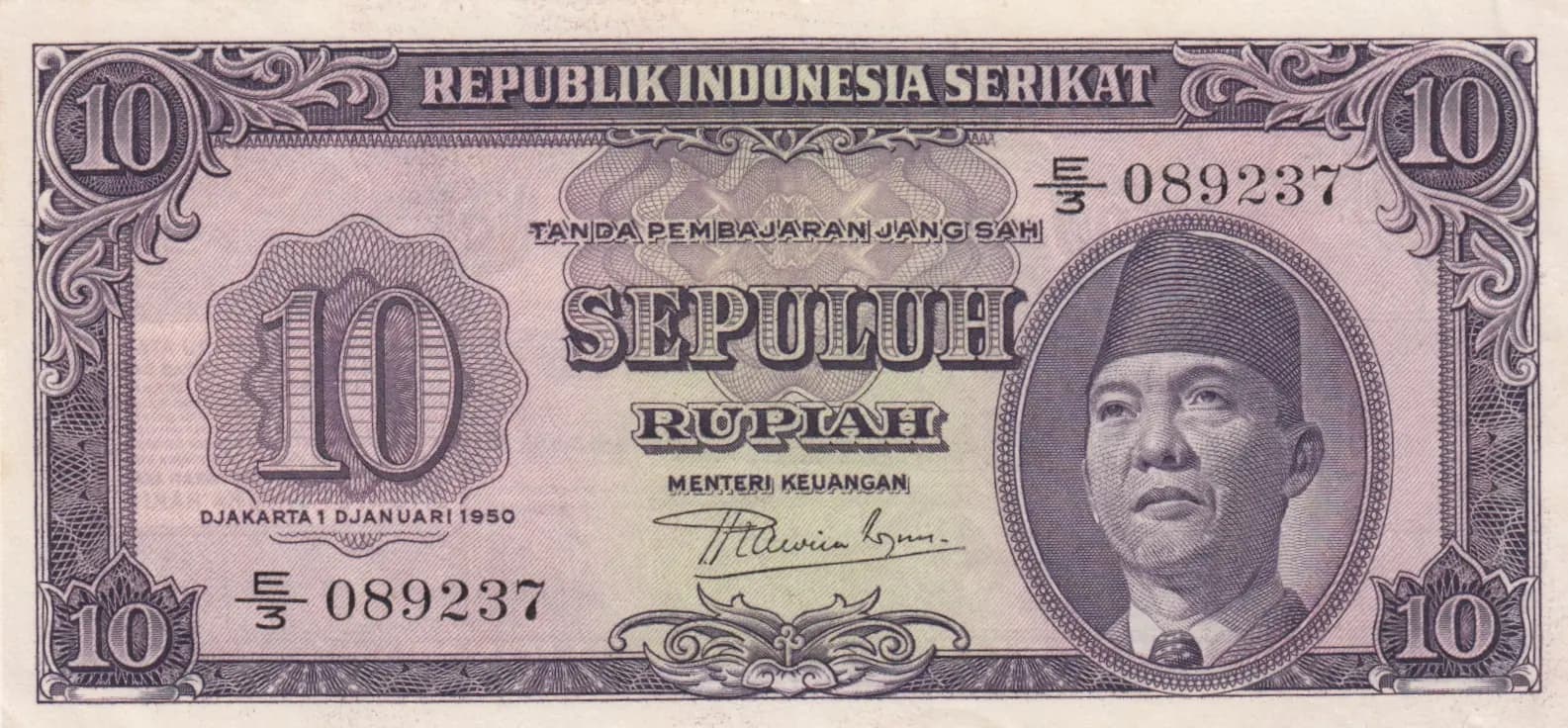
This is a pristine example of the Indonesian 10 Rupiah note from 1950, issued by the Republik Indonesia Serikat during the transition period of Indonesian independence. The note displays excellent condition with sharp purple/lilac coloring, crisp printing, and no visible signs of wear, circulation, or damage. The portrait of President Sukarno and the tropical landscape vignette make this an iconic early Indonesian banknote, particularly notable for its historical significance as part of the short-lived federal republic's currency.
Common. This note remains commonly available in the collector market, as evidenced by consistent eBay sales data spanning from 2012 to 2024 with prices ranging from approximately $3-$28 USD depending on condition (VF notes averaging $13-$28). The catalog value for VF condition is only $7.50, and UNC examples are valued at $22.50. While the issuing authority (Republik Indonesia Serikat) was short-lived, the print run for this denomination was apparently substantial enough that examples remain readily obtainable for modest sums.
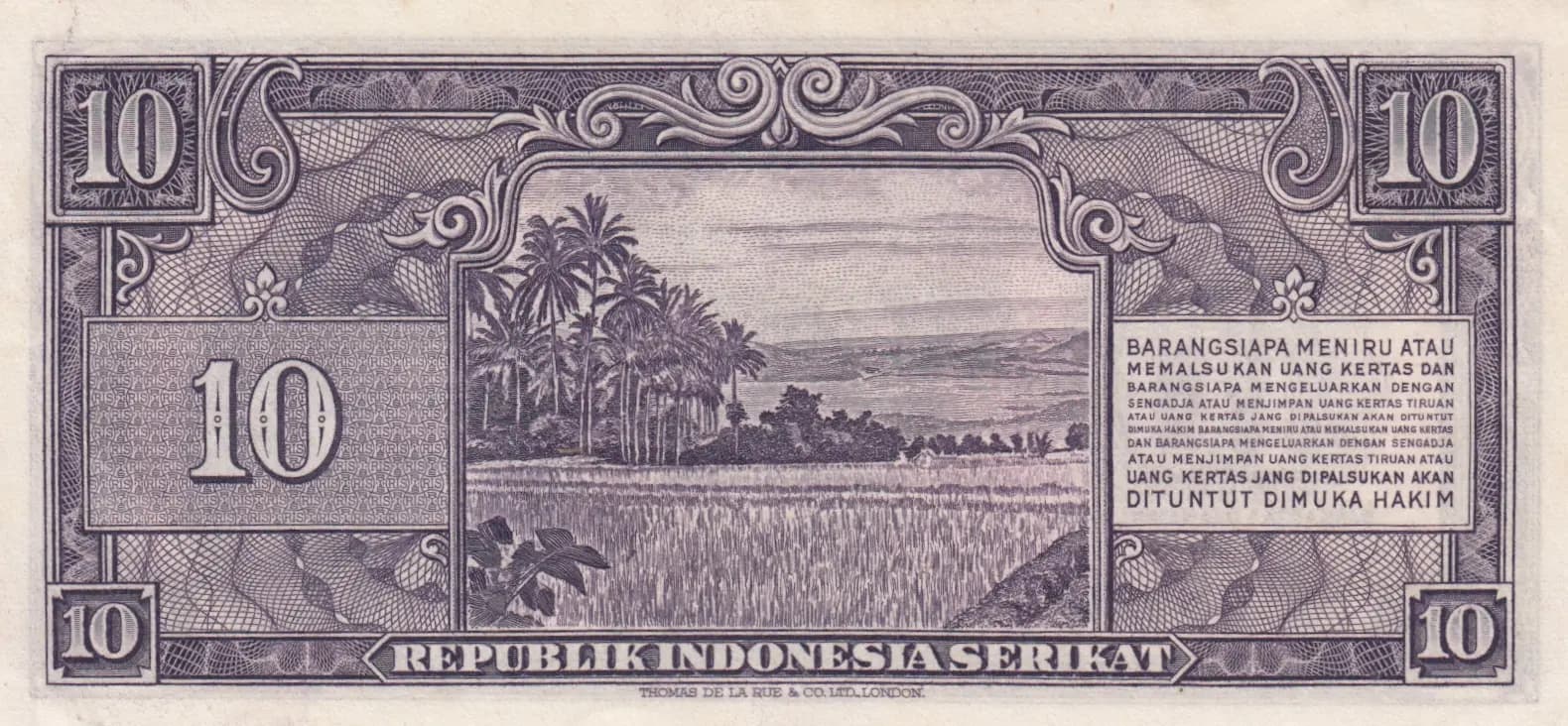
The Republik Indonesia Serikat (United States of Indonesia) existed only from 1950-1956, making its currency issues historically significant markers of this transitional period following Indonesian independence from the Netherlands. The rice paddy landscape on the reverse reflects the nation's agricultural economy, while the portrait of Achmed Sukarno as the founding father emphasizes the new nation's leadership and identity. The January 1, 1950 date indicates this was among the first currency issues of the federal republic, symbolizing the beginning of Indonesian monetary independence.
The note features a classical colonial-era design executed in purple and lilac tones. The obverse displays a left-facing profile portrait of Dr. Ir. Achmed Soekarno (Indonesia's first president) wearing a traditional songkok (Indonesian Islamic head covering), positioned on the right side of the note within a decorative circular frame. The denomination '10' appears in large numerals within ornamental scalloped frames in all four corners. Ornate scrollwork and flourishes frame the entire design, with fine cross-hatching in background areas. The reverse depicts a tropical landscape scene with prominent palm trees in the foreground, open rice paddies or agricultural fields in the middle ground, and hills or mountains beneath a cloudy sky, representing Indonesia's agricultural heritage. Both sides are bordered by intricate decorative patterns characteristic of early 20th-century security printing.
FRONT SIDE: 'REPUBLIK INDONESIA SERIKAT' (Republic of the United States of Indonesia) — 'TANDA PEMBAJARAN JANG SAHI' (Legal Tender / Valid Payment Note) — 'SEPULUH RUPIAH' (Ten Rupiah) — 'MENTERI KEUANGAN' (Minister of Finance) — 'DJAKARTA 1 DJANUARI 1950' (Jakarta, 1 January 1950) — Serial number '0892237'. BACK SIDE: 'REPUBLIK INDONESIA SERIKAT' (Republic of the United States of Indonesia) — 'BARANGSIAPIA MENIRU ATAU MEMALSUKAN UANG KERTAS DAN BARANGSIAPIA MENGELUARKAN DENGAN SENGAJA ATAU MENJIMPAN UANG KERTAS TIRUAN ATAU UANG KERTAS JANG DIPALSUKAN AKAN DIHUKUM DIMUKA HAKIM' (Anyone who counterfeits or forges banknotes and anyone who deliberately issues or possesses counterfeit or forged banknotes will be punished before a judge) — 'THOMAS DE LA RUE & CO LTD, LONDON' (Printer identification).
Intaglio engraving (line engraving and steel plate printing), as evidenced by the finely detailed portrait, complex cross-hatching patterns, intricate scrollwork, and the crisp definition of fine lines throughout the design. The printer was Thomas De La Rue & Co Ltd of London, one of the world's premier banknote printers, whose hallmark was precision intaglio work. The security features include fine line engraving in background areas and detailed portrait rendering, typical of De La Rue's high-security production standards.
The observed serial number is '0892237'. This note is Pick P-37, the standard 1950 issue dated 1 January 1950 from the Republik Indonesia Serikat. No major varieties (such as signature variants, overprints, or significant serial number prefixes) are noted in the visual analysis. This represents the regular issue variety of this denomination for this issuing authority.