1 rupiah 1963
Market Prices
1 saleAbout This Note
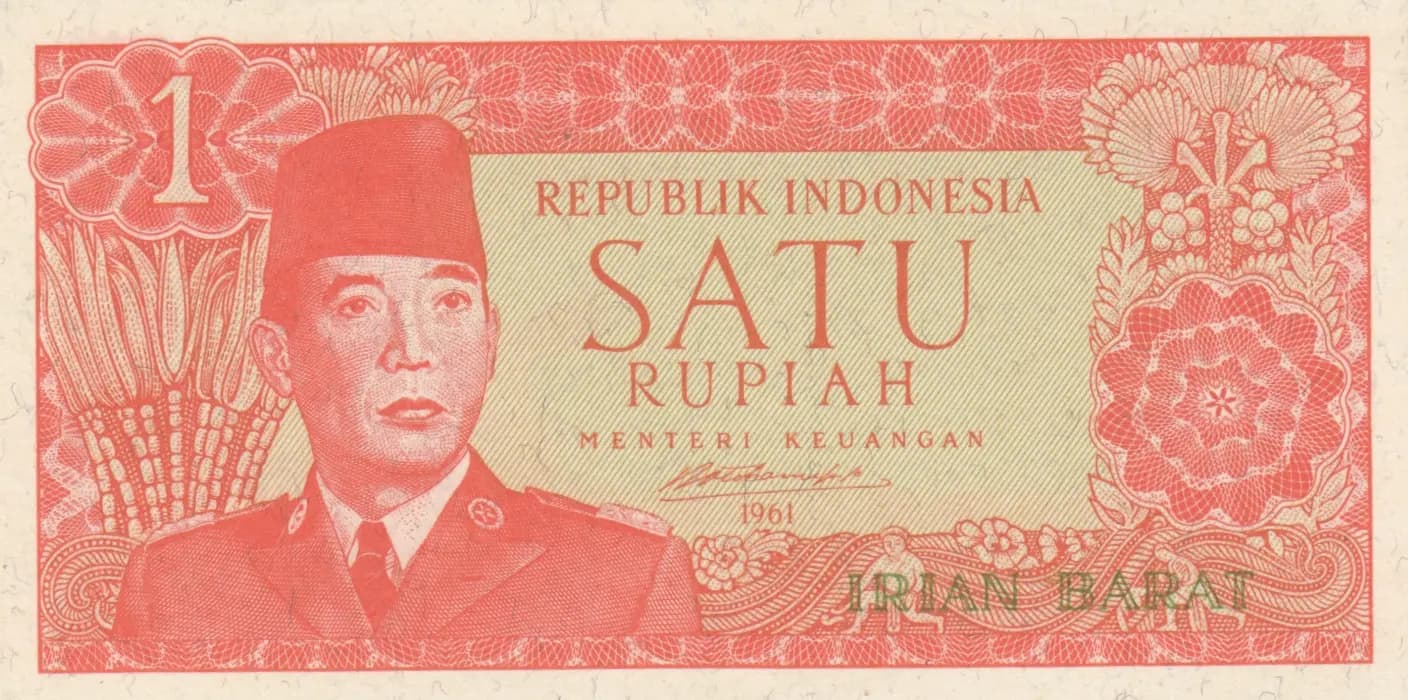
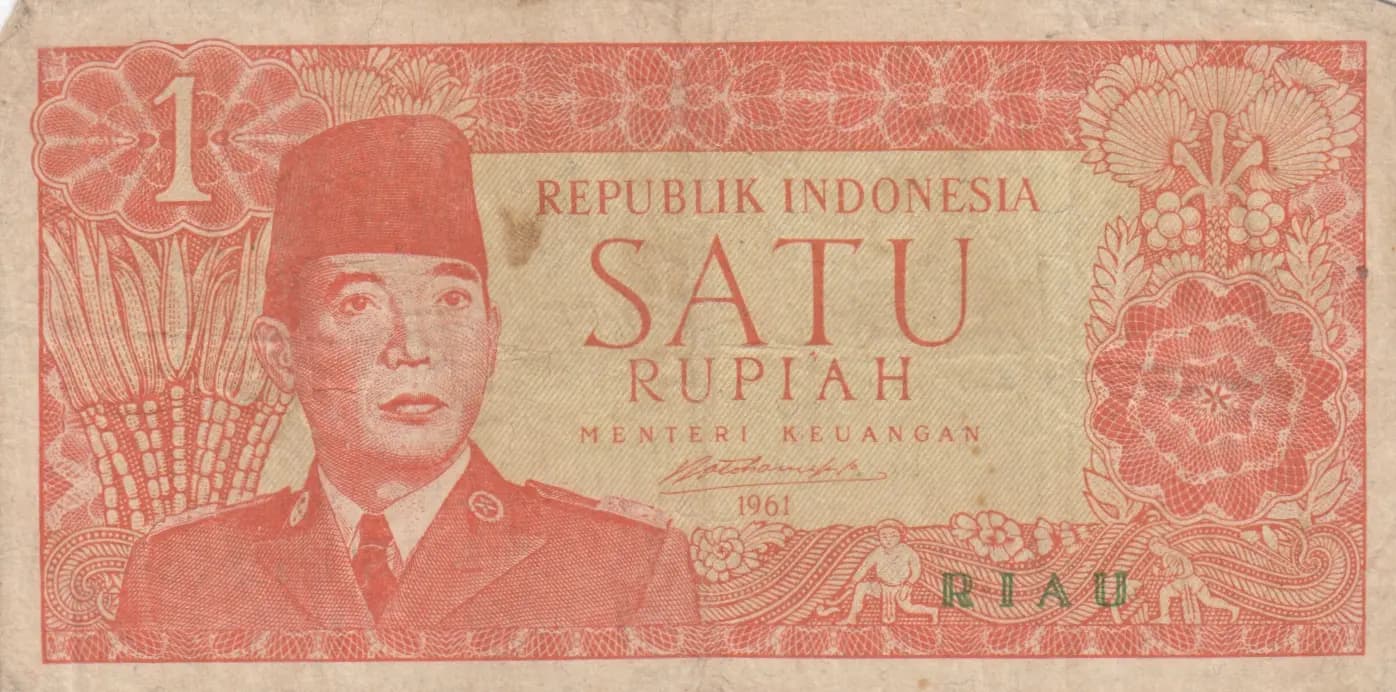
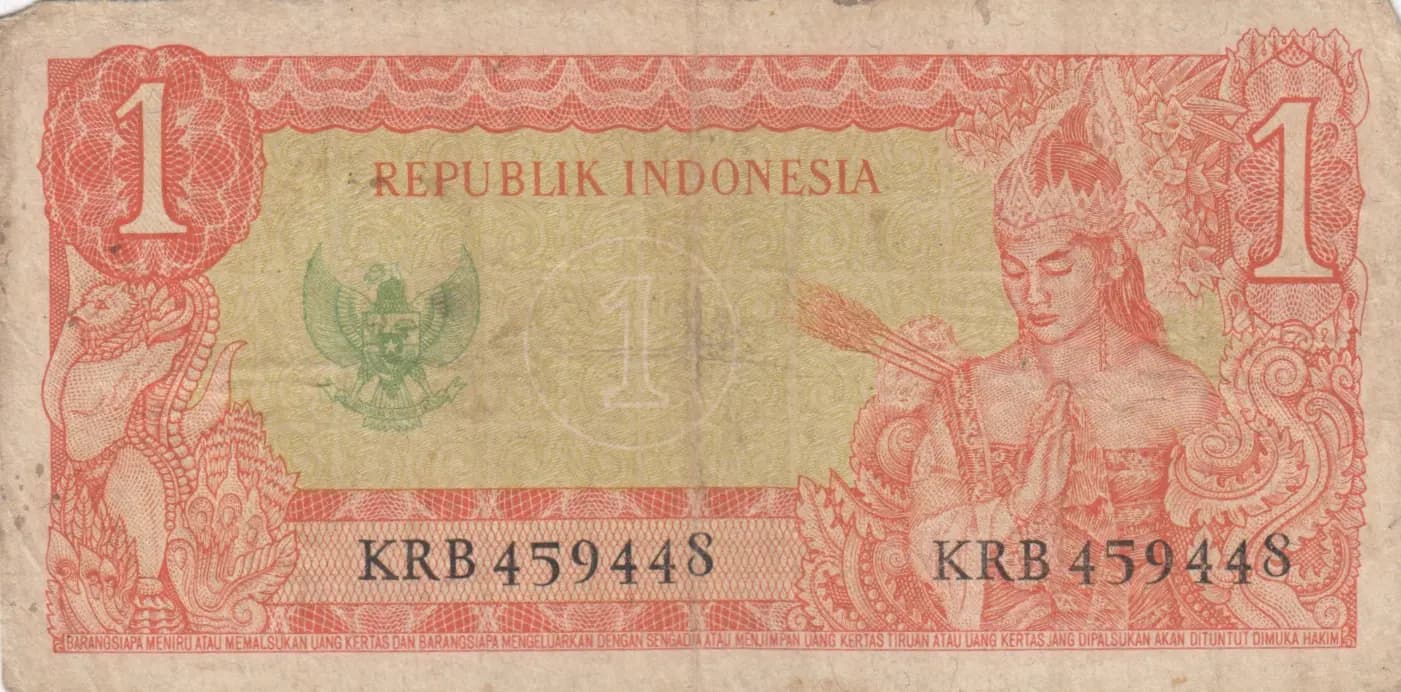
This is a 1 rupiah banknote from the Riau Archipelago region of Indonesia, issued in 1963 (dated 1961 on the obverse). The note features a portrait of a military figure in red uniform with a distinctive red fez hat on the front, accompanied by ornate floral and geometric decorative patterns in red and beige tones. The reverse displays the Indonesian national emblem (Garuda Pancasila) in green and a classical female allegorical figure. The note shows clear signs of extended circulation with foxing, brown staining, and overall yellowing consistent with Fair condition grading.
Common. Although this is a regional banknote with limited geographic circulation, the 1 rupiah denomination from 1963 was produced in substantial quantities for circulation throughout the Riau region. The catalog values from 2008 (VG: $7.50, VF: $20, UNC: $50) and the eBay price data showing a PMG 53 specimen selling for $365 in 2020 reflect modest collector interest rather than rarity. The note's survival in Fair condition is unremarkable; most examples that circulated are found in similar worn states. Regional banknotes from Indonesia, while less common than national issues, are not scarce in the broader numismatic market.
This regional banknote was issued during the early Sukarno era of the Indonesian Republic, a period of political consolidation and nation-building. The Riau Archipelago, an important maritime region with strategic significance in Indonesia's territorial integrity, received this localized currency issue as part of the broader monetary reorganization following independence. The prominent display of the Indonesian national emblem (Garuda Pancasila) and the military-uniformed figure reflect the nationalist and state-building symbolism characteristic of this era.
The obverse features a three-quarter profile portrait of an Indonesian military or nationalist figure wearing a distinctive red military uniform and red fez hat, positioned on the left side. This portrait is framed by elaborate ornamental designs including peacock-tail or fan-like decorative patterns and intricate floral and geometric motifs in red and beige, characteristic of Indonesian artistic traditions of the period. The reverse presents the Garuda Pancasila (the Indonesian national emblem featuring the mythical Garuda eagle) rendered in green at the center, balanced by a classical female allegorical figure in red/pink tones shown in profile on the right side, representing national virtues or Indonesia itself. The overall design employs a symmetrical composition with denomination numerals '1' positioned in the top corners and serial numbers at the bottom, surrounded by ornate decorative borders.
FRONT SIDE: 'REPUBLIK INDONESIA' (Republic of Indonesia) | 'SATU RUPIAH' (One Rupiah) | '1' (denomination numeral) | 'MENTERI KEUANGAN' (Minister of Finance) | '1961' (issue date) | 'RIAU' (issuing region). BACK SIDE: 'REPUBLIK INDONESIA' (Republic of Indonesia) | '1' (denomination numeral in corners) | 'KRB 459448' (serial number, repeated) | 'DILARANG MELEPAS MENIRU ATAU MEMALSUKAN UANG KERTAS DAN UANG LOGAM SERTA BARANGSIAPA MELANGGAR DENGAN SENGAJA AKAN DIHUKUM SESUAI DENGAN UNDANG-UNDANG HUKUM PIDANA' (It is forbidden to counterfeit or imitate banknotes and coins, and whoever violates this intentionally will be punished according to criminal law).
This note was produced using traditional intaglio (engraved) printing methods, evidenced by the crisp, detailed line work visible in the ornamental patterns, portrait rendering, and fine decorative borders. The multi-color printing (red, beige/cream, green, and pink) was achieved through sequential passes typical of mid-20th century security printing. The intricate floral and geometric patterns serve both aesthetic and anti-counterfeiting functions. This note was likely printed by Peruri (Perum Peruri Nusantara), Indonesia's state security printer, or by an international security printer contracted by the Indonesian Ministry of Finance.
Serial number observed: KRB 459448 (repeated on both sides). The prefix 'KRB' likely indicates a specific printing batch or series designation. This note carries the date '1961' on the obverse despite being issued in 1963, which was a common practice (the design date differs from the issue date). No obvious overprints or subsequent modifications are visible in the visual analysis. Collectors should note serial number variations and any differences in signature placement or minor design variations that may exist within the Pick R6 designation for this regional issue.