1 rupiah 1963
Market Prices
1 saleAbout This Note
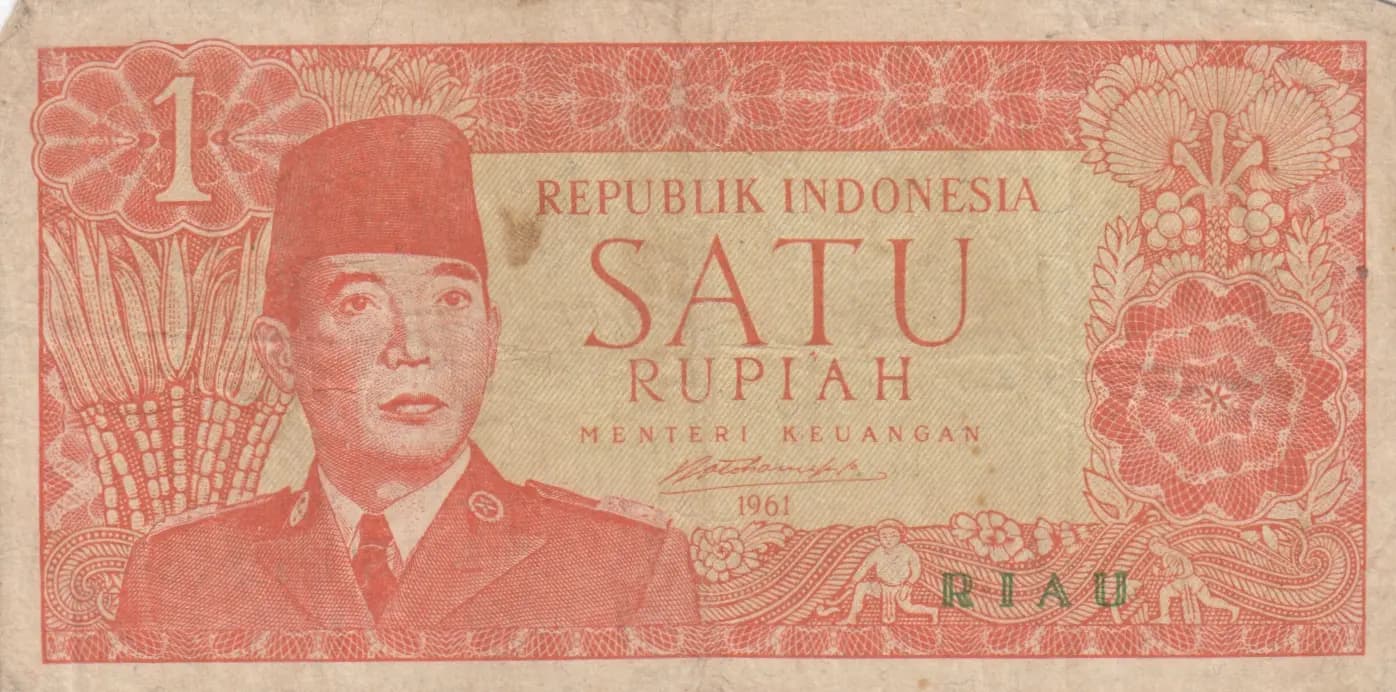
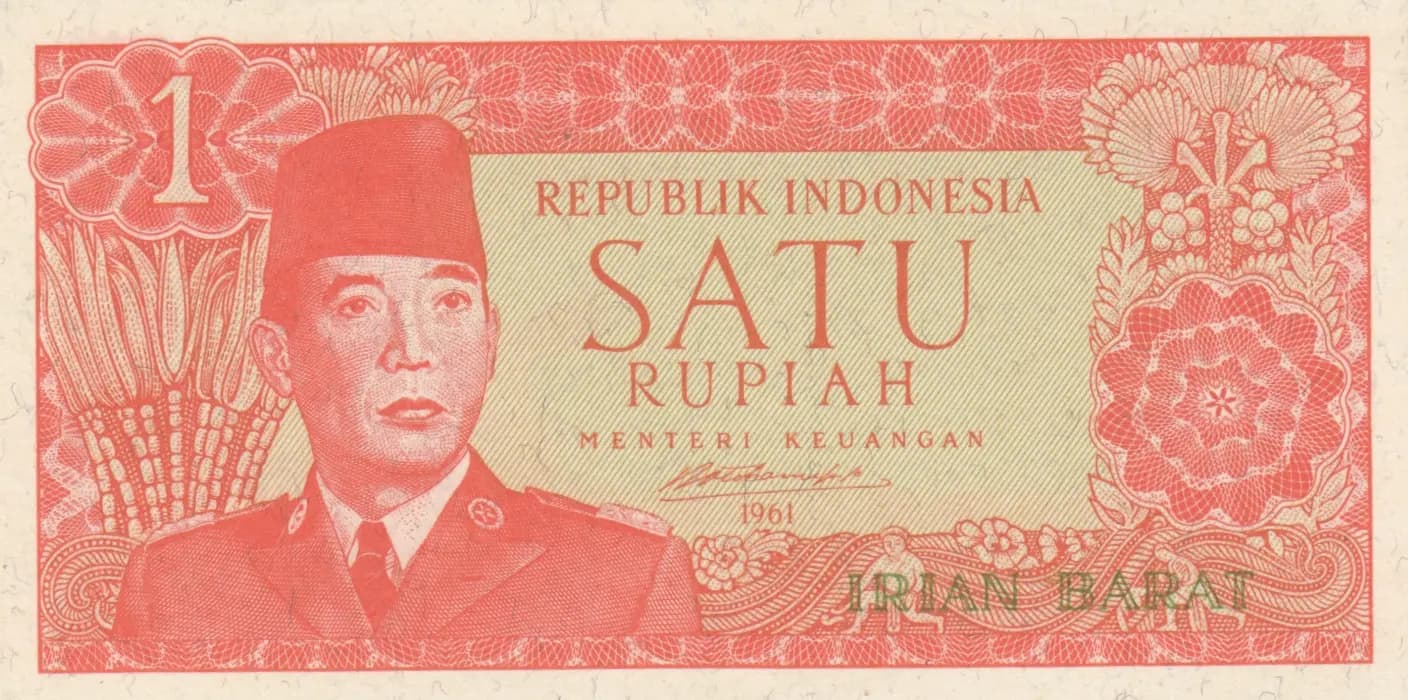
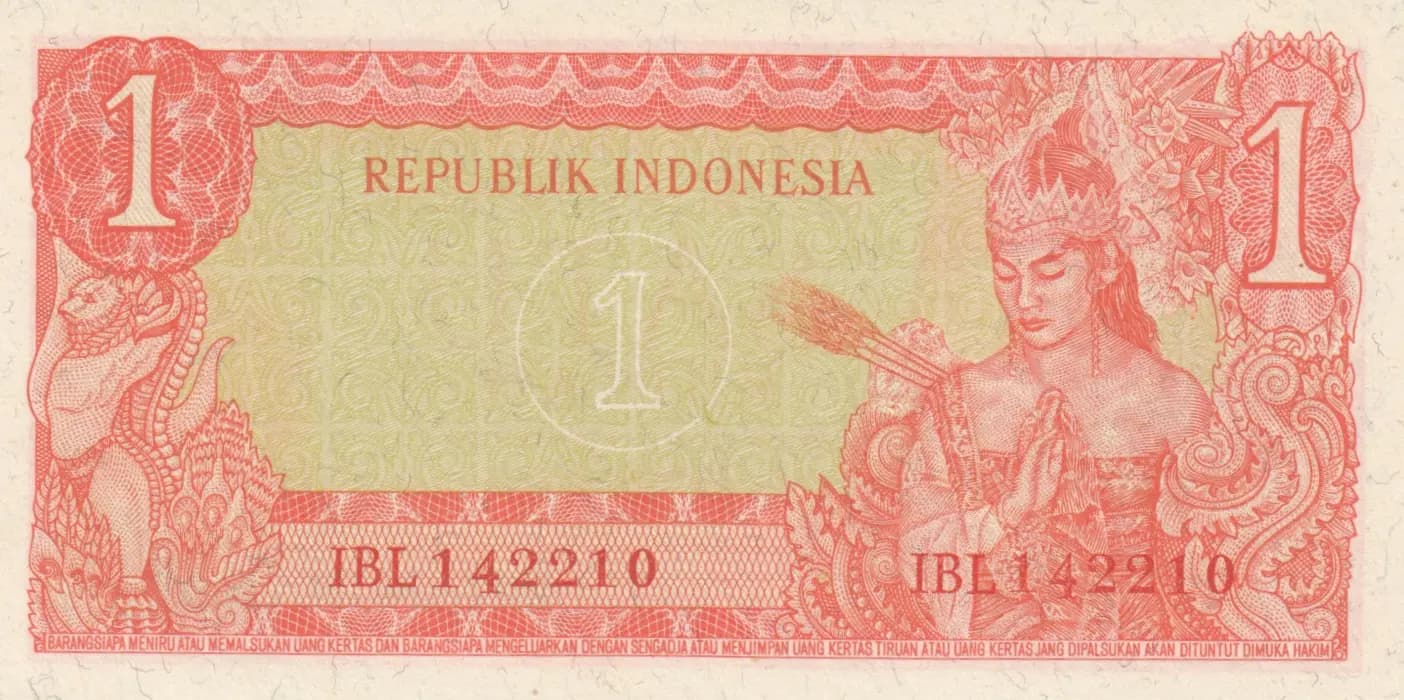
This 1963 Indonesian 1 Rupiah note from Irian Barat is a regionally-issued banknote featuring a portrait of a military figure in a red fez on the obverse and a woman in traditional Indonesian dress on the reverse, both rendered in fine engraved detail with ornate decorative borders in red and cream. The note displays light aging with minimal foxing and creasing, consistent with AU condition, and represents an important transitional period in Indonesian monetary history during the early consolidation of the nation's currency.
Common. The catalog reference price data from 2008 establishes this as an accessible and commonly available note in collector markets (VG: $4, VF: $10, UNC: $30). The eBay transaction cited (PMG 58 at $192.50 in 2020) reflects the grading premium rather than exceptional scarcity. As a regional banknote from an issue of approximately 16 million notes printed for Irian Barat, the P-R1 remains readily obtainable in most condition grades, with typical circulation examples available at modest cost.
The 1963 Irian Barat (West Irian) issue commemorates Indonesia's integration of formerly Dutch New Guinea following the 1962 United Nations-brokered agreement transferring the territory to Indonesian administration. The military figure on the obverse likely represents Indonesian leadership during this nationalist consolidation period, while the traditional dress figure on the reverse symbolizes the cultural identity of the newly incorporated Irian territory. This regional emission reflects Indonesia's efforts to assert sovereignty and economic control over the newly acquired eastern territory during the early Sukarno era.
The obverse features a prominent portrait of an Indonesian military officer wearing a red fez (songkok) and formal military uniform with insignia, positioned on the left side with the denomination '1' in large ornamental numerals in the upper left corner. The reverse displays a large circled '1' at center with a secondary portrait of a woman in traditional Indonesian dress with ornamental headdress on the right side. Both sides employ intricate engraved decorative borders featuring symmetrical geometric patterns, rosette designs, fan-like ornaments, and stylized mythological creature motifs in the side panels. The color scheme throughout is predominantly red and cream/beige with accents of yellow-green, executed in the classical engraved banknote style characteristic of early 1960s Indonesian currency.
FRONT: 'REPUBLIK INDONESIA' (Republic of Indonesia), 'SATU RUPIAH' (One Rupiah), 'MENTERI KEUANGAN' (Minister of Finance), dated '1961' (design year), and 'IRIANDARA' (Irian Barat/West Irian). BACK: 'REPUBLIK INDONESIA' (Republic of Indonesia), serial number 'IBL142210' (repeated), and counterfeit warning text: 'BARANGSAJA MENIRU ATAU MEMALSUKAN UANG KERTAS DAN BARANGSAJA MENGELUARKAN DENGAN SENGAJA ATAU MENJIMPAN UANG KERTAS TIRUАН ATAU UANG KERTAS JANG DIPALSUKAN AKAN DITUNTUT DIMUKA HAKIM' (Anyone who counterfeits or falsifies banknotes and anyone who deliberately circulates or keeps counterfeit or falsified banknotes will be prosecuted in court).
Intaglio engraving (recess printing). The fine line work, intricate geometric patterns, decorative rosettes, and complex border designs visible throughout indicate professional security printing using traditional engraved steel plates. The depth and consistency of the fine lines and background patterns are characteristic of high-security intaglio production, likely executed by an international security printer contracted by the Indonesian Ministry of Finance during this period.
Serial number IBL142210 observed on this specimen. The 'IBL' prefix indicates Irian Barat Lama (Old Irian Barat) designation. Pick catalog lists one variant for P-R1. Variations in serial number prefixes and printing runs may exist within the 1963 issue, but the standard variety as catalogued represents the principal circulation type. No overprints or significant design variants are apparent on this example.