1 rupiah 1960
Market Prices
36 salesAbout This Note
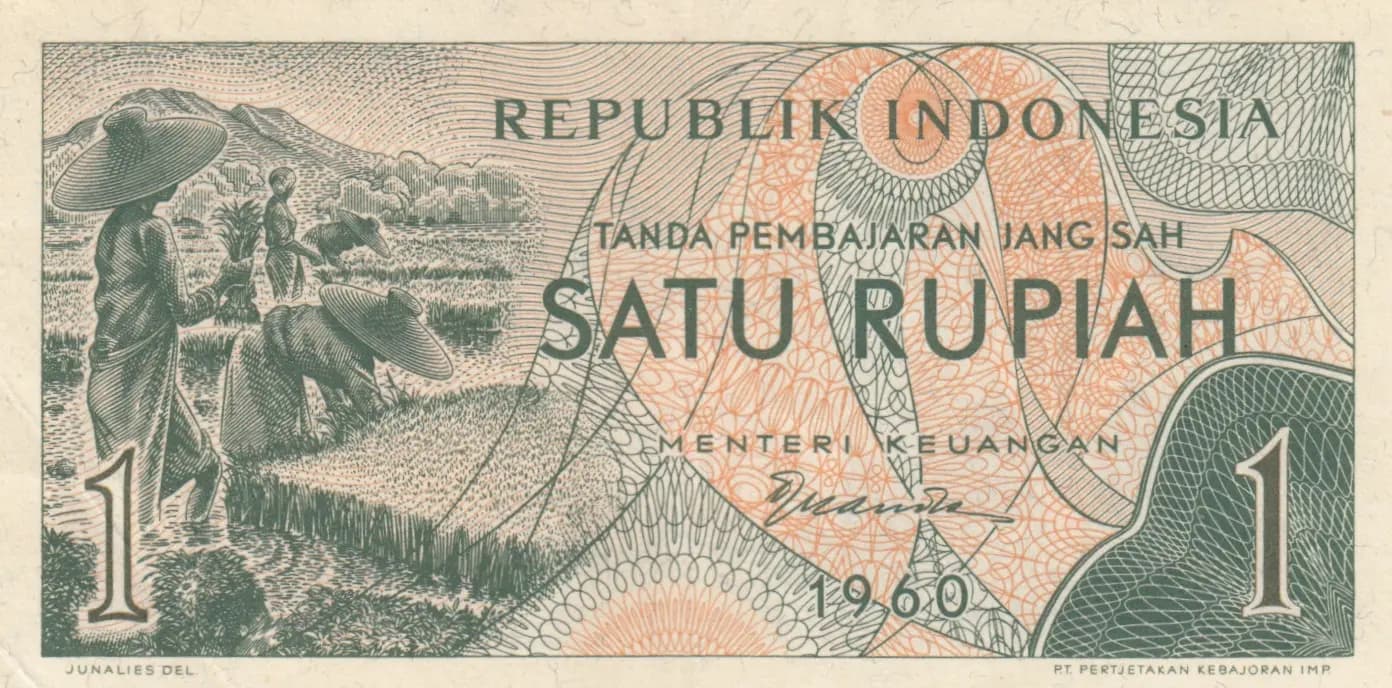
This 1960 Indonesia 1 Rupiah note (P-76) in AU condition presents a beautiful example of early post-independence Indonesian currency design, featuring vibrant green and orange agricultural imagery depicting rice harvest workers on the obverse. The note shows appropriate aging patina consistent with a 1960s banknote that has been carefully preserved, with visible cream/beige toning to the paper but no major damage or tears, making it a desirable example for collectors of Southeast Asian currency or early Republican Indonesian notes.
Common. Market data shows consistent eBay sales of this note in various grades, with UNC examples trading for $1.45–$4.25 and graded examples (PMG 64–68) selling for $9.95–$32.50 over an extended period from 2012–2022. Catalog values from 2016 list UNC at only $1.25, and the large number of sales transactions across multiple grades indicates substantial availability in the collector market. This is a regularly issued denomination with no indication of restricted print runs or recall.
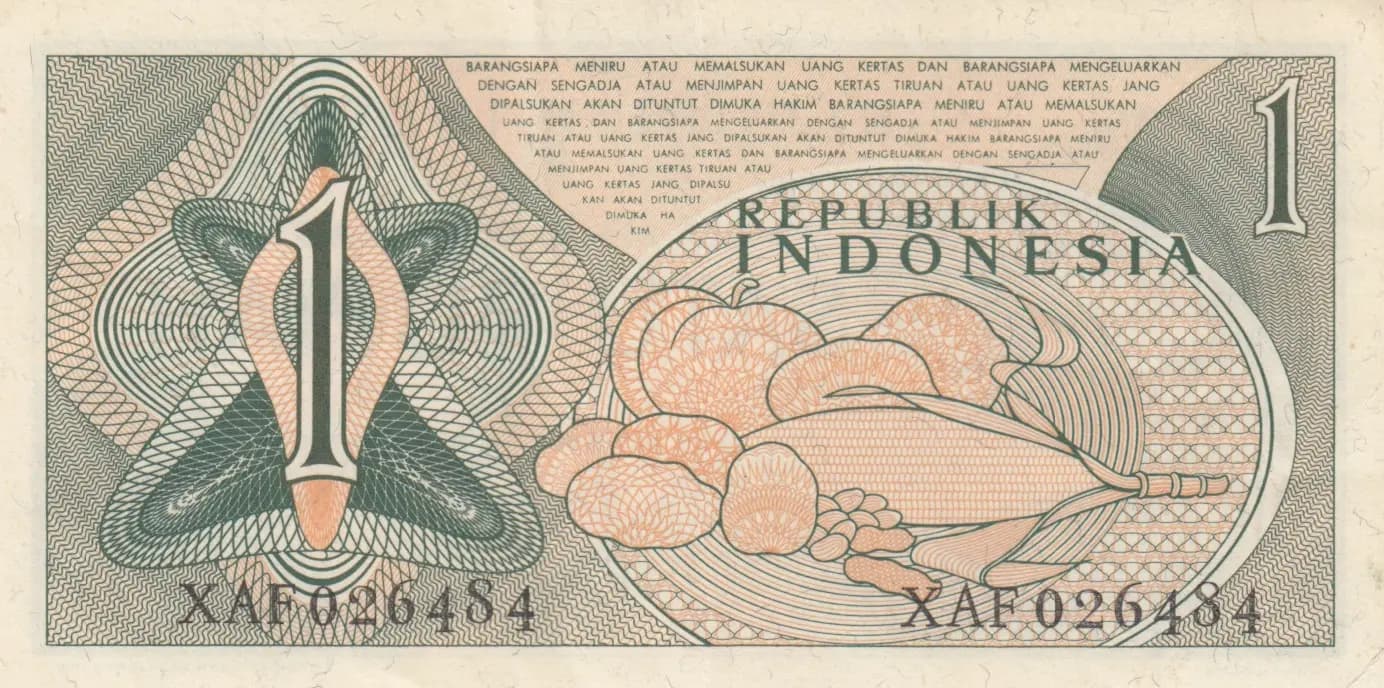
Issued in 1960 by the newly independent Republic of Indonesia, this banknote reflects the nation's agrarian economy and cultural identity during the early Sukarno era, with the obverse prominently featuring rice field workers—a celebration of the agricultural foundation of Indonesian society. The reverse displays the Garuda emblem, Indonesia's national symbol representing the state, alongside botanical imagery emphasizing the country's natural resources and agricultural wealth. This note type bridges Indonesia's transition from colonial currency to its own sovereign monetary system, representing a formative period in the nation's post-independence development.
The obverse features a romantic agricultural scene depicting three rice harvest workers, including a figure wearing a traditional wide-brimmed hat, laboring in terraced rice paddies with hills or mountains visible in the background—symbolizing Indonesia's agrarian heritage and the labor force sustaining the nation's economy. The reverse displays the Garuda Pancasila national emblem on the left with characteristically spread wings, accompanied by a detailed botanical illustration on the right, likely representing a significant agricultural or medicinal plant. Large ornamental numerals '1' anchor all four corners, with the design employing extensive guilloche work, fine line engraving, and cross-hatching throughout to create a sophisticated, anti-counterfeit aesthetic. The color scheme of green with orange/tan accents complements the agricultural theme while providing visual distinction.
FRONT: 'REPUBLIK INDONESIA' (Republic of Indonesia), 'TANDA PEMBAYARAN JANG SAH' (Valid Payment Certificate), 'SATU RUPIAH' (One Rupiah), 'MENTERI KEUANGAN' (Minister of Finance), '1960' (date), 'JUNALIES DEL' (artist signature), 'PT PERTJETAKAN KEBAJORAN IMP' (PT Pertjetakan Kebajoran Printing). BACK: 'REPUBLIK INDONESIA' (Republic of Indonesia), 'BARANGSIAPA MENIRU ATAU MEMALSUKAN UANG KERTAS DAN BARANGSIAPA MENGELUARKAN DENGAN SENGAJA ATAU MENJIMPAN UANG KERTAS TIRUAN ATAU UANG KERTAS JANG DIPALSUKAN AKAN DIHUKUM DIMUKA HAKIM' (Whoever counterfeits or forges banknotes and whoever deliberately issues or keeps counterfeit or forged banknotes will be punished before a judge—anti-counterfeiting warning), serial number 'XAB0264'.
This note was produced by PT Pertjetakan Kebajoran using steel engraving and intaglio printing techniques, as evidenced by the intricate guilloche patterns, fine cross-hatching, detailed line work, and the characteristic relief printing quality visible throughout both sides. The sophisticated security printing includes complex background patterns, stippled engraving, and interlocking line designs typical of high-security banknote production from this era.
The observed example is P-76 with the serial number XAB0264. The PMG Population Report indicates one cataloged variant (P-76a) exists for this Pick number, though it references a 500 Gulden denomination note by JEZ printer—indicating cataloging inconsistency in available references. The visual analysis shows the standard P-76 variety printed by PT Pertjetakan Kebajoran in 1960. Serial number prefixes and subsequent varieties may exist but are not definitively documented in the provided references.