1 rupiah 1951
Market Prices
52 salesAbout This Note
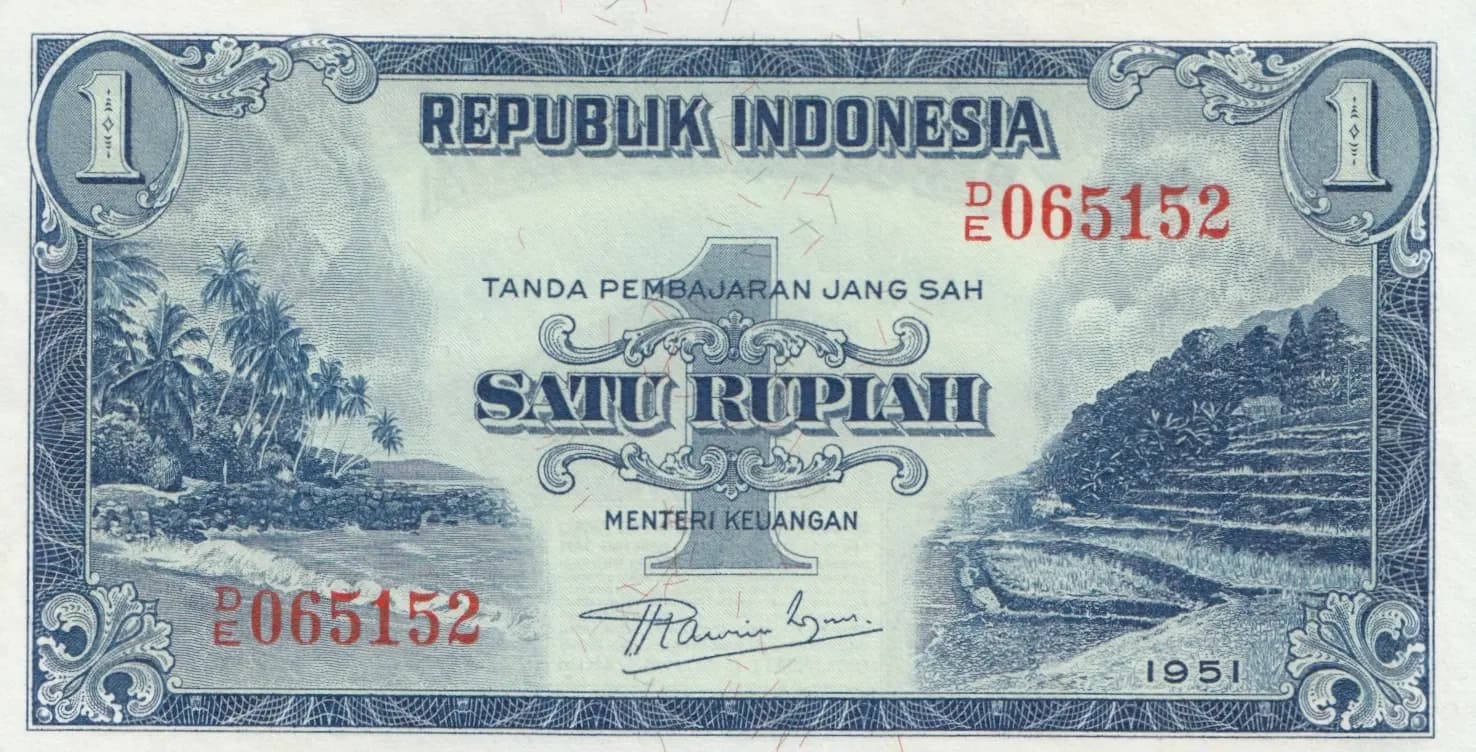
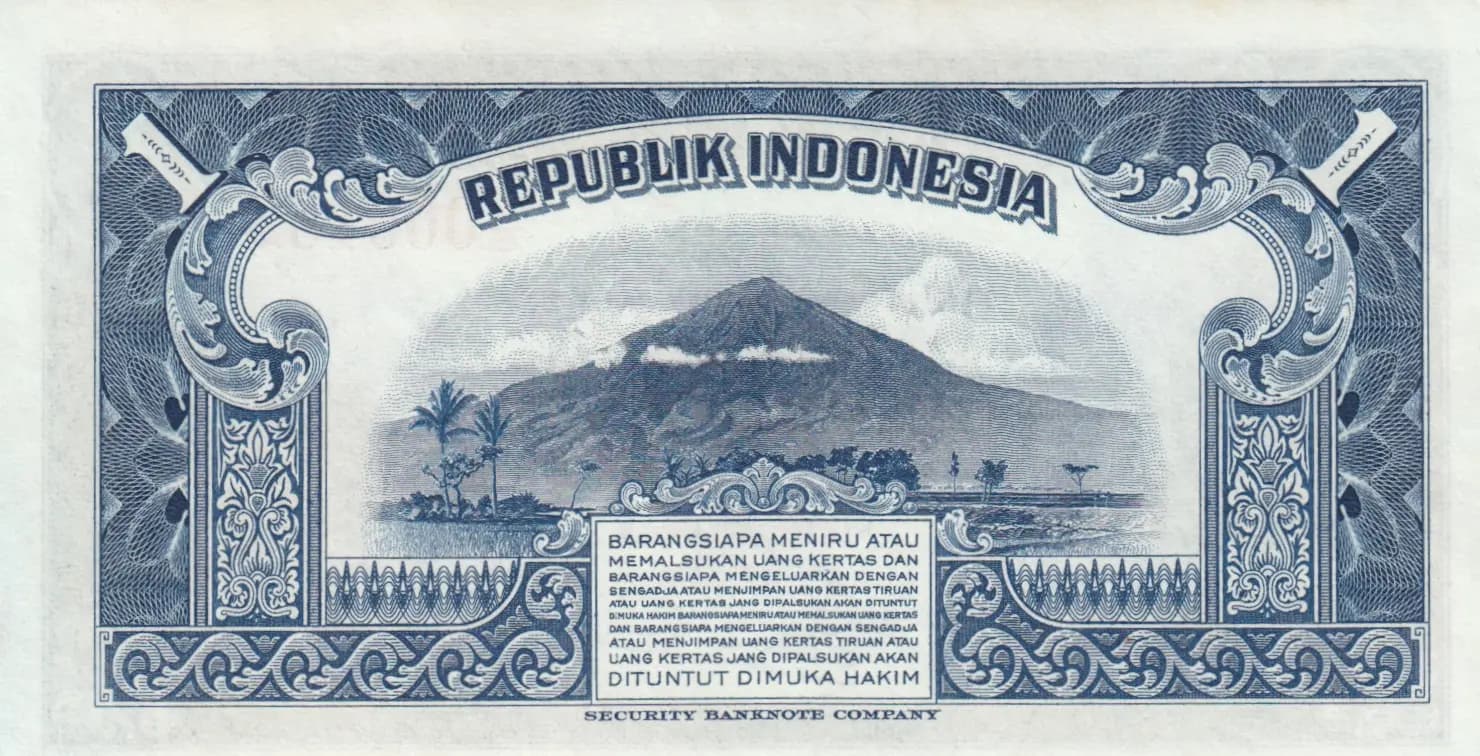
This is a 1951 Indonesian 1 Rupiah banknote (Pick P-38) issued by Republik Indonesia, printed by the Security Banknote Company. The note displays the characteristic blue color scheme with ornate decorative borders and features two landscape vignettes on the front—a coastal scene with palm trees and a mountainous terraced agricultural landscape. The reverse showcases a detailed engraving of a volcanic peak (likely Mount Semeru) with tropical vegetation. While the catalog condition is listed as UNC, the visual analysis reveals the front side shows multiple creases, foxing, and discoloration suggesting circulation and aging, with the reverse in noticeably better condition.
Common. The eBay sales data shows this note trades regularly with a consistent range of $2-$99 depending on condition and grading service, with most sales in the $15-$35 range for grades PMG 64-66. The 2016 catalog values list UNC at $4, well within the range of common, circulating-era banknotes. The note was produced in substantial quantities and remains readily available on the secondary market. No evidence of limited print runs, recalls, or scarcity exists in the provided data.
This note was issued during the formative years of the Indonesian Republic, following independence recognition in 1949. The imagery reflects Indonesia's natural heritage and economic foundation: the coastal and terraced agricultural scenes on the front represent the nation's maritime and agricultural sectors, while the iconic volcanic mountain on the reverse symbolizes Indonesia's dramatic tropical landscape. The 1951 date places this note in the early period of the new nation's currency development before later denominations and series were introduced.
The front features a balanced composition with two landscape vignettes separated by text elements. The left vignette depicts a tropical coastal scene with prominent palm trees and what appears to be a beach or shoreline, representing Indonesia's maritime geography. The right vignette shows terraced agricultural fields on a hillside, symbolizing the nation's rice-farming heritage and rural economy. The denomination '1' appears in ornate oval frames in both top corners. The reverse displays a dominant central vignette of a snow-capped volcanic mountain (Mount Semeru or similar) surrounded by tropical vegetation including palm trees and lush foliage, framed within ornate decorative borders featuring floral and scrollwork patterns. The design language emphasizes Indonesia's natural beauty and economic resources through landscape imagery rather than portraiture.
FRONT SIDE: 'REPUBLIK INDONESIA' (Republic of Indonesia), 'TANDA PEMBAJARAN JANG SAH' (Legal Tender), 'SATU RUPIAH' (One Rupiah), 'MENTERI KEUANGAN' (Minister of Finance), '1951' (year of issue), Serial number 'DE065152' appears in red ink at top right and bottom left. BACK SIDE: 'REPUBLIK INDONESIA' (Republic of Indonesia), 'BARANGSIAPA MENIRU ATAU MEMALSUKAN UANG KERTAS DAN BARANGSIAPA MENGELUARKAN DENGAN SENGAJA ATAU MENJIMRAN UANG KERTAS TIRUAAN ATAU UANG KERTAS JANG DIPALSUKIN AKAN DITUNTUT DIMUKA HAAKIM' (Whoever counterfeits or forges banknotes and whoever knowingly issues counterfeit or forged banknotes will be prosecuted before the court), 'SECURITY BANKNOTE COMPANY' (printer attribution).
Intaglio engraving (line engraving), as evidenced by the fine detailed line work visible throughout the design, the ornate scrollwork borders, the finely rendered landscape vignettes, and the precise serial number application in red ink. The visual analysis confirms the characteristic sharp, well-defined lines of intaglio printing. Security Banknote Company, USA, was a professional security printer specializing in high-quality engraved currency and banknotes, employing traditional intaglio techniques.
The observed specimen carries the serial number DE065152 in red ink. The 'DE' prefix is consistent with the 1951 series. No specific variety information is available from the catalog data, though the reference to Pick P-40 as a 'similar later note' suggests there may be later variants of this design. The Indonesian orthography visible ('JANG' for 'yang', 'DIMUKA HAAKIM' for 'di muka hakim') reflects the transitional spelling conventions of early 1950s Indonesian. No visible signatures of multiple signatories are apparent in the visual analysis, suggesting a single-signature series.