5 rupees 1945-46
About This Note
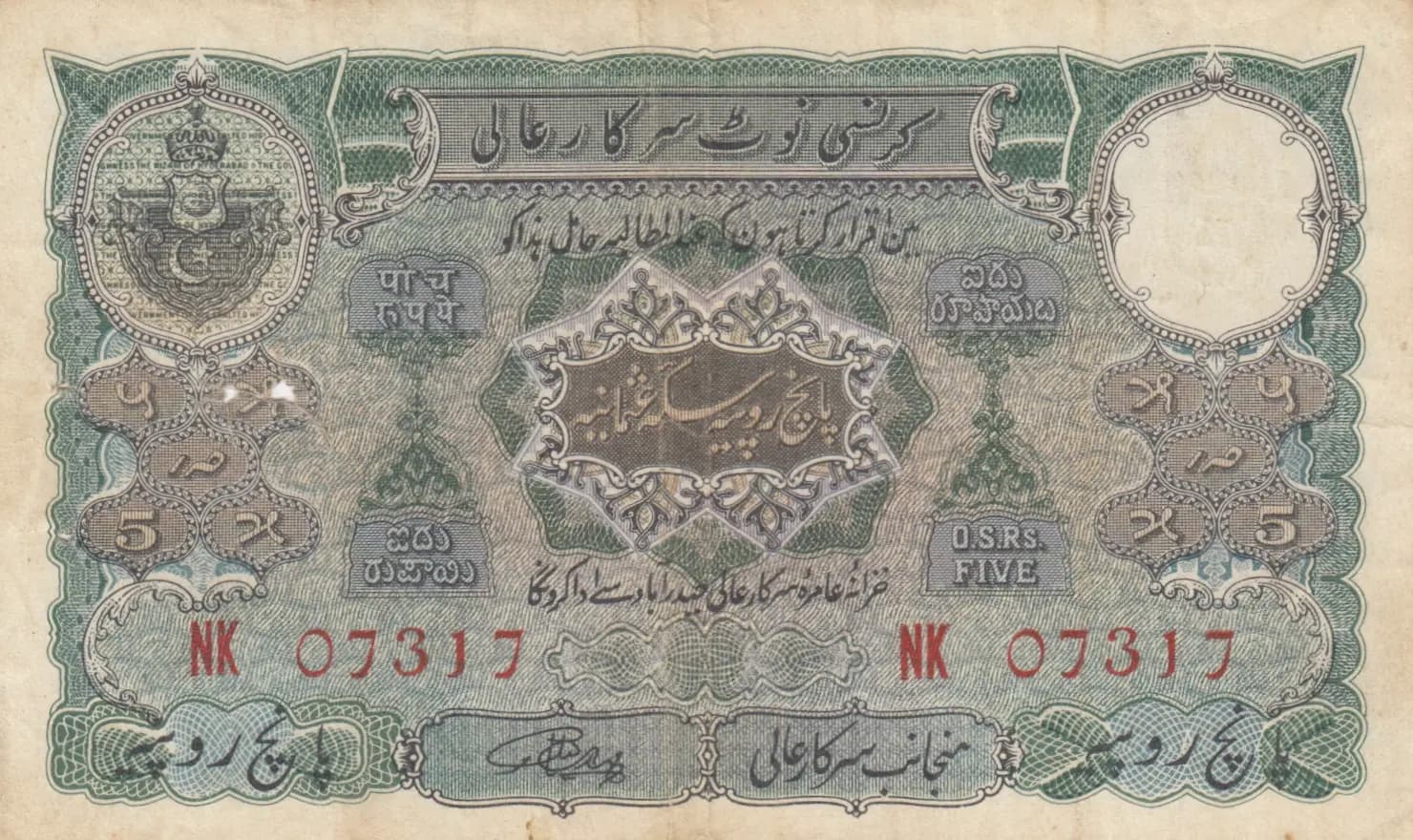
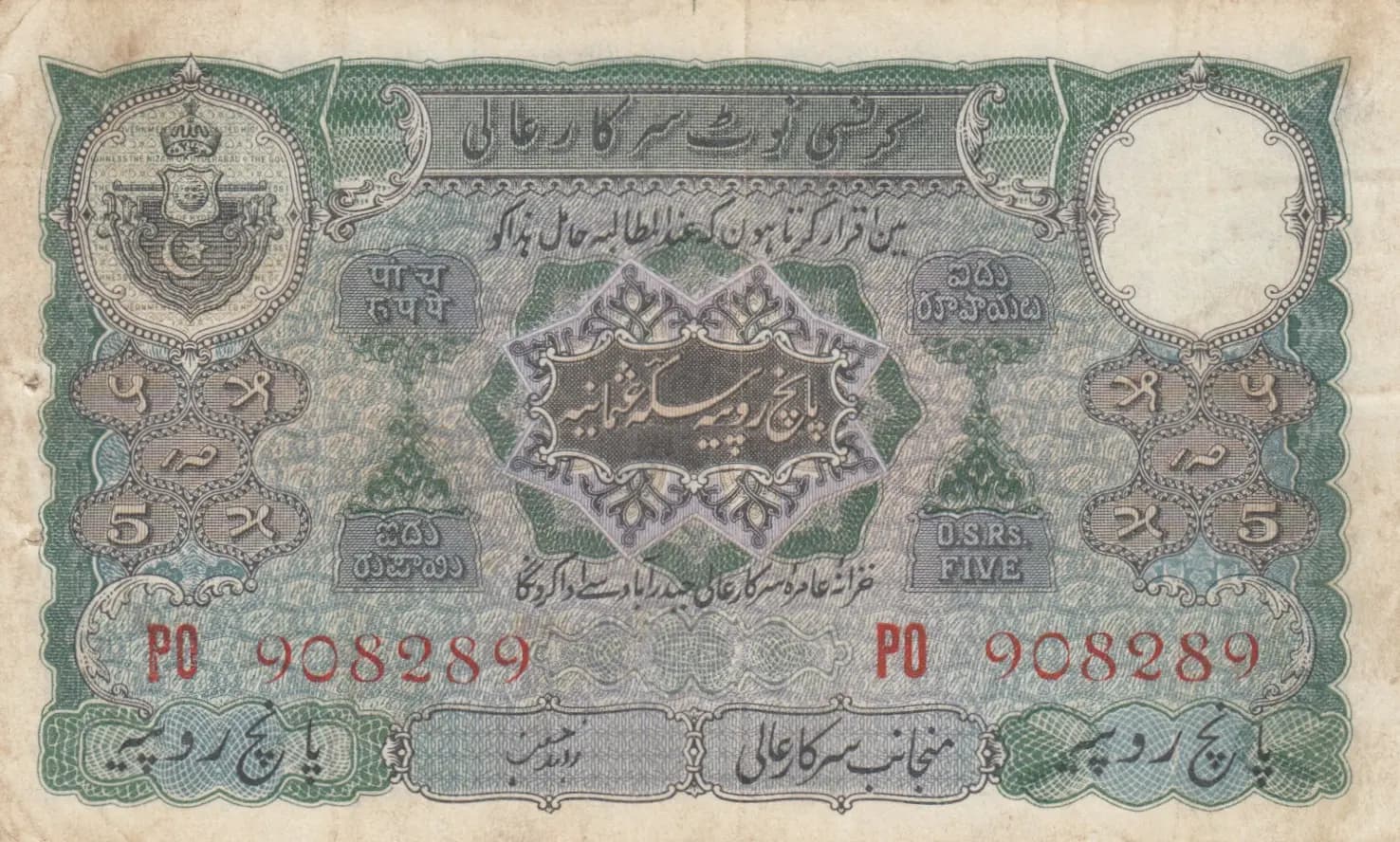
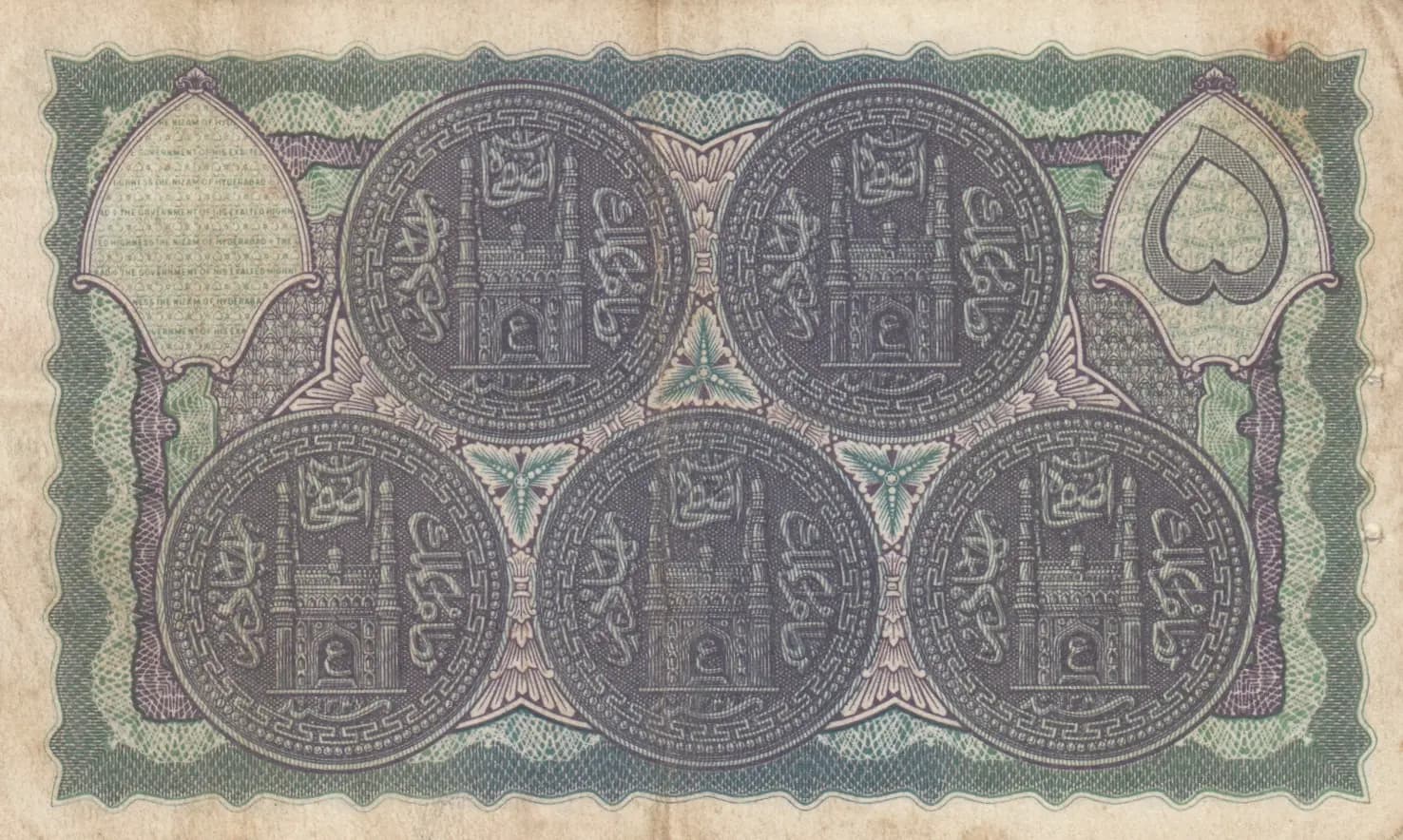
This is a VF-graded 5 Rupees note from the Hyderabad State's Rupee Sicca Osmania System, issued in 1945-46, representing an interesting piece of pre-partition Indian numismatic history. The note features ornate Indo-Islamic design elements with a heraldic coat of arms on the obverse and four architectural medallions on the reverse, printed in green, cream, and purple with red serial numbers. Despite showing expected aging with cream-tan patina and light foxing consistent with its 80-year history, the note retains sharp engraving detail and remains free of major damage, making it a well-preserved example of this regional currency.
Common. Hyderabad State issued substantial quantities of currency during its final years (1945-48), and this denomination and year appear regularly in the numismatic market. While Hyderabad notes possess historical significance as products of a now-defunct princely state, they were produced in sufficient quantities that even well-preserved examples are readily obtainable. The VF grade specimen observed is not unusual, and such notes typically trade in modest price ranges ($15-40 USD depending on exact variety and eye appeal), consistent with 'common' classification. Collector demand exists primarily among specialists in Indian state currency rather than mainstream numismatists.
The Hyderabad State, one of India's largest princely states, maintained its own currency system under the Nizam until 1948, just before integration into the Indian Union. This 1945-46 issue represents the final years of Hyderabad's monetary independence, with the note's heraldic imagery and bilingual (Urdu/Persian and Hindi) inscriptions reflecting the state's cosmopolitan administrative character. The architectural medallions depicted on the reverse likely represent significant Hyderabadi monuments, connecting the currency to the state's cultural identity during this transitional period.
This banknote exemplifies the refined engraving style of early-to-mid 20th century Indian state currencies. The obverse features a central decorative cartouche flanked by an ornate heraldic coat of arms with crowned emblem on the left and a vacant ornamental frame on the right, suggesting space for state insignia or official seals. The border design uses interlocking geometric and floral scrollwork in green and cream. The reverse displays a sophisticated symmetrical composition of four circular medallions arranged in a 2×2 pattern, each containing detailed engraved architectural scenes representing important Hyderabad structures—likely including buildings of administrative, religious, or cultural significance to the state. Spade suit symbols in ornate frames appear at top corners, a common security feature on currency of this era. The multi-script inscriptions (Urdu/Persian, Hindi/Devanagari, and English) reflect Hyderabad's multilingual administrative tradition.
Front side: 'دارالخلافہ' (Dar-ul-Khilafa/Caliphate/State), 'پنجاب رپیہ' (Paanj Rupiya/Five Rupees), '५' (Devanagari numeral 5), 'पाचपय' (Paach/Five in Hindi), 'D.SRS' (Dar-ul-Sicca Rupee System), 'FIVE' (English denomination), Serial number 'PO 998289' (repeated). Back side: Fine printed text present in left cartouche but not clearly legible in the image provided; likely contains issuer information or regulatory text typical of state currency notes.
Intaglio engraving (line engraving) on banknote paper, evidenced by the sharp, fine-line detail visible throughout the design, particularly in the architectural medallions, heraldic imagery, and ornamental borders. The consistent quality and precision of the engraving suggests professional security printing, likely executed by a European banknote printer—De La Rue or similar contemporary security printers frequently contracted with Indian princely states during this period. Red serial numbers were applied by letterpress or secondary printing. The complexity of the multi-layer design and fine engraving details indicate this was a high-security production suitable for state currency.
Pick catalog P-S273d represents a specific variety of the 1945-46 5 Rupees issue. The observed serial number prefix 'PO' and the absence of overprints or date variations indicate this is a standard printing from the primary series. No signature varieties or significant printing variations are noted in the visual analysis. The red serial number coloration and standard layout are consistent with published examples of this Pick number. Collectors should note that minor variations in serial number prefixes (PO, PH, etc.) may exist within this series, though they do not typically command significant premium pricing.