1 rupee 1950
About This Note
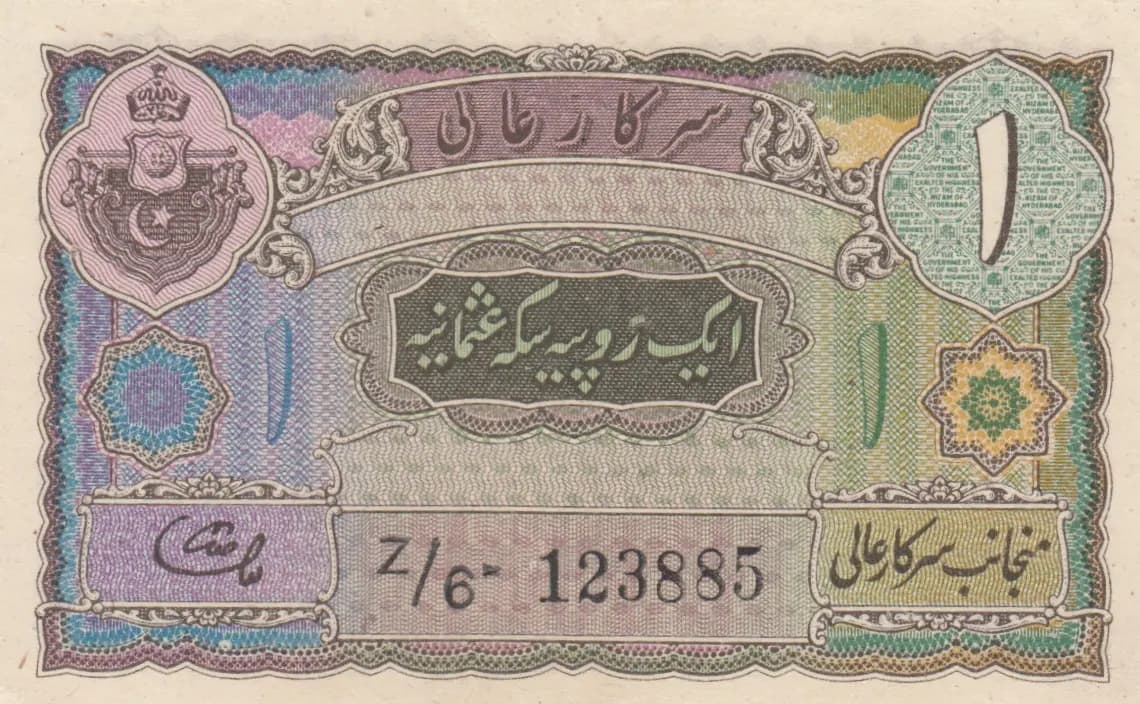
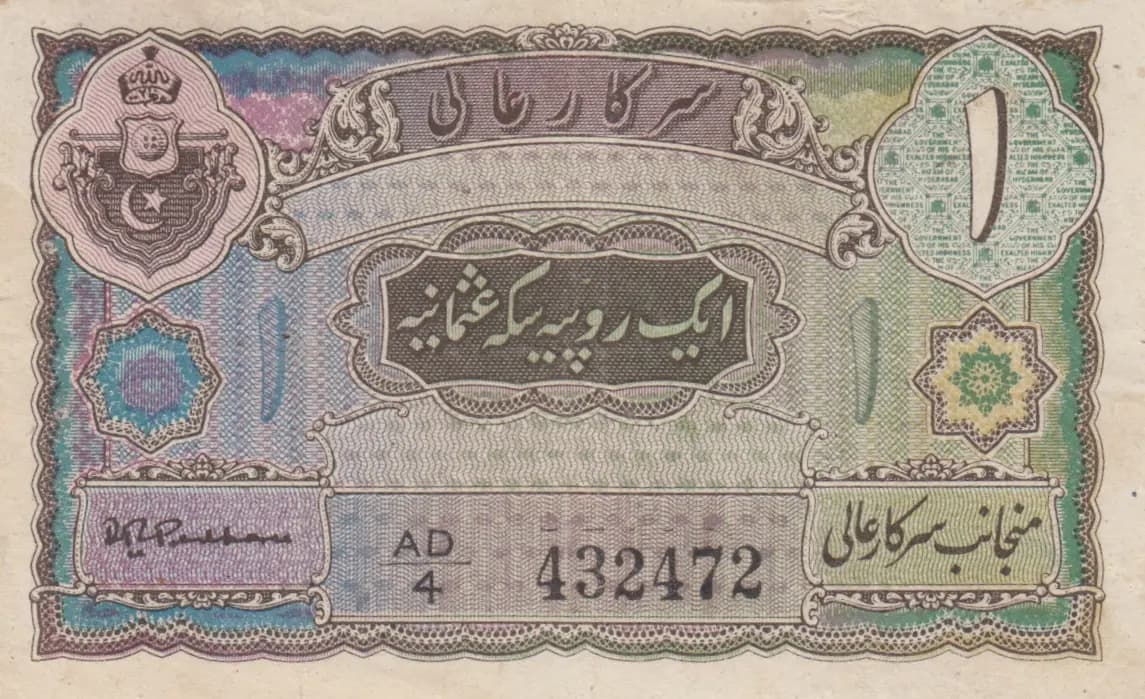
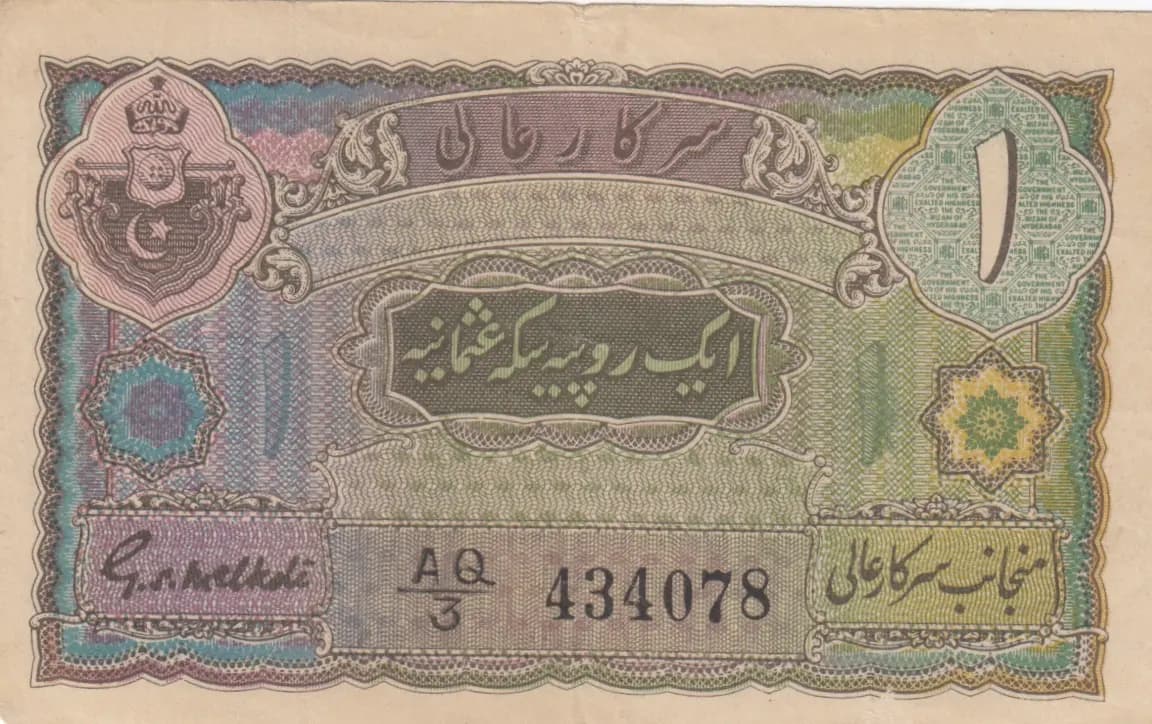
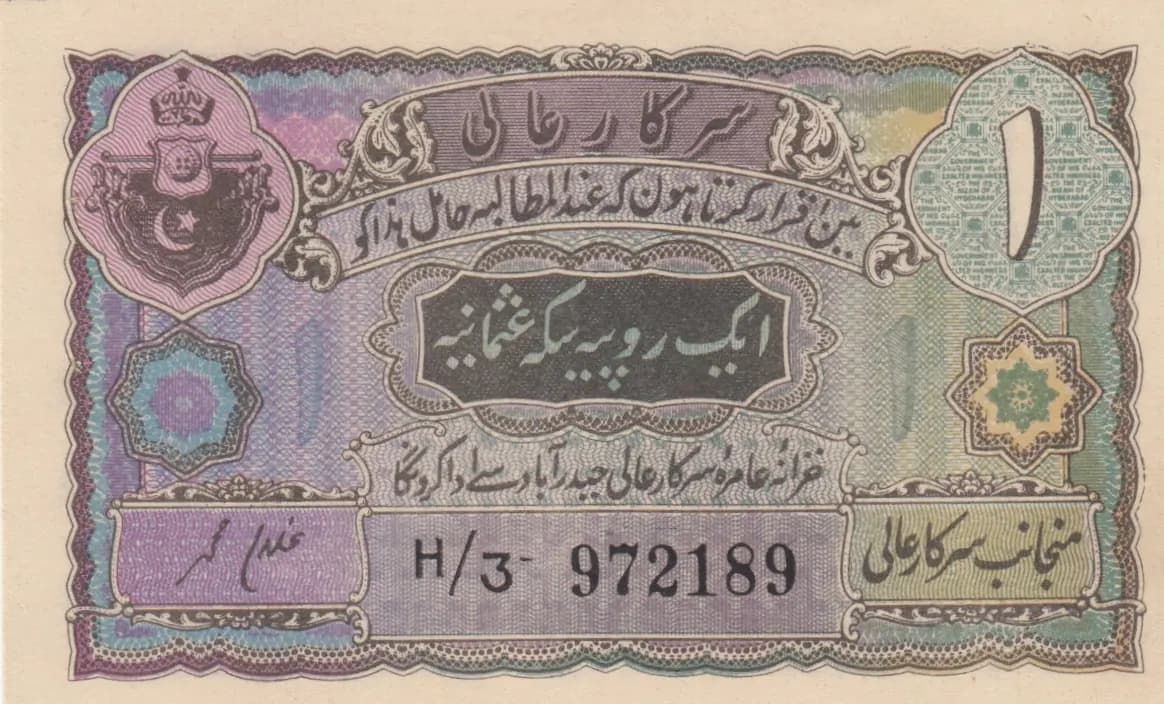
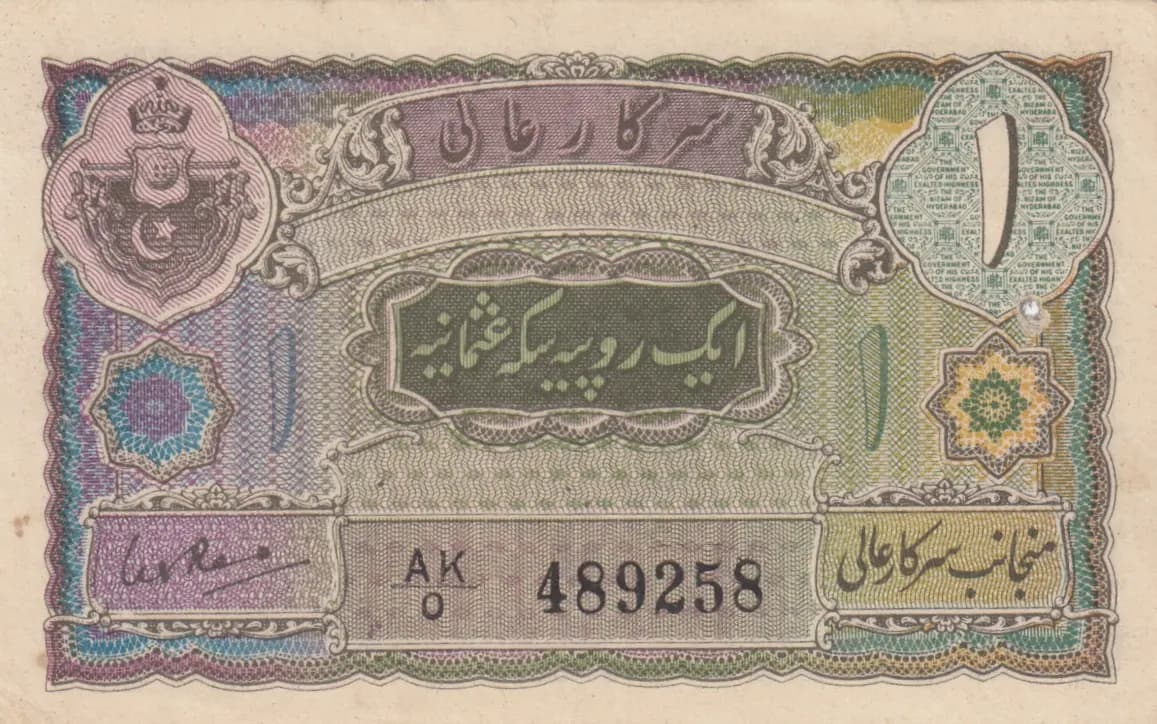
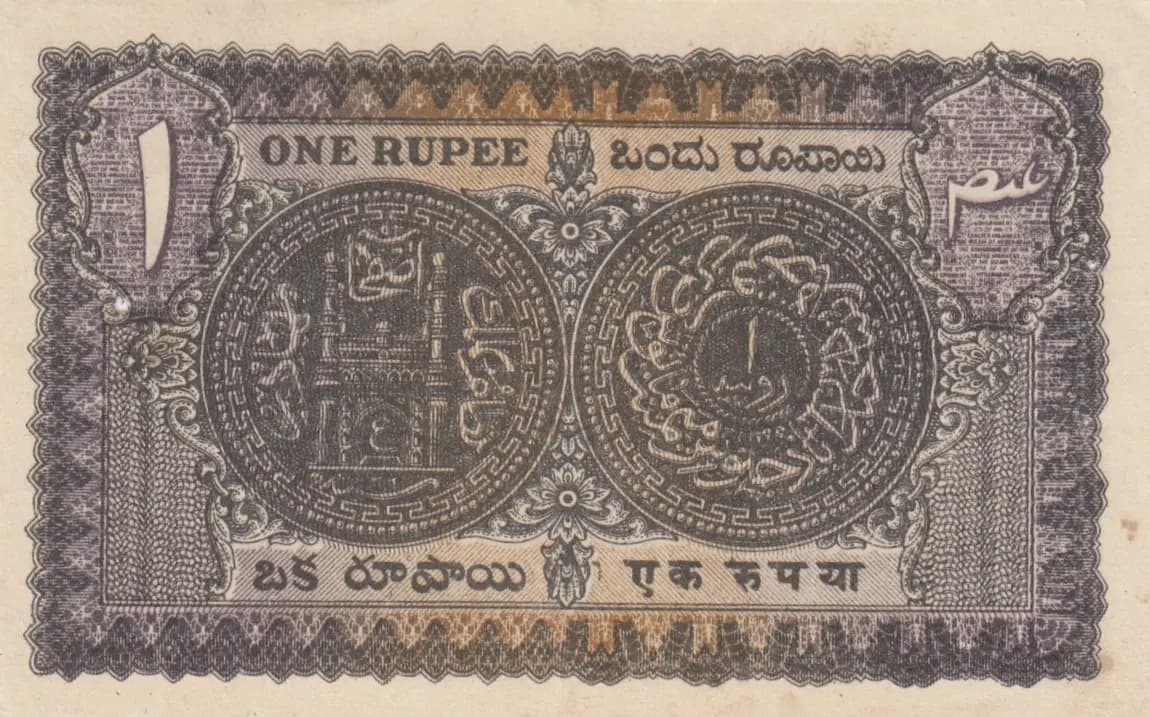
This is a VF-graded 1 Rupee note from the Hyderabad State issue of 1950, representing an important transitional currency from the princely state period. The note exhibits the characteristic ornate Indo-Islamic design aesthetic with Persian/Urdu inscriptions, vibrant purple, green, and yellow tones, and intricate cross-hatching security work typical of early Indian banknote production. Despite visible foxing and age-related discoloration, the note remains well-preserved with clear details, making it a significant example of post-independence Hyderabad State currency.
Common. Hyderabad State 1 Rupee notes from 1950 were issued in substantial quantities to circulate within the state during the final months before integration into the Indian Union. The denomination was a circulating workhorse currency rather than a commemorative or limited issue. While Hyderabad State notes have collector interest, this specific Pick number and denomination remain readily available in the secondary market at modest valuations typical of common twentieth-century banknotes.
This note was issued during the brief period following Indian independence when Hyderabad State maintained its own currency system before integration into the Indian Union in 1950. The bilingual design incorporating English, Persian/Urdu, Kannada, and Odia script reflects the multi-ethnic character of the Hyderabad dominion and its cosmopolitan administrative heritage under the Nizam. The classical architectural and figurative compositions depicted in the reverse medallions evoke the state's rich Mughal and Deccan heritage, while the 1950 date marks the final year of Hyderabad's monetary autonomy.
The front features an ornate classical design centered on a decorated cartouche containing Persian/Urdu script, with the denomination '1' in an elaborate shield-shaped frame in the upper right. Ornamental rosette designs and floral cartouches occupy the corners, while geometric borders frame the entire composition. The reverse presents two large circular medallions with classical compositions—the left likely depicting architectural elements representative of Hyderabad's monuments, while the right contains figurative imagery reflecting state symbolism. Both sides employ the traditional ornate border framework characteristic of late-period princely state currency, with 'ONE RUPEE' prominently displayed in English above the medallions.
Front side: Persian/Urdu 'رپال' (Rupee); Latin prefix 'AK' (serial letter); Latin numeral '489258' (serial number). Back side: English 'ONE RUPEE' (denomination); Kannada 'ಎಂದು ರೂಪಾಯಿ' (One Rupee); Odia 'ଏକ ଟଙ୍କା' (One Rupee). The multilingual inscription pattern emphasizes the inclusive, multi-regional nature of Hyderabad State governance at the time of currency issue.
This note was produced using intaglio (engraved) printing techniques, evidenced by the detailed line-work cross-hatching visible throughout both sides, the precise geometric patterns, and the complex security printing methods employed. The multi-color printing technique combining purple, green, yellow, and brown inks was applied through sequential passes typical of security printing operations of the era. While the specific security printer for P-S272f Hyderabad issues is not definitively documented in standard references, the work quality suggests production by a capable state or contract security printer operating under British colonial-era standards.
The observed serial number prefix 'AK' with sequence '489258' indicates this is part of a standard circulation printing. Pick catalog P-S272f encompasses the standard 1 Rupee denomination from Hyderabad's final currency issue. Varieties for this Pick number are primarily distinguished by serial number prefixes and ranges; the 'AK' prefix observed here represents one of the common prefix blocks used during production runs. No overprints, signatures, or other distinguishing features beyond standard serial numbering are evident in the VF specimen examined.