50 filler 1920
About This Note
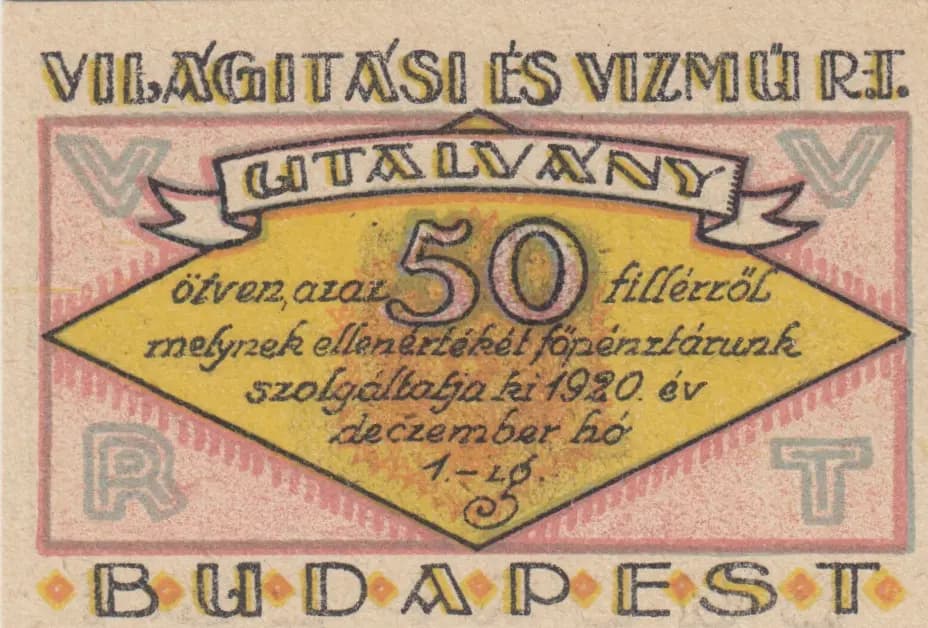
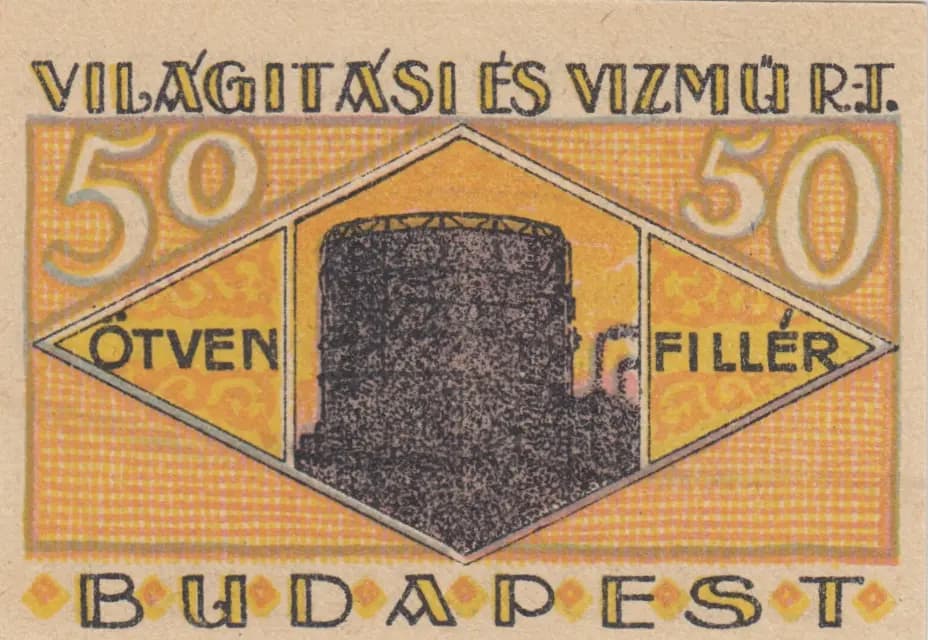
A scarce 50 filler emergency/local currency note issued by Világitási és Vizmű R.T. (Lighting and Water Works Ltd.) in Budapest on December 1, 1920. The note features distinctive pink/mauve borders with geometric patterning and a yellow diamond-shaped central vignette on the front, while the reverse displays an architectural element (possibly a company building or water tower) within the diamond frame. Despite significant aging with visible foxing and yellowing consistent with over a century of storage, the note maintains its structural integrity and displays the characteristic design elements of post-WWI Hungarian local currency issues.
Uncommon. This is an unlisted Pick number issued by a specific Budapest utility company with presumably limited geographic circulation and print run. While not exceptionally rare, company-issued local currency notes from this period had more restricted circulation than central bank issues, and many were destroyed or lost to time. The specific issuer (Világitási és Vizmű R.T.) was a local utility rather than a major financial institution, limiting the surviving population of this note. The UNC condition grade is notably better than typical survival rates for 1920 Hungarian local issues.
This note was issued during Hungary's tumultuous post-World War I period (1920), when hyperinflation and currency instability led many municipalities, utilities, and private companies to issue their own local currency and emergency money. Világitási és Vizmű R.T., a Budapest-based public utility company providing lighting and water services, issued this filler denominated note to facilitate local commerce and manage cash flow during the economic crisis. The December 1, 1920 date places this precisely in the early phase of Hungary's economic recovery, when such company-issued notes were essential to economic function in major cities.
The obverse features a pink/mauve border with intricate geometric patterning framing a yellow diamond-shaped central vignette containing a white banner with company and denomination information. Corner elements display decorative geometric motifs and denomination numerals. The reverse presents a mirror composition with yellow/golden tones and orange borders, centering on a diamond frame containing what appears to be an architectural landmark—likely the company's water works facility or a prominent building associated with Világitási és Vizmű R.T.—rendered in dark/black tones. The denomination '50' appears prominently on both sides of the reverse diamond vignette. Both sides employ geometric dot-pattern backgrounds as an anti-counterfeiting security measure typical of the period.
FRONT: 'VILÁGITÁSI ÉS VIZMŰ R.T.' (Lighting and Water Works Ltd.) / 'UTAZLVÁNY' (Travel Ticket/Pass) / 'ötven, azaz 50 fillérről melyinek ellentékét függenztárunk szolgáltatja és 1920 év december hó 1.-én' (Fifty, that is 50 filler, the counterpart of which our counting house provides, dated December 1, 1920) / 'BUDAPEST' (Budapest). BACK: 'VILÁGITÁSI ÉS VIZMŰ R.T.' (Lighting and Water Works Ltd.) / 'OTVEN FILLÉR' (Fifty Filler) / '50' (denomination numeral) / 'BUDAPEST' (Budapest).
Lithographic printing, a standard technique for Hungarian local currency notes of 1920. The multi-color design with distinct color zones (pink, yellow, orange, black) and geometric background patterns are characteristic of lithographic production. The visible handwritten or manuscript elements in the central vignette suggest possible hand-completion or authorization marks by company officials. The aged, foxed condition and yellowing of the paper is consistent with wood-pulp paper stocks used during this economically constrained period.
This note is cataloged as Pick-unlisted, indicating it does not appear in standard Pick catalogs covering Hungarian currency. The specific date of issue (December 1, 1920) and company name 'Világitási és Vizmű R.T.' appear consistent across both sides, suggesting a single standard variety. Without access to comprehensive records of this utility company's currency emissions, additional varieties (different denominations, dates, or series numbers) may exist but cannot be confirmed from the visual analysis. The manuscript-like elements in the central vignette may represent hand-authorization or serial number variations typical of local currency issues of this era.