50 filler 1920
About This Note
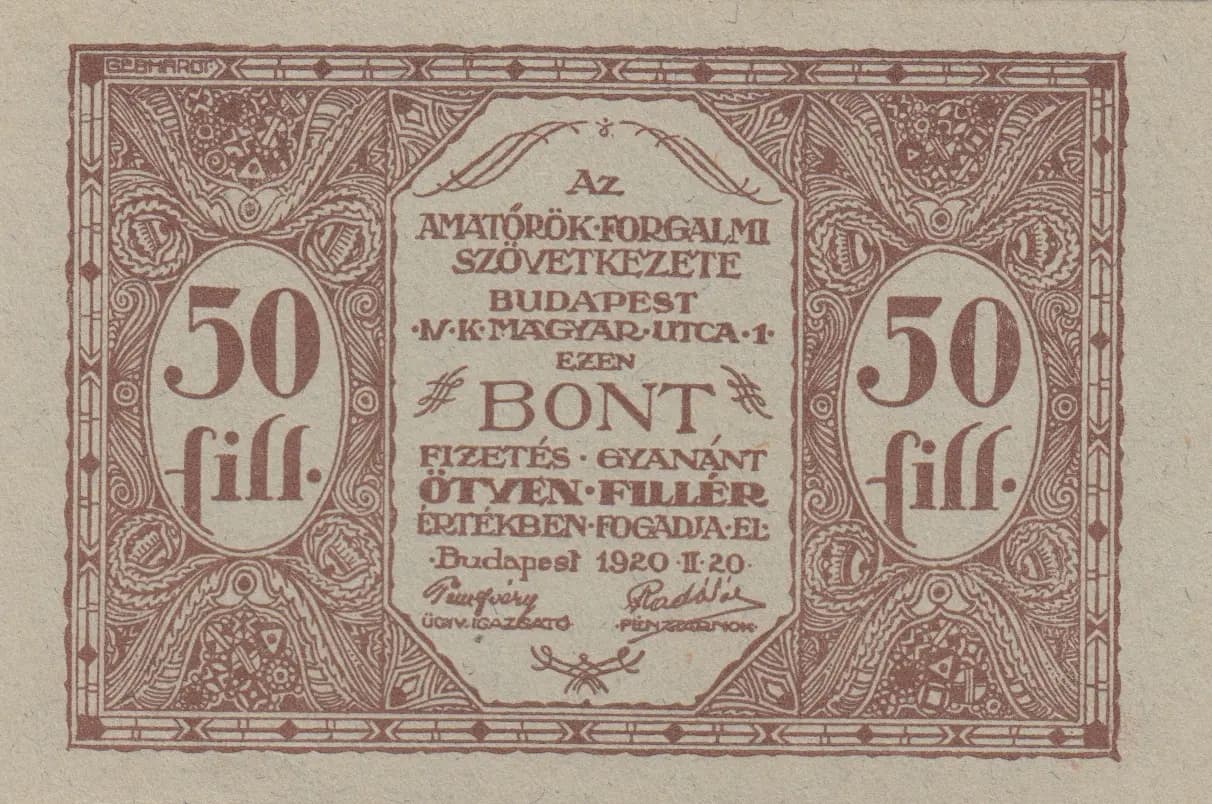
This is an exceptional example of a 50 fillér emergency notgeld issued by the Amatorök Forgalmi Szövetkezete (Amateur Traffic Association) of Budapest on February 20, 1920. The note displays elegant Art Nouveau-style ornamental borders in brown and reddish-brown tones on a cream background, with the denomination clearly marked in large numerals. In AU condition with no visible wear or damage, this unlist Pick number represents a fascinating artifact of post-WWI Hungarian monetary chaos when private organizations and cooperatives issued their own small-denomination currency.
Scarce. This is an unlisted Pick number from a limited-lifespan local issuing authority (a Budapest cooperative) with an issue date of February 1920, during the brief period of monetary experimentation following the Hungarian Soviet Republic's formation. The Amatorök Forgalmi Szövetkezete was not a major or long-lived institution, and the denomination (50 fillér) was among the smallest denomination scrip issued, suggesting smaller print runs than higher denominations. The AU condition grade is notably exceptional, as most circulated notgeld from this period shows significant wear. The combination of rarity of the issuing authority, unlist status, low denomination, and pristine condition elevates this beyond common.
This notgeld was issued during the tumultuous period following Austria-Hungary's defeat in World War I, when Hungary faced severe currency shortages and economic instability. The Amatorök Forgalmi Szövetkezete, a Budapest-based amateur/traffic cooperative, was authorized to issue this 50 fillér note as emergency currency, accepting it as payment equivalent to 70 fillér in value—a premium suggesting inflationary pressures and loss of confidence in official currency. The February 1920 date places this issue during the early Hungarian Soviet Republic period, a time of extraordinary monetary experimentation and the proliferation of private and institutional scrip throughout the country.
The note features a single-sided design typical of emergency scrip from this period. The obverse displays an ornamental rectangular frame composed of intricate Art Nouveau-style geometric and floral patterns executed in brown and reddish-brown ink. The large denomination numerals '50' appear in the upper left and right corners. The central text area contains the issuer's details, purpose statement, and authorization signatures for both the Director (Igazgató) and Cashier (Pénztárnok). The note declares acceptance at 70 fillér value, indicating a 40% premium reflecting contemporary inflation. The reverse is completely blank, printed on cream or light tan paper stock typical of emergency currency production. No portrait heads, heraldic symbols, or architectural landmarks are depicted; instead, the security derives from the complexity of the ornamental border design.
FRONT SIDE: Denomination: '50 fillér' (50 filler). Issuer: 'Az AMATŐRÖK-FORGALMI SZÖVETSÉGE' (The Amateur Traffic Association). Location: 'BUDAPEST' and 'M. MAGYAR-UTCA-I' (Hungarian Street address). Purpose statement: 'EZÉN BONT FIZETÉS GYANÁNT ÖLTYEN FILLÉR ÉRTÉKBEN FOGADJA EL' (This bond is accepted as payment for seventy filler in value). Date: 'Budapest 1920 II.20' (Budapest, February 20, 1920). Signature lines: 'Igazgató' (Director) and 'Pénztárnok' (Cashier). BACK SIDE: Blank/unmarked.
Letterpress or typographic printing, employing decorative metal borders and type set to create the Art Nouveau frame and text. The single-color brown/reddish-brown printing on cream stock suggests economical production methods consistent with emergency notgeld issuance. No security printer attribution is recorded for this unlisted Pick number; production was likely handled by a local Budapest printing establishment contracted by the cooperative. The blank reverse and minimal printing complexity are characteristic of cooperative and institutional scrip from 1920 Hungary.
Specific variety identification requires examination of signature variants (Igazgató and Pénztárnok signatures may appear in different hands across print batches) and any serial numbering if present. The date is fixed as 1920 II.20 (February 20, 1920). No known overprint varieties or color variations are documented for this unlisted issue. The note should be cataloged by the issuing institution, denomination, and date as the primary identifying characteristics in the absence of a Pick listing.